

Selling to HR: recruiters and CHROs live in different realities
The recruiter wants better candidates by Friday. The CHRO wants to avoid an organisational problem three years from now. Yet both may receive the same deck about an HR solution. That is the weakness of selling to “HR”: a department is not a shared buying mindset.
Neurofactor’s broad target group cards distinguish five roles: HR manager, HR director, recruiter, CHRO and People & Culture lead. In these profiles, the recruiter has BIS 4, BAS 8 and k 0.45, reflecting a strong focus on immediate candidate results. The CHRO has BIS 7, BAS 5 and k 0.08, reflecting greater attention to organisation-wide risk and long-term consequences. Three further routes sit between those extremes.
If you want to sell the same proposition across HR, you need to change more than the job title in your email. The claim, evidence, pace and route to a decision must fit the role.
The mistake begins with the department label
Imagine selling employer branding, recruitment technology and line-manager support as one solution. The provider sees one offering. The five HR roles see five different problems. The recruiter sees unfilled vacancies; the HR manager sees administration and adoption risk; the HR director sees a business case to defend; the CHRO sees an organisational programme; the People & Culture lead sees a risk that growth will dilute the culture.
These are not cosmetic differences. Accountability shapes what a decision-maker fears, when progress must become visible and which evidence makes a proposal credible. The better question is not “how do we sell to HR?” but “which decision is this HR role trying to make possible?”
Five HR roles, five buying questions
This summary follows the source workbook, “5 HR & Recruitment”. Pains, greatest fears, proof requirements, time horizons and preferred routes are condensed from its original fields.
Pain
- HR manager
- Administration and operational demands overwhelm a small team
- HR director
- HR impact is hard to demonstrate and defend
- Recruiter
- Too few qualified applicants; demanding hiring managers
- CHRO
- Organisation and leadership adapt too slowly
- People & Culture
- Rapid growth puts the culture under pressure
Greatest fear
- HR manager
- A tool people will not adopt, requiring an explanation to management
- HR director
- Losing budget and being reduced to an administrative role
- Recruiter
- Vacancies open for months, trust erodes
- CHRO
- Harm to organisation, culture or reputation
- People & Culture
- Losing people and the culture while growing
Evidence
- HR manager
- Smooth implementation; references from peers
- HR director
- Business outcomes, research, fellow HR directors
- Recruiter
- Time-to-hire, quality and quick comparable wins
- CHRO
- Research, benchmarks and board-level track record
- People & Culture
- Scale-up cases, employee scores and People peers
Horizon
- HR manager
- Accepts implementation time (k 0.20)
- HR director
- Annual plans (k 0.15)
- Recruiter
- Results this week (k 0.45)
- CHRO
- Years ahead (k 0.08)
- People & Culture
- Guided by growth pace (k 0.30)
Preferred route
- HR manager
- HR-manager referral or event, then demo
- HR director
- HR-director network, then strategic discussion
- Recruiter
- LinkedIn or peer recruiter, then quick trial
- CHRO
- Warm board-level introduction, then personal discussion
- People & Culture
- Peer community or LinkedIn, then informal team discussion
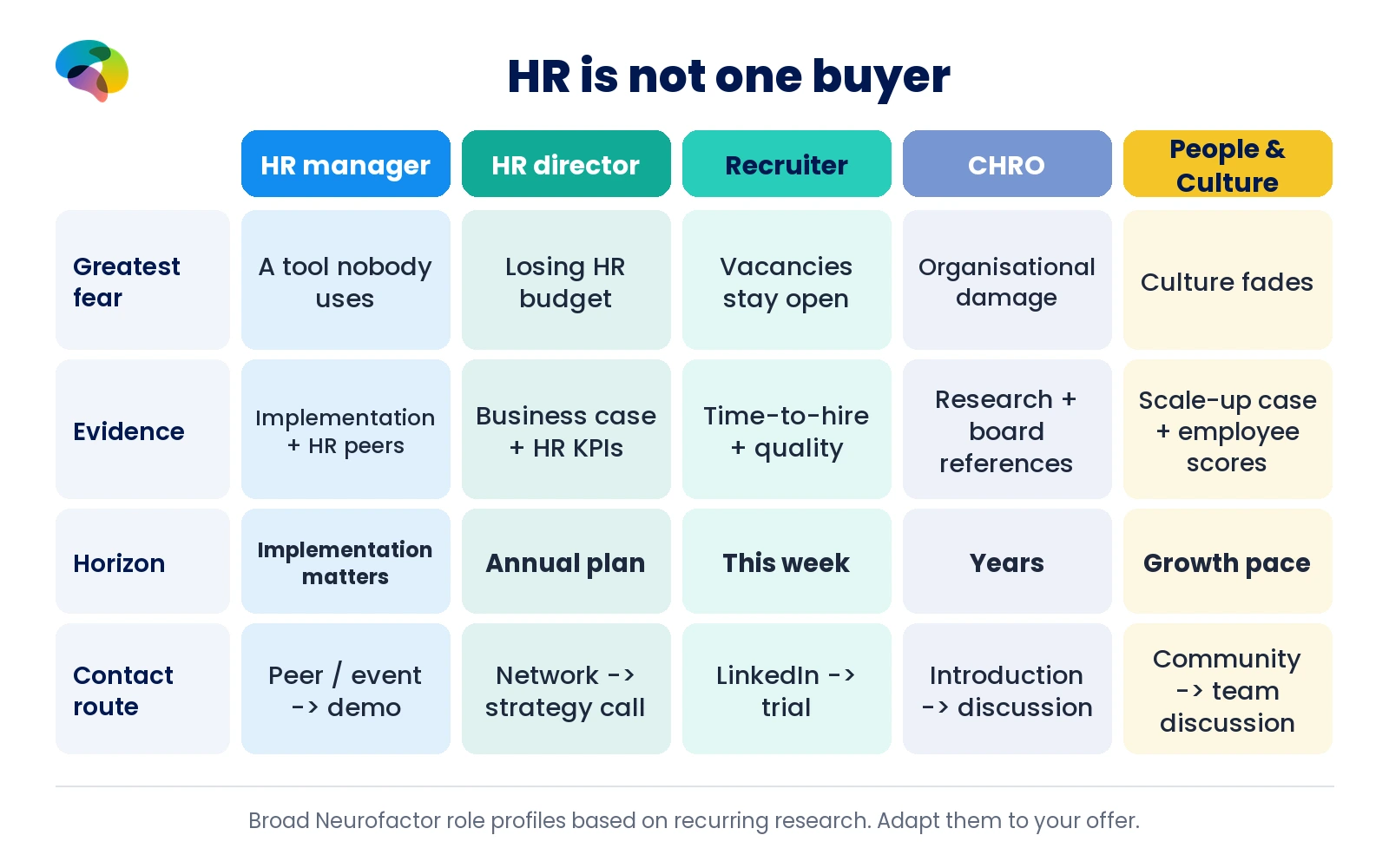
The same ROI can mean five different things
Recruitment cost savings matter to a recruiter when they help produce suitable applicants and shorter vacancy cycles. The same savings may do little for an HR manager if implementation lands extra work on a stretched team. For an HR director, the proposal becomes persuasive when its contribution to broader business outcomes can be defended to the executive team.
For a CHRO, the question widens: does this help talent, succession and leadership, or create another programme with no ownership in the line? The People & Culture lead looks at whether a more efficient process will undermine employee experience or cultural identity. All five may agree with the financial assumptions yet judge the result differently.
Evidence should therefore not be a generic appendix. It connects a specific claim to the uncertainty the buyer is trying to resolve.
Recruiter: will I see better candidates this week?
Recruiters work with open vacancies, candidates dropping out and hiring managers demanding results. The source profile links those pressures to reactive sourcing and an undifferentiated employer story. It also records strong approach motivation (BAS 8), lower inhibition (BIS 4) and the highest short-term preference in the HR set (k 0.45).
Do not lead with a twelve-month transformation roadmap. Show a comparable vacancy, quality or time-to-hire outcomes and a light initial trial. Someone who sees useful early results may become an internal supporter, but the card also notes that larger systems and agency spend are escalated to HR leadership.
“We already use job boards and agencies” is an invitation to demonstrate incremental value, not to repeat product features.
HR manager: less work without creating new work
The HR manager holds operations together with a relatively small team and many requests from line managers. The card mentions fragmented systems, administration and tools that fail to gain adoption. The greatest fear is choosing something that line managers do not use and having to justify the mistake to management.
BIS 6, BAS 5 and k 0.20 sit alongside a very practical question: how much additional implementation work will this require? Offer a reference from a comparable HR team, explain how managers will adopt the process and show exactly which tasks the customer must still complete.
A good-looking demo without a plausible adoption plan does not address the biggest concern.
HR director: make the business contribution of HR visible
The HR director wants HR to be recognised as a strategic partner rather than a cost centre. The source profile describes difficulty defending HR investments, a need for strategic recognition and anxiety that a weak case could cost the function its budget.
BIS 6, BAS 6 and k 0.15 fit a role that weighs opportunity and defensibility within annual planning cycles. Specify which HR KPIs move, how that connects to business outcomes, what the research supports and what finance will need to accept the argument.
The strongest material is often not a sales presentation. It is a concise, transferable argument the HR director can present without the supplier in the room.
CHRO: what happens to the organisation in three years?
The CHRO oversees talent strategy, leadership, culture and organisational change. The card flags slow adaptation, transformation programmes without line ownership and the risk of harming culture or reputation.
BIS 7, BAS 5 and k 0.08 represent the strongest long-horizon, risk-aware profile in this HR set. A recruitment case study alone is unlikely to carry an enterprise-wide decision. Use research, board-level references, senior guidance, phased deployment, ownership and evaluation milestones.
Ask which strategic priority the initiative serves and which risks the executive team needs to contain. A CHRO needs to know not only whether something works, but whether it can keep working responsibly at scale.
People & Culture: can we grow without losing ourselves?
The broad profile places People & Culture close to founders and growing teams. Rapid onboarding, inexperienced managers and disappearing rituals put cultural coherence under pressure. The greatest fear is a bigger organisation that has lost its people and distinctive culture.
With BIS 5, BAS 7 and k 0.30, opportunities to develop people can be attractive, provided the approach fits the company’s pace. Show employee experience, scale-up references, cultural fit and a way to involve the team in the decision.
A standard corporate rollout can trigger resistance even when the product works. Evidence must demonstrate that more structure does not automatically mean a less human organisation.
All 15 profile values: BIS, BAS and k
The values below come directly from rows 44 to 46 of the HR source card. BIS and BAS use the internal 0-10 role-profile scale; k uses its own source scale. They support interpretation alongside the remaining card fields and are not individual test results, purchase probabilities or brain scans.
BIS (0-10)
- HR manager
- 6
- HR director
- 6
- Recruiter
- 4
- CHRO
- 7
- People & Culture
- 5
BAS (0-10)
- HR manager
- 5
- HR director
- 6
- Recruiter
- 8
- CHRO
- 5
- People & Culture
- 7
k (source scale)
- HR manager
- 0.20
- HR director
- 0.15
- Recruiter
- 0.45
- CHRO
- 0.08
- People & Culture
- 0.30
The real difference is the distance to an outcome
A recruiter sees results in individual vacancies. An HR manager feels the implementation workload every day. An HR director has to defend outcomes in the annual plan. People & Culture sees progress in teams and culture. A CHRO thinks across multiple years and organisational systems. The right proof therefore differs not only in quantity but in the order in which it matters.
Within the source framework, a higher k is associated with a stronger preference for earlier outcomes; a lower k with a longer horizon. That is not a direct measure of approval speed. A CHRO can approve a multi-year initiative quickly, while a recruiter may wait months for authorisation to buy a platform.
Confusing time horizon with purchasing authority creates the wrong message and the wrong sales process.
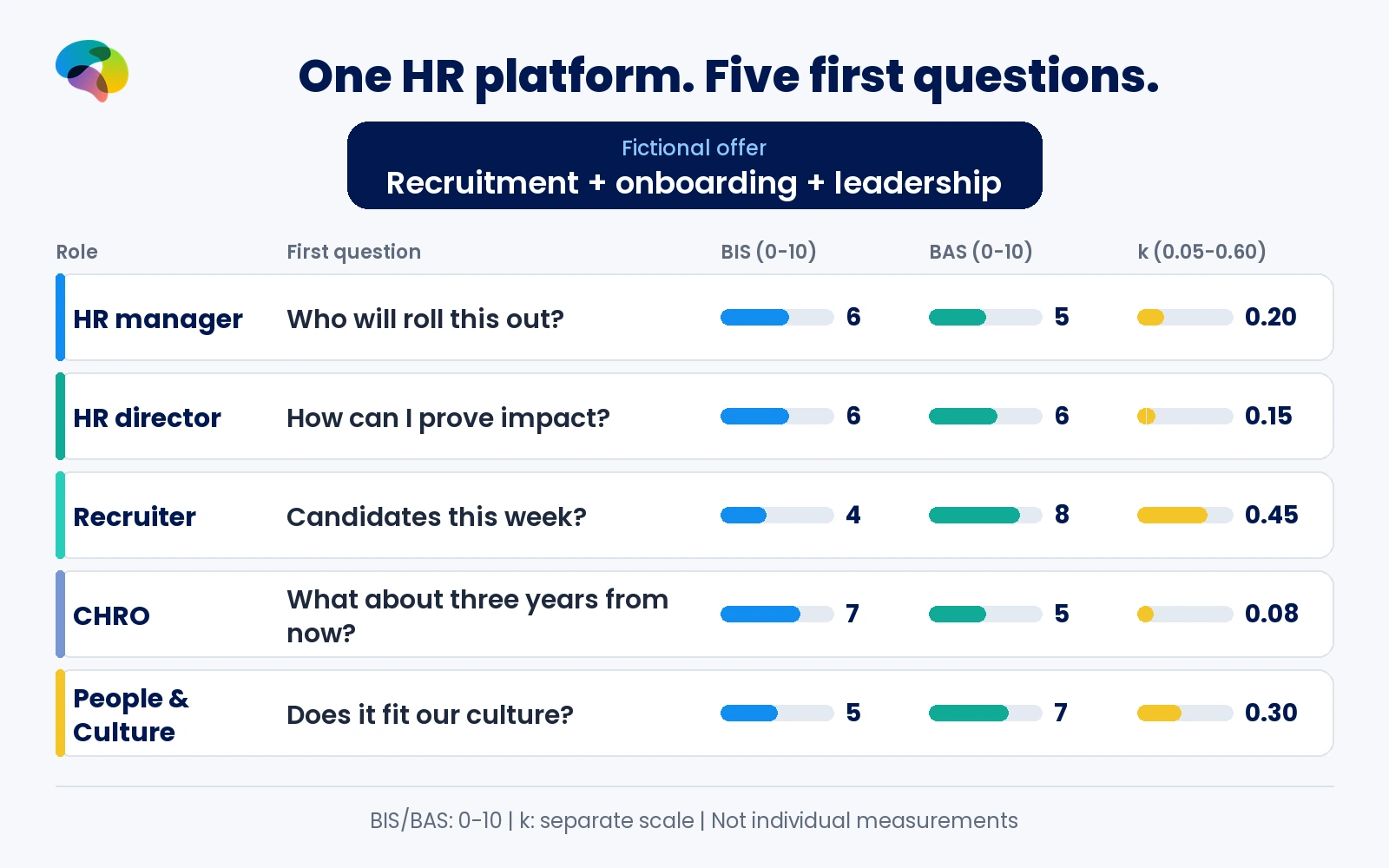
One HR platform. Five first reactions.
Consider a fictional platform combining recruitment, onboarding and leadership insights. The supplier uses one proposition with everyone: “More control over your people and processes in one platform.” It sounds relevant to all five, but their first questions will differ.
Recruiter: “Will I find better candidates and reduce drop-off this week?” HR manager: “Who will implement this, and will our line managers actually use it?” HR director: “How can I demonstrate an impact on retention, cost or productivity?” CHRO: “What does this mean for organisation design, leadership and risk in three years?” People & Culture: “Will our culture remain recognisable, and will employees benefit?”
This is an illustrative sales scenario, not a verbatim research transcript. The questions are editorial translations of the original profiles.
What should you change in your sales approach?
Before the first message, ask who owns the problem and who can approve the solution. Then look at the job to be done, decision horizon and current alternatives. A single HR proposition can serve several stakeholders without beginning with the same claim and the same proof for all of them.
- Recruiter: start with a comparable vacancy, applicant quality and a short trial; show an outcome that can become visible quickly.
- HR manager: start with workload reduction and manageable implementation; prove adoption by line managers.
- HR director: connect the initiative to business outcomes and HR KPIs; provide an executive-ready business case.
- CHRO: connect the solution to talent, leadership and culture; show governance, risk management and phased adoption.
- People & Culture: show employee experience, scale-up references and a plan for involving teams.
- Choose the route to contact using the card: LinkedIn and recruiter peers for recruiters; warmer board-level introductions for CHROs.
- Match the next step to actual authority: quick trial, practical demo, strategic conversation, board-level exploration or team discussion.
Five opening lines for one proposition
These are editorial examples derived from the source cards, not tested winning copy. A specific product and sector require their own validation.
- Recruiter: “For vacancies like yours, we can show how the number of suitable applicants changes in the first weeks.”
- HR manager: “We start with the work your team should no longer have to do, and show what implementation and adoption will demand.”
- HR director: “We connect the HR investment to the KPIs you need to defend to finance and the executive team.”
- CHRO: “We show what this means for talent, leadership and enterprise risk, including a responsible phased deployment.”
- People & Culture: “We show how onboarding can scale without making people feel lost in an anonymous process.”
When should you stop thinking in just one HR role?
With bigger HR purchases, the problem owner, sponsor, budget holder, user and final approver may all be different people. A recruiter can surface demand without being authorised to buy an HRIS. An HR manager can run a pilot but need an HR director’s budget approval. A CHRO can sponsor strategy while People & Culture and team leads test cultural fit.
Build a simple buying-group map: who experiences the problem, who checks the evidence, who bears implementation risk, who owns budget and who can block the decision? Then sequence your contact and evidence accordingly. A coherent core claim can be demonstrated differently to each stakeholder; five conflicting promises will undermine the purchase.
A well-grounded role profile still needs a product context
These profiles draw on recurring patterns in Neurofactor research conducted over several years with these and comparable audiences. They are therefore substantiated broad function profiles. The BIS, BAS and k values shown are those recorded in the supplied function cards; they must not be presented as one representative population survey, individual diagnosis or direct neurological measurements.
A recruiter in healthcare can face a different choice from a recruiter at a scale-up. An HR manager choosing a low-cost service asks different questions from someone implementing a multi-year HRIS programme. Industry, company size, price, product, service, proposition, authority and context can all shift which parts of a broad profile matter.
For maximum predictive and commercial usefulness, connect the role profile to the associations, objections and proof requirements surrounding the actual offer. Neurofactor does that through a target group and association analysis. Want to know what one of these HR profiles looks like for your specific product or service? Start by investigating that real buying context.
Want to know how these HR roles see your product or service? Contact Neurofactor and translate the broad profile into your proposition.
HR is not one buyer. It is a collection of decisions.
The recruiter may value this week’s result. The HR manager needs workload relief without new implementation trouble. The HR director needs a defensible contribution to company outcomes. The CHRO needs a responsible long-term path. People & Culture needs growth that strengthens people and culture.
Sending all five the same HR pitch treats five different uncertainties as one. Effective B2B communication starts not with changing the title above an old deck, but with the question each role must answer and the evidence that makes the answer meaningful.
Key terms
- Target group card
- Structured profile of a defined audience including goals, pain points, objections, evidence requirements and decision context.
- Association map
- Research account of meanings and associations a specified audience links to a brand, product or issue within a given choice context.
- BIS
- Behavioral Inhibition System, a theoretical concept related to conflict or potential negative outcomes. The values here are internal role-profile figures, not direct brain measures.
- BAS
- Behavioral Activation System, a theoretical concept concerning approach towards opportunities and rewards. A profile value is not a predicted likelihood of purchase.
- Delay discount rate (k)
- A time-valuation parameter. Within the same model, a higher k assigns relatively less weight to later outcomes. This article uses the comparative values recorded in the source cards.
- Proof anchor
- Specific evidence linking a central claim to the uncertainty or objection a decision-maker needs resolved.
Frequently asked questions
How is selling to a recruiter different from selling to a CHRO?
In these broad role profiles, recruiters focus more on suitable applicants and near-term time-to-hire results. CHROs need evidence of enterprise-wide impact, governance and manageable long-term risk.
Which HR roles are covered by the Neurofactor target group cards?
The HR category covers HR manager, HR director, recruiter, CHRO and People & Culture, each described using the same forty profile fields.
Which HR role has the highest BAS and k in this dataset?
The recruiter has BAS 8 and k 0.45, the highest of the five HR profiles, consistent with an emphasis on opportunities and near-term outcomes within the source framework.
Which evidence matters to HR managers versus People & Culture leads?
HR managers primarily look for peer references and proof of smooth implementation and line adoption. People & Culture leads look for scale-up cases, employee scores, peer references and cultural fit.
Are BIS 4 and BIS 7 individual measurements of recruiters and CHROs?
No. They are values in broad role profiles grounded in recurring Neurofactor research patterns, not personal diagnoses, direct EEG readings or standalone purchase probabilities.
How do I adapt a general HR role profile to my product?
Define the sector, buying group, price, proposition and decision context. Then investigate product-specific associations, fears, objections and evidence needs through target group and association research and test the resulting message.
Sources
- 1.Behavioral Inhibition, Behavioral Activation, and Affective Responses to Impending Reward and Punishment: The BIS/BAS Scales - Carver & White / Journal of Personality and Social Psychology (1994)
- 2.Time Discounting and Time Preference: A Critical Review - Frederick, Loewenstein & O'Donoghue / Journal of Economic Literature (2002)
Related topics
Reviewed by: Martijn den Otter · Last reviewed: 10/8/2026
Martijn den Otter
Oprichter van Neurofactor. Expert in neuromarketing en consumentenpsychologie.
LinkedIn →