
Recruiter vs CHRO: hiring today or changing the organisation tomorrow?
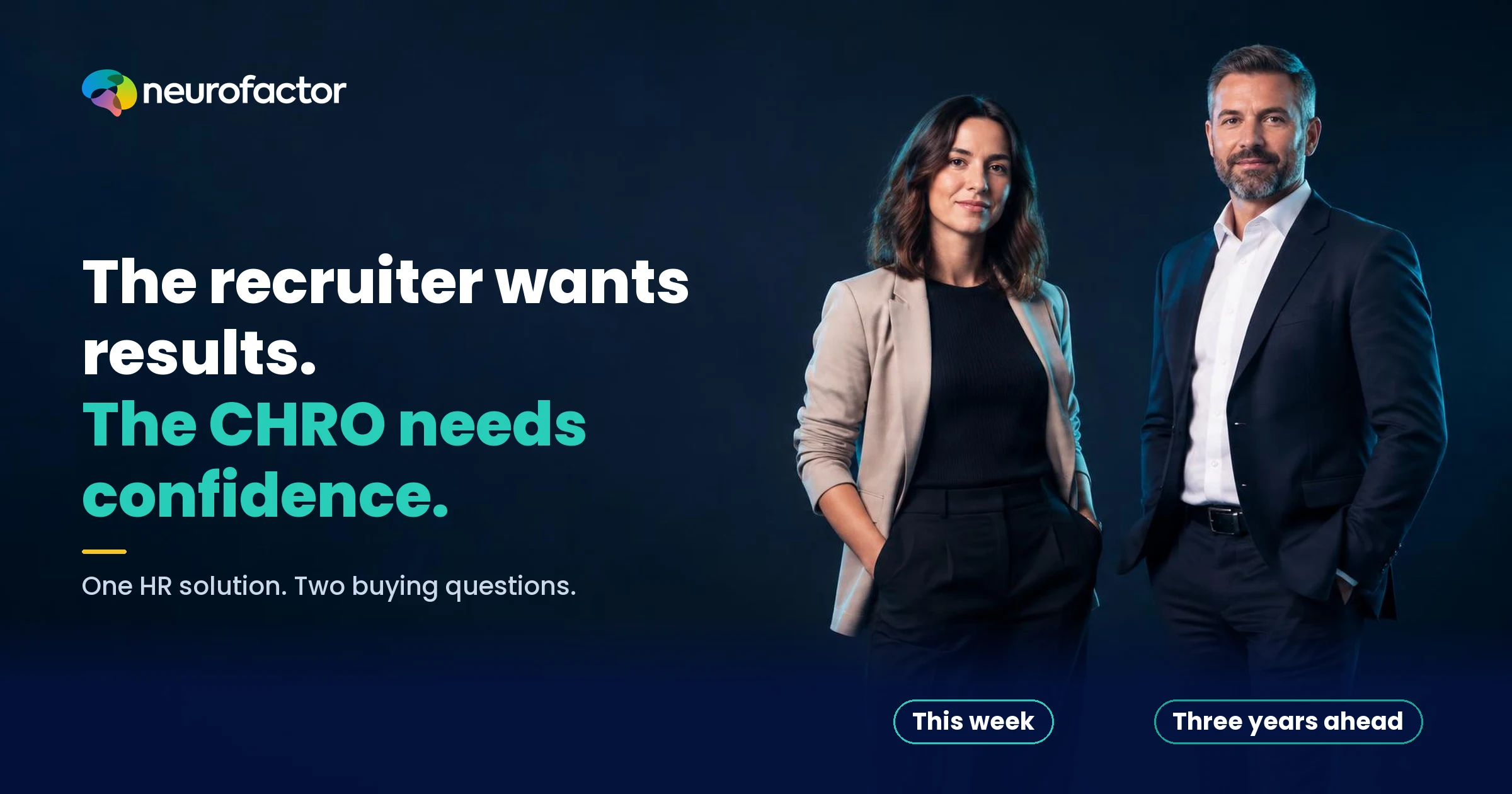
A recruiter opens your proposal and asks: will this bring me better candidates this week? A CHRO opens the same proposal and asks: what will this mean for the organisation, its culture and reputation three years from now? Same solution. Two very different decisions.
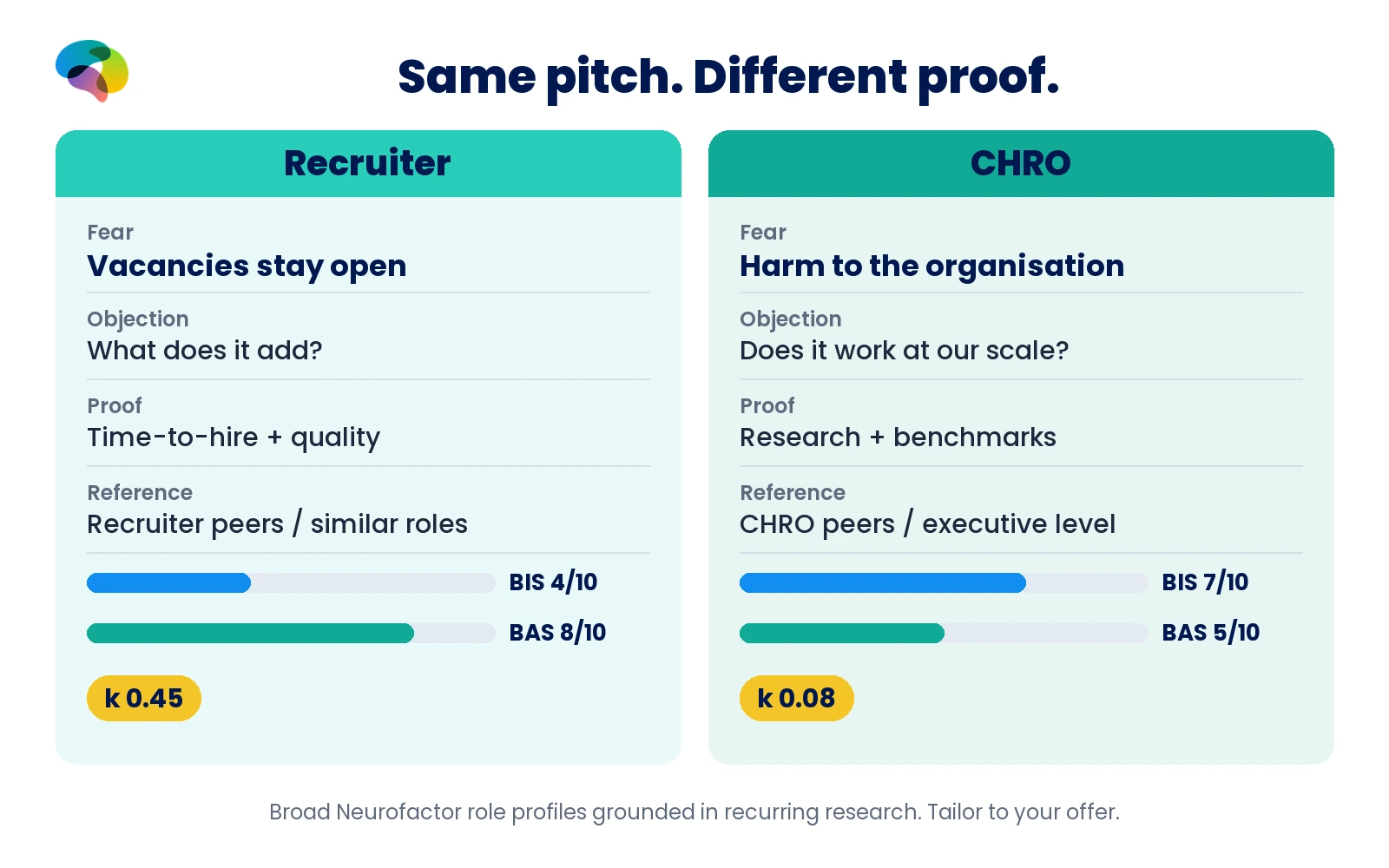
The original Neurofactor target group cards make the contrast clear. The recruiter profile records BIS 4, BAS 8 and delay-discount parameter k 0.45. The CHRO profile records BIS 7, BAS 5 and k 0.08. The deeper distinction is what each role wants to avoid: vacancies that stay open and erode trust, versus a large intervention that damages the organisation.
To sell to both, you need more than two versions of the same slide deck. You need to answer two different questions, with the right evidence, an appropriate first contact and a sensible next step.
The real divide is not HR. It is the downside each role carries.
Both roles have something to lose, but not the same thing. Recruiters face vacancies, drop-offs and impatient hiring managers every week. The negative outcome is immediate and visible: a team remains understaffed and recruitment is held responsible. A CHRO considers an intervention affecting multiple teams, countries, leaders and processes. The damage from a poor decision can persist for years.
The important difference is not that the recruiter is fast and the CHRO is slow. The recruiter sees the risk of not acting effectively. The CHRO sees the risk of changing too much without ownership and safeguards. A single generic pitch rarely resolves both concerns.
Two HR roles, two buying frameworks
This table follows the original target group cards, sheet 5 HR & Recruitment, columns F (recruiter) and G (CHRO). Entries are concise editorial summaries of the recorded profile fields.
Responsibility
- Recruiter
- Open roles, candidate quality and hiring manager satisfaction
- CHRO
- Talent strategy, leadership, culture and organisational change
Primary pain
- Recruiter
- Too few suitable candidates and demanding hiring managers
- CHRO
- Organisation adapts too slowly to changing labour market and leadership needs
Underlying cause
- Recruiter
- Reactive recruiting and an undifferentiated employer story
- CHRO
- Complex layers, different cultures and slow decisions
Emotional pressure
- Recruiter
- Stress and powerlessness when vacancies stay open
- CHRO
- Concern the organisation may not be ready for what comes next
Greatest fear
- Recruiter
- Long-unfilled roles and lost hiring manager confidence
- CHRO
- A decision that harms the organisation, culture or reputation
First objection
- Recruiter
- We already use agencies and job boards; what will this add and how much work is it?
- CHRO
- Has it worked at our scale, what are the risks and how does it fit existing programmes?
Evidence needed
- Recruiter
- Time-to-hire, quality, similar vacancies and recruiter peers
- CHRO
- Research, benchmarks, CHRO references and a board-level track record
Desired outcome
- Recruiter
- Better candidates sooner, satisfied hiring managers
- CHRO
- Adaptable organisation, stronger leadership and healthy culture
Preferred access
- Recruiter
- LinkedIn or recruiter peer, followed by a quick demo or trial
- CHRO
- Introduction from CEO, board member or fellow CHRO, followed by personal discussion
Buying authority
- Recruiter
- May approve smaller tools, escalates larger suppliers and systems
- CHRO
- Executive responsibility, accountable to CEO and oversight body
The same promise means something different to each role
Imagine a supplier claims: “Our platform makes talent decisions smarter and faster.” Recruiters may interpret that as identifying candidates earlier and reducing drop-off. CHROs may think about strategic workforce planning, line-leader ownership and whether the platform can be governed across a large business.
For the recruiter, value is close to the next hiring outcome. For the CHRO, value depends on how the offer fits existing strategic programmes. This is not about changing one adjective in a headline. It is about proving a different condition before the promise can be trusted.
Recruiters are not buying more reach. They need more suitable candidates.
The source profile identifies scarce candidates, expensive agencies with inconsistent quality, candidate drop-off and pressure from hiring managers. One common mistake is to treat greater reach as the solution.
Yet the card identifies that very assumption as problematic: reach does not automatically translate into candidate quality. The desired outcome is shorter time-to-hire and better candidates without extra administrative load. Show a comparable vacancy: the quality of applicants, process duration, withdrawals and workload before and after.
BIS 4, BAS 8 and k 0.45 reflect the strong near-term result orientation in this broad profile. They do not replace performance evidence. They help explain why an easy trial with quick feedback is a more relevant opening than a one-hour presentation on an enterprise transformation roadmap.
CHROs are not buying another programme. They need responsible change.
The CHRO card describes slow organisational adaptation, gaps in leadership development and succession, inconsistent systems and cultures, and multiple layers of decision-making. The concern is not merely how to close individual vacancies. It is whether the organisation can change sustainably.
The greatest fear is a decision that damages the organisation, culture or reputation. Previous unsuccessful alternatives explicitly include transformation programmes with no ownership in the line and leadership initiatives without lasting adoption. Another glossy programme can reinforce the wrong association.
With BIS 7, BAS 5 and k 0.08, the commercial implication is to make risk controls tangible. Who owns the work? How are managers involved? What is evaluated, when, and who can stop or adjust the rollout? A convincing ROI still leaves a gap if these questions go unanswered.
Fear, objection and evidence are not interchangeable
An objection is what someone says during a sales conversation. The underlying fear is the adverse outcome that concern relates to. Evidence must answer that uncertainty rather than simply make the supplier look impressive.
Stated objection
- Recruiter
- “We already have agencies and job boards.”
- CHRO
- “Is it proven at our scale?”
Underlying fear
- Recruiter
- Unfilled vacancies and loss of hiring manager trust
- CHRO
- Damage to organisation, culture or reputation
Relevant proof
- Recruiter
- Comparable vacancies, quality, time-to-hire and recruiter references
- CHRO
- Research, benchmarks, comparable scale, CHRO references and executive delivery experience
Logical next step
- Recruiter
- Short demo or tightly scoped trial
- CHRO
- Strategic meeting focused on risk and governance
What recruiters need to see first: one comparable vacancy
A case study featuring thousands of applications is not helpful if the buyer struggles to find qualified applicants. Start with a recognisable role. How many applicants were genuinely suitable? Where did candidates drop out? What changed in the hiring timeline?
Make the initial test easy to run and be clear about what it does and does not demonstrate. A short trial gives recruiters something useful to act on. It is not proof that outcomes will generalise to every role or location.
The source card favours LinkedIn or a referral from another recruiter, followed by a quick demo or trial. This is a profile-level preference, not a rule about every individual recruiter.
What CHROs need first: scale, ownership and executive confidence
A recruiter testimonial may be useful, but it does not automatically establish that a programme works in a complex organisation. The CHRO profile specifically calls for research, benchmarks, references from established CHROs and experience at board level.
Explain phased implementation, executive and line-manager responsibilities, relevant compliance considerations and how progress will be reviewed. Address failure scenarios as well as success: which risks remain, how will they surface and who makes the decision to intervene?
The source card indicates a preference for introductions through a CEO, board-level contact or fellow CHRO, then a personal conversation. That differs from opening with a cold invite to a product demonstration.
The six source values behind the difference
These numbers are transcribed from rows 44-46 of the source workbook. BIS and BAS use the internal 0-10 role-profile scale. k is a separate parameter, neither a percentage nor a 0-10 score.
BIS (0-10)
- Recruiter
- 4
- CHRO
- 7
BAS (0-10)
- Recruiter
- 8
- CHRO
- 5
Delay-discount parameter k
- Recruiter
- 0.45
- CHRO
- 0.08
A lower k does not mean a slower decision-maker
Within the source framework, a higher k corresponds to a stronger relative preference for earlier outcomes. The recruiter has k 0.45: progress on current vacancies matters immediately. The CHRO has k 0.08: organisational results further in the future retain relatively more weight.
This should not be confused with contract approval speed. A recruiter may like a tool within minutes and still lack authority to buy a new platform. A CHRO may make a clear strategic decision after a short, well-prepared governance discussion.
Use k to understand when the result becomes valuable, not to predict the number of days before a deal closes.
One recruitment platform. Two almost opposite first questions.
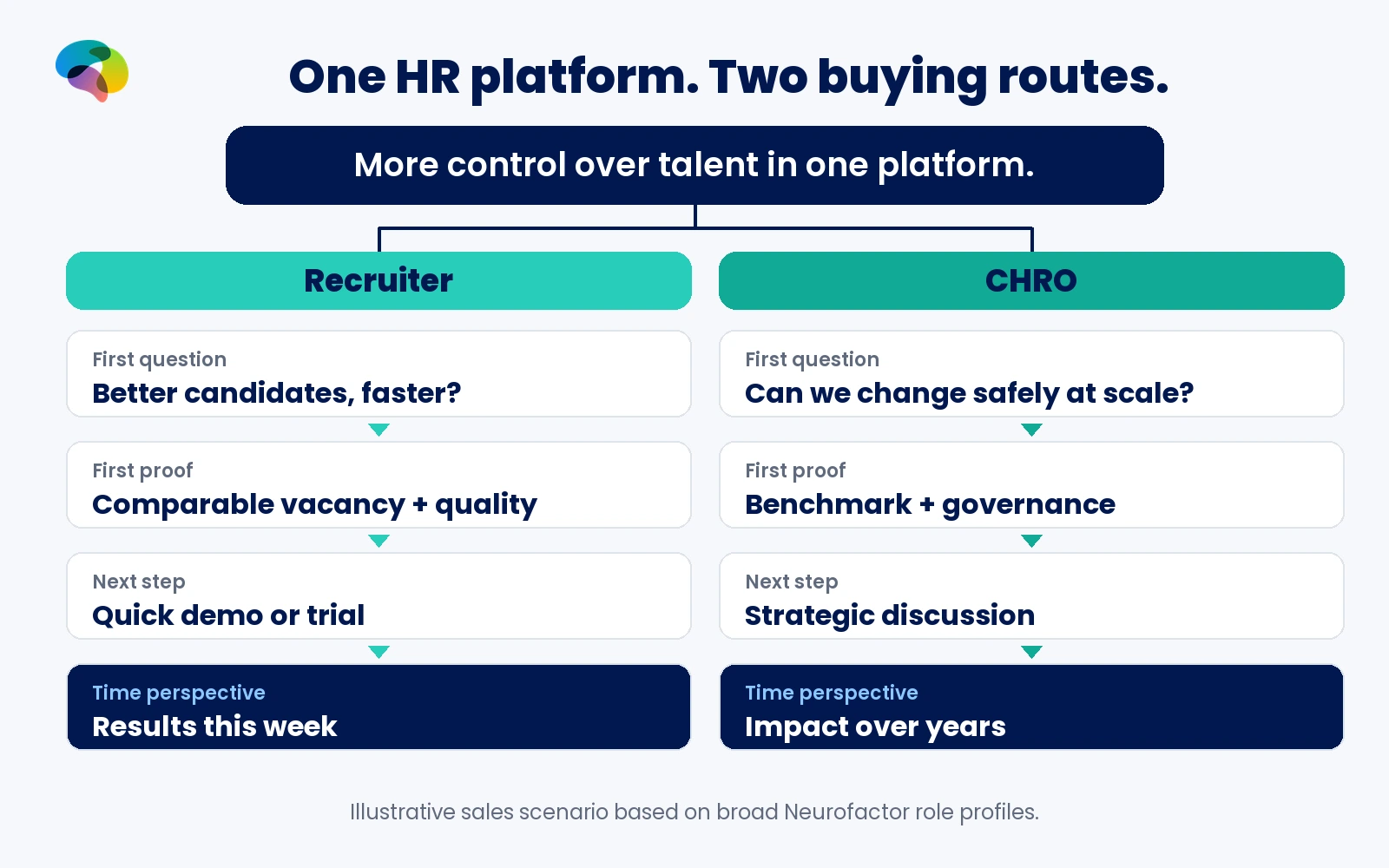
Imagine a fictional platform that combines employer communication, candidate inflow and leadership insights. The supplier tells both buyers: “More control over talent in one smart platform.” The scenario is illustrative; the questions are editorial translations of the cards, not verbatim interviews.
Recruiter: “Will this get me better applicants for my difficult roles, and how much extra work will it create?” CHRO: “How will this affect our talent strategy and leadership, and who owns the downside if a rollout at scale fails?”
The core product need not change. The entry claim, first evidence and next step do. For the recruiter, lead with a relevant vacancy and a lightweight trial. For the CHRO, lead with strategic alignment, scale experience and governance before walking through features.
Build two sales routes around the same offer
These recommendations follow the recorded differences in the source cards, rather than a generic persuasion framework.
- Recruiter - begin with the vacancy that is hardest to fill, not a multi-year transformation vision.
- Recruiter - show applicant quality, time-to-hire, comparable cases and the operational work required.
- Recruiter - use LinkedIn or a credible recruiter referral to offer a short demo or contained trial.
- CHRO - begin with the strategic challenge and organisational risk the solution addresses.
- CHRO - combine research, benchmarks and executive references with a practical governance and risk-control plan.
- CHRO - favour a warm introduction and personal discussion of priorities before a product walkthrough.
- For both - keep the product claim consistent, with operational evidence and executive evidence reinforcing each other.
Two ways to open the conversation
These examples are derived from the profiles and are not research-tested, winning message claims.
For the recruiter: “Which open role is taking the most time right now? I can show you how we track candidate quality and hiring speed on a comparable vacancy, without adding a separate project to your team.”
For the CHRO: “Which change in talent or leadership must be evident three years from now? I can show how our approach is governed at scale, how risks are contained and how progress is reported at executive level.”
Both ultimately concern better talent decisions. What differs is the route to making that value believable.
When you should not choose between the recruiter and the CHRO
For larger HR purchases, the person with the problem, the end user, the sponsor and the budget holder may be different people. Recruiters can expose a problem before CHROs sponsor a strategic programme. HR managers may own implementation while procurement applies separate requirements.
Map the buying group: who suffers the urgent problem, who assesses evidence, who carries implementation risk, who controls budget and who can prevent approval?
A compelling case then has two complementary layers: demonstrable operational outcomes for the users and a defensible, controlled enterprise contribution for those accountable. This is not about writing conflicting promises. It is about proving different dimensions of one proposition.
A research-based role profile is not a diagnosis of your customer
These profiles are based on recurring patterns in research Neurofactor has conducted over several years with these and comparable groups. They are substantiated broad, generalised role profiles. BIS, BAS and k values are transcribed from the supplied cards; they are not individual diagnoses, direct EEG measurements or purchase probabilities.
A recruiter in healthcare may face different constraints from one at a software scale-up. A CHRO in a regulated multinational may evaluate an offer differently from one in a rapidly growing business. Sector, company size, price, the specific product or service, authority and choice context can shift which attributes matter.
For predictive and commercial usefulness, connect the broad role profile to the actual proposition. Target group and association research can identify what that audience links to your product and which objections and evidence requirements become salient. Want to know how a recruiter or CHRO perceives your specific offer? Start with that buying context. See also the five-profile HR comparison.
Want to know how recruiters or CHROs see your product or service? Contact Neurofactor and translate the broad profile into your proposition.
Recruiters need to solve a problem. CHROs need to avoid creating a new one.
Recruiters seek an immediate, visible outcome: a suitable candidate in the right role without unnecessary delay. CHROs seek a resilient, future-ready organisation without uncontrolled side effects. Both want progress, but they need very different proof that progress will be real and responsible.
One generic HR pitch therefore rarely works. Not because you need different buzzwords, but because you need to understand the two responsibilities behind the purchase.
Key terms
- Target group card
- A structured function or audience profile covering motivations, pain points, objections, evidence needs, communication and decision context.
- Association map
- A study of the meanings and associations a particular audience connects to a brand, product or issue in a specific choice context.
- BIS
- Behavioral Inhibition System, a theoretical concept related to conflict and potential negative outcomes; the value here belongs to a broad 0-10 role-profile scale.
- BAS
- Behavioral Activation System, a theoretical concept related to opportunities and positive outcomes; the profile value is not a likelihood of purchase.
- Delay-discount parameter (k)
- A parameter representing the relative weighting of earlier versus later outcomes within the source framework, not approval speed or a percentage.
- Proof point
- Evidence selected to address a particular objection, risk or desired outcome that matters to a buyer.
- Buying group
- The people involved as user, influencer, sponsor, budget owner or approver in a B2B purchase.
Frequently asked questions
What is the key buying difference between a recruiter and a CHRO?
Recruiters tend to focus on how quickly an offer improves candidate quality and time-to-hire. CHROs focus on organisational impact across talent, leadership and culture, including long-term risk.
What are the BIS, BAS and k values for recruiter and CHRO profiles?
The Neurofactor source cards record recruiter BIS 4, BAS 8, k 0.45 and CHRO BIS 7, BAS 5, k 0.08. They are broad function-profile values, not measurements of specific individuals.
What evidence should a supplier show a recruiter?
The source card specifies time-to-hire, candidate-quality metrics, quick results from comparable vacancies and recruiter references. A lightweight trial is a suitable next step.
What evidence does a CHRO expect?
CHROs need research, benchmarks, references from respected CHROs and a board-level track record, accompanied by an explanation of governance, implementation and risk.
Does the CHRO’s lower k value mean a longer purchasing process?
No. k concerns relative weighting of earlier and later outcomes, not contracting speed. Authority, type of procurement and buying-group structure are separate considerations.
How do I tailor these profiles to my own HR product or service?
Define the proposition, industry, price and decision context, then investigate the actual associations, fears, objections and proof requirements through target group and association research.
Sources
- 1.Behavioral Inhibition, Behavioral Activation, and Affective Responses to Impending Reward and Punishment: The BIS/BAS Scales - Carver & White / Journal of Personality and Social Psychology (1994)
- 2.Time Discounting and Time Preference: A Critical Review - Frederick, Loewenstein & O'Donoghue / Journal of Economic Literature (2002)
This series
Who are you really selling to?Category synthesis
Selling to HR: recruiters and CHROs live in different realitiesRead next
Related topics
Reviewed by: Martijn den Otter · Last reviewed: 10/8/2026
Martijn den Otter
Oprichter van Neurofactor. Expert in neuromarketing en consumentenpsychologie.
LinkedIn →