
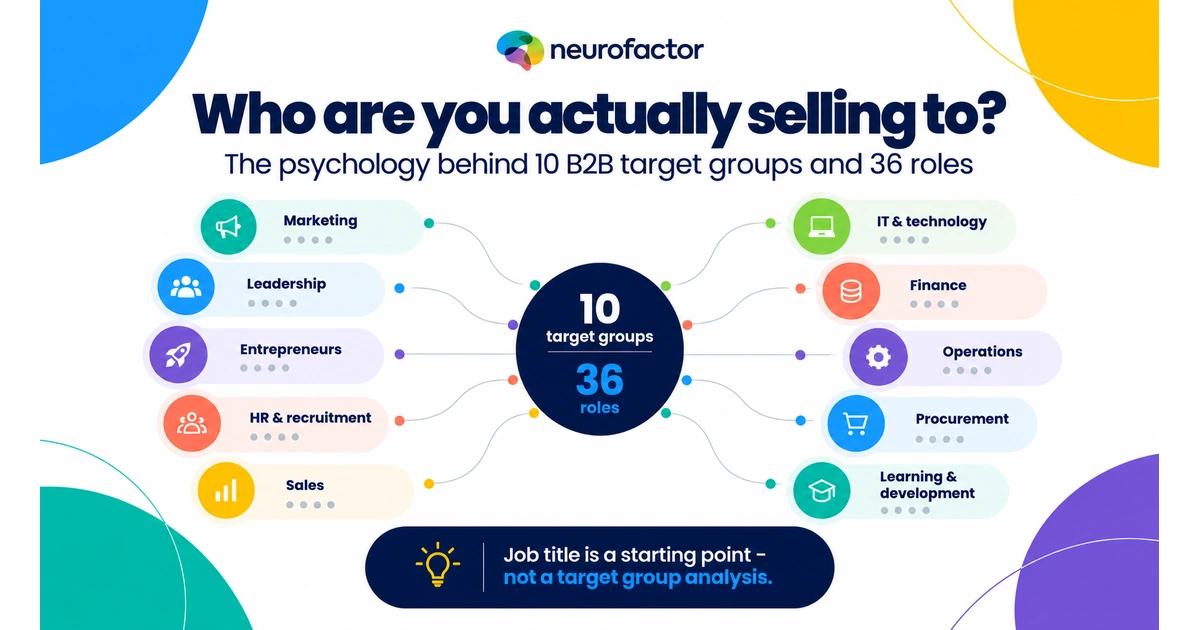
Who are you really selling to?
The psychology behind 10 B2B audiences and 36 roles
The psychology behind 10 B2B audiences and 36 roles.
A job title tells you what someone is responsible for. It does not yet tell you why that person says yes. In LinkedIn targeting, advertising, outbound sales or account-based marketing, it is logical to start with industry, company size, department and job title. That tells you who you want to reach. It does not tell you what risk that person sees, what evidence is required, how quickly results must appear or what makes a decision defensible internally.
In this series we therefore compare 36 roles across 10 common B2B audiences. Not to create 36 new stereotypes, but to make visible how much information disappears when an audience is reduced to a job title.
A job title tells you where someone sits, not why they say yes
LinkedIn makes segmentation attractively simple. Pick a department, add job titles and the audience suddenly looks well defined. That is useful for reach. For persuasion, it is only the beginning.
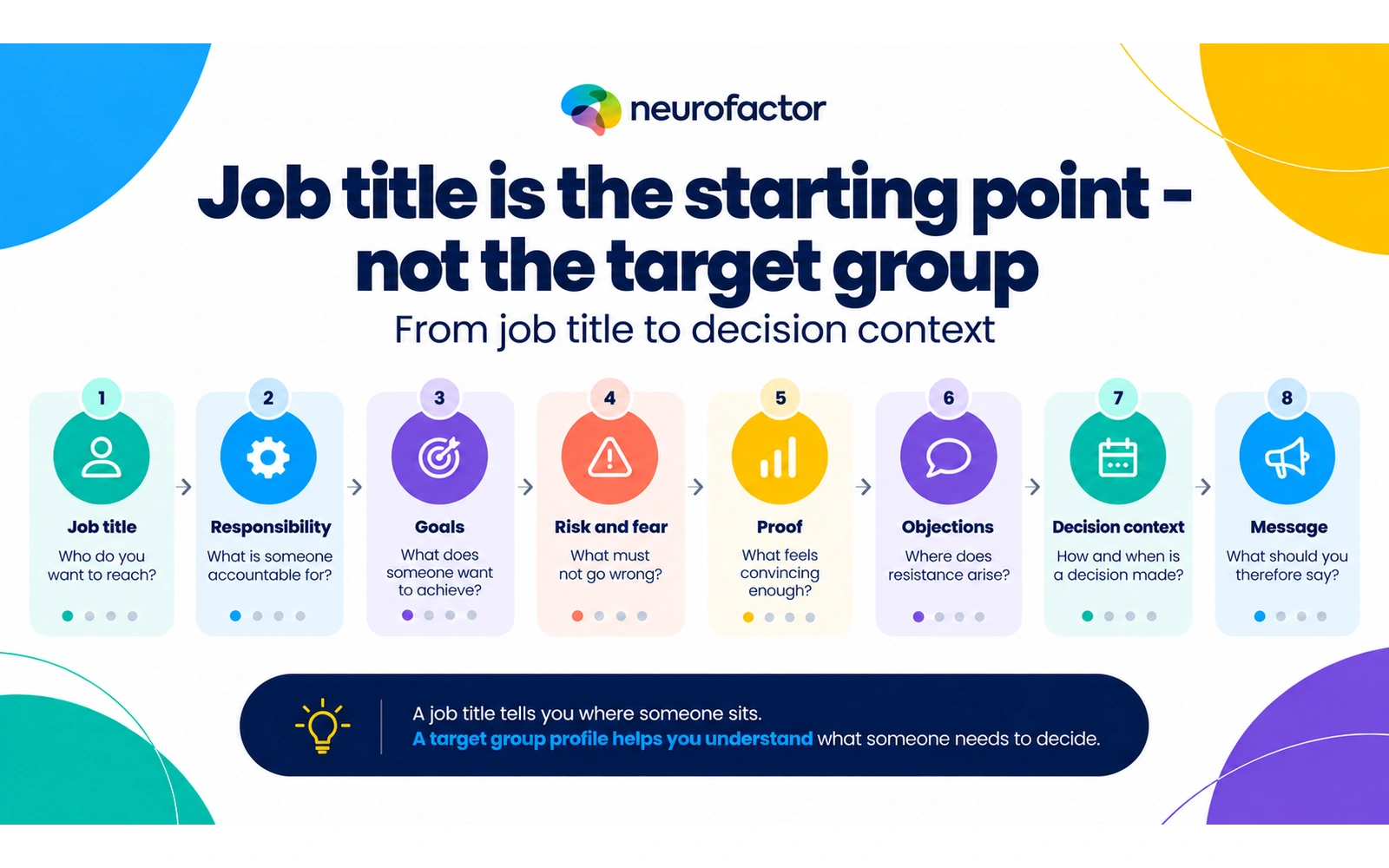
A job title usually tells you something about responsibility, position and mandate. It tells you much less about the mental context of a decision. What can go wrong for this person? What will they be held accountable for? How quickly must an effect become visible? What evidence is strong enough to defend the decision internally? And is the person primarily responding to an opportunity or trying to prevent a loss?
Those differences determine whether the same message feels relevant, flat or even unsafe.
Four people in marketing. One pitch. Four different questions.
Imagine selling software that helps marketing teams make better decisions. You approach a marketing manager, CMO, brand manager and head of marketing. All four belong to marketing. It would be easy to use one message: our solution helps marketing teams improve results with data.
Yet that same message can trigger four different questions. The marketing manager may want to know whether it is practical and whether results appear quickly. The CMO may need to show what the investment contributes to brand or revenue and how it can be defended to finance. The brand manager may focus more on reliability and the risk of a wrong choice damaging the brand. The head of marketing may ask how quickly the impact shows up in the funnel and growth.
Four roles. One department. Four different meanings of the word evidence.
Responsibility is not the same as decision logic
A job title often gives a reasonable indication of responsibility, collaboration and likely KPIs. But a decision is not driven by formal responsibility alone.
- What can go personally or professionally wrong for this person?
- What will they be held accountable for if the decision fails?
- How quickly must a result become visible?
- What type of evidence makes a claim credible enough?
- Which previous experiences or assumptions create resistance?
- Is the emphasis mainly on capturing an opportunity or preventing a risk?
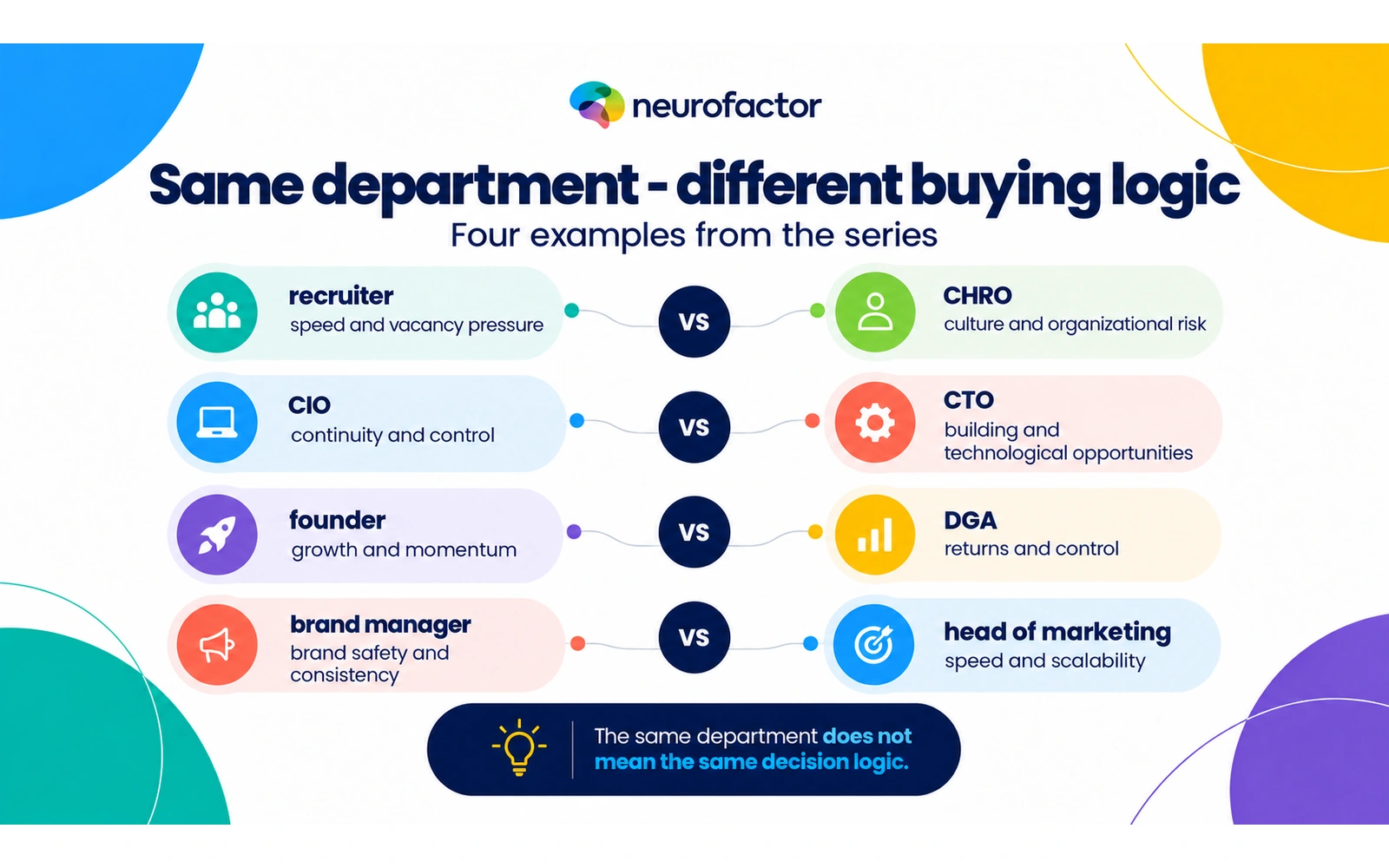
Four contrasts that show what a job title hides
The role profiles are not diagnoses of individuals. They summarise recurring patterns Neurofactor sees in research with these audiences. That gives a well-founded broad picture of how roles can differ in areas such as evidence needs, risk, urgency and decision logic.
| Contrast | What shifts in the profile? | Why does it matter commercially? |
|---|---|---|
| recruiter vs CHRO | Immediate hiring pressure versus long-term organisation, culture and reputation | Tempo, evidence and the scale of the business case change |
| CIO vs CTO | Continuity, security and architecture versus building, scalability and technical opportunity | The same innovation can first be read as risk or as possibility |
| founder vs DGA-owner | Growth momentum versus protection of wealth and built-up company value | Speed and traction persuade differently from financial defensibility and control |
| brand manager vs head of marketing | Brand safety and consistency versus growth, funnel and speed | Research evidence and brand cases carry different weight from growth metrics and dashboards |
The same evidence is not evidence for everyone
A recurring pattern across the 36 profiles is that almost every role asks for evidence, but the meaning of evidence changes.
For a recruiter, evidence may be time-to-hire and quality metrics from comparable vacancies. For a CFO, a quantified business case covering total cost and return may carry more weight. For a CIO, certifications, security audits and architecture can be decisive. For an owner, a recommendation from another entrepreneur in the same sector may be more persuasive than a lengthy analyst report.
The question is therefore not only: do we have enough evidence? A better question is: what evidence does this buyer need to accept this specific claim?
Read more in what evidence means in a target group profile.
Why we also include BIS, BAS and time preference
In the target group profiles we use BIS, BAS and delay discounting, among others, as additional lenses to make recurring differences compactly visible. The profile values are based on patterns from Neurofactor's accumulated research base. They are directional audience-level profile values intended for comparison, not individual psychological diagnoses. For a specific proposition, these broad profiles are refined further.
In the aggregated Neurofactor profiles, for example, the founder sits strongly on the approach and faster-result side, while a board member is characterised more strongly by risk management and a longer time horizon. This does not mean every founder decides quickly or every board member is risk-averse.
See also interpreting BIS and BAS together and delay discount rate k in a target group profile.
The 10 B2B audiences in this series
The series is built around ten categories. Within each category we are not looking for an average buyer, but for the differences that genuinely change communication, evidence and the sales approach.
- Marketing: marketing manager, CMO, brand manager and head of marketing. How can the same word, evidence, mean four different things?
- Leadership: CEO, managing director and board member. What changes between strategy, target pressure, reputation risk and governance responsibility?
- Entrepreneurs: founder, owner, DGA-owner and owner-managing director. Where does buying logic shift from growth momentum to control and wealth protection?
- HR & recruitment: HR manager, HR director, recruiter, CHRO and people & culture. How does the time horizon run from filling vacancies this week to managing organisational risk years ahead?
- Sales: sales manager, head of sales, CRO and commercial director. Everyone wants growth, but what kind of growth must become visible and when?
- IT & technology: IT manager, CIO, CTO and head of IT. When is the same technology primarily seen as a risk, and when as an opportunity?
- Finance: CFO, finance director and controller. What happens when the person who feels the operational urgency is not the person with the investment mandate?
- Operations: COO, operations manager and supply chain manager. Why do continuity, predictability and disruption risk carry so much weight?
- Procurement: procurement manager, buyer and purchasing director. Why is procurement about more than reducing price?
- L&D: L&D manager, talent manager and HR development. When does the business case shift from learning to retention, scale and organisational development?
How to use this series in marketing and sales
The purpose of this series is not to hand you 36 ready-made personas. It is to help you ask better questions about your own audience.
- Proposition: what value is genuinely relevant to this role?
- Advertising: should the first message show an opportunity or first reduce uncertainty?
- Sales conversation: what responsibility or fear sits behind the first objection?
- Case: what outcome must be visible before it counts as evidence for this role?
- Content: are you only helping someone understand the product, or also helping them defend the decision internally?
- Outbound: are you using supplier language or the language the buyer uses to describe the problem?
From broad audience profile to your proposition
The role profiles in this series are based on recurring patterns from research Neurofactor has conducted with these audiences over the years. This allows us to identify broad role-level patterns in areas such as evidence needs, perceived risk, objections, time horizon and buying logic.
The profiles are intentionally generalised. A CMO remains a CMO, but the way that person evaluates evidence, value and risk changes depending on what is being bought. Software, a research service, an employer proposition or a consumer brand can trigger different associations and objections.
For the strongest result, we therefore connect the broad audience profile to your product or service, proposition and decision context. A target group profile and association map shows which broad patterns remain relevant and which associations are specific to your offer.
Want to know how this audience views your product or service? Contact Neurofactor to tailor the profile to your proposition.
Conclusion: a job title is the starting point
A job title tells you where someone sits in the organisation. A good audience analysis tries to understand what someone needs in order to make and defend a decision.
Those are two different things.
That is why this series does not start with which job title to target. It starts with another question: who are you really selling to? The first category is marketing. Four roles in one department, four different buying contexts and one word that can mean something different to all four: evidence.
Key terms
- Target group profile
- A structured profile that combines relevant characteristics of an audience and decision context based on research insights, such as goals, pain points, evidence needs, objections and decision characteristics.
- Evidence need
- The form of substantiation an audience needs to find a specific claim credible enough to assess or accept.
- BIS and BAS
- Directional lenses for sensitivity to possible negative outcomes and approach motivation toward opportunities and reward. In this series the scores are directional audience-level profile values based on recurring research patterns, not individual diagnoses.
- Delay discounting
- The tendency for the subjective value of an outcome to decrease as it moves further into the future. In the profiles, k is used only as a directional indication of time preference.
Frequently asked questions
Is a job title not useful for B2B targeting?
It is. A job title is an efficient way to define a relevant group. The problem begins when you assume the job title also tells you enough about motivation, evidence needs, risk and decision-making.
What are the 36 role profiles based on?
The profiles are built from recurring patterns in research Neurofactor has conducted with these audiences over the years. They are generalised role-level audience profiles, not individual diagnoses. For a specific proposition, they should be further tailored to the market, product or service and decision context.
How is this different from a buyer persona?
A buyer persona often bundles characteristics into a recognisable fictional person. This series focuses less on a character and more on the decision context: goals, risk, evidence, resistance, language and time horizon.
Why do you use BIS and BAS?
BIS and BAS add a lens on avoidance and approach. They are used directionally alongside other information and never determine on their own how a person will decide.
Can I use these profiles directly in advertising or sales?
Yes, as a broad starting point. The profiles describe recurring patterns within a role or audience. For the strongest result, adapt the evidence, message, objections and associations to your specific product or service, proposition and buying context.
What is the central lesson of this series?
A job title mainly tells you where someone sits in the organisation. Good audience analysis tries to understand what someone needs to make and defend a decision.
Sources
- 1.Product Differentiation and Market Segmentation as Alternative Marketing Strategies - Journal of Marketing (1956)
- 2.Behavioral inhibition, behavioral activation, and affective responses to impending reward and punishment: The BIS/BAS Scales - Journal of Personality and Social Psychology (1994)
- 3.Heroin addicts have higher discount rates for delayed rewards than non-drug-using controls - Journal of Experimental Psychology: General (1999)
- 4.The Influence of Source Credibility on Communication Effectiveness - Public Opinion Quarterly (1951)
All articles in this series
Executives
Coming soon
Entrepreneurs
Coming soon
HR and recruitment
Coming soon
Sales
Coming soon
IT and technology
Coming soon
Finance
Coming soon
Operations
Coming soon
Procurement
Coming soon
Learning & Development
Coming soon
Across departments
Coming soon
Reviewed by: Martijn den Otter · Last reviewed: 10/5/2026
Martijn den Otter
Oprichter van Neurofactor. Expert in neuromarketing en consumentenpsychologie.
LinkedIn →