

You sell to marketing. But who is actually buying?
Four people work in marketing. You send them the same case, the same ROI calculation and the same demo. One may engage immediately while another first wants to know whether the brand is protected, whether finance will accept the case or when the effect will show up in the funnel.
That is the core of this target-group profile: within marketing, proof does not mean the same thing to everyone. The marketing manager, CMO, brand manager and head of marketing share a discipline, but they carry different responsibilities, fears and time horizons. If you sell to 'marketing' as if it were one buyer, you miss exactly those differences.
Marketing is one department, not one buyer
Marketing is often treated as a single audience in B2B targeting. That makes sense. These roles share language, KPIs, agencies, technology and often budget. Their individual responsibility is different.
The marketing manager has to get the work done with a small team. The CMO has to explain to the CEO, sales and finance why marketing deserves investment. The brand manager protects whether a decision strengthens rather than dilutes the brand. The head of marketing is building a machine that has to keep pace with company growth.
Those differences change not only which benefits are attractive, but also what each person sees as risk, which evidence feels credible and how long they are willing to wait for results.
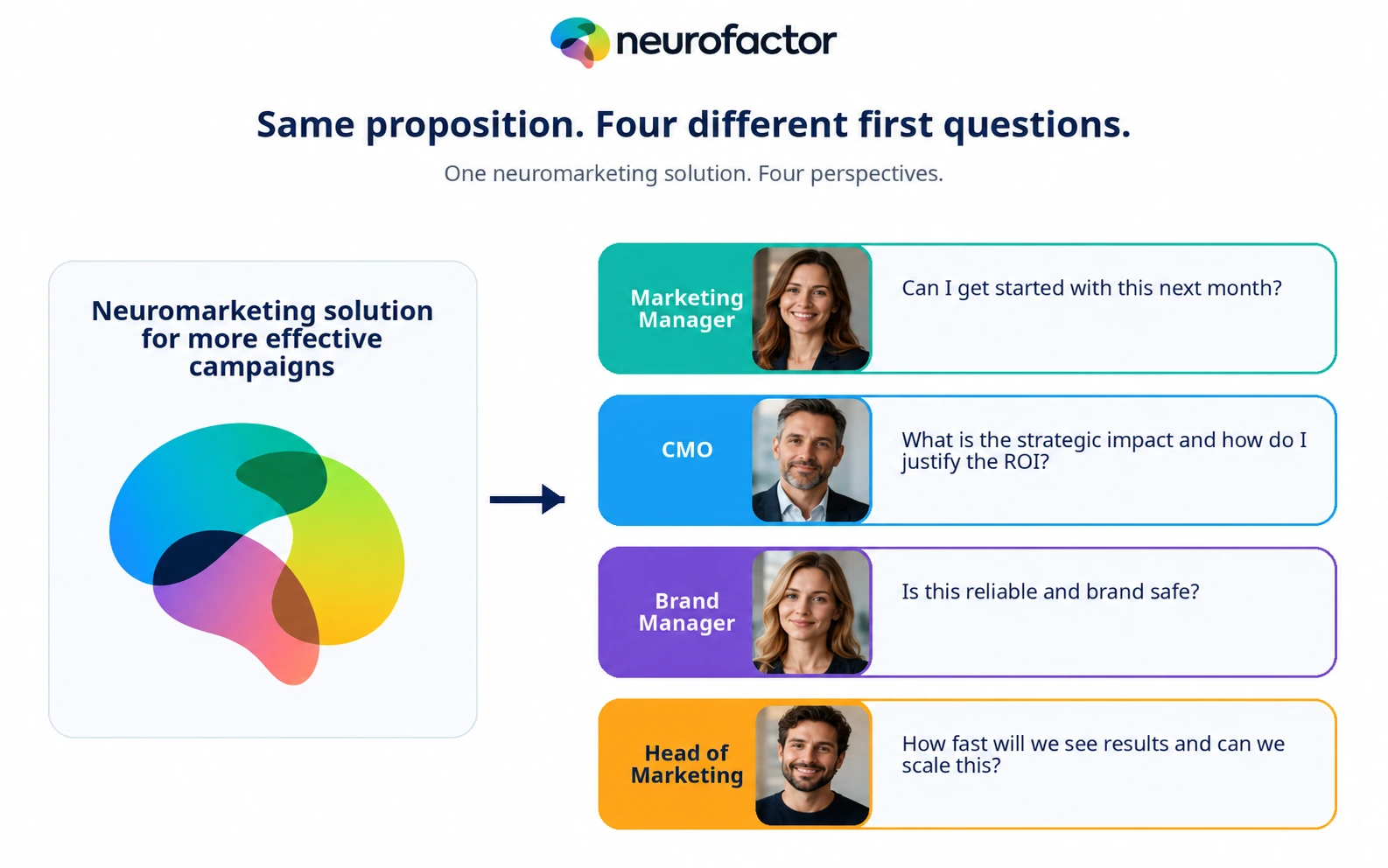
One offer, four first questions
Imagine you sell a new research or marketing platform. The promise is the same for everyone: better marketing decisions based on data.
The marketing manager may think: does this fit alongside everything we already have to do, and will it deliver something quickly?
The CMO may think: can I use this to demonstrate that marketing contributes to growth, and can I defend the investment internally?
The brand manager may think: is the method reliable enough to base brand decisions on?
The head of marketing may think: when will I see this in the funnel, CAC or pipeline, and can I scale it if it works?
The proposition does not change. Its meaning does.
Four marketing roles side by side
The differences become clearer when we look beyond job descriptions to pain, proof, fear and time horizon. The BIS, BAS and k values below are directional profile values Neurofactor uses to make recurring research patterns easier to compare. They describe the audience level and are not individual diagnoses.
| Aspect | marketing manager | CMO | brand manager | head of marketing |
|---|---|---|---|---|
| Dominant mindset | execution under pressure | evidence and position | brand protection and growth | build and prove |
| Main pain | too many tasks and too little clarity on what works | proving marketing's contribution to revenue | dilution and inconsistent execution | pipeline not yet predictable enough |
| Evidence | campaign and lead results, peer references | brand and revenue cases, data, benchmarks, other CMOs | research quality, brand cases, brand-team references | funnel metrics, scale-up cases, transparent dashboard |
| Biggest fear | wasting time and budget on something that fails | losing budget and being treated as a cost centre | damaging the brand through a wrong decision | failing to meet growth expectations |
| BIS / BAS / k | 5 / 6 / 0.30 | 6 / 7 / 0.15 | 7 / 6 / 0.12 | 4 / 8 / 0.35 |
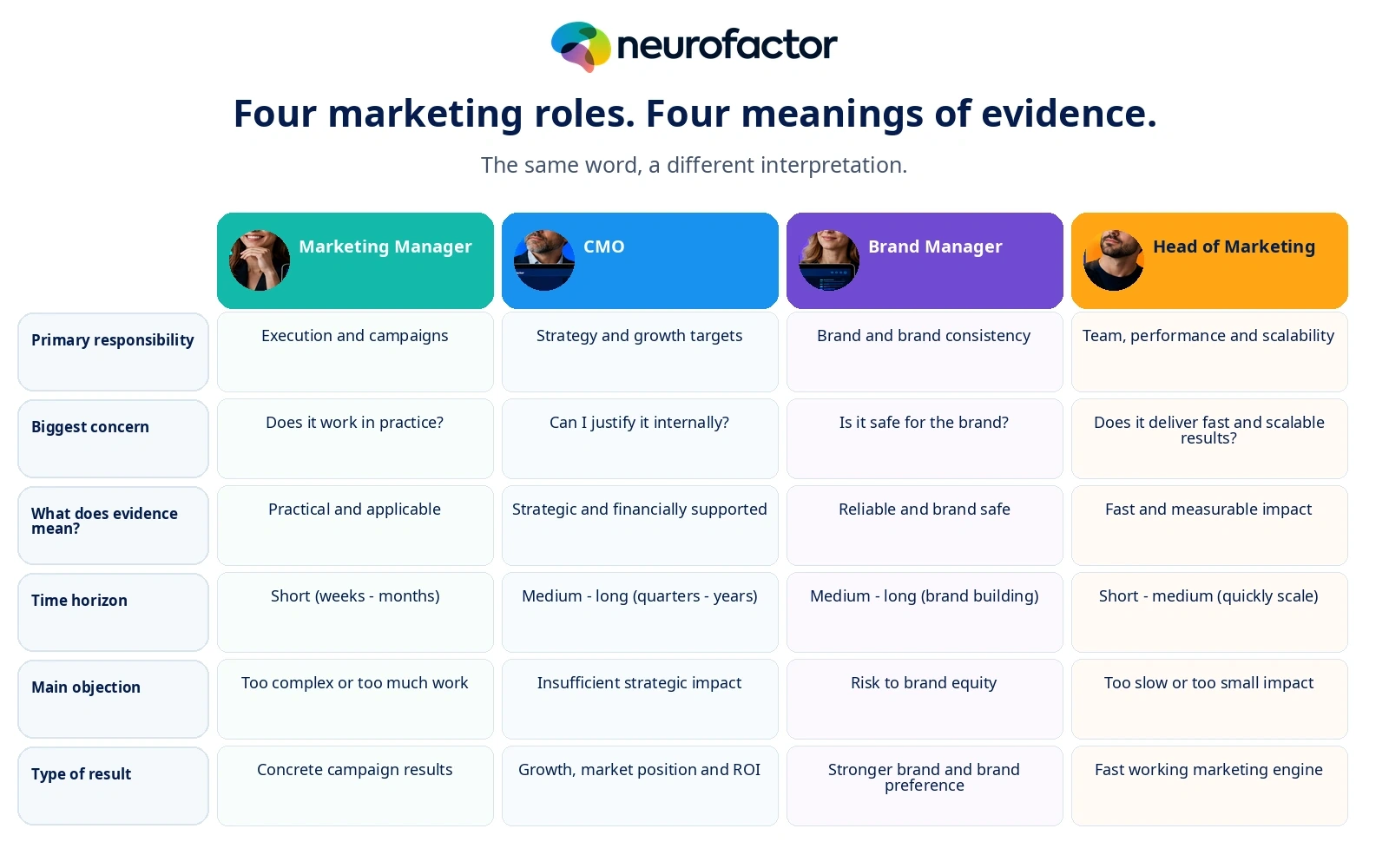
The word proof has four meanings
All four want evidence. They do not want the same thing proven.
For the marketing manager, proof should show that something works in practice. Concrete campaign or lead results, a peer reference and a low-friction entry point reduce the barrier. The evidence should also show that the solution will not become another project that consumes more time.
For the CMO, evidence needs to be usable at leadership level. A nice case is not enough if it does not help defend brand value, commercial contribution or budget. Benchmarks, revenue or brand outcomes and material that can be carried into the boardroom matter more.
For the brand manager, evidence needs to reduce uncertainty around the brand. Method quality, brand relevance and examples where research led to better brand decisions carry more weight. The question is not only whether it works, but whether it is responsible to steer the brand with it.
For the head of marketing, evidence should combine speed with scalability. A funnel result, dashboard or pilot is attractive when it quickly shows what works and answers whether the approach can grow with the business.
So 'show more proof' is not a strategy. The better question is: what evidence does this audience need for this claim?
Risk and time horizon change the order of the story
The sharpest contrast in this category is between the brand manager and the head of marketing. In the aggregated Neurofactor profile, the brand manager scores BIS 7, BAS 6 and k 0.12. The head of marketing scores BIS 4, BAS 8 and k 0.35.
These scores are not diagnoses. They help make a contrast visible. The brand manager looks further ahead and is more focused on avoiding brand damage. The head of marketing is more approach-oriented and wants to learn, test and scale faster.
That means you can start with reliability, brand fit and method quality for the brand manager. With the head of marketing, you can lead earlier with opportunity, pace, experimentation and measurable growth potential.
The CMO sits strategically between those poles: growth-oriented, but with a clear need to make the investment defensible. The marketing manager sits closer to daily execution and primarily wants to avoid extra work without visible effect.
Read more about these directional lenses in interpreting BIS and BAS together.
The same pitch can land four different ways
Take this opening line:
Our approach gives you better insight into what drives customers, so you can make marketing more effective.
For a marketing manager, that can still feel too large and abstract. They want to know what becomes easier tomorrow or which result improves.
For a CMO, the leadership translation is missing: how does this help prove marketing as a growth engine?
For a brand manager, reassurance is missing: how reliable is the insight and how does it protect the brand decision?
For a head of marketing, pace is missing: when will the effect show and how will it be measured in the funnel?
The solution does not need to be four different products. The first meaning you attach to it does.
What should you change in sales and marketing?
You do not need four completely different propositions. Often it is enough to change the order of message, proof and next step.
- marketing manager: start small and practical. Show time savings, concrete results and low implementation effort. A short demo, peer case or pilot works better than a large strategic vision.
- CMO: translate the offer into brand value, commercial contribution and internal defensibility. Provide numbers, benchmarks and a story that also holds up with finance and leadership.
- brand manager: lead with method quality, brand fit and risk reduction. Show how the insight improves consistency and brand decisions, not only campaign performance.
- head of marketing: make it quickly testable. Connect proof to funnel KPIs, scalability and learning loops. Provide a transparent dashboard or clear measurement plan.
What this means for LinkedIn content
Content can follow the same logic. A post on 'five ways to run better campaigns faster' is closer to a marketing manager's execution pressure. An article on 'how to defend marketing budget with better evidence' is closer to the CMO. An analysis of brand consistency and research quality is more relevant to a brand manager. A case with funnel metrics, experiments and fast iteration fits the head of marketing more naturally.
This does not mean every post should target one job title only. It means you deliberately choose which decision problem the content solves.
For the broader translation from target-group information to message and channel, see from target-group profile to communication strategy.
A broad marketing profile is the starting point
The four marketing profiles in this article are based on recurring patterns from research Neurofactor has conducted with this audience over the years. This allows us to describe broad differences between the marketing manager, CMO, brand manager and head of marketing in areas such as evidence needs, perceived risk, objections, time horizon and buying logic.
The profiles are intentionally generalised. What feels like convincing evidence to a CMO also depends on what you sell. Software, research, consultancy or an employer proposition can activate different associations, objections and decision criteria.
For the strongest result, the broad role profile should therefore be connected to your product or service and the specific decision context. A target group profile and association map shows which broad patterns remain relevant and which associations are specific to your offer.
Want to know how marketing roles view your product or service? Contact Neurofactor to tailor the profile to your proposition.
Conclusion: do not sell to marketing, sell to the decision
The marketing manager, CMO, brand manager and head of marketing share a discipline. They do not necessarily see the same risk, accept the same evidence or expect the same pace.
That is why one generic marketing pitch rarely works equally well across all four.
The next article in this series puts two roles directly side by side: CMO versus marketing manager. Both want results. One needs to defend them internally, while the other first needs to know whether the solution is workable tomorrow.
Key terms
- Evidence need
- The type of substantiation an audience needs to find a specific claim credible enough to evaluate or accept.
- BIS
- A directional lens for sensitivity to possible negative outcomes and avoidance. Scores in this blog are directional audience-level profile values based on recurring patterns from Neurofactor research, not individual diagnoses.
- BAS
- A directional lens for approach motivation towards opportunities and reward. Scores in this blog are directional audience-level profile values based on recurring patterns from Neurofactor research, not individual diagnoses.
- Delay-discount-rate k
- A directional indication of how strongly quicker results are weighted against outcomes further in the future.
Frequently asked questions
How do you sell to a marketing manager?
Start practically. Show how the offer saves time, fits the existing workflow and delivers concrete campaign or lead results. Keep the entry point small and implementation simple.
How do you sell to a CMO?
Connect the offer to brand value and commercial contribution, and provide evidence that can be defended internally. Think benchmarks, brand or revenue cases and clear KPIs.
What matters to a brand manager when buying?
In the aggregated Neurofactor profile, reliability, brand fit and avoiding brand damage weigh heavily. Research quality and brand cases are therefore more relevant than fast performance figures alone.
What persuades a head of marketing?
Show quickly and transparently what the offer does to funnel, pipeline or another growth metric. A pilot, dashboard and scalable measurement plan fit this buying logic well.
How should I interpret the BIS, BAS and k values in this blog?
The values are directional profile values Neurofactor uses to summarise recurring research patterns at audience level. They make differences between roles easier to compare, but they are not individual psychological test scores. For a specific product or service, they should be further tailored together with the relevant associations and decision context.
Do you need a separate proposition for every marketing role?
Not necessarily. Often the core proposition stays the same while the order of arguments, type of evidence, first case and next step change.
Sources
- 1.Behavioral inhibition, behavioral activation, and affective responses to impending reward and punishment: The BIS/BAS Scales - Journal of Personality and Social Psychology (1994)
- 2.Heroin addicts have higher discount rates for delayed rewards than non-drug-using controls - Journal of Experimental Psychology: General (1999)
- 3.The Influence of Source Credibility on Communication Effectiveness - Public Opinion Quarterly (1951)
- 4.Personal involvement as a determinant of argument-based persuasion - Journal of Personality and Social Psychology (1981)
This series
Who are you really selling to?Read next
Related topics
Reviewed by: Martijn den Otter · Last reviewed: 10/5/2026
Martijn den Otter
Oprichter van Neurofactor. Expert in neuromarketing en consumentenpsychologie.
LinkedIn →