

Selling to entrepreneurs: when the business and the person are hard to separate
Four people own businesses. You offer all four exactly the same service. A founder wants to shorten the route to growth. An established owner wants a supplier they can rely on. A director-shareholder wants measurable returns without threatening accumulated value. An owner-manager wants the leadership team to work without everything returning to their desk. What differs is not simply purchasing authority, but what the purchase means for the business and the person. The Neurofactor role cards give directional BIS estimates of 3 to 7, BAS estimates of 5 to 9 and k values of 0.10 to 0.45. They are based on recurring patterns from years of Neurofactor research, generalised at role level. They are still useful for choosing which question, evidence and first conversation to test.
Four entrepreneurs can put four different prices on uncertainty
The mistake starts with segmentation. In LinkedIn you select business owners and assume you have found people with purchasing authority, commercial instincts and the ability to move quickly. Yet authority does not tell you which consequence a person is most determined to avoid.
An investment of 50,000 euros may look to a founder like the cost of missing a growth window if they delay. A director-shareholder may see the potential impact on capital, reserves and the business built over many years. An owner might be more concerned about whether the supplier is trustworthy and understands the company. An owner-manager may wonder whether implementing the solution adds yet another task that only they can do.
These are not personality laws. They are possible decision frames within one category. The important question is not simply "Can this entrepreneur approve the budget?" It is "What could this person lose personally by saying yes?"
Four entrepreneur roles compared on the same evidence
These are four role-based profiles using the same 40-field framework. They are not mutually exclusive legal categories. A founder may also be a director-shareholder and owner-manager. Treat each difference as something to investigate, not a personality label.
| Dimension | Founder | Owner | Director-shareholder | Owner-manager |
|---|---|---|---|---|
| Main pain | Not enough time and people for growth | Everything ends up with the owner | Uncertainty about business and asset protection | Management team lacks ownership |
| Biggest fear | Wasting time and money without faster growth | Paying for an unnecessary long-term commitment | Damaging wealth or company value | Another project that falls back on the owner |
| Evidence needed | Startup growth cases and founder references | Local or sector peer references | Financial calculations and relevant track record | Proven reduction in owner dependency |
| Main objection | Too expensive at our stage; we can move faster | What does it cost and why trust you? | What do you add beyond my accountant and advisers? | We tried this before and it did not last |
| Desired outcome | Predictable growth with a capable team | Peace of mind and continuity without the owner | Valuable, well-structured company fit for transfer | Professional organisation with autonomous managers |
| Preferred route | Investor/founder introduction then short video call | Local peer referral and face-to-face visit | Adviser/accountant referral and private discussion | Director referral/network then strategic meeting |
| Preferred delivery | Fast start, short cycles, results in weeks | Practical sector-aware execution | Clear analysis, plan and pricing | Phased programme involving the management team |
| Time perspective | Early visible result | Can wait once trust is established | Years, value and wealth | Milestones through organisational change |
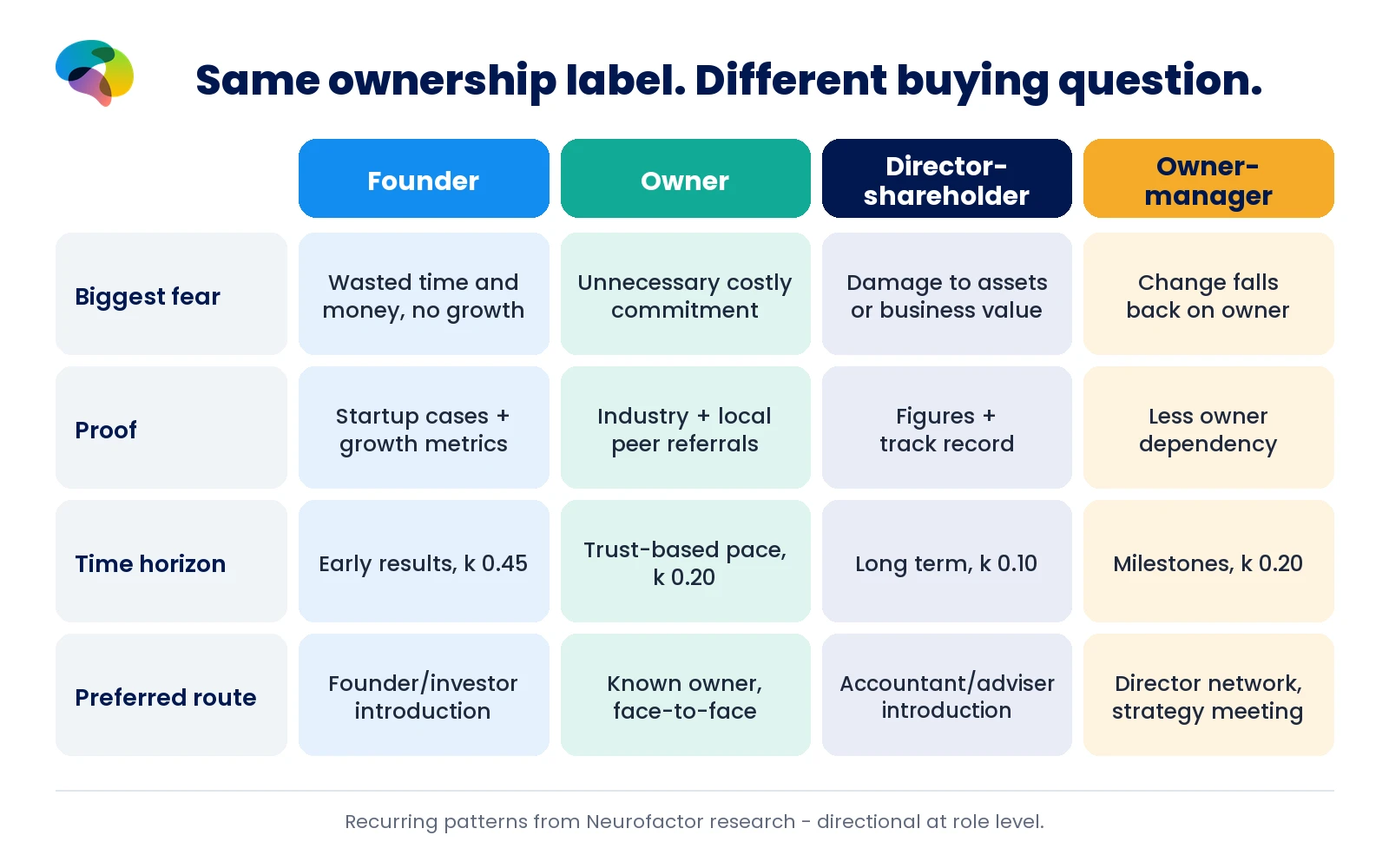
One investment can expose four very different interests
A 50,000-euro proposal is not the same risk to every owner. The founder weighs it against runway and missed momentum. The established owner wonders whether the commitment was needed and whether the supplier will deliver. The director-shareholder examines returns, downside and accumulated capital. The owner-manager worries about another change programme that will need their personal attention to survive.
The cards also describe an emotional dimension. Founders may fear public failure; established owners may feel trapped inside the business; director-shareholders may worry about future financial security; owner-managers may feel alone when a leadership team does not take responsibility.
You do not need four different services. You need to discover which consequence matters, choose proof for that consequence and propose a first step that reduces the relevant uncertainty.
The founder: growth must not burn through runway
The founder card gives BIS 3, BAS 9 and k 0.45. Opportunity and pace matter, but the main fear is wasting money and time on something that does not accelerate growth. Growth has outpaced processes and the team; cashflow is constrained.
Comparable startup cases with hard growth numbers and credible founder references are the stated evidence preference. Add the starting point, period, investment and limits of comparison. The card names three possible objections: too expensive for this stage, we can do it faster ourselves, or it will not fit our culture.
Offer a limited first test with clear learning value. An introduction via an investor or another founder followed by a short video call is the preferred route in the aggregated Neurofactor profile.
The established owner: dependable help is more valuable than hype
The established SME owner has BIS 6, BAS 5 and k 0.20. The main pain is that everything still lands on the owner; the company may stall when they step away. The emotional cost is exhaustion and feeling captive to the business.
The main fear is committing to an expensive service the company did not need. Clear pricing, concrete benefits and references from similar businesses in the same sector or region are central. The objection is simple: what will it cost, what will it achieve and why should I believe you?
A personal meeting, preferably on site or through a trusted business contact, fits the preferred route in the card. Make responsibilities and pricing explicit. Communicate in grounded language, without buzzwords.
The owner-manager: make sure the leadership team really takes over
The owner-manager card assigns BIS 5, BAS 7 and k 0.20. The main pain is that managers do not take enough ownership, pulling the owner back into operations. The desired state is a professional organisation with autonomous leaders.
The card names the objection: "We tried something like this before and it did not stick." Another training day alone does not answer that fear. Evidence must show that responsibilities truly transferred and remained in place after the consultant left.
Offer a phased plan with the management team and explicit milestones. The preferred introduction is through a fellow director or a management network, followed by a strategic conversation.
Every BIS, BAS and k estimate from the source cards
The original workbook provides values for all four roles. BIS and BAS are assigned on the working 0-10 scale; k uses a different, separate range. These numbers were not obtained from representative measurement of employees or entrepreneurs, so they must not be treated as normative scores or individual test results.
| Dimension | Founder | Owner | Director-shareholder | Owner-manager |
|---|---|---|---|---|
| BIS - sensitivity to possible downside | 3 | 6 | 7 | 5 |
| BAS - sensitivity to opportunity | 9 | 5 | 6 | 7 |
| k - relative preference for earlier outcomes | 0.45 | 0.20 | 0.10 | 0.20 |
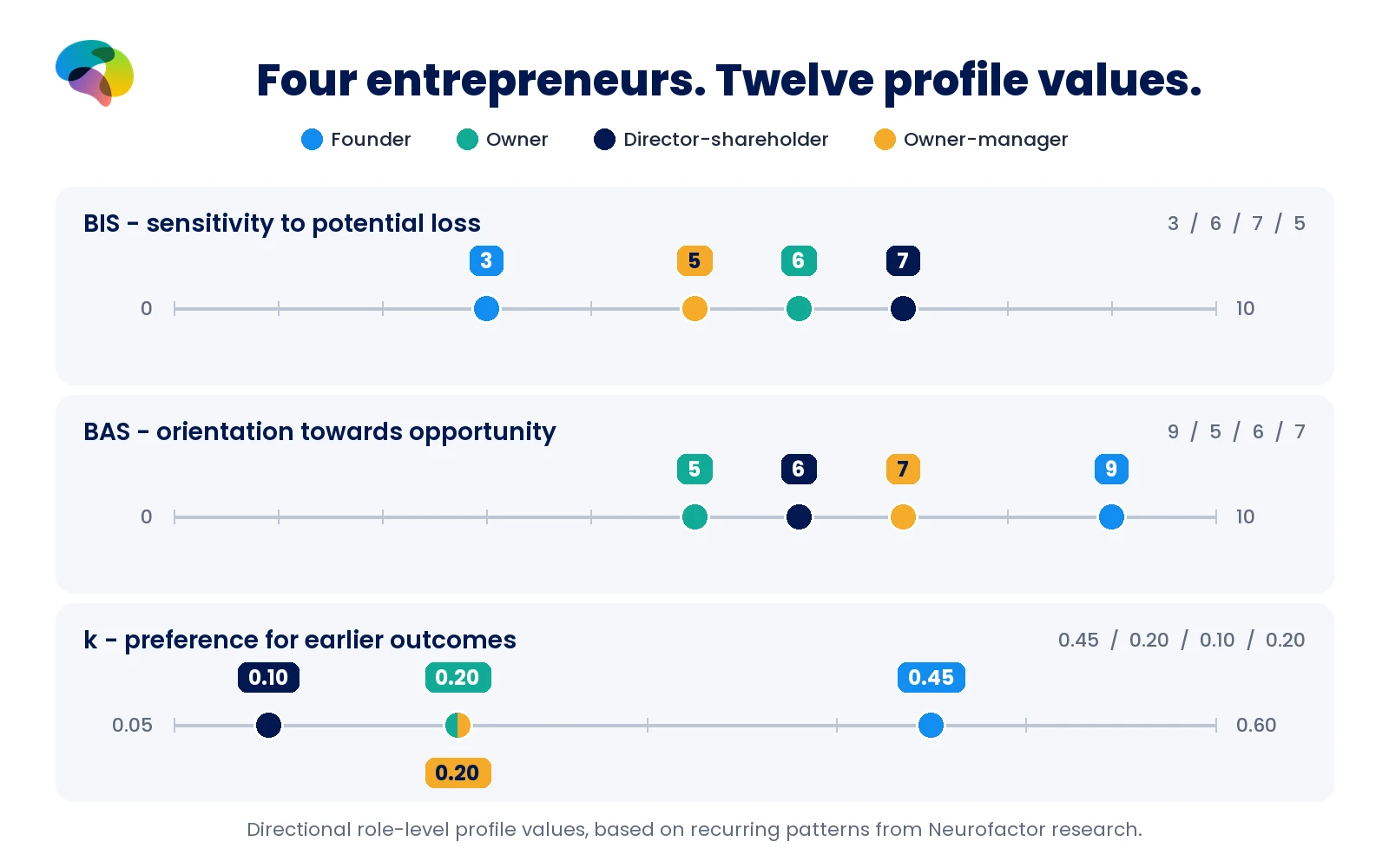
How to use the numbers without overclaiming
In these profiles, the founder has the highest BAS (9) and k (0.45), so an early test of a growth opportunity is a useful starting point. The director-shareholder has the highest BIS (7) and lowest k (0.10), making protection of value and the long-term case worth addressing. The established owner combines BIS 6 and BAS 5, making supplier reliability a logical opening question. The owner-manager combines BIS 5, BAS 7 and k 0.20, suggesting phased organisational progress.
BIS and BAS concern avoidance and approach motivation; they are not mutually exclusive. In experimental delay-discounting research, k refers to the devaluation of delayed outcomes. Here, k is a directional profile value at audience level.
The values come from the aggregated Neurofactor profile: recurring patterns from years of research within this audience, generalised at role level. They are not an individual diagnosis; how they play out depends on your product, service and proposition.
One programme, four reasons to accept or reject it
Imagine a fictional six-month, 50,000-euro programme that improves commercial processes, customer insight and team ownership. The proposition stays unchanged; the first buyer question does not. These are constructed examples based on the role cards, not respondent quotes.
Founder: "Can you show early evidence of faster growth without burning our runway?" Lead with a limited test and a comparable startup case.
Owner: "Who will do the work, what will it cost, and will I have to chase everyone?" Lead with a named contact, clear plan, known costs and a sector reference.
Director-shareholder: "What is the expected return, what are the risks, and how does this complement my existing advisers?" Lead with financial analysis, a track record and defined scope.
Owner-manager: "How will you stop all of this ending up back on my desk?" Lead with team responsibilities, transfer milestones and long-term follow-through.
The service stays the same. The meaning of the first proof point changes with the risk the owner is trying to manage.
Seven ways to adapt your next entrepreneur sales conversation
The role profile is a starting point, not a finished communication strategy. Listen to the buyer before choosing the claim and proof.
- Founder: seek a warm founder/investor introduction and start with a short, measurable growth test.
- Owner: prefer a personal conversation, a relevant peer reference and simple explanations of cost, process and responsibility.
- Director-shareholder: clarify the return, downside, fee and where your expertise adds to the accountant or current advisers.
- Owner-manager: involve managers in the purchase and require evidence of lasting delegated responsibility.
- Ask what failed before: unsupported growth hacks, doing it all personally, advisers without outcome commitments, or change without reinforcement.
- Choose the proof asset after hearing the objection: startup data, local peer case, financial record or reduced-dependency results.
- Set pace to the decision: quick test, trust building, durable returns or phased team change.
Four opening lines for the same service
These are fictional examples informed by the cards, not tested subject lines or literal customer quotes.
Founder: "Which growth decision could you make sooner if the first meaningful signals were available within four weeks?"
Owner: "What would improve if this were handled reliably, at an agreed cost, without you constantly checking progress?"
Director-shareholder: "What return and risk reduction would justify this investment beyond the advisers you already use?"
Owner-manager: "Which decision should your management team be able to make without you when the programme ends?"
Four assumptions that make entrepreneur sales harder
Founders only want speed. The card specifically warns about wasting runway. Offer an appropriately bounded experiment.
Established owners mainly want a lower price. Supplier trust, predictable costs and real relief can matter more than a polished discount.
Director-shareholders only want spreadsheets. The evidence needs to explain additional value over existing professional advisers, not simply repeat their jargon.
Owner-managers want you to take everything over. Long-term dependence is the problem. Show how the team takes responsibility.
What the source cards support - and what still requires research
The profiles in this article come from the aggregated Neurofactor profile: recurring patterns from years of Neurofactor research within business audiences, generalised to founder, owner, director-shareholder and owner-manager. That applies to every objection, preferred contact route and all twelve profile values. They are not individual diagnoses.
How proof, objections and associations work depends on your product, service, proposition and decision context: the promise, supplier, price and risks.
The roles can overlap: founders can be shareholders and operational directors. Sector, ownership structure, business phase, colleagues and decision authority can all change what matters.
Use a product-specific target group profile and association map to investigate the actual offer, and use the available proof to address the real objection. If the person contradicts a directional role profile, the person matters more.
Want to know how entrepreneurs see your product or service? Contact Neurofactor and translate the broad profile into your proposition.
An owner title does not tell you what the owner needs to protect
Entrepreneur is a useful targeting label. It is a poor substitute for understanding a decision.
The source cards describe a founder seeking fast growth without waste, an established owner seeking dependable relief, a director-shareholder seeking measurable value with controlled downside and an owner-manager seeking a business that operates without them. BIS, BAS and k offer a directional lens, not an answer about a particular person.
A persuasive B2B conversation starts by discovering what the owner wants to gain - and what accepting the offer might put at risk.
Key terms
- Founder
- The person who established the business; being a founder does not by itself establish current ownership or authority.
- Owner
- Someone holding an ownership interest in a company; the extent of operational involvement differs.
- Director-shareholder
- A director who also holds a substantial ownership interest; used here as a contextual translation of the Dutch DGA role, not a universal legal category.
- Owner-manager
- A person who combines business ownership with responsibility for everyday management.
- BIS
- Behavioral Inhibition System, associated with sensitivity to signs of possible adverse outcomes.
- BAS
- Behavioral Activation System, associated with sensitivity to potential reward and approach opportunities.
- Delay discounting (k)
- A parameter for how the subjective value of later outcomes declines; used here as an indicative role-profile dimension.
- Proof asset
- A concrete piece of evidence used to reduce a particular uncertainty in a buying decision.
Frequently asked questions
Why should I pitch founders and established owners differently?
The role cards suggest different opening questions: growth with limited runway versus trusted delivery, predictable costs and relief from daily responsibilities. Confirm these assumptions with the buyer.
What are the BIS, BAS and k values for all four entrepreneur profiles?
Founder: BIS 3, BAS 9, k 0.45. Owner: BIS 6, BAS 5, k 0.20. Director-shareholder: BIS 7, BAS 6, k 0.10. Owner-manager: BIS 5, BAS 7, k 0.20. These are directional role-level profile values based on recurring patterns from Neurofactor research.
What proof should I show a founder compared with an established owner?
The founder card prefers startup growth cases and credible founder references. The established-owner card prefers peer references from the same industry or region. How well each works depends on your product and proposition.
What matters when selling to a director-shareholder?
Support the decision with financial reasoning, a track record, controlled downside and clear value beyond the buyer's existing accountants or advisers.
How do I sell a transformation programme to an owner-manager?
Prove how managers will take on genuine decision responsibility and how the change remains in place when external support ends.
What contact routes do the entrepreneur cards suggest?
Founders: investor or founder introductions and short video calls. Established owners: peer referrals and in-person meetings. Director-shareholders: advisers or accountants and substantive private discussions. Owner-managers: management networks and strategic meetings. These routes come from the aggregated Neurofactor profile; which works best depends on your offer.
Sources
- 1.Behavioral Inhibition, Behavioral Activation, and Affective Responses to Impending Reward and Punishment: The BIS/BAS Scales - Journal of Personality and Social Psychology / Carver & White (1994)
- 2.Time Discounting and Time Preference: A Critical Review - Journal of Economic Literature / Frederick, Loewenstein & O'Donoghue (2002)
- 3.Becoming a Founder: How Founder Role Identity Affects Entrepreneurial Transitions and Persistence in Founding - Journal of Business Venturing / Hoang & Gimeno (2010)
Related topics
Reviewed by: Martijn den Otter · Last reviewed: 10/8/2026
Martijn den Otter
Oprichter van Neurofactor. Expert in neuromarketing en consumentenpsychologie.
LinkedIn →