
Why a business case becomes personal in an owner-led company
The business case makes sense. Costs are transparent, expected returns are supported and the path to payback is clear. Yet the owner says, “I am not sure.”
That response need not be a rejection of your numbers. For someone who owns the business, the same investment can also affect personal peace of mind, exposure of accumulated wealth and the ability to stop being the person everyone depends on. Financial value becomes persuasive when the owner can see what the decision means for their security, autonomy and role in the company.
The Neurofactor role profiles distinguish three buying logics: the established SME owner wants dependable relief, the Dutch director-major shareholder (DGA) weighs financial and enterprise value, and the owner-manager wants a business that no longer revolves around them. Giving all three nothing but a strong ROI percentage misses the actual decision.
You are not just selling a return. You are changing what ownership feels like
Imagine offering an organisational improvement programme. The spreadsheet shows a convincing return. One owner asks who will handle the daily decisions during a week away. Another asks how a commitment could affect the value of the holding company. A third wants proof that the managers will still make decisions once your advisers have left.
All three may accept the business benefits. Their personal meaning is different. Profit is not the same thing as peace of mind. Return is not the same as protecting accumulated wealth. Better processes are not the same as the freedom to step away from daily operations.
“Entrepreneur” is therefore too broad a label to determine the first message you should use.
Three owners, three distinct reasons to approve an investment
The table reflects the EIG, DGA and MDE columns in the source workbook’s entrepreneur section. DGA is a Dutch term for a director-major shareholder; owner-manager refers to the managing director who also owns the company.
| Dimension | SME owner (EIG) | Director-major shareholder (DGA) | Owner-manager (MDE) |
|---|---|---|---|
| Main pain | Everything ends up with the owner and stalls in their absence | Uncertainty about protecting and structuring the company and personal wealth | Managers do not take enough ownership, pushing the director back into operations |
| Emotional pain | Exhaustion and feeling trapped in the business | Anxiety over whether accumulated wealth is secure | Isolation at the top and doubt that managers will ever take responsibility |
| Greatest fear | Paying for an expensive commitment the company did not need | A decision that damages wealth or business value | Another programme that leaves everything with the owner again |
| Objection | What does it cost, what do I get and why should I trust you? | I already have an accountant and adviser; what do you add? | We tried this before and it did not stick |
| Proof required | References from known entrepreneurs in the same sector or region | Quantified evidence, a comparable track record and domain expertise | Cases where companies demonstrably became less dependent on their owners |
| Desired outcome | A sound business that runs even during a two-week absence | A valuable, well-structured business ready for transfer or sale | A professional company with a management team that takes responsibility |
| Preferred approach | In-person discussion or referral from a trusted entrepreneur | Referral through an accountant or adviser, followed by a substantive one-to-one discussion | Peer-director recommendation or network, followed by a strategic discussion |
Why one ROI leads to three different questions
Suppose the investment reduces rework or improves margins. For the SME owner, that benefit may finally mean fewer interruptions on a Sunday. For the DGA, it matters in the context of overall enterprise value, asset protection and a future transfer. For the owner-manager, it only becomes real if managers continue to use the new way of working after the programme ends.
These are not arbitrary personality categories. The cards describe different responsibilities, fears, objections and evidence requirements. Before you build your presentation, establish which unwanted consequence this particular owner most wants to avoid.
The SME owner: “I need someone I can trust to get it done”
The established owner’s main problem is that too much still depends on them. Years of solving everything personally may have produced few documented routines and limited delegation. The emotional consequence described in the card is exhaustion and a sense of being trapped inside the company.
The profile values craftsmanship, reliability and straightforward business dealings. Its strongest fear is an unnecessary expensive commitment. A polished forecast cannot, on its own, show that you understand the sector or will do what you promised.
Lead with evidence of dependable delivery: an up-front price, a recognisable reference from the sector, a clear owner of the work and an explanation of what will no longer land on the entrepreneur’s desk. The desired outcome in the source card is concrete: the company should run for two weeks without the owner.
The DGA: return, company value and personal wealth are connected
A Dutch director-major shareholder owns and runs the business. In the role card, this creates a second layer to almost every major investment: how does it affect business value and protection of accumulated wealth? The profile explicitly includes long-term value, structural risk and eventual transfer or sale.
The objection is not “I have never used an adviser.” It is the opposite: “I already have an accountant and an adviser. What do you add?” Vague strategic language does not answer this.
Lead with evidence of incremental value: distinguish your work from existing advisers, show quantified benefits and the risks assumed, provide a comparable track record and use a fixed price or transparent fee structure. This buyer need not choose the cheapest solution; the profile allows a higher price when the return is substantiated. A large upside without a bounded downside is not enough.
The owner-manager: buying independence for the team, not another slide deck
The owner-manager’s main pain in the source card is a management team that does not take sufficient responsibility. Workflows have grown informally, and previous change initiatives may have faded when the adviser departed.
For that reason, a strong final presentation does not complete the business case. The buyer wants to know who will decide what, which manager becomes accountable and what prevents the old routines from returning.
Lead with evidence of lasting implementation: phased milestones, examples of more independent leadership teams, changed decision rights and follow-up after the external team leaves. The personal outcome is freedom to lead strategically without remaining the default problem-solver.
The numbers help explain the decision frame
These are the source-card values for the three broad roles, not individual brain measurements or universal population averages.
| Measure | SME owner (EIG) | DGA | Owner-manager (MDE) |
|---|---|---|---|
| BIS (0-10) | 6 | 7 | 5 |
| BAS (0-10) | 5 | 6 | 7 |
| Delay-discount-rate k | 0.20 | 0.10 | 0.20 |
| Meaning of BIS | Cautious about unnecessary cost and unknown suppliers | Highly attentive to loss and risk | Avoids changes that burden the team without durable results |
| Meaning of BAS | Pursues opportunities that feel concrete and familiar | Pursues opportunities with clear returns | More actively drawn to professionalising the company |
| Meaning of k | Can wait when the outcome feels trustworthy | Takes a comparatively longer-term view of enterprise value | Accepts phased programmes with clear milestones |
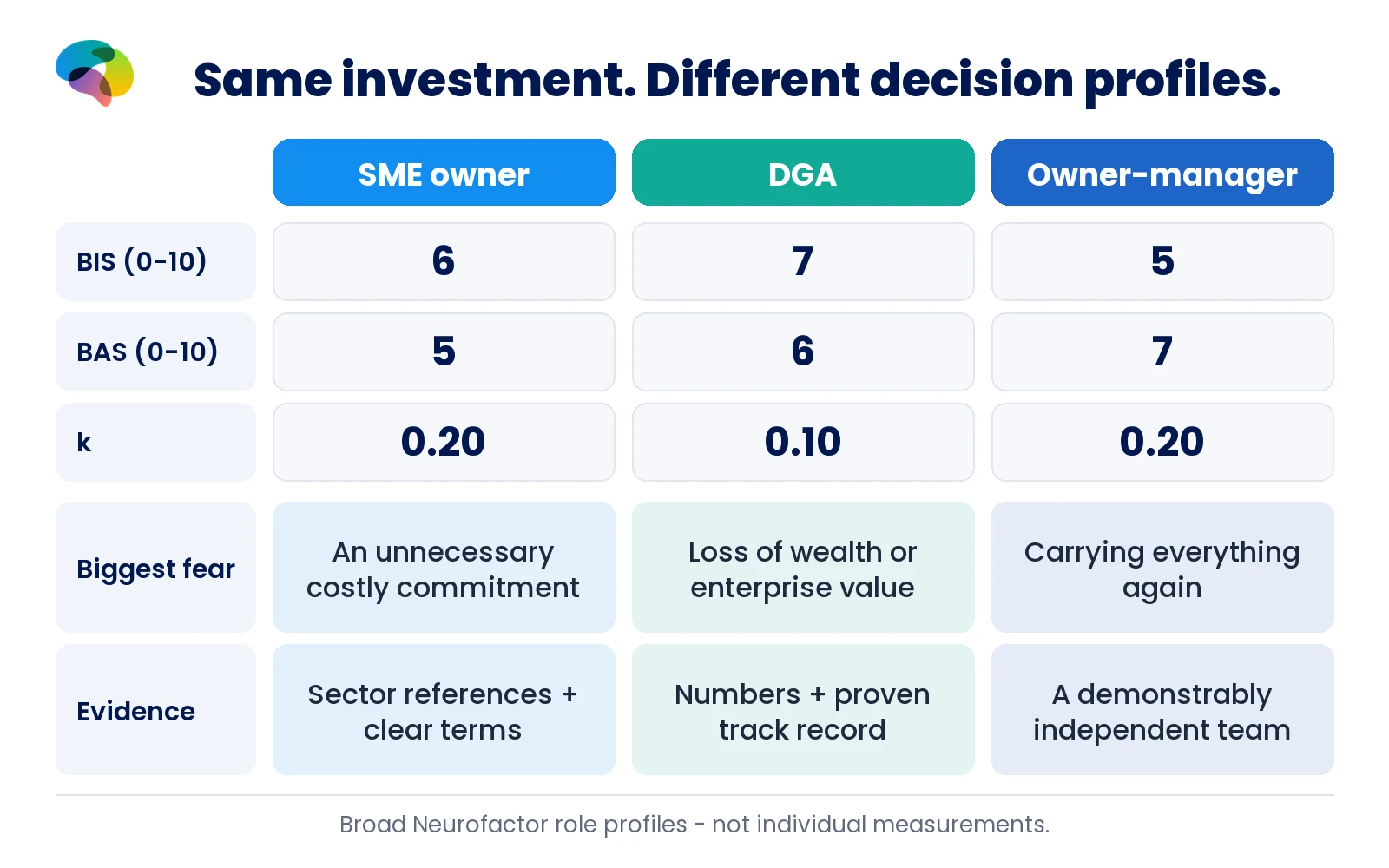
BIS, BAS and k: three measures, not a ready-made personality verdict
BIS represents sensitivity to possible negative outcomes in this profiling framework. The DGA’s BIS 7 is consistent with wanting to contain value-related risk; the owner-manager’s BIS 5 does not mean risk is irrelevant.
BAS concerns the pull of opportunity and reward. The owner-manager scores BAS 7, highest of these roles, which fits the desire for professionalisation. The established owner’s BAS 5 makes concrete, familiar benefits especially relevant.
The delay-discount parameter k concerns how future outcomes are weighted relative to nearer ones. At k 0.10, the DGA profile gives comparatively more weight to long-term outcomes than the two k 0.20 profiles. That does not mean we can predict an individual purchase date.
A useful sales hypothesis comes from combining the numbers with the actual objections, desired outcome and required evidence - not from treating a score as an automatic buying script.
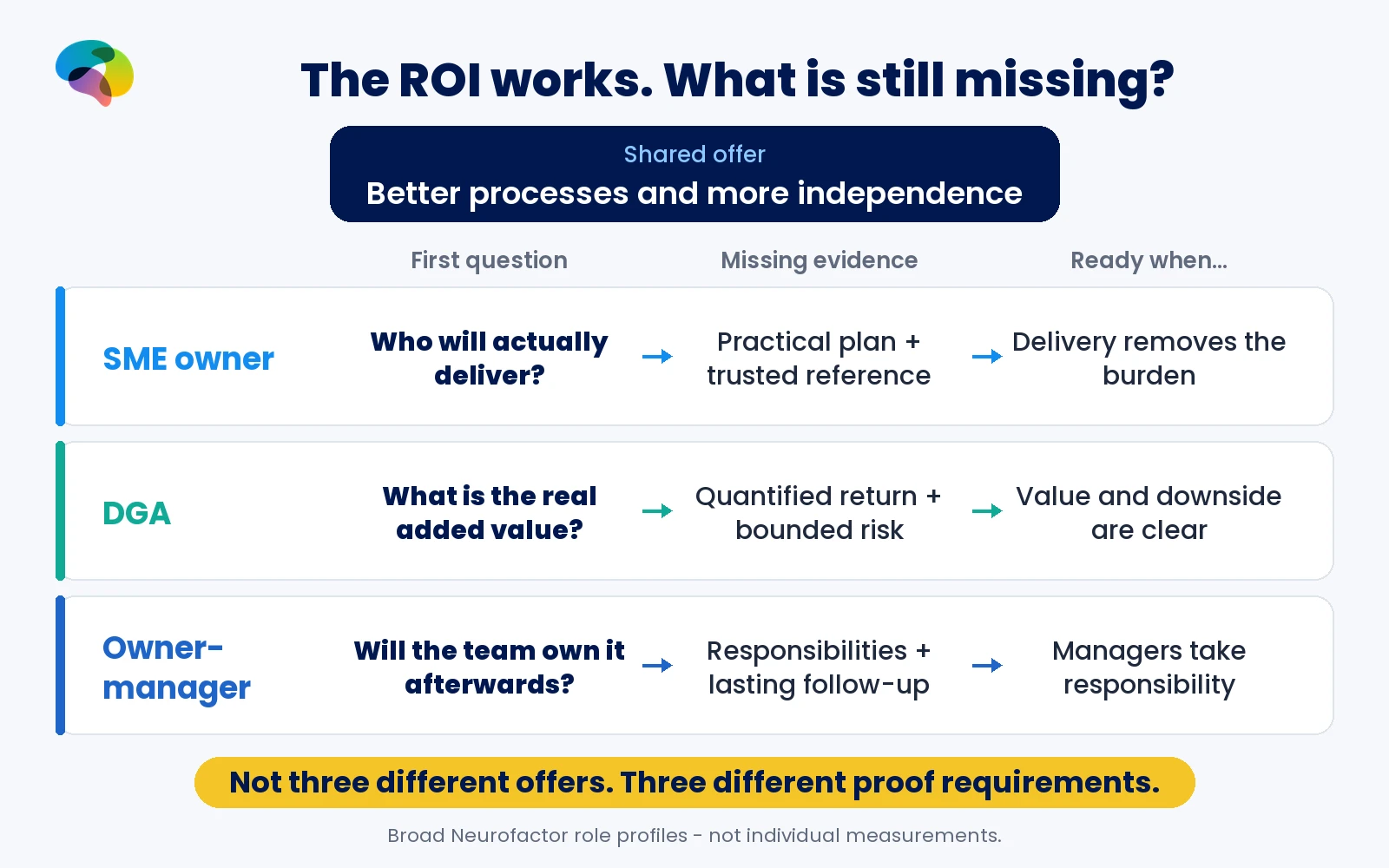
The same proposal: three different missing reasons to sign
Illustrative example, not a real respondent case: you propose a programme to improve responsibilities, processes and management information. The financial model expects less rework and a more efficient use of time. You have not promised a specific return.
SME owner: “How much of my time does this take? Who makes sure it actually gets done?” Show the schedule, a named contact, the fixed scope and a relevant peer reference.
DGA: “How is this different from what our accountant or advisers already do? Which downside is included?” Show your incremental contribution, quantifiable assumptions and risk limits.
Owner-manager: “Who makes sure the management team still owns this six months from now?” Show decision rights, manager accountability and post-project reinforcement.
The ROI is unchanged. The missing evidence is not. That is the point of tailoring a business case without arbitrarily reinventing the product.
Three first messages for the same service
SME owner: “When you are away for a week, which decisions still come back to you? I can show you how a comparable company distributed responsibilities without adding more work for its owner.”
DGA: “You already have advisers. Where might risks or opportunities still fall between their disciplines? I would like to compare the measurable value we add, as well as the assumptions that need checking.”
Owner-manager: “What should your management team be able to decide without you six months from now? I can show how we make roles, decision-making and follow-up stick after external support ends.”
These are illustrative copy examples, derived from the cards. They are not tested winning messages or verbatim respondent quotations.
Seven changes to your business case and follow-up
Do not begin every owner conversation with the same ROI slide. Use the role profile to test which order of evidence is more useful.
- Ask what the owner most wants to stop carrying personally: constant interruption, risk to wealth, or dependence on their own involvement.
- Explain both commercial outcomes and the consequence for peace of mind, security or leadership freedom.
- For the SME owner, lead with real-world implementation, fixed scope and sector-relevant references.
- For the DGA, quantify added value, surface assumptions and show how you complement existing advisers.
- For the owner-manager, name the managers who will own decisions and how you will check that change lasts.
- Label uncertainties instead of disguising assumptions as proven returns.
- Agree the right next interaction: on-site meeting, focused adviser-level discussion, or management-team working session.
Three questions that reveal what the spreadsheet cannot
A generic “What do you think?” usually produces feedback on the presentation. Use questions that test the actual decision context.
- “If the financial case works, what could still stop you?”
- “Who would need to work differently after the decision?”
- “Would a trusted peer reference, a quantified risk analysis or proof of independent management make this decision easier?”
An established broad role profile is the beginning, not the individual decision
These role profiles are grounded in recurring patterns from Neurofactor research conducted over several years with these and comparable target groups. They are therefore useful, evidence-informed broad function profiles. The numbers in this article are taken directly from the existing Neurofactor target-group cards. They are neither individual diagnoses nor measured population averages.
A specific business can differ by sector, size, ownership structure, product, service, price, proposition and decision context. Personal motivations and priorities may shift when the offer changes.
For the most predictive and commercially useful application, connect the function profile to the specific product or service using a target-group card and an association map. Those tools help identify the meanings, fears and evidence requirements that your proposal evokes.
Read the broader entrepreneur profile comparison and the founder versus DGA analysis for additional context.
Want to know how owners and director-shareholders see your product or service? Contact Neurofactor and translate the broad profile into your proposition.
The numbers can be right while the decision remains unresolved
A business case becomes personal when the investment touches what the owner has built, needs to protect or hopes to stop carrying alone. The SME owner wants dependable relief; the DGA wants value without uncontrolled risk; the owner-manager wants a company whose people can act independently.
The strongest case is not a larger spreadsheet. It is one that joins commercial value, a credible delivery path and the personally meaningful outcome. ROI tells the company what it could gain. The right target-group insight explains why its owner might be ready to commit.
Key terms
- Business case
- A structured assessment of expected benefits, costs, risks, alternatives and implementation of an investment.
- BIS
- Behavioural inhibition system: in this profiling model, sensitivity to possible negative outcomes and reasons to slow down.
- BAS
- Behavioural activation system: in this profiling model, sensitivity to opportunities, rewards and reasons to act.
- Delay-discount-rate (k)
- A parameter for how strongly future outcomes are discounted relative to nearer ones. A lower k implies a relatively longer time perspective in this model.
- DGA
- Dutch term for a director-major shareholder who both owns a substantial stake and runs a business; it does not map perfectly onto every foreign legal structure.
- Target-group card and association map
- The card maps likely role-specific needs, fears, barriers and decision context; the association map explores what a specific offer means to the target group.
Frequently asked questions
Why does a good ROI not automatically convince an owner?
Financial return is only one part of the decision. Supplier trust, personal exposure, autonomy and whether the organisation can operate without the owner may matter just as much.
How does an SME owner differ from a DGA?
The established SME owner profile prioritises dependable relief and continuity. The DGA profile pays particular attention to quantified return, protection of wealth and business value, and what a new adviser adds to existing relationships.
What does an owner-manager need from a business case?
Evidence that managers will take lasting responsibility after the external programme ends, including clear roles, milestones and reinforcement, not just a financial forecast.
What BIS, BAS and k values appear in the source profiles?
SME owner: BIS 6, BAS 5, k 0.20. DGA: BIS 7, BAS 6, k 0.10. Owner-manager: BIS 5, BAS 7, k 0.20. These are broad role-profile values, not individual test results.
What evidence is most relevant to the established owner?
The source profile highlights credible references from comparable local or sector peers, predictable pricing and an in-person practical discussion.
How can I tailor this to my own product or service?
Use the broad role profile to form a starting view, then test the concrete associations, objections, fears and proof requirements for your specific offer through a target-group card and association map.
Sources
- 1.Behavioral Inhibition, Behavioral Activation, and Affective Responses to Impending Reward and Punishment: The BIS/BAS Scales - Journal of Personality and Social Psychology / Carver & White (1994)
- 2.Time Discounting and Time Preference: A Critical Review - Journal of Economic Literature / Frederick, Loewenstein & O'Donoghue (2002)
This series
Who are you really selling to?Read next
Related topics
Reviewed by: Martijn den Otter · Last reviewed: 10/8/2026
Martijn den Otter
Oprichter van Neurofactor. Expert in neuromarketing en consumentenpsychologie.
LinkedIn →