
Founder vs DGA: chasing growth or preserving control?
You tell two business owners that your service can help their companies grow faster. The founder asks how soon you can start. The director-shareholder asks for the financial assumptions and why your service is needed alongside existing advisers. Same offer. Different first question.
In Neurofactor's general role cards, the founder is more strongly oriented towards opportunity and speed (BIS 3, BAS 9, k 0.45). The Dutch DGA, a director and major shareholder, is more concerned with downside protection and long-term value (BIS 7, BAS 6, k 0.10). These are values within broad Neurofactor role profiles, informed by recurring patterns from years of research; they do not describe every individual buyer. The sales consequence is practical: show a founder how to gain traction without burning runway; show a DGA how value is created, justified and protected.
Both own the business. They do not start with the same risk
Ownership tells you who feels the consequences. It does not tell you which consequence comes to mind first. In the source cards, the founder operates in a young company where momentum and runway matter. The DGA, a Dutch director-majority-shareholder, evaluates decisions not only as a manager but also as an owner whose accumulated enterprise value can be affected.
Imagine a fictional growth programme. A founder may ask how many months of acceleration it can deliver. A director-shareholder may ask what the return calculations assume, what could go wrong and what current advisers think. Both are rational responses to a decision with different exposure.
The point is not that founders are adventurous and DGAs are fearful. It is that one may experience waiting as the bigger loss, while the other may experience an inadequately supported commitment as the bigger loss.
Founder and DGA: the actual source-card differences
These entries are compact translations of the profile fields in Neurofactor's 1 Ondernemers worksheet. They capture broad, research-informed role patterns rather than the behaviour of every individual buyer.
| Dimension | Founder (FND) | DGA (Dutch director-shareholder) |
|---|---|---|
| Business position | Founder of a young company looking to scale | Owner-director concerned with enterprise and personal wealth |
| Main pain point | Too little time and too few hands for all growth opportunities | Uncertainty about protecting and structuring business and wealth |
| Emotional pain | Fear of failing while everyone is watching | Anxiety about the future security of wealth |
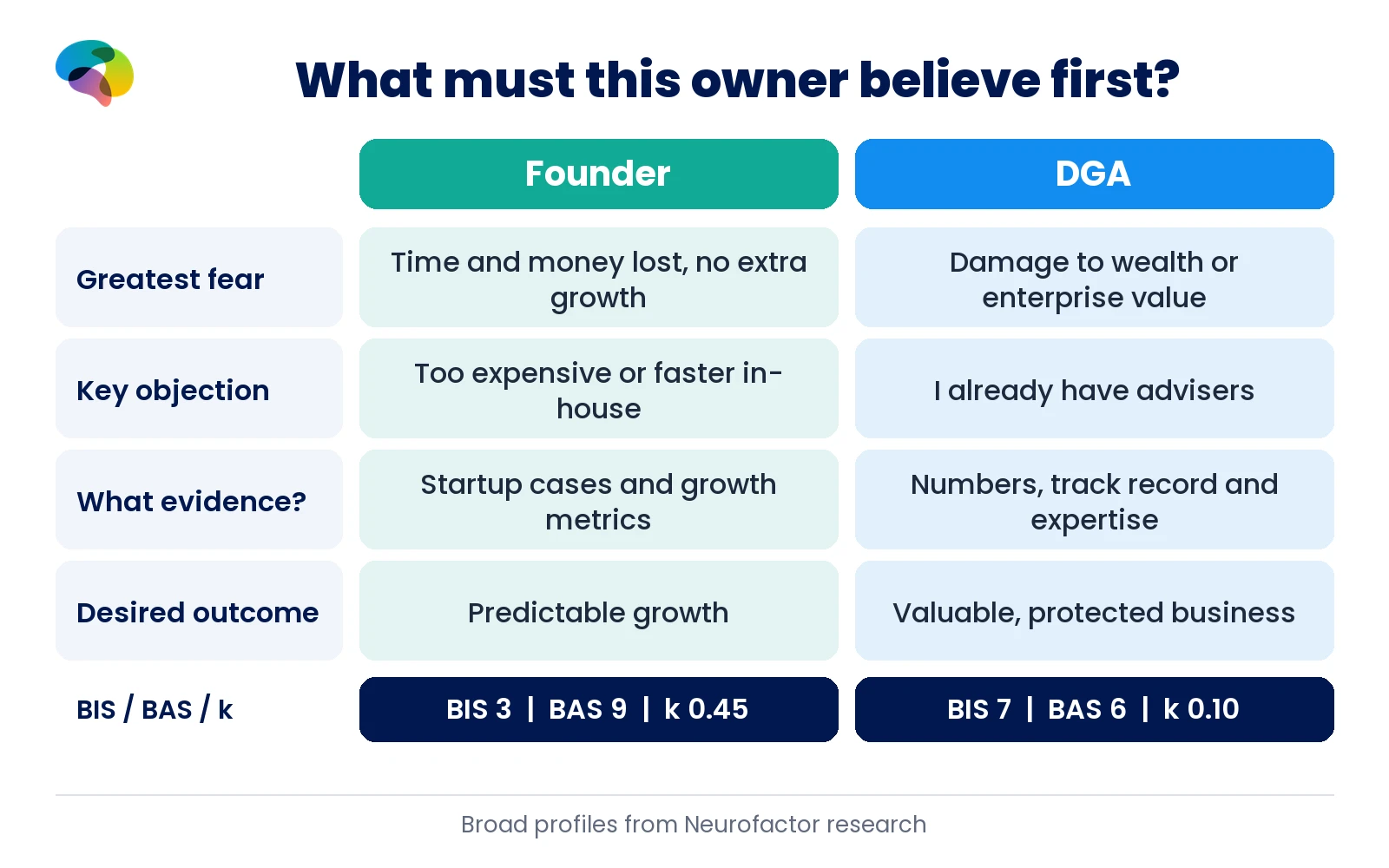
| Greatest fear | Wasting money and time without accelerating growth | A decision that damages wealth or enterprise value |
| Key objections | Too expensive for our stage; we can do it faster; poor cultural fit | I already have an accountant and adviser; what do you add? |
| Desired outcome | Predictable growth with a team that can deliver independently | Valuable, well-structured business ready for transfer or sale |
| Evidence | Comparable startup cases, growth metrics and founder references | Quantitative business case, comparable track record and technical authority |
| Working style | Start fast; short cycles; visible results within weeks | Thorough analysis, clear plan, fixed or transparent fee |
| Preferred contact | Introduction through investor or founder, then brief video call | Trusted accountant or adviser introduction, then a substantial one-to-one meeting |
| BIS | 3 - relatively low avoidance orientation | 7 - stronger loss avoidance |
| BAS | 9 - very strong opportunity approach | 6 - opportunity matters with clear returns |
| k | 0.45 - earlier returns carry more weight | 0.10 - longer time horizon |
The real contrast is the loss each buyer wants to avoid
The founder's source card highlights a lack of time, team capacity and runway. It does not suggest that costs are unimportant. Spending on an initiative that produces no traction may consume the very resources needed for the next growth stage.
The DGA card places business value, wealth structuring, succession and risk in the foreground. A service can be attractive and still fail the decision test if it lacks a credible return, a clear scope or a compelling reason to add another adviser.
In short, the founder may be trying to avoid a missed growth window. The DGA may be trying to avoid eroding accumulated value. Your message should acknowledge the actual concern before promising the upside.
BIS 3 versus 7: what counts as an unacceptable downside?
The cards use BIS as an estimate of avoidance motivation. The founder is rated 3 and described as prepared to take risk when the opportunity appears sufficiently attractive. The DGA is rated 7 and is described as more focused on avoiding losses.
For a founder, ask what a delayed decision costs in lost speed, traction or market access. For a DGA, explain the exposure created by acting: the financial downside, contractual obligations, operational dependencies and review points.
Neither buyer should receive a pitch that ignores risk. Risk evidence simply serves a different opening purpose in each conversation.
BAS 9 versus 6: opportunity is not the same as a persuasive promise
The founder's BAS score is 9, aligned with active opportunity seeking, growth and fast execution in the source profile. The DGA scores 6 and is described as receptive to opportunities that demonstrate a clear return.
A relevant startup case, specific growth result and credible founder reference make an offer tangible for the founder. For the DGA, numbers, a proven record with comparable businesses and subject-matter authority help test whether the additional investment is worthwhile.
Both want evidence. But one will often start by asking whether you can accelerate momentum, while the other will ask what value survives after costs and risks are considered.
k 0.45 versus 0.10: the same payback period means something different
In these cards, delay-discount-rate k is a directional estimate of preference for sooner versus later returns. The founder is assigned 0.45; the DGA 0.10. The values must not be passed off as parameters experimentally fitted to real individual decisions.
Suppose a solution produces its principal benefits after twelve months. The founder may want evidence of earlier traction and near-term impact on runway. The DGA may accept a longer path when its effects on value, risk and succession are well supported.
Do not equate faster preference with recklessness or a long horizon with reluctance. Ask when the next observable result needs to matter.
Which evidence comes first?
The source-card fields on evidence, objections, approach and preferred contact suggest a different sequence, not a different standard of integrity.
| Sales step | Founder | DGA |
|---|---|---|
| Opening | Which growth opportunity is being missed through lack of speed? | Which return, asset or risk needs a defensible decision? |
| First proof | Same-stage startup case with measured growth | Financial assumptions and comparable delivery track record |
| First objection | Too expensive or slower than building it ourselves | How do you complement my current advisers? |
| First commitment | Bounded fast test with clear review | Defined analysis with scope, price and decision point |
| Trusted route | Investor or fellow founder introduction | Accountant, adviser or trusted professional introduction |
| Follow-up | Short video call and actionable milestones | Detailed conversation and a decision-ready financial summary |
One pitch, two interpretations
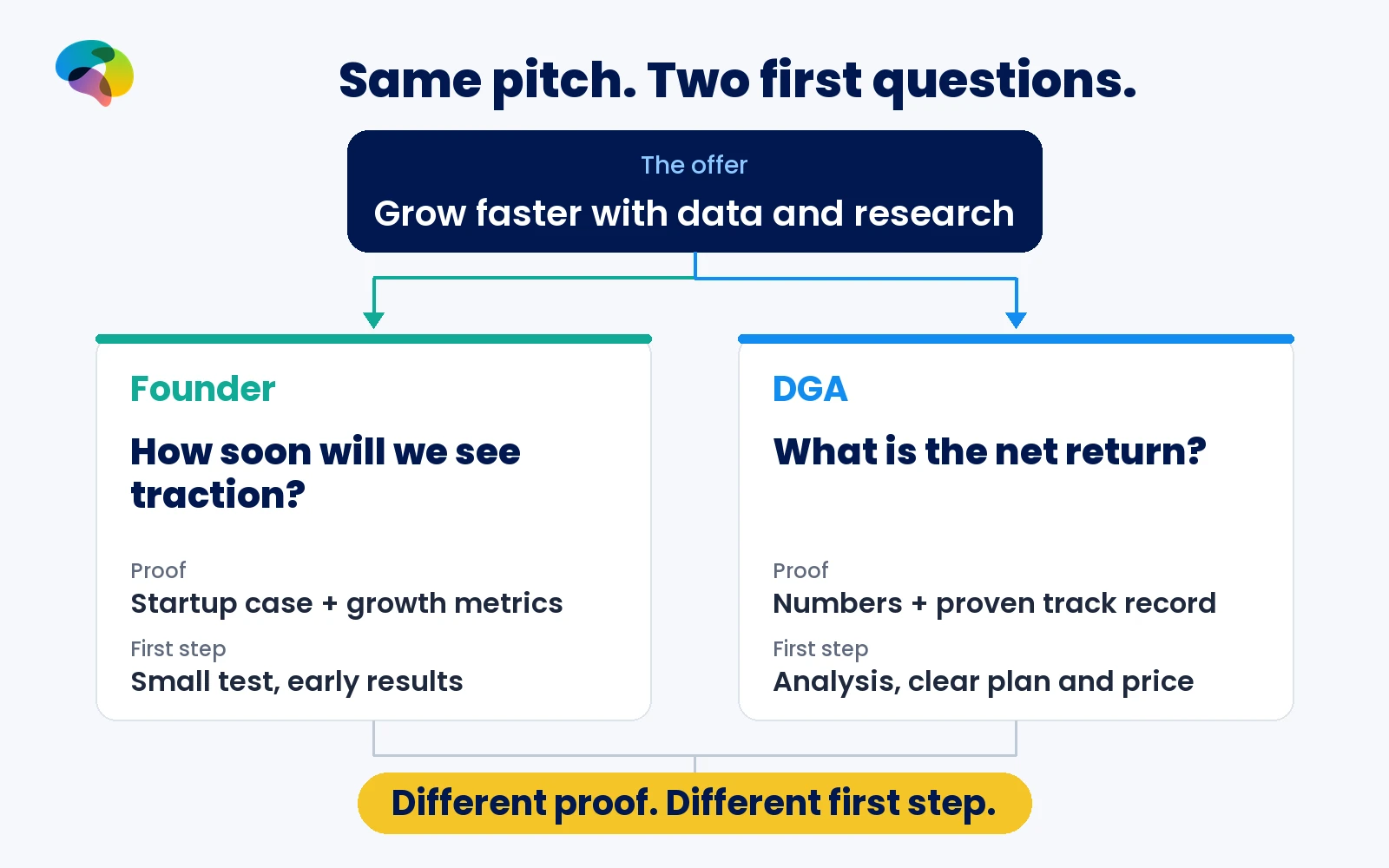
Imagine offering: "We use data, research and an actionable commercial plan to help your business grow faster." Keep the price and service identical.
Founder: "How soon will we know it is working? Can you start without months of preparation? What happened at similar startups?" This reflects the role card's priorities around traction, runway, founder references and short delivery cycles.
DGA: "How did you calculate that? What is the net effect? And why do I need this on top of the advisers I already have?" This reflects the source card's priorities around measurable returns, business value, relevant track record and existing advisers.
These are fictional illustrative reactions, not verbatim respondent quotes. They show how the same proposition can require a different first layer of evidence.
Two different openings for the same service
Founder email: "Your team needs to grow without adding complexity or unnecessary burn. In a short first phase, we can identify which commercial decision could deliver the fastest useful progress. I can share a documented case from a company at a comparable stage, including timing and results."
DGA email: "A growth investment should improve value without creating an uncontrolled risk to the company. We can map the financial assumptions, expected returns, alternatives and how this work complements your existing advisers. That gives you a sound basis for deciding whether the investment is justified."
These are example messages derived from the profiles, not tested or proven winning copy. Only claim a case or a return if you can substantiate it.
Seven practical changes to your next pitch
Change the decision sequence, not just the adjectives.
- Discovery: ask founders about missing traction and the next growth milestone; ask DGAs about enterprise value, financial returns and exposure.
- Proof: start with a relevant startup case for founders; start with quantified results and a comparable track record for DGAs.
- Demonstration: show early milestones and demands on the team to a founder; make assumptions, costs and safeguards visible to a DGA.
- Objections: address runway, time and cultural fit versus incremental value alongside existing advisers.
- First step: propose a bounded rapid experiment versus a scoped analysis with a transparent fee.
- Introduction: use a credible founder or investor route versus a trusted adviser route where possible.
- Follow-up: send action dates and first metrics to a founder; send financial assumptions, options and unresolved risks to a DGA.
When the job title is no longer enough
A founder may now lead a mature business with substantial capital. A DGA may be entering a highly experimental market. Neither situation invalidates the source cards; both show why the broad profile must be refined for the actual company, offer and decision context.
- What is the real liquidity and investment constraint?
- Who else influences the choice: co-founders, shareholders, accountants or advisers?
- Is the immediate driver a growth opportunity, wealth protection or both?
- Which outcome must become visible in the first phase?
- What is the fallback: build, wait, buy elsewhere or do nothing?
- What previous experience has shaped the buyer's trust?
- Which claim needs concrete proof before this buyer advances?
From an established role pattern to your specific buyer
These role profiles draw on recurring patterns identified across years of Neurofactor research involving these and comparable B2B audiences. They are therefore research-informed, broad role profiles. The source workbook's 1 Ondernemers worksheet describes founders and DGAs across forty dimensions, including pain points, fears, objections, evidence needs and BIS, BAS and k. The numbers belong to generalised profiles; they are not individual diagnoses or observations for every founder or DGA.
Generalisations are useful, but never absolute. Sector, company size, growth stage, ownership, product or service, proposition, price and decision context can all alter which motivations and concerns are most relevant. A founder may now run an established firm; a DGA may actively pursue a risky new opportunity. The function title is the beginning of the analysis, not the end of it.
For the greatest predictive and commercial value, refine the broad profile using a target-group card and association analysis for the specific product or service. This identifies the associations, objections, desired outcomes and proof that matter in that choice. Want to know what this founder or DGA profile looks like for your offer? That is where the product-specific analysis begins.
Want to know how founders and director-shareholders see your product or service? Contact Neurofactor and translate the broad profile into your proposition.
The founder is not buying speed for its own sake. The DGA is not buying caution for its own sake
The founder wants growth without spending scarce runway and attention on the wrong initiative. The DGA wants investment to add value without undermining the business and capital already built. These are directional role patterns, not fixed personality types.
The better sales question is therefore not whether your pitch should sound energetic or conservative. It is which uncertainty you should reduce first. For the founder, often speed and traction. For the DGA, often net return, incremental value and controlled downside.
That is how the same offer becomes a clearer choice for two different owners.
Key terms
- Founder
- Someone who starts a business. In these source cards the profile specifically refers to a young company that is building or scaling, where traction, time and runway matter.
- DGA
- Dutch abbreviation for directeur-grootaandeelhouder, a director who is also a substantial shareholder. This source profile combines management with concern for business value and wealth.
- BIS
- Behavioral Inhibition System. In these broad Neurofactor role profiles it describes orientation towards potential negative outcomes, using a 0-10 scale.
- BAS
- Behavioral Activation System. In these broad Neurofactor role profiles it describes responsiveness to opportunity and reward, using a 0-10 scale.
- Delay-discount-rate k
- A coefficient used in these broad role profiles to represent how much earlier outcomes tend to be preferred to later ones. A higher k indicates greater emphasis on near-term outcomes within this model; it is not an individual measurement of every buyer.
- Evidence anchor
- The evidence that directly addresses the most important doubt behind a specific commercial claim.
Frequently asked questions
How does a founder buy differently from a DGA?
The founder profile prioritises quick traction without wasting time and runway. The Dutch director-shareholder profile prioritises measurable financial returns and protecting enterprise value, including value beyond existing advisers. Both are role-level estimates.
Why is a fast-growth pitch not enough for a DGA?
Growth alone does not answer how net returns were calculated, what could go wrong or why a new supplier adds anything beyond the accountant and current advisers. Those concerns are prominent in the DGA source card.
What BIS, BAS and k values are assigned to a founder and DGA?
The founder profile is BIS 3, BAS 9 and k 0.45; the DGA profile is BIS 7, BAS 6 and k 0.10. These are values from broad, research-informed Neurofactor role profiles, not individual measurements.
What evidence matters most to a founder?
The source card highlights growth metrics from comparable startup cases and references from known founders, especially evidence of meaningful progress on a short timeline.
What evidence matters most to a DGA?
The profile highlights financial analysis, a track record with similar companies and professional expertise. A supplier should also explain its incremental value alongside current advisers and make fees transparent.
Can role-based profiles predict an individual entrepreneur's decision?
They describe well-supported patterns across roles, not the exact behaviour of every individual. Refine the broad profile for the actual sector, product, price, proposition and decision context using a target-group card and association analysis.
Sources
- 1.Behavioral Inhibition, Behavioral Activation, and Affective Responses to Impending Reward and Punishment: The BIS/BAS Scales - Journal of Personality and Social Psychology / Carver & White (1994)
- 2.Time Discounting and Time Preference: A Critical Review - Journal of Economic Literature / Frederick, Loewenstein & O'Donoghue (2002)
This series
Who are you really selling to?Read next
Related topics
Reviewed by: Martijn den Otter · Last reviewed: 10/8/2026
Martijn den Otter
Oprichter van Neurofactor. Expert in neuromarketing en consumentenpsychologie.
LinkedIn →