

Selling to executives: why 'the decision-maker' does not exist
You finally get the executive meeting. Three people at the table. One proposal.
The CEO wants to know what it means for strategy and reputation. The managing director wants to know what it does for targets, budget and execution. The board member wants to know whether the decision still stands when colleagues, oversight or compliance challenge it.
All three may have decision power, but they are not buying from the same responsibility.
That is why 'the decision-maker' is often too simple a category in B2B sales. In Neurofactor's broad executive profiles, recurring differences appear in mandate, risk tolerance, evidence need and time horizon. Ignore those differences and you can explain a strong proposition at exactly the wrong level.
Three seats in the same boardroom, three different responsibilities
Executive leadership is often treated as one audience in sales: senior, short on time, focused on results. That is only half true.
The CEO is accountable for direction, performance and reputation of the organisation. The employed managing director carries result responsibility within the mandate, budget and constraints set by owners, a parent company or investors. A board member decides collectively and must not only like a choice personally, but also get it through colleagues, staff and oversight.
The commercial consequence is simple: the same business case can fail in three different places. With the CEO because it feels too operational. With the managing director because it does not fit budget or mandate. With the board member because risk, support or substantiation is insufficient.
One proposal, three first questions
Imagine you sell an organisation-wide solution designed to improve decision-making and deliver measurable results.
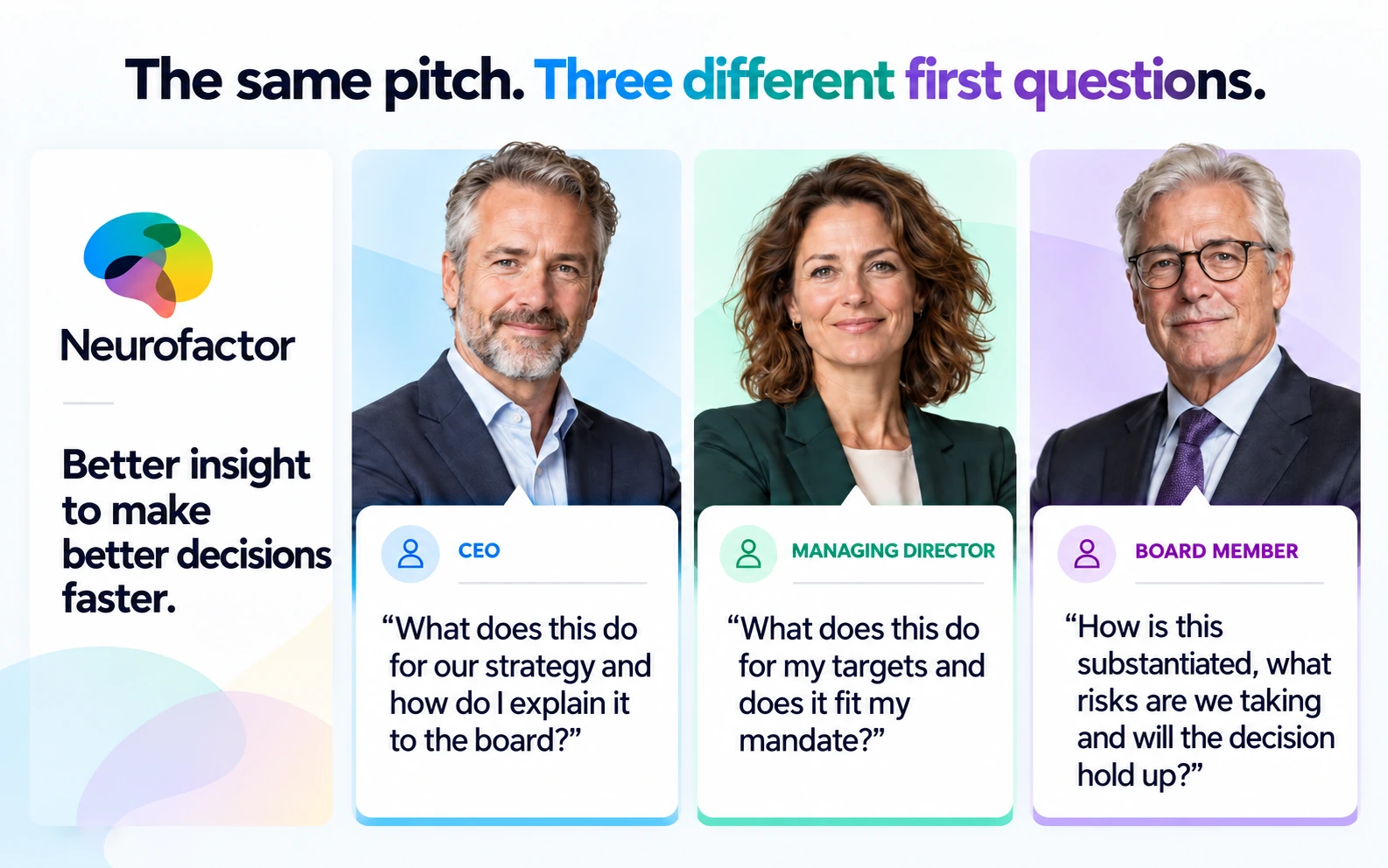
The CEO may first think: what does this do for our strategy, and how do I explain this choice to the board and the organisation?
The managing director may think: does this move my targets, fit the budget and let me act without exceeding my mandate?
The board member may think: how is this substantiated, what risks are we taking and will this decision hold up when colleagues and oversight challenge it?
The proposal is identical. The accountability line behind it is not.
CEO, managing director and board member side by side
This comparison comes from broad executive profiles built from recurring patterns in Neurofactor research among business audiences. The scores are directional profile values at role level. They are not individual diagnostics and should be connected to the real proposition and decision context for a specific product or service.
| Aspect | CEO | managing director (employed) | board member |
|---|---|---|---|
| Dominant responsibility | strategy, performance and reputation | hitting targets within mandate and budget | portfolio, governance and collective support |
| Main pain | too little unfiltered visibility to adjust in time | hard targets with limited room to manoeuvre | slow decision-making and extensive alignment |
| Evidence | recognised organisations, senior counterparts, board-level track record | concrete cases, results in comparable business units, clear business case | independent substantiation, benchmarks, risk analysis, references from other executives |
| Biggest fear | a decision that damages organisational reputation or personal position | missing targets and losing owner confidence | being held personally accountable for a decision that turns out badly |
| Preferred route | introduction via supervisory director, peer CEO or trusted adviser | recommendation from a fellow director or parent-company network | via staff or a fellow board member, then formal board consideration |
| BIS / BAS / k | 6 / 7 / 0.10 | 6 / 7 / 0.25 | 8 / 4 / 0.08 |
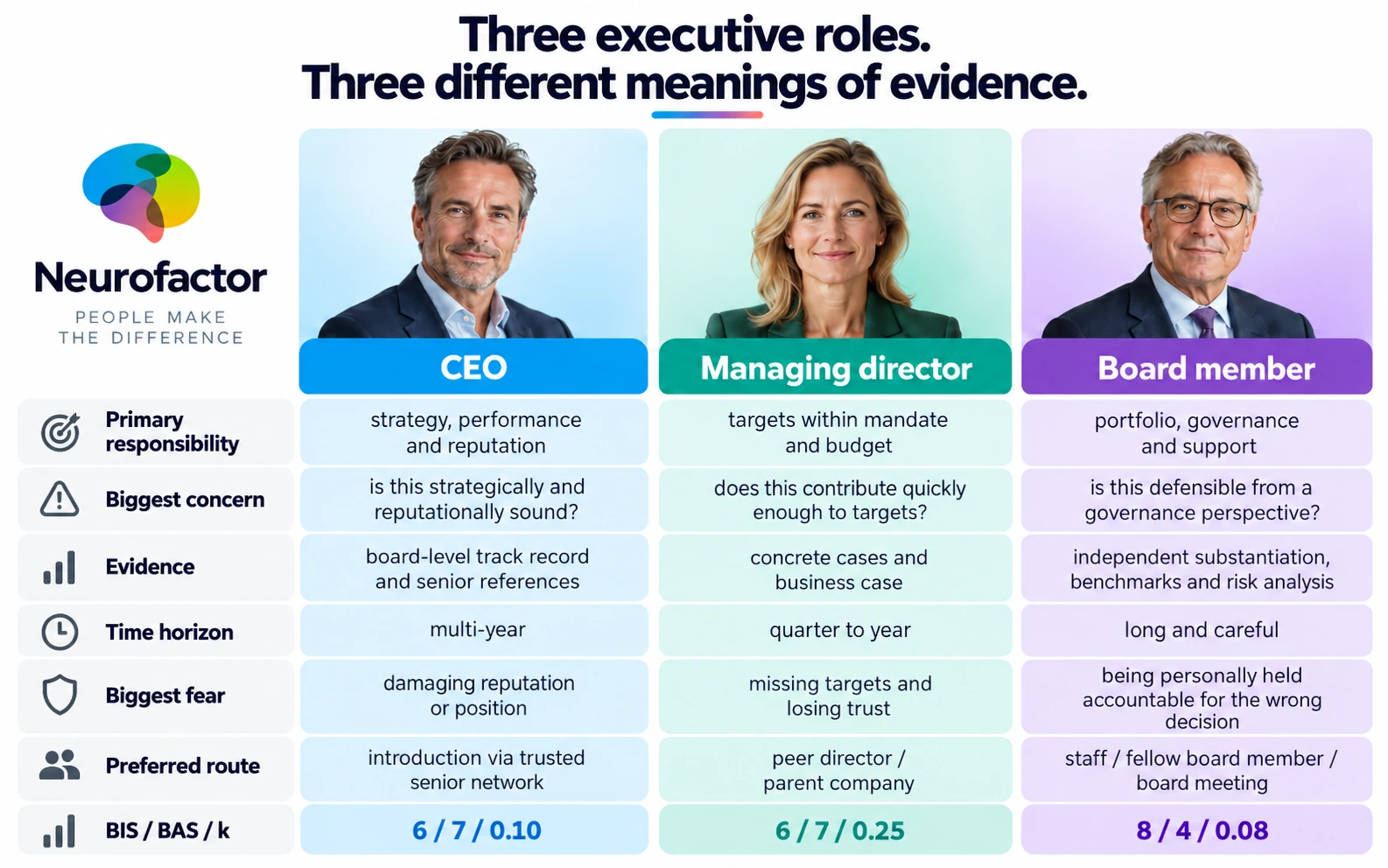
The difference is not seniority, but what happens after the signature
All three are senior. All three may influence a large budget. Their decision risk is still different.
The CEO must connect a choice to the strategic agenda. A solution full of detail but weak on organisation-level impact quickly feels too operational.
The managing director needs more than vision. This role is judged on targets and must show that the investment fits the current budget and the owners' mandate. A strong business case therefore has to be attractive and executable.
With the board member, the centre of gravity shifts again. It is not enough for the solution to be good; the decision must be governable and defensible. Independent substantiation, risk analysis and a route to support become more important.
BIS, BAS and time horizon make the contrast visible
CEO and managing director both sit at BIS 6 and BAS 7 in this profile set. Their time preference differs: the CEO is at k 0.10 and thinks more strongly in multi-year strategy, while the managing director at k 0.25 feels more pressure from quarterly and annual results.
The board member is at BIS 8, BAS 4 and k 0.08. Avoiding governance risk therefore weighs more heavily and the time horizon is longer. Opportunity becomes attractive only when substantiation, support and controllability are sufficient.
This does not mean a board member is 'against change'. It means change must be legitimised differently. Showing only enthusiasm and upside misses a large part of the decision logic.
For the underlying lenses, see interpreting BIS and BAS together and delay discount rate k.
The same pitch can miss at three different levels
Take this opening line:
Our approach gives you better insight, so you can make better decisions faster.
For the CEO, that is too generic. Which strategic decision improves, what changes for the organisation and why does this deserve executive attention?
For the managing director, the link to targets is missing. How fast does it pay off, what does implementation require and does it fit the agreed constraints?
For the board member, governance certainty is missing. What supports the claim, which risks remain and what does the decision route look like?
The solution does not have to change three times. The meaning, evidence and sequence of the story do.
What do you change in your sales approach?
An executive conversation gets stronger when you look beyond the title and focus on the responsibility the person has to defend.
- CEO: start with strategic impact. Show which organisational goal moves closer, which market or reputation effects matter and why this deserves executive attention.
- managing director: translate the proposition into targets, budget, implementation and result within mandate. Give a business case that can also be used with owners or the parent company.
- board member: build the evidence like a decision dossier. Include independent substantiation, benchmarks, risk analysis, alternatives and a clear governance route.
- for all three: keep the opening concise, but make sure the evidence sits directly behind it. Executives do not want a long explanation, but they do need a story that survives critical questions.
- when several executive roles are involved: design the proposal so it can move from strategy to targets to governance without changing the core proposition.
The champion is not automatically the decision-maker
Boardroom sales often becomes dangerous right after someone gets enthusiastic. Sales sees a green light, while the real internal decision process is only beginning.
A CEO may find the idea strategically interesting while the managing director gets stuck on budget or execution. A managing director may see a strong business case while a board member asks about risk, support or oversight. And a board member may be positive yet still not vote for it when the decision dossier is not strong enough.
So the better question is not only who is the decision-maker? It is: which decision logics must the proposal survive, in sequence?
That is also why a target group profile needs more than demographics or job title. The translation into evidence, objection, tone of voice and decision context determines whether a message can travel internally. See from target group profile to communication strategy.
From broad executive profile to your product or service
The patterns in this article come from recurring findings across years of Neurofactor research into business audiences. That allows us to say something broad about how CEOs, managing directors and board members tend to differ in their focus on strategy, targets, risk and evidence.
At the same time, these profiles are deliberately generalised. A CEO evaluating a rebrand can see different risks from a CEO selecting software, consulting or a transformation programme. Sector, ownership structure, company size, urgency and the proposition itself change the context.
For the best result, connect the broad role profile to what your offer specifically evokes. Neurofactor combines a target group profile and association map: who is across the table, and which associations, benefits, objections and risks does your product or service trigger for that person?
Need help sharpening the executive audience for your offer? Contact Neurofactor and translate the broad profile into your proposition and decision context.
Conclusion: do not sell to 'executives' - sell to the responsibility
CEO, managing director and board member may sit in the same meeting, but they do not have to trust the same evidence or carry the same risk.
The CEO wants to know whether the choice is strategically right and defensible. The managing director wants to know whether it moves targets within budget and mandate. The board member wants to know whether the decision is careful enough to survive governance scrutiny.
You do not need three different propositions. You do need three routes into the same decision.
The next deep dive puts two roles directly side by side: CEO versus managing director - setting direction or making the organisation move?
Key terms
- Decision power
- The formal or informal ability to initiate, block, approve or advance a business choice. At executive level this power is often distributed across several roles.
- Mandate
- The scope within which someone may independently decide on budget, direction or execution without additional approval from owners, board or oversight.
- Governance-grade evidence
- Evidence that shows not only that a solution works, but also that risk, alternatives, governance and accountability have been sufficiently addressed.
- BIS/BAS/k
- Directional profile values for avoidance motivation, approach motivation and time preference. They support role-level comparison and are not individual diagnostics.
Frequently asked questions
How do you sell to a CEO?
Start at strategic level. Show which organisational goal moves closer, what the impact is on performance and reputation, and why the choice is defensible towards board, oversight and organisation.
What is the difference between a CEO and a managing director as a buyer?
In this profile, the CEO is more strongly oriented toward multi-year strategy, reputation and ultimate accountability. The employed managing director is closer to targets, budget and results within a defined mandate.
What evidence does a board member expect?
Independent substantiation, benchmarks, risk analysis, board-level references and a clear route to support matter more than upside or an enthusiastic case alone.
Why is one enthusiastic executive sponsor not always enough?
Because several roles may evaluate the decision from a different responsibility. A proposal can be strategically attractive and still fail on budget, execution, risk, support or governance.
Are these executive profiles researched?
Yes. The broad patterns in this series are based on recurring findings from years of Neurofactor research into business audiences. They are deliberately generalised and should be adapted to product, service, sector, proposition and decision context in a concrete assignment.
How do I apply this to my own offer?
Use the role profile as a broad starting point, then investigate which associations, benefits, objections and types of evidence your specific offer evokes. A target group profile and association map combine those two layers.
Sources
- 1.Behavioral inhibition, behavioral activation, and affective responses to impending reward and punishment: The BIS/BAS Scales - Journal of Personality and Social Psychology (1994)
- 2.Time discounting and time preference: A critical review - Journal of Economic Literature (2002)
Related topics
Reviewed by: Martijn den Otter · Last reviewed: 10/6/2026
Martijn den Otter
Oprichter van Neurofactor. Expert in neuromarketing en consumentenpsychologie.
LinkedIn →