

CEO versus managing director: strategy or executable results?
A CEO and a managing director both want results. Giving them the same sales conversation is still a mistake. In the broad executive profiles Neurofactor uses based on years of research, the CEO places more weight on strategy, reputation and ultimate accountability. A managing director in an employed role is relatively more focused on targets, budget, mandate and execution. Interestingly, both profiles have the same BIS and BAS scores in our benchmark. The difference is therefore not simply cautious versus ambitious. Their delay-discount-rate k does differ: 0.10 for the CEO and 0.25 for the managing director. That fits a shorter results horizon for the managing director. The same proposition can therefore require a different first question, different proof and a different pace.
The same executive table does not mean the same decision frame
In this comparison, managing director explicitly means a managing director in an employed role. A managing director who is also an owner operates in a different decision context because personal capital, ownership and wealth exposure can play a much larger role.
For the CEO, a proposal is more likely to become a question of direction: does this fit where the organisation is going, what does it do to our position and can I defend this choice to the board, shareholders or other senior stakeholders? For the managing director, the same proposition more quickly becomes an execution question: does this contribute enough to my targets, does it fit my mandate and can I deliver it with the budget and organisation I have?
CEO and managing director side by side
The contrast becomes clearer when the same attributes are compared directly.
| Aspect | CEO | Managing director |
|---|---|---|
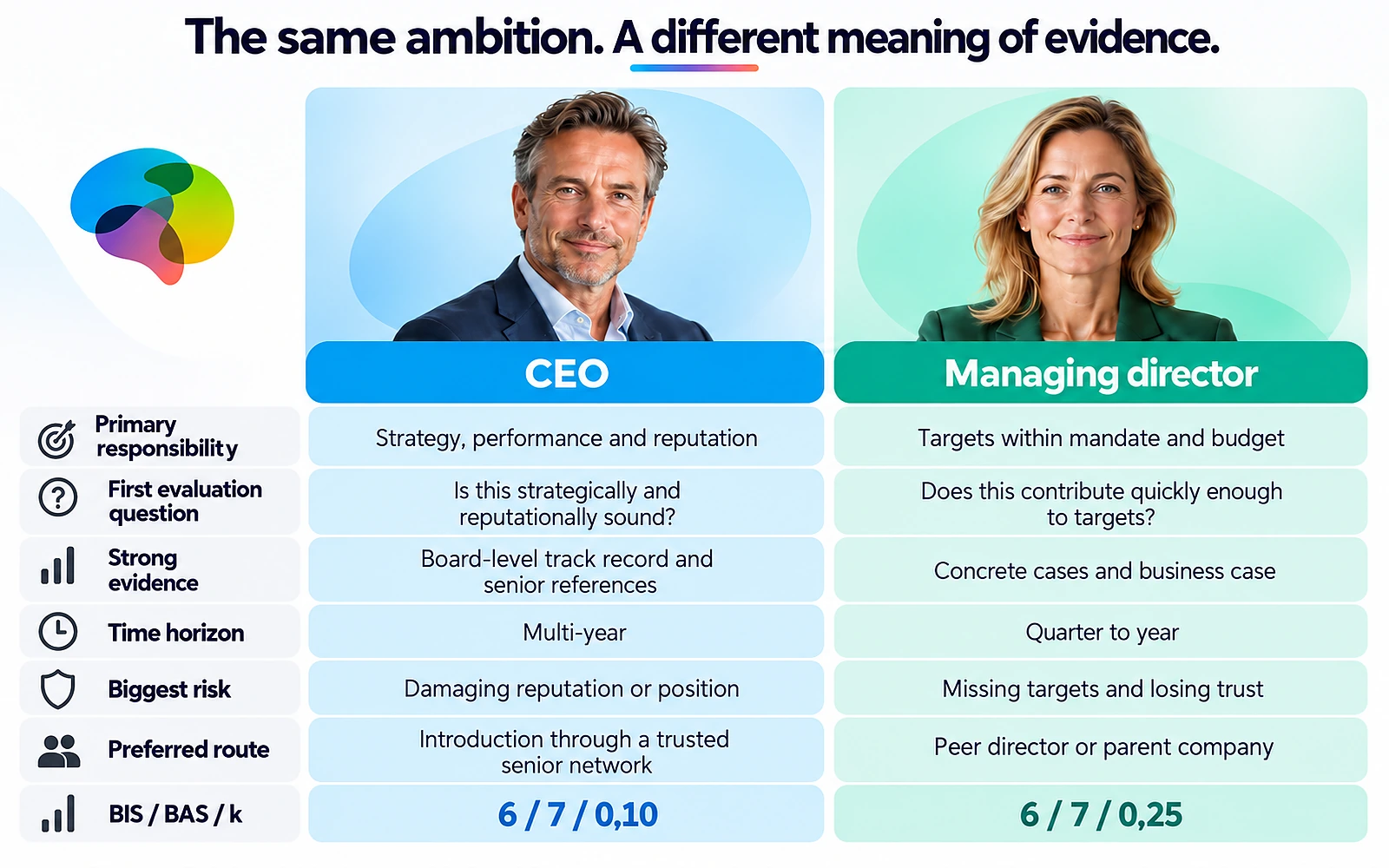
| Primary responsibility | Strategy, performance and reputation | Targets within mandate and budget |
| First evaluation question | Is this strategically and reputationally sound? | Does this contribute quickly enough to targets? |
| Strong evidence | Board-level track record and senior references | Concrete cases and business case |
| Time horizon | Multi-year | Quarter to year |
| Biggest risk | Damaging reputation or position | Missing targets and losing trust |
| Preferred route | Introduction through a trusted senior network | Peer director or parent company |
| BIS / BAS / k | 6 / 7 / 0.10 | 6 / 7 / 0.25 |
The interesting difference is in k, not BIS or BAS
The clearer dividing line is the time value of the outcome. The managing director has the higher k value: 0.25 versus 0.10 for the CEO. Within this profile, outcomes that are closer in time therefore carry relatively more weight. That fits the practical reality of a managing director: quarterly targets, annual budgets, mandate and visible progress are organised closer to the role.
The CEO has a broader horizon. An investment can still be acceptable when the immediate effect is modest, provided the strategic value, position or reputation is convincing over time. The same business case can therefore feel too tactical to a CEO and too abstract to a managing director.
What evidence means to a CEO
For the CEO, evidence becomes more valuable when it supports the strategic claim. Think of a credible track record at a comparable organisational level, senior references, consequences for market position, reputation, growth or organisational direction and a clear account of the risks of acting and not acting.
This also changes the function of a case. For the CEO, a case is not only proof that something works. It must help make the decision defensible at executive level. A good proof asset therefore links one important claim to verifiable evidence instead of stacking as much evidence as possible on one page.
What evidence means to a managing director
A strong case does not only show that a solution worked before. It also shows how quickly the effect became visible, which resources were needed, which dependencies emerged and whether the approach can scale within the existing organisation. The evidence helps the managing director make a choice within mandate.
Concrete does not mean short-sighted. A managing director can support a long-term investment as long as the path towards it is manageable. Milestones, decision points, budget phasing and visible intermediate results reduce the distance between today and the final return.
The same proposition, two different first questions
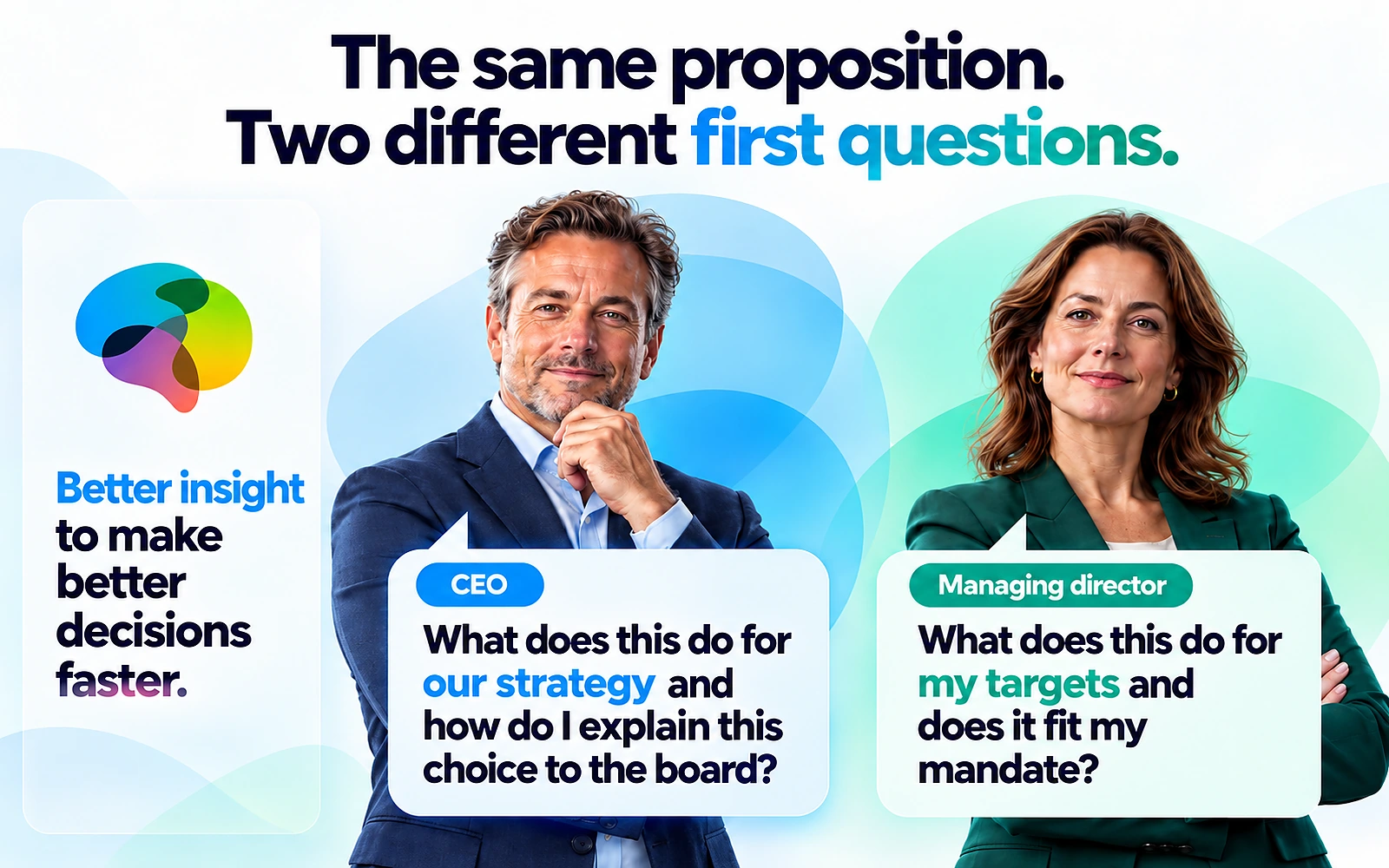
The CEO may first think: 'What does this do for our strategy and how do I explain this choice to the board?'
The managing director may hear the same line and think: 'What does this do for my targets and does it fit my mandate?'
The proposition does not need to change completely. The evidence anchor does. For the CEO, translate the promise into strategic consequence and executive defensibility. For the managing director, translate the same promise into result, timing, budget and execution.
What should change in your first sales email or conversation?
Do not start with the same deck and merely change the job title. Change the order in which you build relevance.
- For the CEO: open with the strategic consequence. Which position, growth, reputation or direction is affected?
- For the CEO: use senior proof early. One board-level reference can be more relevant than ten operational cases.
- For the CEO: include the consequence of not acting, without turning it into fear-based selling.
- For the managing director: open with the result that becomes visible within their responsibility.
- For the managing director: make pace concrete. When does the first effect appear and when can it scale?
- For the managing director: show what is required in budget, capacity, implementation and decision space.
- For both roles: translate evidence into the decision context. Evidence without a clear link to the relevant claim remains information.
When should you not choose between the two?
The managing director can build the concrete business case and create internal traction. The CEO can then decide whether the choice fits strategy, reputation and broader investment priorities. Serving only one of those logics creates a familiar problem: the proposal is operationally attractive but strategically too small, or strategically interesting but insufficiently executable.
A message matrix can help you support the same core proposition differently for each decision role without making the story inconsistent.
What these profiles do and do not say
They remain generalised. A CEO of a listed company, a scale-up CEO and a managing director of a business unit can respond differently because of industry, company size, ownership structure, price level and decision context. The meaning of evidence also changes with what you sell.
For maximum usefulness, connect the broad function profile to your specific product or service. A target group profile and association map shows which general characteristics remain relevant and which associations, objections, evidence needs and language are specific to your proposition. The greatest fear is not a stereotype of a role, but the feared scenario that carries the most weight in a specific choice context.
Conclusion: the same ambition, a different route to yes
That is why the same proposition does not automatically work with the same evidence. When selling to executives, it is not enough to know who is at the table. You need to understand which consequence of the choice becomes relevant first for that role.
Key terms
- BIS
- Behavioral Inhibition System: a measure used in the Neurofactor profile to describe sensitivity to potential negative outcomes and inhibition.
- BAS
- Behavioral Activation System: a measure used in the Neurofactor profile to describe sensitivity to reward, opportunities and approach behaviour.
- Delay-discount-rate (k)
- A measure of how much subjective value an outcome loses as it moves further into the future. A higher k means a stronger preference for earlier results within the profile.
- Evidence anchor
- The explicit link between a relevant claim and a concrete, verifiable piece of evidence.
Frequently asked questions
What is the main difference between selling to a CEO and a managing director?
The CEO evaluates a proposal relatively more through strategy, reputation and ultimate accountability. The employed managing director is relatively more focused on targets, budget, mandate and execution. The same proposition can therefore require different evidence.
Why do the CEO and managing director have the same BIS and BAS scores in this profile?
Because the difference is not simply cautious versus ambitious. In the broad Neurofactor profile, both score BIS 6 and BAS 7. The clearer separation lies in time horizon and context, including the different k value.
What evidence works better for a CEO?
Evidence that supports a strategic claim at executive level: senior references, board-level track record, consequences for position or reputation and a substantiated account of long-term value and risk.
What evidence works better for a managing director?
Concrete cases, a clear business case, timing, feasibility and proof that results can be delivered within budget, capacity and mandate.
Does this apply to every CEO and managing director?
No. These are broad function profiles based on recurring research patterns. Industry, company size, ownership, product, price and the specific decision context can shift the profile, which is why proposition-specific refinement matters.
This series
Who are you really selling to?Category synthesis
Selling to executives: why 'the decision-maker' does not existRead next
Reviewed by: Martijn den Otter · Last reviewed: 10/6/2026
Martijn den Otter
Oprichter van Neurofactor. Expert in neuromarketing en consumentenpsychologie.
LinkedIn →