

CMO vs marketing manager: same result, different proof
A marketing manager and a CMO can look at exactly the same solution and both say: show me that it works first.
But they do not mean the same thing.
The marketing manager is closer to execution. Will it work with the current team? How much extra work will it create? When will we see an effect in campaigns, conversion or lead quality?
The CMO evaluates the same offer in a broader arena. Does it demonstrably contribute to growth? Can the investment be justified to leadership and finance? Is the effect large enough to attach budget, attention and reputation to it?
The difference is not the desire for results. The difference is what counts as convincing proof of those results.
Both want results - but at a different level
On paper, the marketing manager and CMO sit close together. Both care about growth, brand, conversion and commercial impact. In practice, however, they are held accountable at different levels.
The marketing manager is usually closer to campaigns, channels, agency management, team capacity and daily optimisation. Results therefore need to be visible quickly enough and practical enough to implement.
The CMO carries broader responsibility. Marketing must not only run, but visibly contribute to the direction of the business. The question shifts from does this work? to is this important enough, proven enough and defensible enough for the organisation to invest in?
That looks like a small wording difference. For your sales story, it is fundamental.
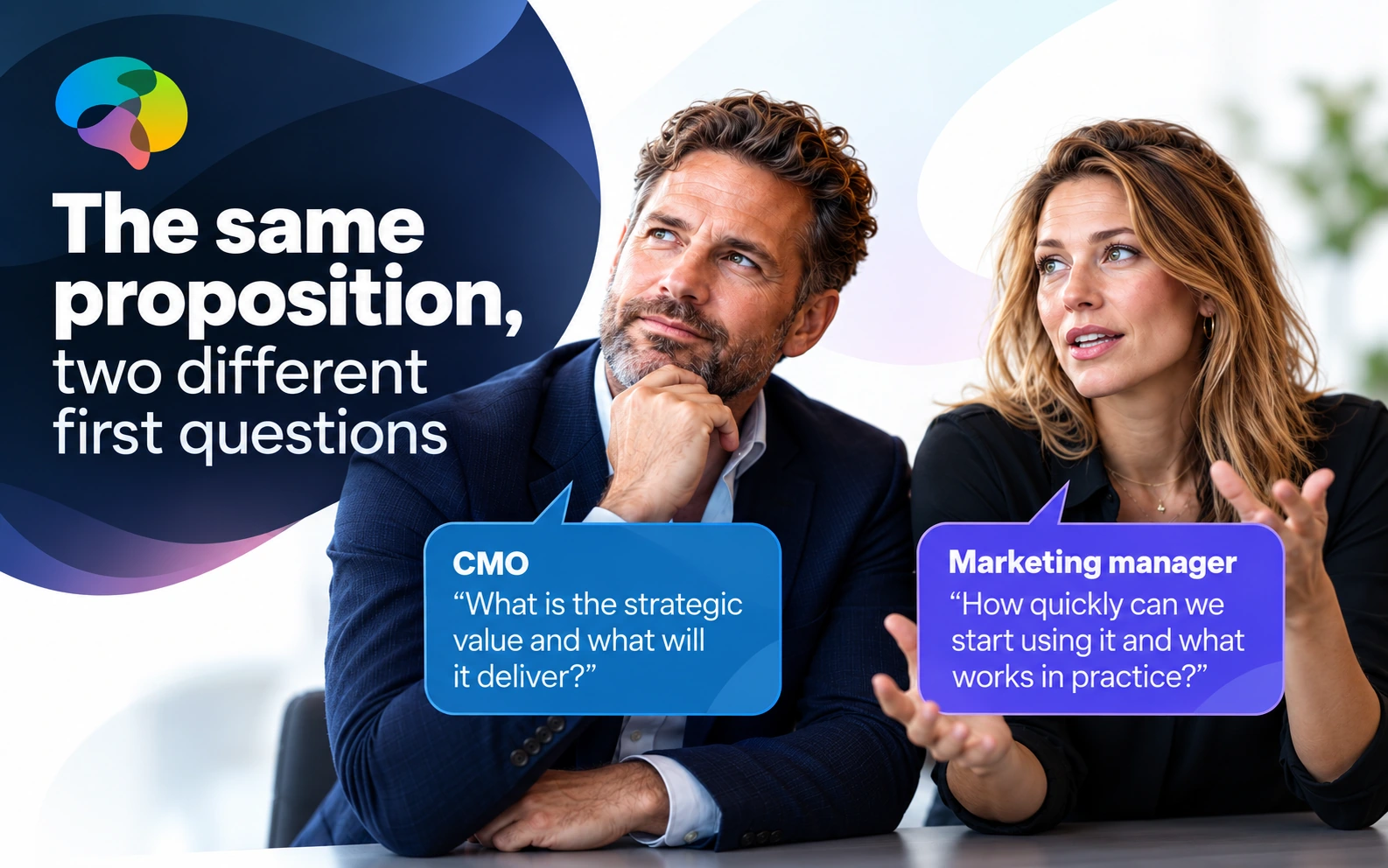
The same proposition, two first questions
Imagine you offer a research or marketing solution with this promise:
We help you understand what drives customers, so your marketing decisions become demonstrably more effective.
The marketing manager may first think: how quickly can we use this and what will it concretely improve in our campaigns?
The CMO may first think: what is the strategic impact and how do I justify the investment to leadership and finance?
The words are almost the same. The mental calculation behind them is not.
Marketing manager and CMO side by side
The contrast becomes clearer when responsibility, risk and evidence are placed side by side. This comparison reflects recurring patterns in Neurofactor research into these roles and is intentionally broad.
| Aspect | marketing manager | CMO |
|---|---|---|
| Primary responsibility | execution, campaigns and concrete marketing performance | strategy, growth and marketing's position in the organisation |
| First question | does this work in our day-to-day reality? | is this strategically relevant and defensible internally? |
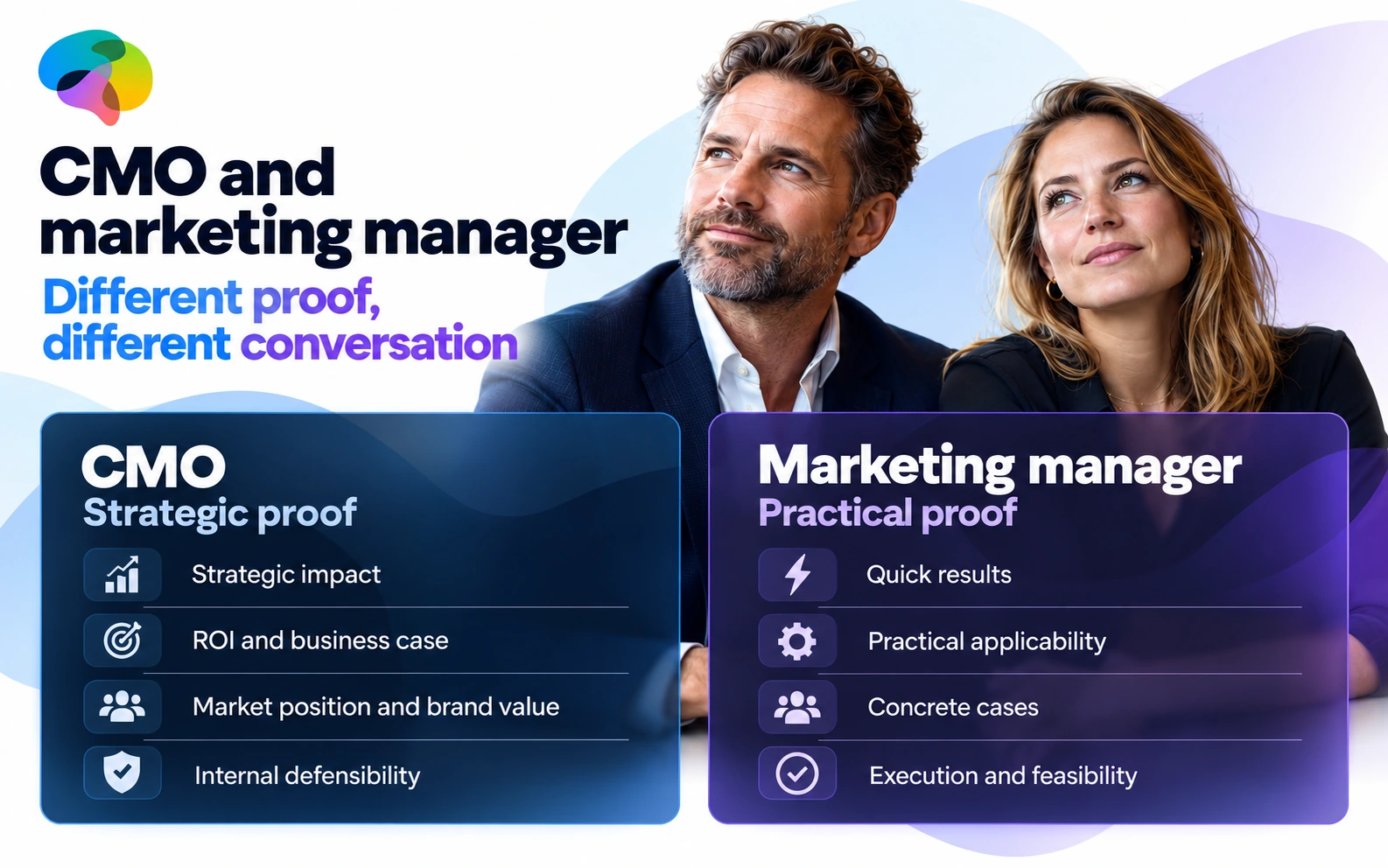
| Evidence need | concrete results, practical case, pilot, time savings and usability | business case, ROI, benchmark, market impact and broader commercial support |
| Biggest risk | extra work, wasted budget and a solution that does not land with the team | wrong investment, insufficient impact and loss of internal trust or budget |
| Time horizon | more often weeks to months | more often quarters to years |
| Desired result | measurable improvement in campaign, conversion or workflow | sustainable growth, market position, brand value and financial contribution |
The same word evidence, two different requirements
For the marketing manager, evidence first needs to be usable evidence. A case becomes stronger when it shows what actually changed, how much implementation effort was required and what happened to a recognisable marketing KPI. A pilot, dashboard or clear before-and-after can therefore be persuasive.
For the CMO, evidence also needs to survive at leadership level. A campaign uplift may be interesting, but the next question quickly becomes: what does this mean for revenue, margin, brand position or structural growth? And how confident are we in that conclusion?
This does not mean that CMOs ignore detail or that marketing managers do not think strategically. It means their decision has to be defended in a different context.
That is why evidence in a target group profile is never just a list of cases. The real question is what evidence this buyer needs to accept this particular claim with enough confidence.
The marketing manager also buys on implementation risk
A solution can be excellent in theory and still lose because it appears to create too much extra work.
Neurofactor's research into marketing audiences repeatedly shows this tension. Marketing managers often operate under simultaneous pressure from campaigns, internal requests, agencies, tooling and quarterly targets. A new initiative therefore competes not only with other suppliers, but with time.
That is why words such as practical, usable, quickly translated into action and clear next step become more persuasive when you can actually prove them.
A strong marketing manager case answers four questions: what did the team have to do, how quickly was the first useful insight available, which marketing decision changed and which result or uncertainty improved?
The CMO also buys on internal legitimacy
For the CMO, evidence gets an extra layer: the decision often has to travel beyond the marketing team.
A CMO can be enthusiastic and still not buy if the investment is difficult to explain to the CEO, CFO, sales leadership or the board. Internal legitimacy therefore becomes part of the value proposition.
A strong CMO case does not only show what improved in marketing. It shows how that outcome connects to a wider business goal, such as growth, revenue potential, market position, budget efficiency or reduced uncertainty in an important strategic decision.
The CMO is not only buying a marketing solution. The CMO is also buying a story that makes the investment legitimate internally.
The same case can feel too small for the CMO
Suppose your case says:
After four weeks, conversion on a landing page increased by 18%.
For a marketing manager, that may be exactly the proof needed: concrete, fast and recognisable.
A CMO may still ask: good, but is this a local optimisation or does it structurally change our growth?
The case does not need to disappear. It needs to be translated one level higher. What hypothesis was validated? Can the principle scale across propositions or markets? What does the improvement mean for the wider funnel? Which financial or strategic risk decreases?
You use the same evidence, but make its consequence larger.
How to change the same pitch by role
You do not need two completely different propositions. The main difference is the order.
- For the marketing manager: start with the concrete problem, show how quickly the approach can be used and prove what improves in practice. Make implementation effort small and visible.
- For the CMO: start with the business consequence of the problem. Translate the solution into growth, position, ROI or risk reduction and show how the conclusion can be defended internally.
- For the marketing manager: close with a concrete next step such as a pilot, analysis or short working session.
- For the CMO: close with a decision-ready frame: investment, expected business impact, level of evidence, risk and what becomes scalable afterwards.
Who should you approach first?
That depends on the nature of your solution.
If the solution is relatively small, immediately usable and can be tested within existing marketing budget, the marketing manager can be a logical entry point. They can validate the practical value and build internal evidence.
If the solution affects multiple departments, a significant budget, brand strategy or a fundamental change in direction, involve the CMO early. Otherwise you may build an excellent operational case that later fails on strategic relevance.
In complex B2B sales, both roles are often needed. The marketing manager becomes the operational validator and the CMO the strategic sponsor. The core promise stays the same, but the proof routes differ.
From broad role profile to your product or service
The patterns in this article are not based on one isolated exercise. They come from recurring findings across years of Neurofactor research into these audiences.
That allows us to describe broad differences between marketing managers and CMOs. At the same time, these remain generalised role profiles. The buying logic changes when the specific proposition, price, category, brand position, decision context and alternatives are added.
A CMO buying software may need different evidence from a CMO selecting a rebrand, research programme or agency. The same applies to the marketing manager.
For the best result, translate the broad profile to your specific offer. Neurofactor combines a target group profile and association map: who is the buyer, and which associations does your product, service or proposition trigger for that buyer?
Need help sharpening these two roles for your offer? Contact Neurofactor to translate the broad profile into your own proposition and decision context.
Conclusion: practical proof is not the same as strategic proof
Marketing managers and CMOs both want results. But the marketing manager mainly needs to see that a solution works in everyday marketing practice. The CMO needs to show that the same solution matters enough to the organisation.
That is why one case can be convincing for the marketing manager and still insufficient for the CMO.
The goal is not to collect more evidence. It is to tell the evidence at the right level.
In the next Marketing article, we compare brand manager and head of marketing. The tension shifts from practical versus strategic proof to a different contrast: brand safety versus speed and scale.
Key terms
- Practical evidence
- Evidence that shows a solution is feasible in day-to-day work and produces a recognisable, concrete effect.
- Strategic evidence
- Evidence that connects an investment to broader business goals such as growth, market position, ROI, brand value or risk reduction.
- Internal legitimacy
- The extent to which a decision is logical, defensible and sufficiently supported for other stakeholders as well.
Frequently asked questions
What is the main difference between a CMO and marketing manager as a buyer?
Marketing managers typically evaluate a solution closer to execution, team impact and concrete marketing results. CMOs evaluate the same investment more strongly on strategic contribution, ROI, market position and internal justification.
What evidence works best for a marketing manager?
Concrete cases, a practical pilot, clear implementation steps and measurable impact on recognisable marketing KPIs are often stronger than an abstract strategic story.
What evidence works best for a CMO?
A CMO more often needs a business case that connects marketing impact to growth, ROI, brand position, budget efficiency or another organisation-wide goal.
Do you need a different proposition for a CMO and marketing manager?
Not necessarily. The core proposition can stay the same. Usually the order of arguments, level of evidence, case and desired next step need to change.
Are these role differences based on research?
Yes. The broad patterns in this series are based on recurring findings from years of Neurofactor research into these audiences. They are intentionally generalised and are further tailored to the product, service, proposition and decision context in a specific project.
How do I apply this to my own product or service?
Use the role profile as a broad foundation and then investigate which associations, risks, benefits and forms of evidence your concrete offer triggers for the audience. A target group profile and association map combine those two layers.
Sources
- 1.Behavioral inhibition, behavioral activation, and affective responses to impending reward and punishment: The BIS/BAS Scales - Journal of Personality and Social Psychology (1994)
- 2.The Influence of Source Credibility on Communication Effectiveness - Public Opinion Quarterly (1951)
- 3.Personal involvement as a determinant of argument-based persuasion - Journal of Personality and Social Psychology (1981)
This series
Who are you really selling to?Category synthesis
You sell to marketing. But who is actually buying?Read next
Related topics
Reviewed by: Martijn den Otter · Last reviewed: 10/6/2026
Martijn den Otter
Oprichter van Neurofactor. Expert in neuromarketing en consumentenpsychologie.
LinkedIn →