

HR manager vs HR director: same risk score, different stakes
You are pitching an HR solution to two people in the same department. The HR manager wants to know who will implement it and whether line managers will actually use it. The HR director asks how the investment will be justified to finance and the executive team. Same product. Very different first questions.
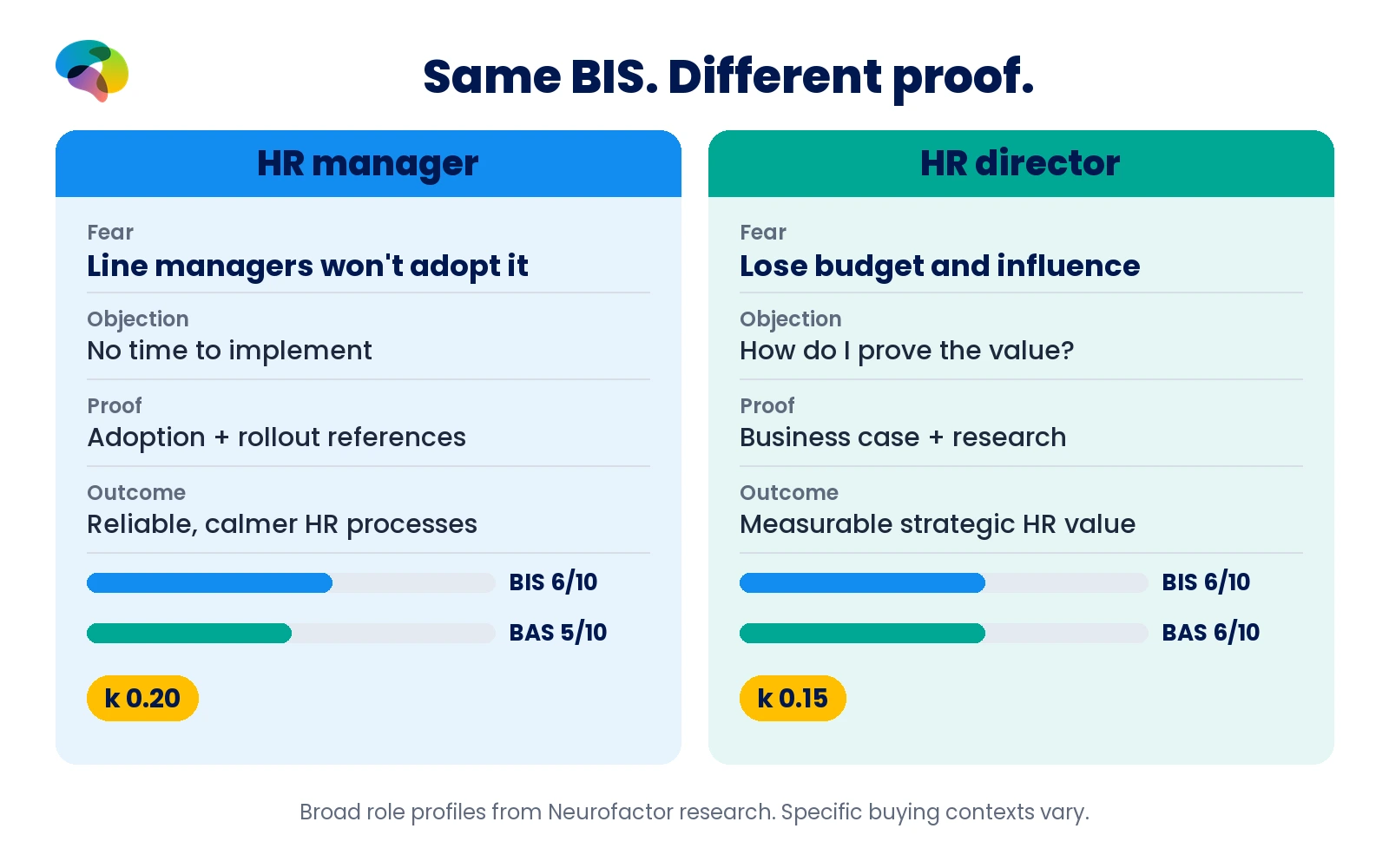
The original Neurofactor target group cards make this contrast particularly revealing: both broad profiles have a BIS score of 6. Yet the manager fears being held accountable for a system nobody adopts, while the director fears losing budget and HR's standing as a strategic function. Equal avoidance scores do not mean equal concerns.
To communicate effectively, stop simply tailoring slides to job titles. Identify the failure each role is responsible for preventing and put the relevant evidence first.
The interesting finding is that their BIS score is identical
A familiar shortcut is to describe the manager as operational and the director as strategic. The source cards tell us something more useful. Both profiles have BIS 6, but their feared outcomes differ. The manager imagines choosing a system that line managers never use and having to explain the decision to senior leadership. The director imagines losing budget and seeing HR reduced to an administrative function again.
In one role, confidence means the solution works without burdening the team. In the other, it means the investment withstands scrutiny in the executive meeting. A generic promise to “reduce risk” fails when you have not identified which risk the buyer actually owns.
The actual differences in the original role cards
This comparison is based on the original Neurofactor workbook, sheet 5 HR & Recruitment, column D (HRM) and column E (HRD). The wording below condenses those fields without adding unsupported market statistics.
Setting
- HR manager
- Small HR team, operational HR processes and line support
- HR director
- Executive-level HR strategy, talent, culture and costs
Main pain point
- HR manager
- Too many operational requests and administrative tasks
- HR director
- HR investment is difficult to defend as business contribution
Root cause
- HR manager
- Fragmented systems and managers not taking on HR tasks
- HR director
- Results are difficult to measure and executives focus on costs
Emotional driver
- HR manager
- Order, peace of mind, recognition from line managers
- HR director
- Recognition as a strategic partner
Biggest fear
- HR manager
- Choosing a tool that the business does not adopt
- HR director
- Losing budget and strategic standing
Objection
- HR manager
- No implementation time, limited budget, existing system, low line adoption
- HR director
- How can impact be measured and justified to finance?
Desired outcome
- HR manager
- Reliable HR processes and more time for employees and managers
- HR director
- HR recognised as a strategic function with demonstrable impact
Required proof
- HR manager
- Comparable HR manager references and smooth implementation
- HR director
- Cases showing business results, research and HR director references
Preferred route
- HR manager
- Peer recommendation or professional event, followed by demo
- HR director
- HR director network and recommendation, followed by strategic conversation
Decision context
- HR manager
- Buys within budget; larger items escalated
- HR director
- Strategic accountability to CEO and executive team
The offer is identical; the accountability is not
The HR manager deals with recruitment, absence, appraisals, pay conditions and systems while responding to constant requests from line managers. The original card describes an overstretched team and a sense of always catching up. A new supplier is useful only if it makes the daily workload lighter.
The director has to align HR with business goals while balancing talent, culture and cost. A product cannot merely promise better processes. It needs to demonstrate that HR makes a defensible contribution to organisational results. Both professionals care about employees and effective HR. Their responsibilities simply make different evidence relevant.
For the HR manager, another tool can become another problem
The source card names previous disappointments: an HR system that was never adopted, an extra adviser and isolated management workshops. That is why a claim such as “everything becomes automated” may create concern. Software can be installed without changing what line managers actually do.
An effective demonstration therefore needs to answer practical questions. Who migrates the data? Who trains managers? Which tasks stop coming back to HR? What happens when adoption stalls? Show a comparable implementation, time saved, support available and examples of genuine usage. A list of features is not equivalent to proof of less work.
For the HR director, an attractive programme still needs a defensible outcome
The HR director profile describes the frustration of having to justify HR repeatedly. Previous initiatives included culture programmes not connected to results, dashboards that failed to create insight and restructuring HR. The problem is not a shortage of ambitious initiatives. It is the difficulty of demonstrating their effect.
A credible proposal links the intervention to relevant HR and business outcomes, explains which metrics can be measured, and separates plausible effects from optimistic assumptions. The card specifically calls for cases with business results, research evidence and references from fellow HR directors. These materials give the director something that can stand up to finance and the executive team.
BIS 6 vs BIS 6: equal avoidance, different threats
Within the role model, BIS captures sensitivity to possible adverse outcomes. Both HR profiles score 6 on the 0-10 scale. But the manager's source card links this to implementation risk and extra work; the director's card links it to investments that cannot be justified.
That is why BIS is not a complete psychological explanation or an individual diagnosis. It becomes useful alongside the specific fear, objection, root cause, evidence need and buying context. Otherwise two equal figures can tempt you to write the same message for two entirely different decisions.
BAS 5 vs BAS 6: where does the upside become meaningful?
The manager scores BAS 5, which the source card relates to opportunities to remove work from the team. That suggests an attractive outcome of calmer operations, fewer mistakes and usable processes. The director scores BAS 6, linked to opportunities that strengthen HR's strategic position. The positive outcome becomes measurable impact, talent retention and credibility.
The difference is modest; it does not prove that one role is ambitious and the other is not. The commercial implication lies in making the same gain legible in the right terms: less operational friction for one buyer, more defensible business contribution for the other.
k 0.20 vs k 0.15 does not predict signing speed
The HR manager card records k 0.20, described as moderate time preference with acceptance of an implementation period. The director has k 0.15, described as a lower time preference and a focus on annual plans. This is about how near-term and later outcomes are weighted within the broad profiles. It is not a clock for procurement.
A manager may postpone an apparently urgent purchase because the team lacks implementation capacity. A director may approve a strategic decision quickly when a budget window or regulatory need requires it. Put short-term operational proof and longer-term organisational value in the right sequence rather than treating k as a promised close date.
Show implementation first or show the business case first?
With the manager, start in the workflow. Demonstrate the user journey, the implementation plan, actual adoption by line managers, the required support and which tasks disappear. A practical demo should reduce the fear of additional work, not parade every feature.
With the director, start with the organisational question. Which business or HR goal improves? How will baseline and results be measured? What are the costs, assumptions and failure conditions? A business case supported by research and peer evidence helps the director defend the choice. The technical demo still matters, but it is often not the first piece of evidence needed.
One HR platform. Two readings of the same sentence
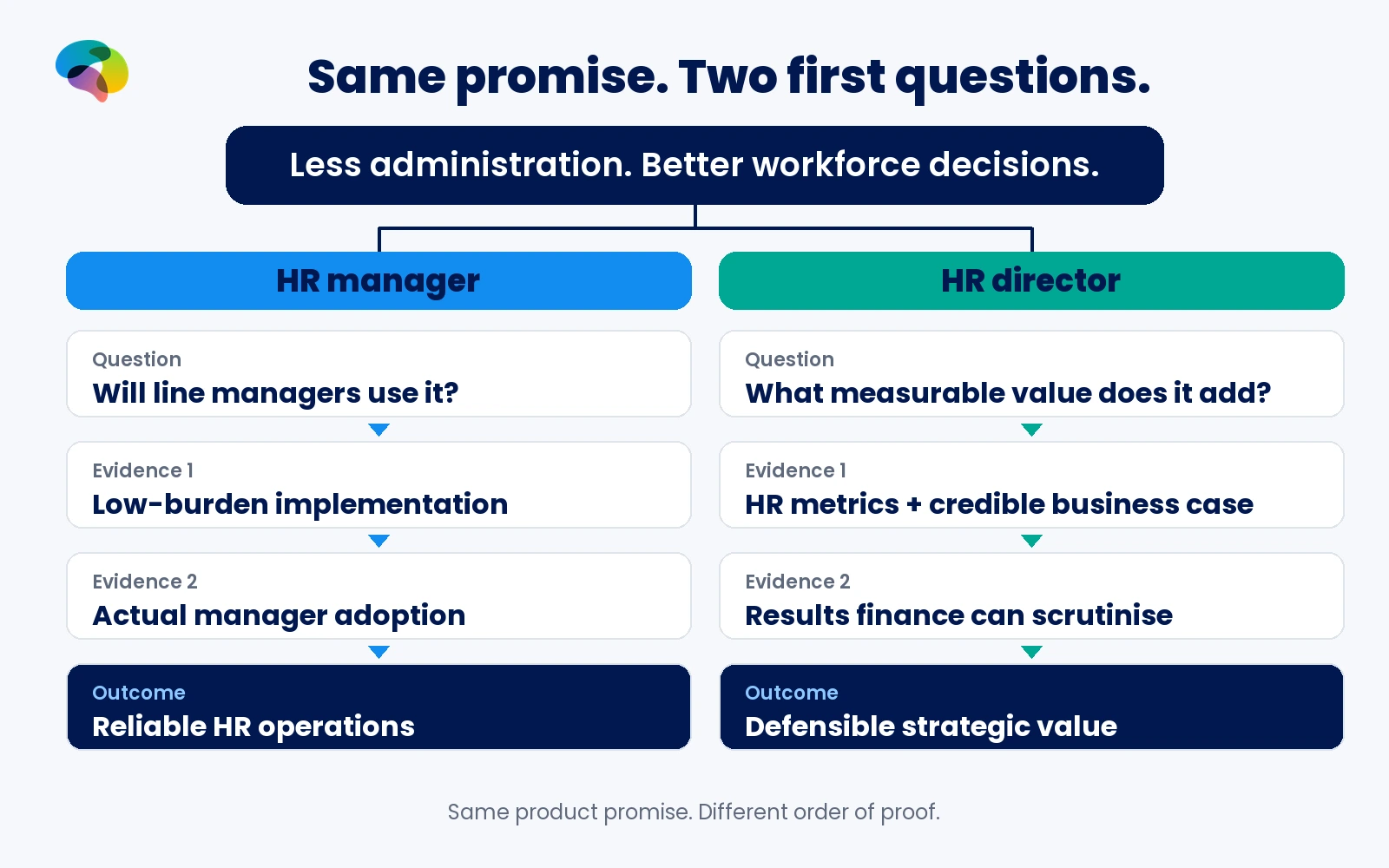
Imagine a platform with the core proposition: “Less administration, better workforce decisions.” The product claim stays unchanged. The HR manager wonders: will the workload actually fall, or will we end up maintaining an extra system that line managers ignore? The HR director wonders: which measurable improvements in talent, cost and business performance justify the investment?
For the manager, show a real implementation sequence, usage and saved time. For the director, connect those operational changes to measurable outcomes, using assumptions, a baseline and evaluation points. One is evidence that people can use it. The other is evidence that buying it creates value.
This scenario is an editorial illustration based on the cards, not a documented customer case or a tested winning headline.
Six practical changes to your sales approach
- Open with the repetitive tasks burdening the manager today; open with the business objective the director needs HR to support.
- Give the manager an end-to-end implementation reference; give the director a credible business case with costs, metrics and measured results.
- Answer “how much implementation work is involved?” early for the manager; answer “how do I defend this to finance?” early for the director.
- Follow a peer recommendation or professional event with a pragmatic demo for the manager; use senior HR networks and a strategic conversation for the director.
- Use the manager's language of absence, HR systems, onboarding and line adoption; use the director's language of talent, workforce planning and HR analytics.
- Keep one consistent product claim and one set of truthful results. Adapt the order of proof, not the underlying facts.
Two different openings for the same product
Example for the HR manager: “Your HR team is handling constant requests from line managers. I can show you how a comparable organisation reduced that workload without creating another implementation project. Could we start with the tasks your team struggles to get through?”
Example for the HR director: “You need to demonstrate how HR contributes to business performance. We connect process improvements to measurable HR outcomes and make the assumptions explicit, so you can evaluate the investment and make the case internally.”
These are illustrative messages derived from the profiles. They are not verbatim research quotes or experimentally validated sales copy.
When both buyers have a say
On many HR purchases, the manager is accountable for implementation while the director is accountable for budget, strategic fit and the HR function's credibility. If the manager hears only about ROI or the director hears only about convenience, an unresolved concern may appear late in the buying process.
Build a shared evidence structure. On one side: adoption, time saved and operational reliability. On the other: measured organisational contribution, financial rationale and strategic alignment. Add IT, privacy, finance or line leaders when the specific purchase requires them. The broad profiles indicate relevant questions, not fixed signing authority in every company.
A broad profile is a starting point, not your customer's full story
These role profiles draw on recurring patterns from years of Neurofactor research involving these and comparable audiences. They are therefore research-informed broad function profiles, not unsupported guesses. They are still generalisations: no individual HR manager or director is expected to match every characteristic. The BIS, BAS and k figures are profile values, not individual EEG readings, diagnoses or buying probabilities.
Industry, organisation size, pricing, offer, the actual product or service and the choice context can change which fears or proof points are most relevant. An enterprise-wide HRIS purchase does not have the same associations as a small onboarding service.
For the best commercial and predictive use, connect these broad profiles to the actual proposition through a target group card and association map. Want to know how these roles evaluate your specific offer? Study the relevant associations and decision context. See the five HR role overview and the recruiter vs CHRO comparison.
Want to know how HR managers or HR directors see your product or service? Contact Neurofactor and translate the broad profile into your proposition.
The same risk score does not justify the same sales message
Both the HR manager and HR director score BIS 6 in the original cards. What separates their buying questions is the failure they would personally have to account for: a system that nobody adopts, or an investment that cannot be defended.
You do not need to invent two products. You do need to prove two sides of the same value proposition: that people can successfully work with it, and that the organisation is better off because of it.
Key terms
- Target group card
- A structured broad audience or role profile describing problems, motives, objections, fears, evidence needs and buying context, refined for specific offers.
- Association map
- A research-based map of meanings an audience connects to a product, service, brand or theme within a particular decision context.
- BIS
- Behavioral Inhibition System: a concept describing sensitivity to potentially adverse outcomes, represented here by a broad role-profile score from 0 to 10.
- BAS
- Behavioral Activation System: a concept concerning motivation towards opportunity and positive outcomes; not a purchase-probability percentage.
- Delay-discount-rate (k)
- A profile parameter for the relative weighting of earlier and later outcomes; not an estimate of time to sign a contract.
- Line-manager adoption
- The extent to which operational leaders and teams actually use a new process or system.
- Evidence anchor
- A verifiable result, case or reference directly addressing a buyer's particular fear or objection.
Frequently asked questions
What is the biggest buying difference between an HR manager and an HR director?
HR managers prioritise practical processes, less work and adoption by line managers. HR directors need measurable organisational contribution, strategic fit and an investment they can defend to finance and leadership.
What are their BIS, BAS and k scores?
The original Neurofactor cards give the HR manager BIS 6, BAS 5 and k 0.20; the HR director BIS 6, BAS 6 and k 0.15. These are broad function-profile values, not individual test results.
Why do both roles have BIS 6 despite different fears?
The BIS profile score reflects sensitivity to downside, not what specifically causes it. The manager fears failed implementation and non-adoption. The director fears a financially or strategically indefensible investment.
What evidence matters to an HR manager?
References from managers in comparable organisations, smooth rollouts, time saved and actual adoption by the line organisation. A practical demonstration supports this evidence.
What evidence matters to an HR director?
Cases showing business outcomes, research data, HR director references and relevant HR metrics arranged in a finance-ready business case.
How do I apply these general profiles to my own product?
Use a specific target group card and association map to examine the actual offer, price, sector and choice context. Broad role patterns are the starting point, not a substitute for product-specific evidence.
Sources
- 1.Behavioral Inhibition, Behavioral Activation, and Affective Responses to Impending Reward and Punishment: The BIS/BAS Scales - Carver & White / Journal of Personality and Social Psychology (1994)
- 2.Time Discounting and Time Preference: A Critical Review - Frederick, Loewenstein & O'Donoghue / Journal of Economic Literature (2002)
This series
Who are you really selling to?Category synthesis
Selling to HR: recruiters and CHROs live in different realitiesRead next
Related topics
Reviewed by: Martijn den Otter · Last reviewed: 10/8/2026
Martijn den Otter
Oprichter van Neurofactor. Expert in neuromarketing en consumentenpsychologie.
LinkedIn →