
People & Culture versus traditional HR: a new title, or a different reason to buy?
Imagine selling a platform that makes onboarding, feedback and employee development easier. An HR manager asks whether line managers will actually use it. An HR director asks whether its value will stand up in the executive meeting. A People & Culture lead wants to know whether the approach fits the culture the company is trying to preserve.
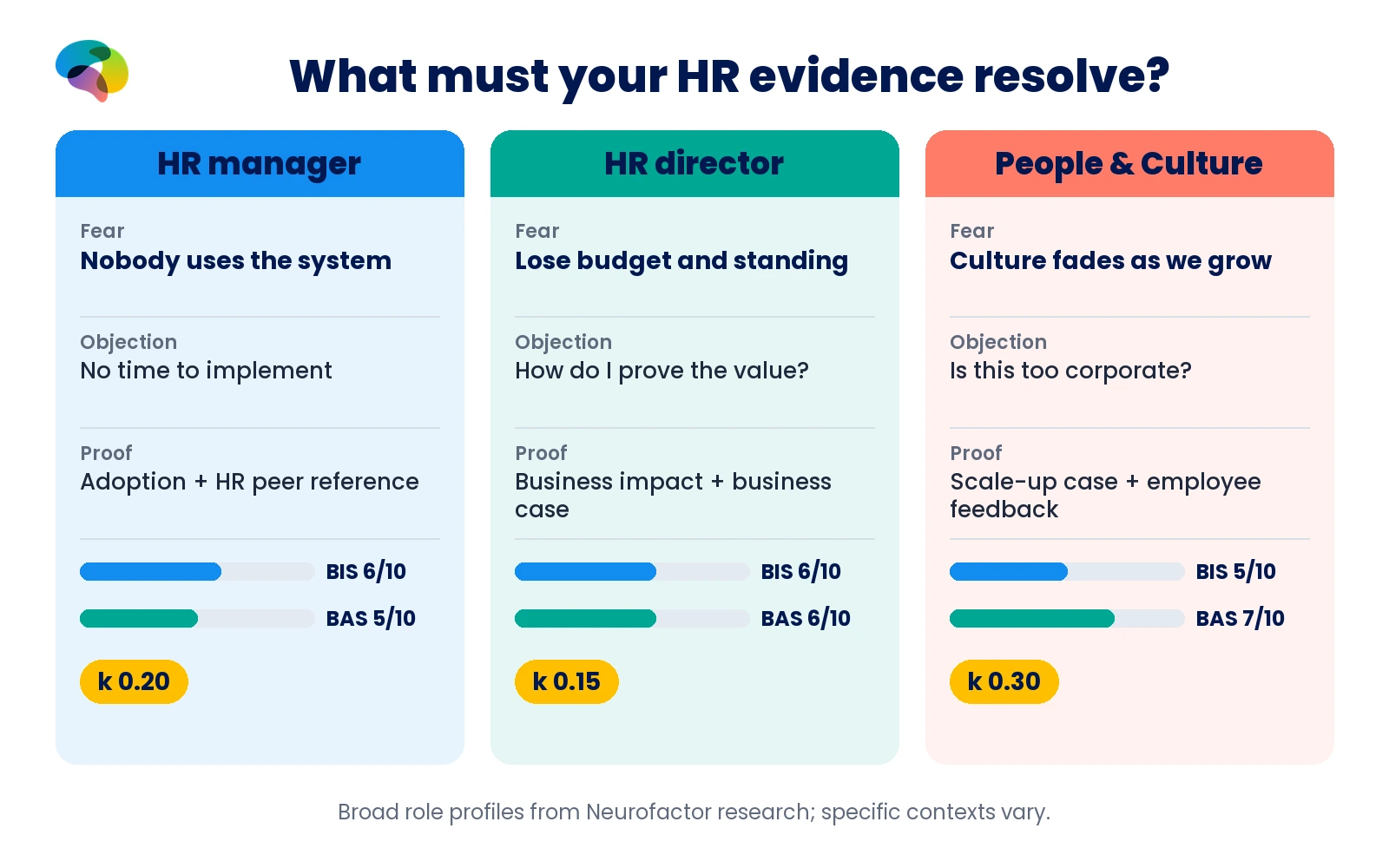
Three people dealing with the same workforce. Three different tests of the same product. In Neurofactor's broad role profiles, People & Culture has BIS 5, BAS 7 and k 0.30. The HR manager has BIS 6, BAS 5 and k 0.20; the HR director has BIS 6, BAS 6 and k 0.15. Those figures provide direction, but the title itself does not cause buying behaviour. Responsibility, context, associations and the downside each person wants to avoid matter more.
Changing the job title in the first sentence of your LinkedIn message while keeping the same pitch misses precisely that distinction.
Modern versus traditional is the wrong comparison
People & Culture sounds like culture, autonomy and a modern workplace. HR sounds like absence management, employee policies and systems. That difference in vocabulary invites a simplistic sales rule: People & Culture buys innovation, while HR buys certainty. The source profiles do not support such a clean split.
The HR manager believes careful processes protect people. The HR director sees people and culture as fundamental to business performance. The People & Culture lead still needs to get basic HR operations right as the company grows. All three care about people and organisational outcomes. What differs is the failure each feels responsible for preventing.
For the HR manager, that is a system line managers ignore. For the HR director, it is losing budget and strategic credibility. For People & Culture, it is a growing organisation losing its identity and its people. Not old versus new, but three different forms of downside.
The three buying profiles, side by side
This comparison draws from the original 40-field Neurofactor audience cards for HRM, HRD and PCL. The source fields have been shortened for readability rather than replaced by assumed market data.
Typical setting
- HR manager
- Mid-sized organisation, small HR team, daily line-manager queries
- HR director
- Larger organisation, HR strategy and executive accountability
- People & Culture
- Scale-up or modern service business, people and culture close to founders
Main problem
- HR manager
- Too much administration and operational demand
- HR director
- HR impact is difficult to measure or defend
- People & Culture
- Rapid growth, new managers and diluted culture
Underlying cause
- HR manager
- Fragmented processes; line managers do not take on HR tasks
- HR director
- Executive team focuses on costs; HR outcomes hard to quantify
- People & Culture
- Fast hiring, insufficient onboarding, immature management
Greatest fear
- HR manager
- Buying a system line managers will not use
- HR director
- Losing budget and being seen as an administrative function
- People & Culture
- Growing while losing culture and people
Objection
- HR manager
- No time/budget; already have a system; no adoption
- HR director
- How do we measure value and justify it to finance?
- People & Culture
- Does it fit our culture? Too corporate? What will employees think?
Proof required
- HR manager
- Comparable HR manager references and smooth rollouts
- HR director
- Business-impact cases, research and senior HR references
- People & Culture
- Scale-up cases, employee scores and People-lead references
Desired outcome
- HR manager
- Calm, dependable HR operations and time for line managers
- HR director
- HR recognised as a strategic partner with measurable value
- People & Culture
- People thrive and culture stays recognisable during growth
Preferred route
- HR manager
- Peer recommendation or industry event, then demo
- HR director
- Senior HR network, then strategic meeting
- People & Culture
- Peer community or LinkedIn, then informal team discussion
BIS / BAS / k
- HR manager
- 6 / 5 / 0.20
- HR director
- 6 / 6 / 0.15
- People & Culture
- 5 / 7 / 0.30
Why culture fit is a commercial requirement for People & Culture
In the PCL profile, the main problem arises from rapid recruitment without a reliable onboarding structure and newly appointed managers who are still learning to lead. The company is scaling, but habits that once came naturally no longer survive without effort. A technically efficient platform can feel inappropriate if it introduces an impersonal management style.
The objection "Is this too corporate?" is not simply resistance to professionalisation. It reflects the risk of undermining exactly what the People & Culture lead is trying to protect: autonomy, trust, employee experience and an identifiable culture.
So do not lead solely with features or a dashboard. Show what the experience looks like for employees and managers, what can be adapted, and how the team participates in selecting and implementing the approach.
What the HR manager is trying to prevent
The HRM profile describes a small team fielding too many questions from the business, fragmented processes and vendors whose tools are never adopted. The underlying feeling is always being one step behind. The manager fears having to explain why line managers are not using yet another purchased system.
An employee-experience story may be relevant. But until the workload of implementation, system ownership and actual manager adoption are clear, the offer remains risky. Show a comparable rollout, real evidence of adoption and how much effort the HR team had to invest.
The original card names HR-peer recommendations or an industry event, followed by a demo, as the preferred route. An attractive culture deck is not a substitute for that practical reassurance.
What the HR director needs to defend
The HRD profile describes a different pressure. HR wants to operate as a strategic partner, but its contribution to business outcomes can be hard to demonstrate. The director fears losing budget and being pushed back into an administrative role.
A new platform may improve employee experience, but the director also needs a credible account of its contribution to retention, leadership, costs or other relevant HR outcomes. The source calls for business-impact cases, research data and references from other HR directors.
Not every benefit can be reduced to a cash amount. You can still make assumptions explicit, establish a baseline, define an evaluation window and distinguish product usage from employee experience and organisational impact. A dashboard is not evidence of results by itself.
What the BIS, BAS and k figures add, and what they do not
The HR manager profile has BIS 6 and BAS 5, the HR director BIS 6 and BAS 6, and People & Culture BIS 5 and BAS 7. Among these broad profiles, People & Culture is relatively more opportunity-oriented. That does not mean a culture-focused lead buys without proof: the card explicitly names concern about employee reaction and cultural fit.
The k values are HR director 0.15, HR manager 0.20 and People & Culture 0.30. Within this profiling framework, a higher k places comparatively more weight on earlier outcomes. This is consistent with a People-lead working at the pace of organisational growth, whereas an HR director commonly works with annual plans and larger strategic investments.
k is not a percentage, not the actual length of a buying cycle, and not an individual EEG result. These are broad role-level parameters, not proof that any person will sign a contract faster.
Three different voices behind one HR category
The audience card summarises the HR manager's voice as: "I just want it to work without creating another problem for me." The HR director wants to "show with numbers that HR contributes to performance." People & Culture is closer to: "If it fits our culture and makes people better off, I want to try it."
These are translated profile voice lines from the source card, not verified verbatim interview quotations attributable to named respondents. Still, they help you enter the first sales conversation with the right question. One person wants less operational burden, another wants defensible impact, and the third wants the human experience to remain intact.
The problem is not showing each role the same HR platform. It is introducing that platform through the same feature every time.
One offer, three different first questions
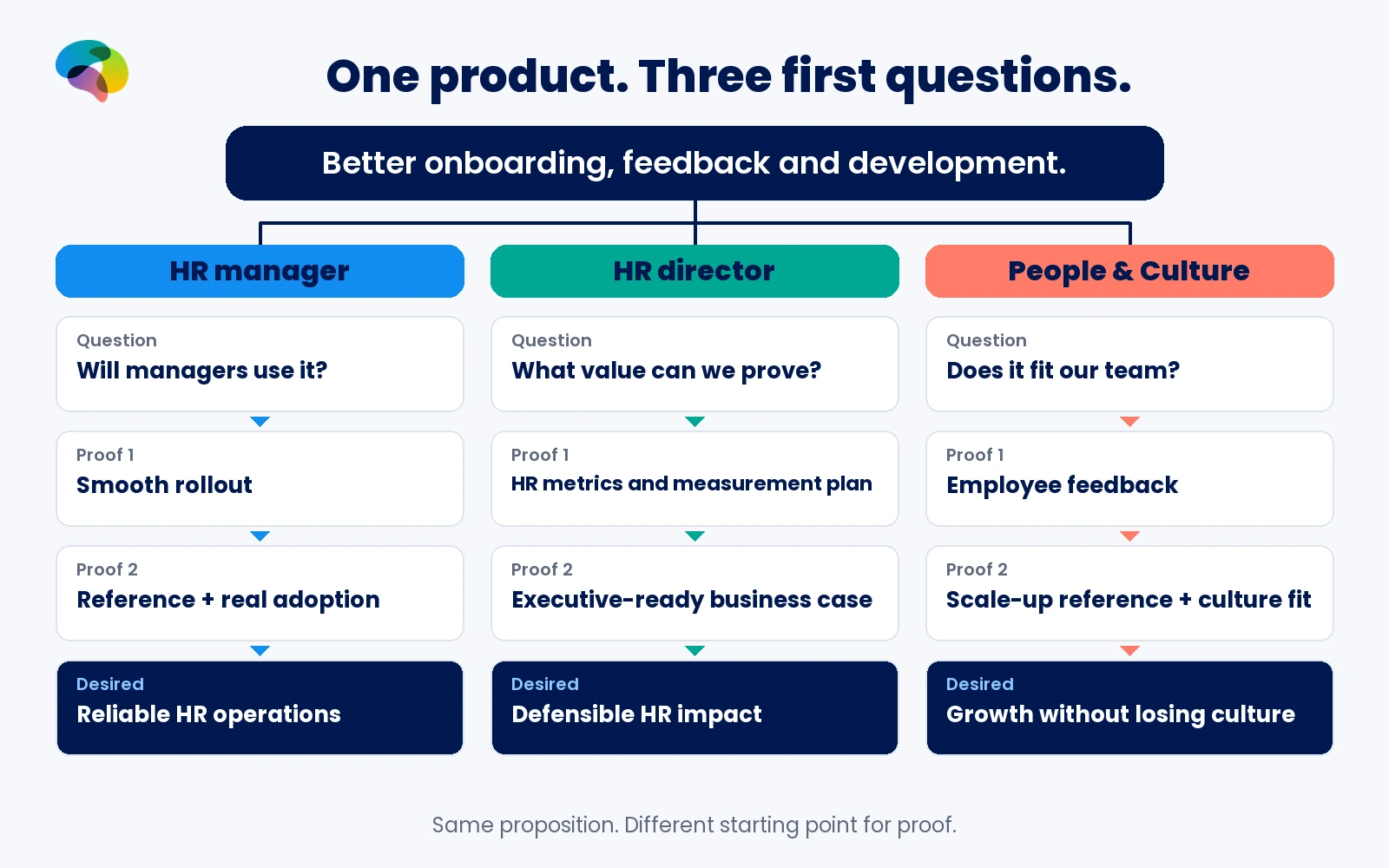
Suppose the proposition is identical for everyone: "A platform that makes onboarding, feedback and employee development easier to manage." The underlying product does not change. The order in which you demonstrate relevance does.
HR manager: "Will this reduce administration, and will line managers actually use it?" Show the rollout, line-manager adoption and a reference from a comparable HR team.
HR director: "How will this contribute to retention and our HR strategy in a way I can defend?" Show measurement logic, relevant HR metrics, assumptions and an executive-ready business case.
People & Culture: "Will this help people grow without imposing a corporate culture that is not ours?" Show team involvement, employee feedback and how the approach adapts to the organisation.
These are illustrative questions derived from the broad profiles. They are not direct respondent quotations or measured results from an A/B sales test.
Seven changes to make in your B2B pitch
- Segment by actual responsibility as well as job title: HR operations, executive accountability or culture through growth.
- Lead with practical time savings, reliable processes and line-manager adoption when addressing an HR manager; show a comparable implementation early.
- Lead with business contribution and an auditable chain of results for an HR director; make assumptions, costs and HR metrics visible to finance.
- Lead with cultural continuity, employee experience and team involvement for People & Culture; use relevant scale-up cases and People-peer references.
- Match the documented route: peer and demo for managers; senior HR network and strategic meeting for directors; community or LinkedIn and team conversation for People & Culture.
- Keep your product claims the same. Change the order of the evidence, not the facts about what the product can deliver.
- Use a proposition-specific audience card and association map to check which concerns are actually activated by your price, sector and offer.
Three openings for the same product
HR manager: "How many questions does your team receive from line managers once onboarding has started? I can show you how similar teams reduced that workload while ensuring managers actually used the process."
HR director: "If better onboarding contributes to retention and performance, you should be able to make a defensible case for it. Which HR measures matter most in your executive discussions, and what baseline do you have?"
People & Culture: "How do you help new colleagues feel part of your culture as the team grows? I can show you a way to structure onboarding without losing how people work together."
These lines are editorial applications of the source profile. They have not been tested as conversion-winning copy.
When HR and People & Culture are actually the same person
A scale-up may have one People & Culture lead who also owns absence management, contracts and HR systems. A large company may have an HR director personally driving cultural change. In that situation, responsibility tells you more than the label on LinkedIn.
Find out who owns implementation, who signs off the budget, who evaluates employee experience and who must explain the outcome. These could be three people or just one.
Build three strands of proof for a joint buying group: implementation and adoption, measurable organisational value, and culture fit with employee experience. You do not need three different products. You need one honest proposition with the evidence relevant to each decision.
Why a culture slogan without follow-through fails
The People & Culture card records three approaches that did not deliver as expected: perks and parties sold as a culture solution, company values on a wall, and engagement platforms with no follow-up. That tells us something important about credible proof. Culture is not a fashionable label you can put on an intranet or slide deck.
If you sell a culture-related service, explain which behaviours change, how new managers are supported and what happens after employees provide feedback. Otherwise you reinforce precisely the concern the People & Culture lead brings to the conversation: another corporate tool that does not fit the team.
The HR manager's unsuccessful alternatives include systems without adoption and isolated manager workshops. The director's include large culture programmes without links to results and dashboards that generate no insight. All three might use the word culture, but they are describing different failures.
Evidence-based broad role profiles are not individual predictions
These profiles draw on recurring patterns from research Neurofactor has carried out over several years with these and similar target groups. They are evidence-informed broad role profiles. They are not diagnoses or fixed traits of every individual HR manager, HR director or People & Culture professional. BIS, BAS and k are role-profile parameters here, not individual EEG findings or probabilities of purchase.
Industry, company size, proposition, product or service, price, authority and decision context can change which concern ultimately matters most. An HR-platform purchase may make implementation the overriding issue even for People & Culture. A leadership programme may put culture first for an HR director.
For the most predictive and commercially useful version, adapt the broad profile to your actual proposition. A target-audience card and association map help determine what your offer means to people, which objections it activates and what evidence is required. Want to know how these roles perceive your specific product or service? Start with that proposition-specific work. See the five-role HR overview, recruiter versus CHRO and HR manager versus HR director.
Want to know how HR managers, HR directors or People & Culture leads see your product or service? Contact Neurofactor and translate the broad profile into your proposition.
A different title matters only when it changes the decision
People & Culture is not automatically a modern HR manager with a greater willingness to buy. The source profiles offer a more useful distinction: an HR manager wants to avoid an unused system, an HR director an unjustifiable investment, and a People & Culture lead growth that costs the organisation its culture.
A job title tells you whom your message might reach. The fear and evidence requirement behind it tell you what you need to prove to help that person make a decision.
Key terms
- People & Culture
- A people-function role emphasising employee experience, culture and development, often alongside recruitment in a scale-up or modern service business.
- HR manager
- A practitioner responsible for dependable HR operations, including onboarding, absence, systems and support for line managers.
- HR director
- An executive HR leader who links people strategy, culture and costs to organisational goals and defends investment at senior level.
- BIS
- Behavioural Inhibition System: a broad 0-10 role-profile marker for sensitivity to potential unwanted outcomes in the Neurofactor card.
- BAS
- Behavioural Activation System: a broad 0-10 role-profile marker for orientation towards desirable outcomes; not a purchase-probability percentage.
- Delay-discount rate (k)
- A profile parameter for the relative valuation of sooner compared with later rewards, not a measured sales-cycle duration.
- Target-audience card
- A structured role profile covering context, pains, fears, objections, proof expectations and decision factors.
- Association map
- Proposition-specific research into the meanings and connections people associate with a product, service, brand or issue.
Frequently asked questions
Is People & Culture just a new name for traditional HR?
Not necessarily. Responsibilities can overlap, but the broad Neurofactor cards focus People & Culture on protecting culture through growth, HR managers on adoption and reliability, and HR directors on defensible strategic impact.
What are the BIS, BAS and k values for People & Culture and HR?
People & Culture is BIS 5, BAS 7, k 0.30. The HR manager is BIS 6, BAS 5, k 0.20; the HR director is BIS 6, BAS 6, k 0.15. These are broad role-profile values rather than individual readings.
What evidence persuades People & Culture?
The card names scale-up case studies, employee scores and references from People leads. Proof should show that people can develop while the company retains a recognisable culture.
What evidence matters to HR managers and directors?
HR managers want practical rollout and adoption proof from comparable organisations. HR directors need business-impact cases, research, a credible business case and senior HR references.
Does a higher k mean a faster purchase?
No. In these profiles a higher k suggests relatively greater weight on sooner outcomes. People & Culture has k 0.30 versus 0.20 for the manager and 0.15 for the director. That does not determine a specific person's purchase timing.
How do I adapt these profiles to my HR product?
Research the associations, objections, benefits and proof expectations triggered by your particular offer, price and decision context. Use a target-audience card and association map rather than relying on a job title alone.
Sources
- 1.Neurofactor - LinkedIn doelgroepen - Doelgroepkaarten, tab 5 HR & Recruitment, HRM, HRD, PCL, forty profile fields - Neurofactor (2026-09)
- 2.Behavioral Inhibition, Behavioral Activation, and Affective Responses to Impending Reward and Punishment: The BIS/BAS Scales - Carver & White / Journal of Personality and Social Psychology (1994)
- 3.Time Discounting and Time Preference: A Critical Review - Frederick, Loewenstein & O'Donoghue / Journal of Economic Literature (2002)
This series
Who are you really selling to?Category synthesis
Selling to HR: recruiters and CHROs live in different realitiesRead next
Related topics
Reviewed by: Martijn den Otter · Last reviewed: 10/8/2026
Martijn den Otter
Oprichter van Neurofactor. Expert in neuromarketing en consumentenpsychologie.
LinkedIn →