
IT does not just buy technology: four roles, four types of risk
One technology demonstration, four reactions. The IT manager sees operational workload. The CIO examines architecture and security. The CTO looks for speed without lock-in. The head of IT asks whether a fast-growing environment will become safer and more scalable. These are four different buying decisions, even when the product is identical.
Neurofactor audience cards document the contrasts in pain points, greatest fears, evidence and time preference. Within these profiles, the CIO records BIS 8 and k 0.08, while the CTO records BAS 8 and k 0.30. The important difference is not a single score. It is the consequence for which each role is accountable.
If you sell technology to businesses, do not give everyone the same demonstration. Show the outcome, the risk and the evidence that matters to each stakeholder.
One demonstration, four different ways to fail
Imagine presenting a cloud platform that automates processes and creates new technical opportunities. The CTO immediately considers what engineers could build. The CIO asks how it fits the architecture, security model and governance. The IT manager wonders how many support tickets and maintenance tasks it will create. The head of IT wants to know whether it can make a growing business safer and more scalable.
The discovery is not that one executive likes innovation more than another. The profiles show four distinct responsibilities for the consequences of the same purchase. That changes which evidence a buyer considers credible - and what your first conversation should be about.
Four IT buyers: what can go wrong on their watch?
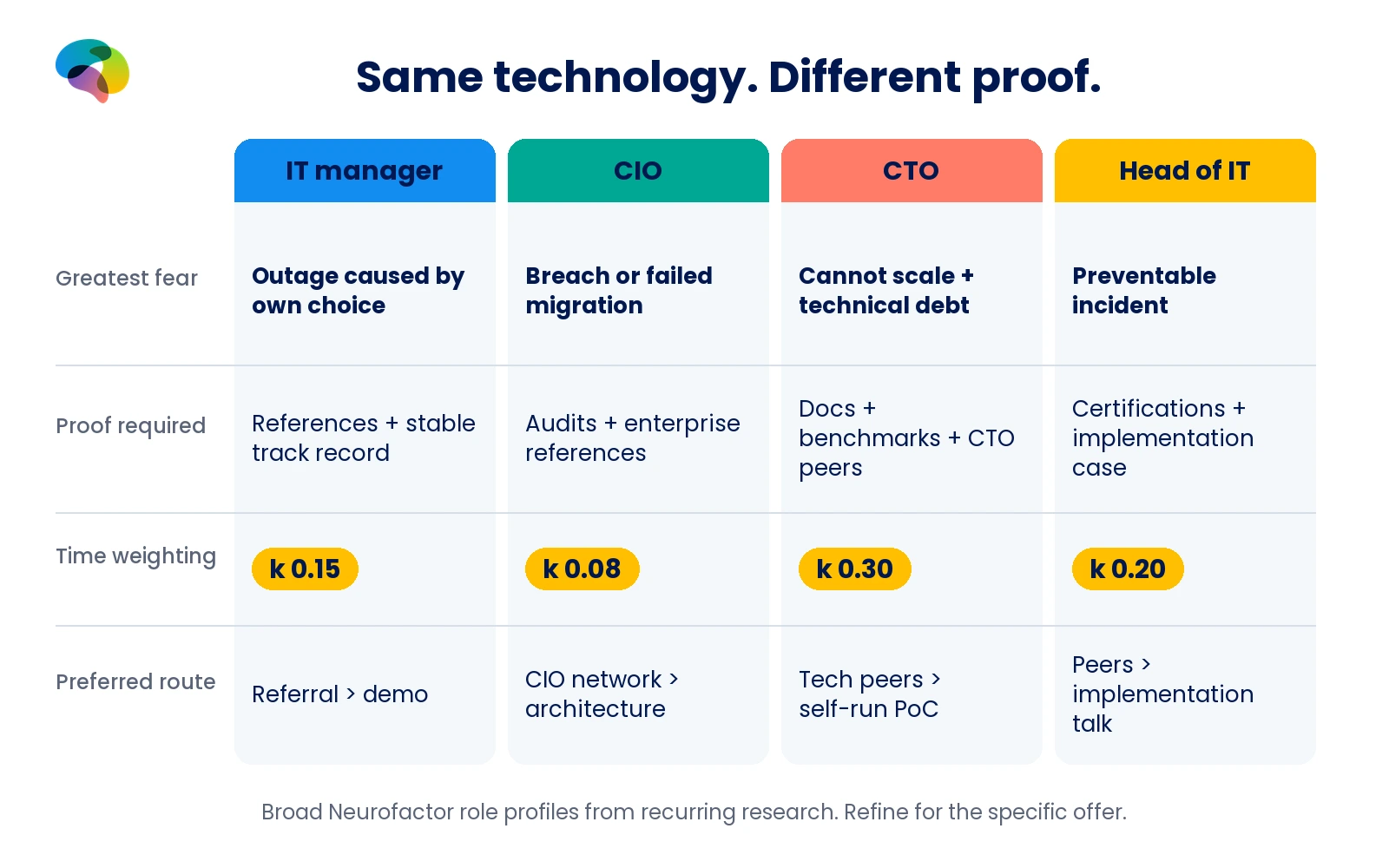
This comparison condenses the source fields for main pain point, greatest fear, evidence, preferred route and desired outcome. It describes broad role profiles, rather than every person with a particular title.
Pain point
- IT manager
- Too many tickets and operational tasks for a small team
- CIO
- Legacy systems, complex architecture and digitalisation pressure
- CTO
- Technical debt and pressure to ship faster than is sensible
- Head of IT
- An organically grown IT environment that is insufficiently safe or scalable
Greatest fear
- IT manager
- An outage caused by a decision they made
- CIO
- A breach, data leak or failed migration on their watch
- CTO
- A platform that cannot scale or locks the team into years of technical debt
- Head of IT
- A preventable incident caused by inadequate IT foundations
Desired outcome
- IT manager
- Fewer tickets, predictable operations, a calmer team
- CIO
- A governed, compliant landscape supporting business strategy
- CTO
- Quality engineering and faster delivery without lock-in
- Head of IT
- Safe, professional IT that grows with the business
Evidence
- IT manager
- Comparable references, certifications, stable track record
- CIO
- Enterprise references, audits, certifications, analyst reports
- CTO
- Documentation, open benchmarks, community, CTO references
- Head of IT
- Growth-company references, certifications, implementation case
Preferred route
- IT manager
- Trusted recommendation, demonstration, trial
- CIO
- CIO network or analyst, architecture discussion, RFP
- CTO
- Technical communities and peers, self-run proof of concept
- Head of IT
- Peer or vendor referral, demo, implementation discussion
Time weighting in profile
- IT manager
- k 0.15
- CIO
- k 0.08
- CTO
- k 0.30
- Head of IT
- k 0.20
The deciding difference is who has to defend the consequences
After the purchase, the IT manager still owns day-to-day operations. A new capability is attractive only if it does not turn a small team into a permanent incident-response unit. The CIO is accountable to senior leadership and sometimes oversight bodies, so architecture, strategic fit and risk must hold up over years.
A CTO is responsible for engineering quality and delivery speed. A platform may look impressive today but create years of technical debt tomorrow. The head of IT is often building a professional function on top of systems that grew without a plan. If you ignore those different accountabilities, you end up explaining features while the buyer is asking about evidence, control or freedom to build.
IT manager: reducing operational work beats adding features
The source card describes excessive tickets and daily operational tasks in an undersized team. The emotional cost is feeling like a firefighter rather than someone with time to improve the environment. Selling another tool without specifying who will run it may sound like another burden.
The IT manager expects proven technology, clear documentation, responsive support, managed implementation and references from similar organisations. A credible promise starts with stable operation and fewer tasks, not an abstract claim that everything becomes smarter. Ask how many tickets the team handles today and who owns each responsibility after launch.
CIO: the business case must stand up to scrutiny
The CIO faces legacy systems, fragmented applications and pressure to modernise with limited resources. Their greatest fear in the source profile is a major security incident, data breach or failed migration under their responsibility. They need to understand architectural compatibility, governance, risk ownership and the total cost of the decision.
A polished product demo is not enough. The card explicitly calls for an architecture review, security documentation, total cost of ownership, enterprise references and an appropriate procurement process. Rejecting a weakly governed implementation is not resistance to progress. It is a different definition of responsible progress.
CTO: enable engineers to test the technology themselves
The CTO wants higher development speed and quality without buying a platform that constrains future decisions. Technical debt, scaling limits, cloud costs and lock-in are stated objections, not abstract concerns. Strong documentation, open benchmarks and access to engineers can therefore be more persuasive than an executive-only return-on-investment presentation.
The card describes a route through technical communities and trusted peers, followed by a proof of concept the CTO or team can run themselves. Provide APIs, explain trade-offs and agree on a technical stop condition. The strongest demonstration shows not just what your product does, but what their team can independently build with it.
Head of IT: professionalise without creating another mess
The head of IT often works in a growing organisation where technology choices were made ad hoc before there was formal IT leadership. The central problem is an estate that is no longer sufficiently secure or scalable. Their greatest fear is an incident that could have been prevented with better foundations.
This buyer wants control, security and a realistic path to professionalisation. A reference from a growing company, relevant certifications, practical guidance and a phased roadmap carry more weight than a presentation full of impressive capabilities. The key question is not just whether the platform scales, but whether the current team can safely implement and operate it.
BIS, BAS and k: the twelve original profile values
The values come from the IT & Technology audience cards, rows 44-46. BIS and BAS use separate descriptive 0-10 dimensions in these profiles. The k parameter concerns the relative weighting of delayed outcomes and has its own scale. It is not a percentage, probability of purchasing or a BIS/BAS score.
BIS (0-10)
- IT manager
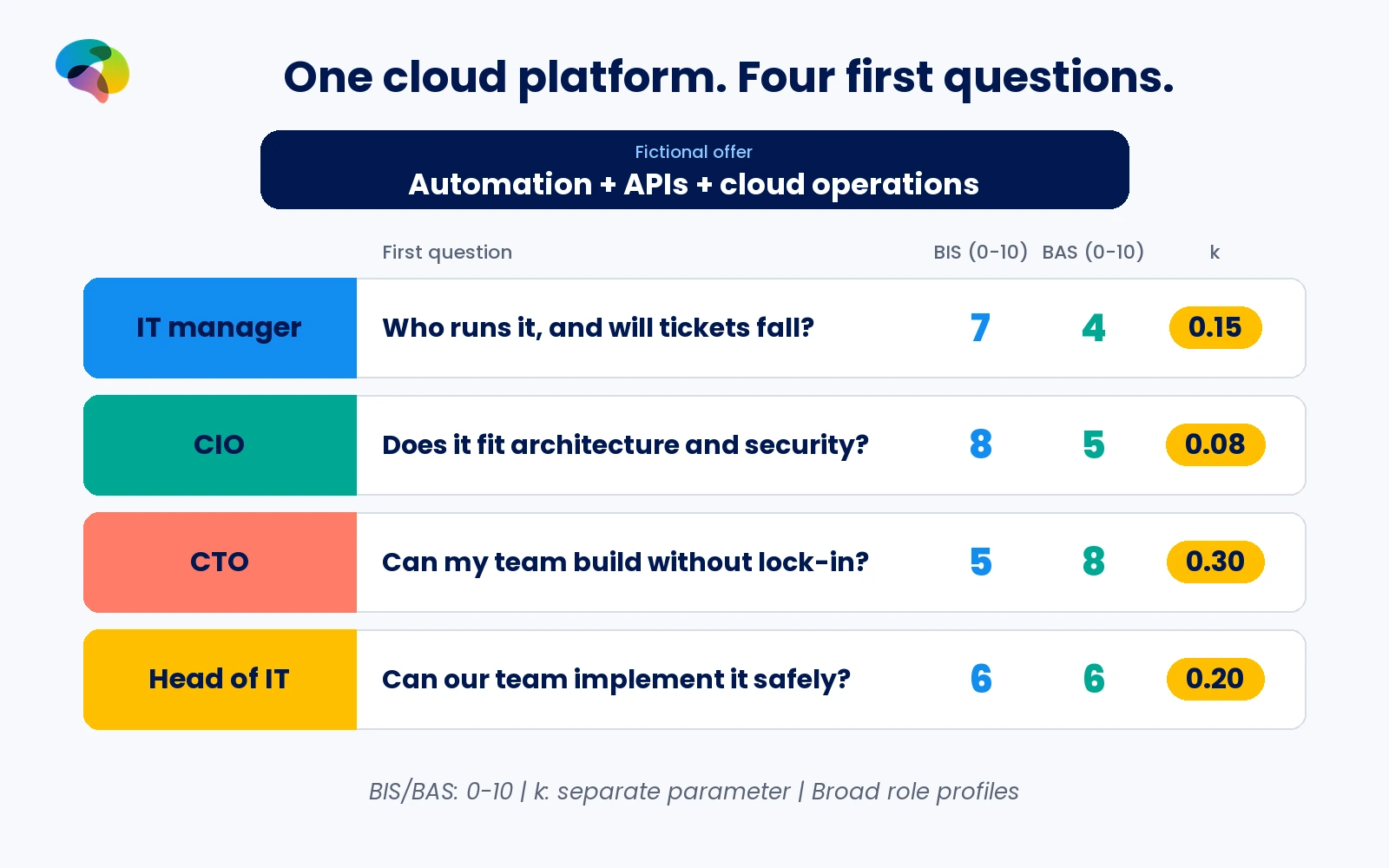
- 7
- CIO
- 8
- CTO
- 5
- Head of IT
- 6
BAS (0-10)
- IT manager
- 4
- CIO
- 5
- CTO
- 8
- Head of IT
- 6
k (separate parameter)
- IT manager
- 0.15
- CIO
- 0.08
- CTO
- 0.30
- Head of IT
- 0.20
Why the highest BIS and highest BAS can support the same project
The CIO has the highest BIS of the four profiles at 8 and the lowest k at 0.08. That is consistent with multi-year, strategic risk control. The CTO has the highest BAS at 8 and k at 0.30, with greater emphasis on technical opportunities and nearer-term engineering progress.
That does not mean CIOs dislike innovation or CTOs ignore risk. The CTO card explicitly flags technical debt and lock-in as unacceptable. Nor does k tell you how many weeks a particular person needs to sign a contract. The figures help formulate better first questions; the actual product and decision context determine what to test next.
One cloud platform, four entirely different questions
Suppose you offer a platform that automates operations, exposes APIs and simplifies cloud management. This is an illustrative sales scenario, not a recorded research observation.
The IT manager asks who handles incidents, how much migration work will fall on the team and whether ticket volumes will go down. The CIO asks how the platform fits architecture, security standards, total cost and governance. The CTO asks whether engineers can run a meaningful proof of concept through the APIs without lock-in. The head of IT asks whether this safely replaces ad hoc processes with scalable operations without overwhelming the team.
Four buyers, one platform. If everyone sees the same feature deck, they must do the work of translating the promise into their own responsibilities.
What to change in your pitch and proof
A useful role profile should change what you prepare for the meeting. Start from the existing card, then check which responsibilities, systems, decision rights and buying constraints actually apply.
- IT manager: lead with reduced operational workload, support arrangements, migration effort and demonstrated stability. Bring a plan that protects a small team.
- CIO: start with architecture fit, security, compliance and total cost of ownership. Prepare a risk register, governance approach and senior IT references.
- CTO: open with a technical problem the team genuinely recognises. Offer API access, open benchmarks, documentation and a tightly scoped proof of concept.
- Head of IT: begin with the maturity and risks of the current environment. Show a phased roadmap and implementation support.
- Adapt the introduction route: trusted suppliers for IT managers; CIO networks and architecture dialogue for CIOs; technical peers and communities for CTOs; peer referrals and implementation discussion for heads of IT.
- Map the buying group: who proposes, who reviews architecture and security, who controls budget and who will operate the service after purchase?
Four opening lines for the exact same offer
These are editorial examples derived from the source-card themes. They are not experimentally tested headlines or verbatim participant quotations.
- IT manager: "Which maintenance tasks and ticket categories would need to disappear before this genuinely helps your team?"
- CIO: "What security, governance and architecture conditions must we demonstrate before this fits your roadmap?"
- CTO: "What technical test would convince your engineers that this scales without locking them in?"
- Head of IT: "Which preventable risks must you remove before the next growth phase, and what implementation support would make that feasible?"
What if the CIO, CTO and operations team all decide?
Real technology purchases often involve several of these roles. A CTO can strongly favour a tool while relying on the CIO to validate architecture and risk. The IT manager must still operate the service. A head of IT may have to turn an ambitious roadmap into something a small team can actually deliver.
Avoid inventing four incompatible value propositions. Build one documented case around the problem, intended outcome, implementation and constraints, then provide a different evidence layer for each stakeholder. Make trade-offs explicit, such as faster releases versus additional operational exposure, or engineering flexibility versus governance. That creates room for a defensible collective decision.
A research-backed role profile is not an individual prediction
These profiles are grounded in recurring patterns from Neurofactor research conducted over several years with these and comparable audiences. They provide a research-informed broad starting point for understanding B2B buying decisions. They do not literally describe every IT manager, CIO, CTO or head of IT.
Industry, company size, technology stack, regulation, price, product or service and buying situation can shift the emphasis. A CIO in a small organisation may also lead hands-on engineering. A CTO in a regulated organisation may be the strictest guardian of compliance. The figures are not an individual EEG diagnosis or a calculated probability of purchase.
To apply the profile to your offer, connect it to a product-specific audience card and its evidence requirements and an association map. That deeper research identifies which fears, objections, associations and proof points matter in the actual choice context.
Want to know how IT managers, CIOs, CTOs or heads of IT see your product or service? Contact Neurofactor and translate the broad profile into your proposition.
On LinkedIn, the subject matters as much as reach
The source cards show activity on LinkedIn across these functions, alongside different information sources. The IT manager also consults industry media, Tweakers and vendor newsletters. The CIO follows business technology publications and analyst research. The CTO uses technical communities including GitHub and Hacker News as well as podcasts and other technical channels. The head of IT consults communities, webinars and vendor expertise.
That suggests a concise operational case for the IT manager; a detailed architecture and risk perspective for the CIO; a technical walkthrough with documentation for the CTO; and a phased modernisation example for the head of IT. These are role-based communication recommendations, not measured channel conversion rates.
For further reading, see tone of voice and handling buyer objections, followed by our deeper comparisons of CIO versus CTO and IT manager versus head of IT.
You are not selling technology to a job title
One IT buyer must prevent incidents. Another needs to defend the architecture. A third wants engineers to build at higher speed without long-term debt. A fourth must professionalise a growing estate. Each asks a different question of the same offer.
A strong technology proposition explains more than what a platform can do. It shows which consequence improves for that buyer, which risk remains under control and what evidence can justify moving forward. Start with the decision, not the feature list.
Key terms
- IT manager
- An IT leader responsible in this profile for users, applications, suppliers and reliable everyday operations.
- CIO
- Chief information officer: the executive responsible for IT strategy, architecture and information governance.
- CTO
- Chief technology officer: leader of technology, product engineering and scalable technical delivery.
- Head of IT
- Leader responsible for establishing safe, professional IT operations as an organisation grows.
- BIS
- Behavioural inhibition system: a profile dimension describing sensitivity to risks and possible negative outcomes on a 0-10 scale.
- BAS
- Behavioural activation system: a profile dimension describing orientation towards opportunities and desired outcomes on a 0-10 scale.
- Delay-discount-rate (k)
- A parameter describing the relative weighting of later outcomes, not a percentage or an individual purchase prediction.
- Audience card
- A structured, broad or product-specific profile of goals, pain points, fears, objections, evidence needs and buying context.
- Association map
- A research-based map of meanings and associations connected to a specific brand, product or service in a choice context.
Frequently asked questions
What is the main difference between selling to a CIO and a CTO?
A CIO needs defensible architecture fit, security, compliance and strategic value. A CTO prioritises technical quality, delivery speed and scalability and often wants to test the technology directly.
What proof does an IT manager need?
The audience card identifies references from comparable organisations, relevant certifications, a stable track record, support and manageable implementation.
Why does a head of IT need an implementation roadmap?
The role often involves professionalising an organically grown IT environment. A roadmap shows how to reduce risks without overloading a small team.
Does BIS 8 mean every CIO is resistant to change?
No. BIS 8 is a value in a broad Neurofactor function profile. A CIO can be a strong sponsor of innovation when architecture, governance and security are adequately demonstrated.
What does a CTO k value of 0.30 mean?
It indicates relatively greater weighting of nearer-term outcomes in the source profile than for a CIO at k 0.08. It does not specify a buying timeline or conversion probability.
How can I apply these profiles to my technology offering?
Combine the broad role profiles with a product-specific audience card and association map, then test which objections, associations and evidence needs matter in your industry and buying context.
Sources
- 1.Behavioral Inhibition, Behavioral Activation, and Affective Responses to Impending Reward and Punishment: The BIS/BAS Scales - Carver & White / Journal of Personality and Social Psychology (1994)
- 2.Time Discounting and Time Preference: A Critical Review - Frederick, Loewenstein & O'Donoghue / Journal of Economic Literature (2002)
Related topics
Reviewed by: Martijn den Otter · Last reviewed: 10/9/2026
Martijn den Otter
Oprichter van Neurofactor. Expert in neuromarketing en consumentenpsychologie.
LinkedIn →