
IT manager vs head of IT: better technology can still be the wrong decision
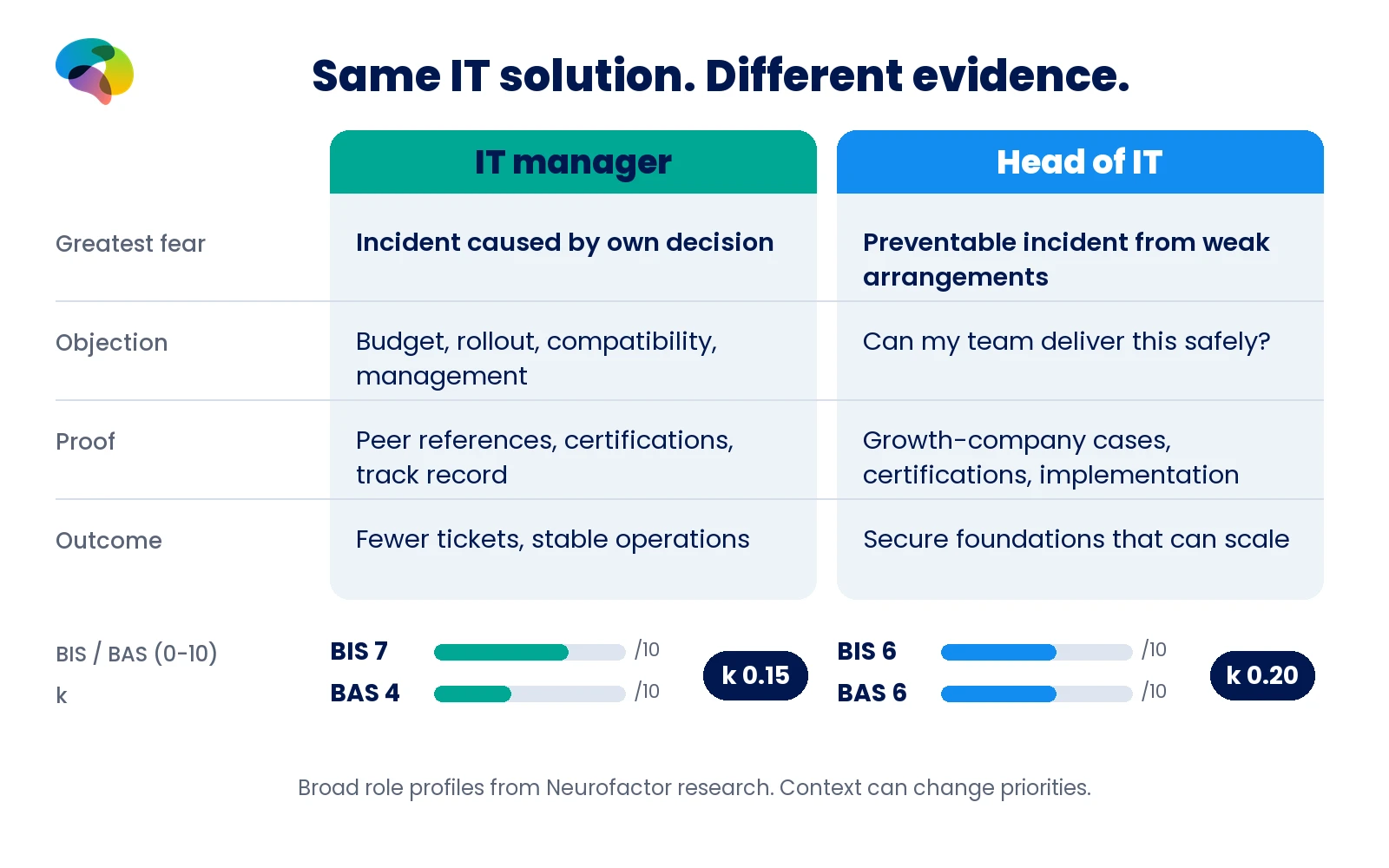
An IT manager and a head of IT may like the same technology and still assess it differently. The IT manager wants to know whether the solution fits current operations and genuinely relieves an already overstretched team. The head of IT asks whether it helps turn ad hoc systems into a professional, secure and scalable environment. Neurofactor's role profiles show BIS 7, BAS 4 and k 0.15 for the IT manager, compared with BIS 6, BAS 6 and k 0.20 for the head of IT.
The commercial implication is straightforward: technical superiority is not enough. For the IT manager, demonstrate limited disruption and manageable support demands. For the head of IT, demonstrate a safe implementation path that makes the next stage of business growth possible.
The same demo. One sees another risk; the other sees a way out of a fragile setup
You are presenting a platform for centrally managing devices, identities and updates. The IT manager asks who will run the implementation, whether existing systems remain compatible and who will handle tickets if something breaks. The head of IT asks whether the platform could finally bring scattered tools under control and create a stable foundation for continued growth.
The features have not changed. The problem the buyer is trying to solve has. In Neurofactor's source profile, the IT manager is overwhelmed by operational work and tickets. The head of IT manages an organically grown environment that lacks sufficient security and scalability. One needs the technology to reduce workload. The other needs it to change how IT is organised.
The decision profiles side by side
| Dimension | IT manager | Head of IT |
|---|---|---|
| Responsibility | Keep existing IT running with a small team and restricted budget | Build or professionalise the IT function while the business grows |
| Main pain | Too many tickets and operational tasks, leaving no time to improve | Organically grown systems no longer sufficiently secure or scalable |
| Underlying cause | Years of underinvestment; staff treat IT as a help desk | No prior IT leadership; ad hoc decisions and shadow IT |
| Emotional strain | Always firefighting, rarely able to improve the environment | Uncertainty about whether the environment is properly secured |
| Greatest fear | Outage or incident caused by the IT manager's choice | A preventable incident caused by poor IT organisation |
| Objections | Budget, implementation time, fit with current systems, who will manage it | Team capacity, security and consequences if something fails |
| Evidence | Comparable references, certifications and a reliable track record | Certifications, growth-company references and a clear implementation case |
| Preferred route | Trusted vendor or peer recommendation, then demo and trial | Peer or vendor recommendation, then demo and implementation discussion |
| Desired outcome | Fewer tickets, stable systems and time to improve | Secure professional IT that grows without constant stress |
What the buyer wants to prevent determines what counts as proof
The IT manager's downside is immediate. Employees need working accounts, devices and networks today. With a small team, even a short disruption or an extra layer of management can consume scarce capacity. A vendor who demonstrates twenty advanced features without addressing the operational impact has not answered the buying question.
The head of IT faces a different exposure. The organisation has outgrown decisions made before IT had clear ownership. Teams have bought their own applications, security responsibilities are fragmented and the current setup may no longer support growth. Staying put is also risky. Technology becomes attractive if it provides a credible route from improvised IT to controlled operations.
The IT manager does not want another platform to run
The source card describes a manager accountable for workstations, networks, applications, security and vendors in a medium-sized organisation. Underinvestment and the perception of IT as a ticket desk have created persistent pressure. Security threats are increasing, while the wider business can underestimate the operational burden.
The compelling promise is therefore documented reliability, good support and a controlled implementation. The actual benefit is fewer incidents, fewer tickets, time back for the team and more satisfied users. Show what work disappears after launch. Who handles exceptions? Who owns incidents? What happens outside normal working hours? These questions may matter more than another feature on the pricing page.
The head of IT needs an organisation that can survive the next growth stage
The source profile concerns an IT leader in a growing business where IT decisions have often been made without central leadership. Shadow IT, scattered cloud subscriptions and improvised security are signs that the operating model has not kept up with company growth.
The desired outcome is a professional, safe environment that can expand without constant firefighting. This role expects guidance, a practical implementation plan and a roadmap. A convincing proposal does not promise to replace everything overnight. It shows which risks to address first, who is responsible and how each step creates a more sustainable operating model.
BIS, BAS and k in the original profiles
| Profile value | IT manager | Head of IT |
|---|---|---|
| BIS (0-10) | 7 - strongly oriented towards avoiding outages and operational risks | 6 - oriented towards avoiding incidents and uncontrolled decisions |
| BAS (0-10) | 4 - seeks opportunities that relieve the team | 6 - seeks opportunities that professionalise IT |
| Delay-discount rate k | 0.15 - lower present preference, controlled change | 0.20 - moderate present preference, influenced by growth pace |
More approach motivation does not mean the head of IT ignores risk
The IT manager's BIS 7 and BAS 4 sit alongside a preference for dependable, proven technology. Change needs to justify its operational cost. The head of IT combines BIS 6 with BAS 6: preventing incidents matters, but so does moving towards a more professional and scalable environment. Neither profile describes a person who likes failures.
The k values are 0.15 and 0.20 respectively. In the broad profile, nearer-term visible results carry somewhat more weight for the head of IT. This is not a fixed purchasing deadline and k is not a conversion probability or percentage. Price, integrations, team capacity, governance and approval authority can change the actual timeline.
Both fear incidents, but their sense of responsibility differs
In the source card, the IT manager's greatest fear is an outage or incident caused by a decision they made. The purchase itself could introduce the failure. Compatibility checks, phased rollout, rollback options and support are therefore part of the value proposition, not implementation details to postpone.
The head of IT fears an incident that should have been prevented with better arrangements. Here the risk also lies in postponing professionalisation. It is not enough to say that your technology is secure. Demonstrate how ownership, access management, back-ups, documentation and escalation will be organised after implementation.
Different evidence should appear first in the sales process
The IT manager asks for references from comparable organisations, relevant certifications and a stable track record. A demonstration and bounded trial help verify fit with the existing environment. If you cannot provide a matching reference, say so and define what a pilot can actually prove. Do not turn hypothetical results into customer evidence.
The head of IT also values certifications, but explicitly seeks references from growing companies and a clear implementation case. A corporate enterprise case can be less useful than evidence that a small IT team can implement the solution while continuing day-to-day operations. Show sequencing, support, responsibilities and measurable milestones.
Objections reveal the missing part of your proposition
"No budget, no time to implement, does it fit our environment, and who runs it?" These are the source-profile objections for the IT manager. Translate them into a scoped compatibility check, transparent resource requirements, support commitments and a controlled transition plan.
"Can my team carry this, is it safe, and what happens when something fails?" The head of IT needs a credible roadmap that includes people as well as technology. Document who implements each phase, how shadow IT is identified, which controls come first and what the fallback options are. A diagram alone is not an implementation guarantee.
Six changes to make to your sales approach
1. Lead with a different risk. Ask the IT manager which incidents and tickets occupy the team. Ask the head of IT which unresolved security or ownership issues growth has exposed.
2. Change the first slide. Show the IT manager operational fit and support. Show the head of IT an achievable maturity roadmap with priorities.
3. Choose relevant proof. For the IT manager, comparable references, operating history and support arrangements. For the head of IT, a growth-company case, security controls and a practical implementation story.
4. Quantify internal effort. Specify what the customer team must do, what the vendor owns and how exceptions are handled.
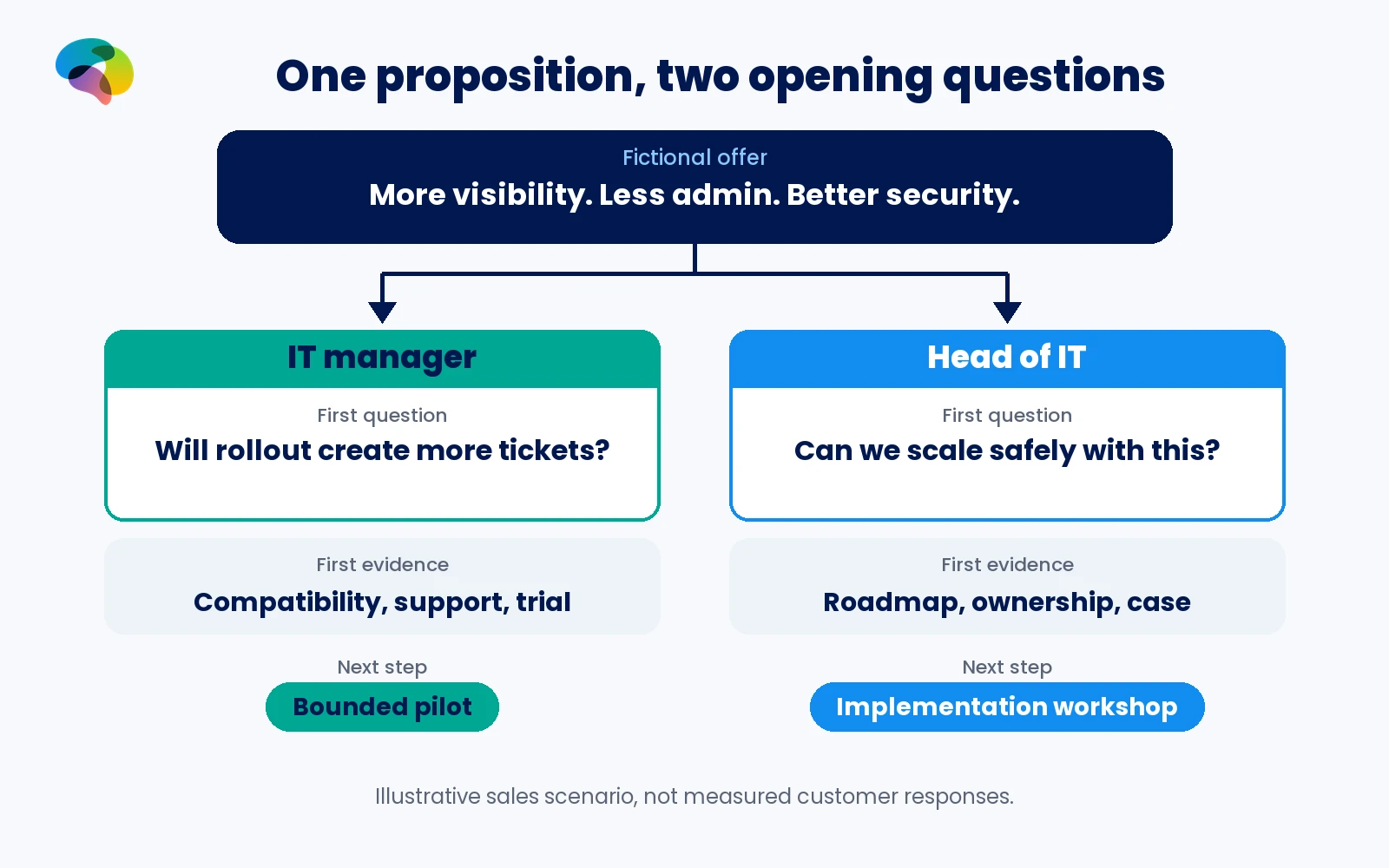
5. Adapt the next step. Offer the IT manager a limited trial in the existing environment. Offer the head of IT an implementation workshop focused on risks and team capacity.
6. Test the real context. Establish the budget holder, decision rights, systems that cannot fail and the associations the specific product creates.
One endpoint management platform, two buying questions
Suppose you offer a platform that centrally manages devices, identities and software updates. Your core proposition is: "More visibility, less manual administration and better security." This is an invented commercial example, not a verbatim research quote or observed customer response.
IT manager: "What if the rollout causes incidents, how many new tickets will we get and who helps my team?" Relevant evidence includes compatibility testing, a limited trial, support obligations and a rollback plan.
Head of IT: "Can this bring disconnected systems under control, assign ownership and help us scale safely without exhausting the team?" Relevant evidence includes a phased roadmap, security ownership model, a growing-company case and implementation support.
The demo can use the same product. The order in which you build confidence should not be identical.
Two opening messages with different promises
To an IT manager: "You need to keep the existing environment running while tickets keep coming. A new management tool must not become more work. We can show you compatibility checks, support arrangements and how to start with a limited test. Which recurring administration task currently consumes the most time?"
To a head of IT: "Your company is growing, but many IT decisions were made before clear ownership existed. We can review the risks, capacity requirements and a phased route towards a secure foundation. Which part of the current setup would you most like to bring under control before the next growth step?"
The first message promises a manageable transition and lower workload. The second offers an accountable path to professionalisation. Neither asks the buyer to accept a generic efficiency claim at face value.
When the same person performs both roles
Not every company employs both titles. In a smaller business, the head of IT may also run the help desk and vendor relationships. In another organisation an IT manager may lead a major transformation. Treat these as broad role profiles, not rigid job descriptions.
If both perspectives are present, build one investment case with two tracks. The operational track covers availability, migration, tickets, support and management hours. The professionalisation track covers governance, security, ownership, roadmap and scaling. Decide which requirements are absolute, who owns the budget and what success will look like after deployment.
The original profiles also describe different mistaken assumptions: the IT manager may treat standing still as safer than changing, while the head of IT may assume the organisation is still too small to require serious security. Good communication makes the cost of inaction as testable as the proposed improvement.
Grounded broad role profiles, not a reading of each individual buyer
These profiles are based on recurring patterns from research Neurofactor has conducted over multiple years among these and comparable audiences. They are therefore substantiated broad function profiles. The BIS, BAS and k values and the qualitative attributes used here come from the existing Neurofactor audience cards. They are not individual test results, percentages or a prediction of every specific purchase.
Industry, company size, regulatory obligations, proposition, price, products and services, decision rights and the buying context can shift priorities. A head of IT in a mature enterprise might focus almost entirely on continuity; an IT manager at a scale-up may be tasked with leading IT professionalisation. A broad role profile provides a starting point, not a substitute for research into your actual offer.
Want to know how IT managers and heads of IT see your product or service? Contact Neurofactor and translate the broad profile into your proposition.
Connect the role profile to your product with an audience and association map
Cybersecurity software, a managed service, a migration project and an AI platform create different associations. The IT manager may see one proposition as extra management work and another as genuine relief. For the head of IT the same offer may promise stronger foundations or introduce unwanted dependence.
Build a proposition-specific audience profile and association map for each role. Examine which brand associations are already present, which losses the buyer expects, what evidence is trusted and who really decides. Translate those findings into a communication strategy grounded in the audience profile. Want to know what these broad profiles look like for your actual product or service? That is where the targeted work starts.
Technical superiority only matters when the change is manageable
The same technology can help both an IT manager and a head of IT. But a better feature list does not answer their core questions. One needs confidence that the running environment will not suffer from a bad decision. The other needs confidence that the business will not keep growing on a fragile IT foundation.
The winning argument is not simply that your technology is better. It is verifiable evidence of what becomes better organised after the decision, who will do the work and which risk the buyer can now reduce.
Key terms
- IT manager
- Manager responsible for day-to-day technology operations, systems, support, security and vendors.
- Head of IT
- Leader responsible for developing the IT function, controls and scalable processes, often in a growing organisation.
- BIS
- Behavioral Inhibition System: a profile dimension describing sensitivity to potential losses and risks.
- BAS
- Behavioral Activation System: a profile dimension describing orientation towards opportunities and rewards.
- Delay-discount rate (k)
- A parameter reflecting the relative value of nearer versus later outcomes, not a percentage or probability of purchase.
- Proof requirements
- The specific evidence a buyer needs to reduce uncertainty about a purchase.
- Shadow IT
- Systems or software adopted outside established IT decision and governance processes.
- Audience profile
- A broad representation of motivations, fears, objections, scores and communication preferences for a defined audience.
- Association map
- A proposition-specific map of the meanings people connect with a brand, product or decision.
Frequently asked questions
What is the main buying difference between an IT manager and a head of IT?
An IT manager prioritises continuity and relief for the operating team. A head of IT prioritises security, professionalisation and the ability to scale. Both require confidence in the change, but for different reasons.
What are their BIS, BAS and k values?
The IT manager profile shows BIS 7, BAS 4 and k 0.15; the head of IT shows BIS 6, BAS 6 and k 0.20. BIS and BAS use 0-10 scales, while k is a separate time-preference parameter, not a purchasing probability.
What does an IT manager fear most when selecting a solution?
The Neurofactor source card identifies an outage or incident caused by the manager's own purchasing decision. Compatibility, reliability, support and controlled deployment therefore matter.
What evidence helps convince a head of IT?
The profile specifies certifications, references from growing businesses and a credible implementation case. This addresses both technical security and the team's ability to deliver change.
Does a higher BAS make the head of IT less concerned about risk?
No. BIS and BAS are both 6 in this profile. Security and professionalisation can be equally important, and the specific context determines their relative weight.
How can I apply these profiles to my own technology product?
Use the broad role data as a starting point, then investigate product-specific associations, objections, decision rights and proof requirements through an audience profile and association map.
Sources
- 1.202609 - LinkedIn doelgroepen - Doelgroepkaarten - Neurofactor.xlsx; worksheet 6 IT & Technologie; IT manager (column D) and head of IT (column G); rows 7-46 - Neurofactor (2026-09)
- 2.Neurofactor 39-article series master sitemap; record NF-BLOG-LI-IT-02 - Neurofactor (2026-10)
This series
Who are you really selling to?Category synthesis
IT does not just buy technology: four roles, four types of riskRead next
Related topics
Reviewed by: Martijn den Otter · Last reviewed: 10/9/2026
Martijn den Otter
Oprichter van Neurofactor. Expert in neuromarketing en consumentenpsychologie.
LinkedIn →