
CIO vs CTO: the same technology, two reasons to say yes
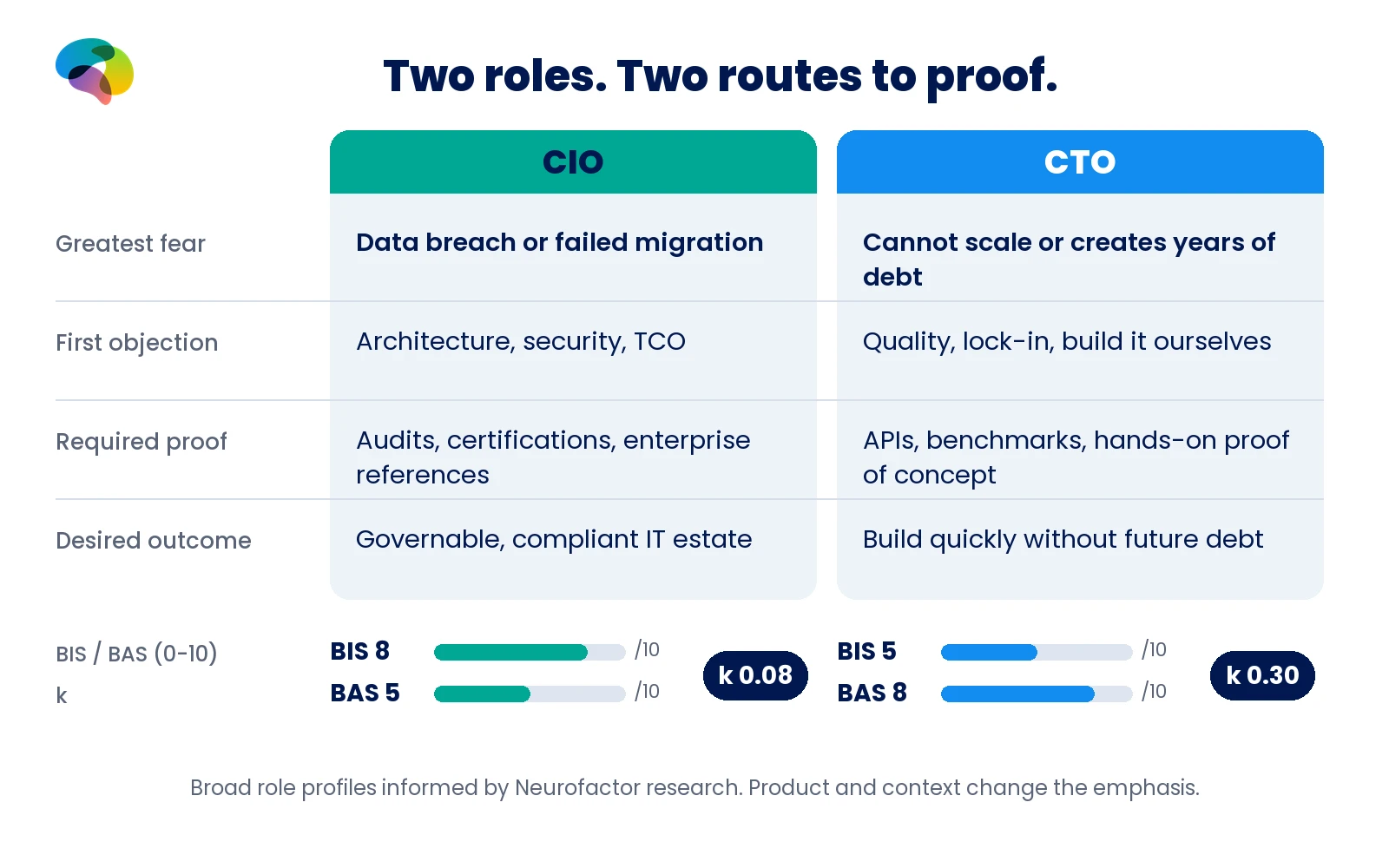
A CIO and CTO may both want the same technology for different reasons. The CIO starts with architectural fit, security and business continuity. The CTO asks whether engineers can build faster and better without inheriting new technical debt. Neurofactor's broad role profiles reflect this distinction: CIO BIS 8, BAS 5, k 0.08; CTO BIS 5, BAS 8, k 0.30.
The sales implication is not necessarily a different product promise. It is a different first question and a different route to credible proof.
The same demo. One sees momentum, the other sees exposure
You demonstrate a new cloud platform. A single integration could help a product team ship features faster. The CTO wants API access and asks when the engineers can run their own proof of concept. The CIO interrupts somewhere else: how does it fit the enterprise architecture, who owns the risk when something fails, and what will it cost over three years?
Those are not two reactions to the same sales trick. They are two different decision problems. The Neurofactor audience profiles describe a CIO who seeks architectural fit, security and compliance, while the CTO seeks engineering speed and scale without creating new technical debt. Same technology. Different meaning attached to the decision.
CIO and CTO: the decision profiles side by side
| Dimension | CIO | CTO |
|---|---|---|
| Accountability | Information strategy, architecture, portfolio and governance | Technology, product, engineering, architecture and teams |
| Main pain | Legacy and complex architecture under pressure to digitise | Technical debt under pressure to ship faster |
| Greatest fear | Security incident, data breach or failed migration | Platform fails to scale or creates years of technical debt |
| First objections | Architectural fit, security, compliance and TCO | Technical quality, lock-in and build-versus-buy |
| Required proof | Enterprise references, certifications, audits, analyst reports | Documentation, open benchmarks, community, CTO peers |
| Preferred route | CIO network and analysts, architecture meeting, RFP | Technical peers and community, hands-on proof of concept |
| Desired result | Controlled, compliant technology estate aligned to strategy | Scalable platform and an engineering team delivering well and fast |
Why a CIO cannot ignore the consequences of a wrong choice
The source profile positions the CIO as accountable for information systems and digital transformation in a larger organisation. Legacy platforms, fragmented applications and competing business-unit requirements turn each purchase into a portfolio decision. The CIO must also defend that decision to executives and oversight bodies. A good demo does not remove that responsibility.
The primary fear is not missing out on the newest technology. It is a security incident, data breach or failed migration under the CIO's watch. Rising licensing costs and business units buying tools without IT add to the pressure to regain control. A supplier who promises speed alone skips the problem that needs solving first.
Open with dependencies, enterprise fit, clear responsibilities and a manageable path to migration. You cannot guarantee zero incidents. You can show how risks are identified, owned and governed.
Why the CTO wants to find out what becomes possible
The CTO in the source profile owns technology and product, often in a technology company or scale-up. Engineering teams must ship faster while earlier architectural shortcuts begin to hurt. The main problem is not a shortage of features. It is the combination of technical debt, delivery pressure and the uncertainty of whether today's stack will survive the next stage of growth.
This is why the CTO asks for transparent documentation, APIs and a hands-on proof of concept. They want to see the limits: what happens under load, how observable is the platform, where does latency rise and how difficult would it be to leave? A black-box demonstration supported by polished commercial claims is often the wrong evidence.
The profile also highlights scarce engineers and increasing cloud costs. A solution can therefore be valuable because it removes complexity, not just because it adds features. Engineers need a way to verify that value themselves.
BIS, BAS and k: three profile values, not two caricatures
The profiles show almost mirrored emphasis on the 0-10 BIS/BAS scales. The separate parameter k describes the discounting of delayed outcomes within a profile. It is neither a purchase probability nor a percentage.
| Profile | BIS (0-10) | BAS (0-10) | k (separate) |
|---|---|---|---|
| CIO | 8 | 5 | 0.08 |
| CTO | 5 | 8 | 0.30 |
BIS points to different kinds of exposure
The CIO's BIS value is 8, with the source explicitly emphasising avoidance of security and compliance risks. The CTO's is 5: more balanced, but still attentive to lock-in and technical debt. It would be wrong to claim that a CTO ignores risk or that a CIO automatically rejects change.
What matters is the negative outcome the proposal brings to mind. For a CIO, a new integration can mean vulnerabilities, uncontrolled data flows or a migration failure affecting the wider business. For a CTO, that same integration may raise questions about vendor dependency, engineering freedom and maintenance work that only becomes visible two years later.
So a credible sales conversation does not offer one generic risk slide. It explains the distinct downside for each buyer and the evidence that would address it. See the greatest fear in an audience profile.
BAS: seeing opportunity is not buying carelessly
With BAS 8, the CTO profile is strongly oriented towards building and improving. That appears not only in the score but also in the preference for engineering quality, team autonomy and products that remain scalable. A well-designed API or a convincing open benchmark can therefore make an immediate difference.
The CIO scores BAS 5. That does not mean innovation is uninteresting. Opportunities become attractive when they demonstrably advance the digital strategy. The CIO is more likely to connect that benefit to governance, portfolio decisions and the ability to defend the investment. Both can want the platform, but they will not necessarily start from the same reason.
Practical implication: let a CTO experience the engineering potential. For the CIO, connect that potential to controlled delivery and a credible strategic business case. The concept of BIS and BAS together helps explain the interaction.
The k values help explain why one sales cadence will not fit both
The CIO profile has k 0.08, a longer planning horizon and relatively infrequent major strategic purchases. The CTO profile has k 0.30 and describes frequent purchases of tooling and cloud services. The interpretation is anchored in responsibilities and purchasing patterns, not in one number alone.
Do not turn k into a stopwatch. A value of 0.30 does not tell you how many days a CTO needs to sign. A critical platform migration can take a long time even when the CTO wants to test quickly. Conversely, an urgent security issue may accelerate a CIO's decision.
The commercial translation is practical: give the CTO a focused technical evaluation with explicit success criteria. Give the CIO a decision pack covering enterprise fit, ownership of risk, total cost and long-term scenarios. For context, see delay-discount-rate k.
Which evidence opens the door for each buyer?
The CIO card explicitly names enterprise references, certifications, security audits and analyst reports. It also calls for architectural fit, security documentation and total cost of ownership. A vendor showing excellent developer experience has not yet demonstrated that the platform can be governed inside an existing enterprise landscape.
The CTO wants technical documentation, open benchmarks, community signals and references from other CTOs. A hands-on proof of concept, access to engineers and clear exit mechanisms are more persuasive than a parade of customer logos without technical depth. The product must be open to scrutiny.
Good evidence is not simply more evidence. Choose the proof that answers the actual objection. For the CIO, build a reviewable architecture and security pack. For the CTO, offer a real test environment, meaningful documentation and agreed performance criteria. Do not claim certifications that are not held or present benchmarks without test conditions.
Objections tell you what your pitch has not yet answered
'Will it fit our architecture, how will it meet our security and compliance requirements, and what is the total cost?' That is the CIO's objection line in the source card. An attractive acquisition price cannot answer questions about integration, ongoing ownership and dependence over the contract lifecycle.
'Is it technically good enough, will we be locked in, and could we build it ourselves?' That is the CTO's objection line. A generic enterprise roadmap will not satisfy a team that wants to know whether its engineers will genuinely work better and retain technical freedom.
Ask a more uncomfortable question: which part of our proposition requires buyers to take our word for it? Replace that leap of faith with something inspectable. For the CIO, run an architecture workshop and share a risk register. For the CTO, define a trial with the buyer's own requirements and a transparent build-versus-buy review. See how to address audience-specific objections.
How to change your marketing and sales approach
First message. Lead with business dependency for the CIO: 'How do you add a cloud capability without increasing exposure and unpredictable lifecycle costs?' For the CTO, open with the engineering tension: 'How can your team ship faster without creating new technical debt?'
First evidence. Show architectural fit, a security overview, operational responsibilities and a relevant enterprise reference to the CIO. Give the CTO API documentation, actual benchmark conditions and a proposal for hands-on evaluation. If these materials do not yet exist, do not invent them. Be explicit about what still needs validating.
Demo. Do not run through twenty features before letting the CIO ask about risk. Map integrations, data flows and owners in advance. Give the CTO room to call an endpoint, inspect performance and challenge the solution with their engineers.
Follow-up. Send the CIO a decision brief containing unresolved risks, TCO assumptions and stakeholders. Send the CTO a test plan with access, technical acceptance criteria and direct contact with engineers. Both discussions may eventually belong to the same buying committee.
One cloud platform, two questions that shape the purchase
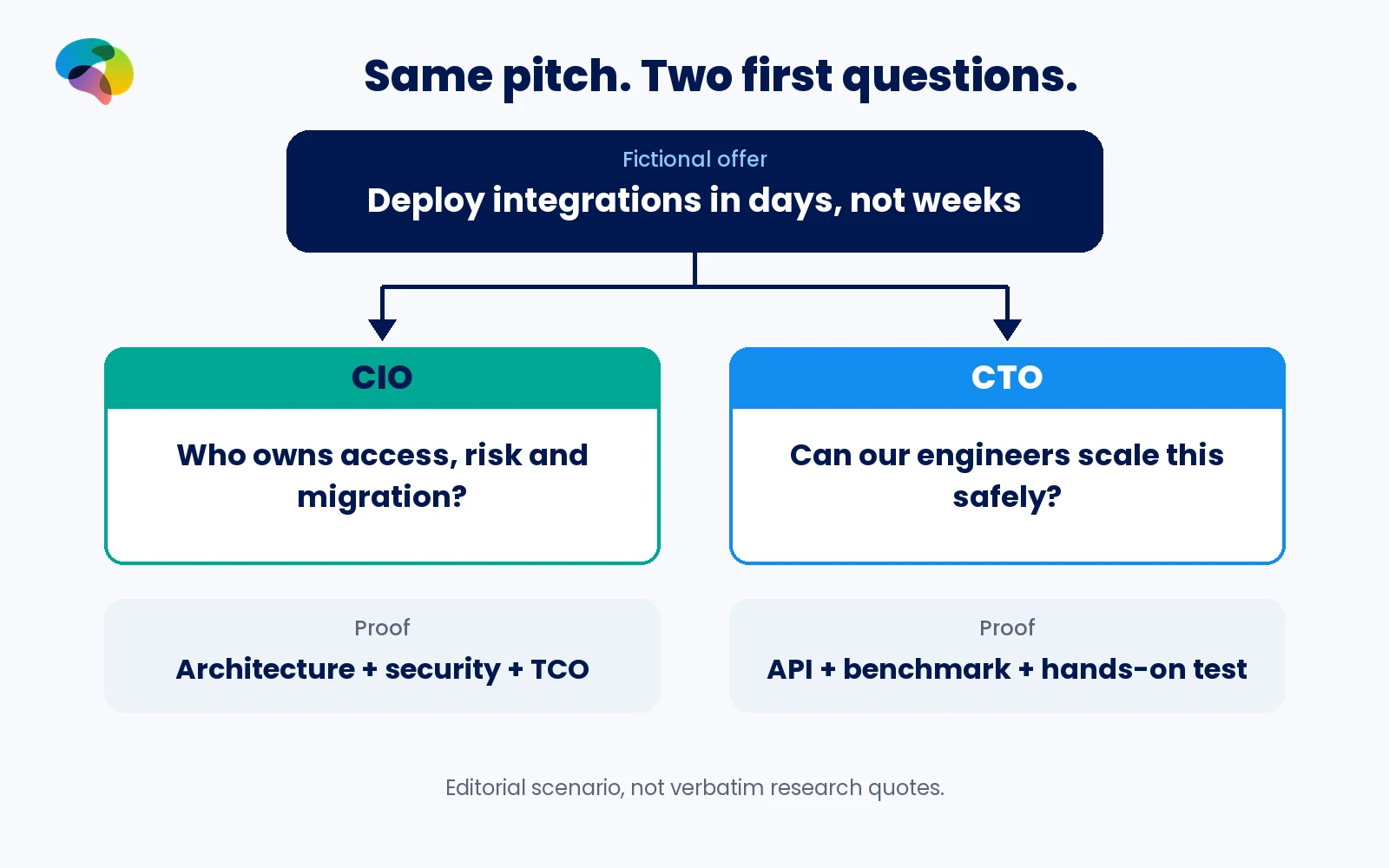
Imagine offering a cloud platform that connects systems faster and reduces custom engineering work. The pitch is: 'Deploy new integrations in days, not weeks.' This is an illustrative, fictional offer to compare how roles may interpret it, not a recorded research quote.
The CIO asks: 'Which applications gain access, what does this mean for our security architecture, and who owns the issue if an integration fails?' Relevant first evidence is a documented architecture and security model, a TCO view and a reviewable migration plan.
The CTO asks: 'How flexible is the API, will my engineers avoid new lock-in and does the platform handle real production load?' Relevant first evidence is a functioning trial, open documentation, transparent benchmarks under agreed conditions and a viable exit route.
You do not need two different product promises. You need two different ways to demonstrate why the same product is worth the decision.
Two opening emails that do not ask the same question
To the CIO: 'You want to modernise without introducing an unmanaged layer of risk. We can walk through architectural fit, the security questions that must be answered and the assumptions behind total cost. Would an initial architecture discussion be useful?'
To the CTO: 'Your engineers need to build integrations faster without inheriting another dependency that will hurt later. You can inspect our API documentation and test the key scenarios in your own proof of concept. Which technical requirement would you want to validate first?'
The CIO email offers a structured decision conversation. The CTO email offers technical validation. These are editorial examples, not measured winning templates, and must reflect what the actual product can prove.
When CIO and CTO belong to the same buying group
Do not turn this into a contest between control and innovation. CIOs can be strong sponsors of technological change, and CTOs can impose demanding security standards. In many organisations the roles coexist and challenge different aspects of the same proposed investment.
Start with one shared outcome, such as faster integration without creating unacceptable dependencies. Build two reviewable workstreams. The governance track covers security, architecture, compliance, accountability, risk and TCO. The engineering track covers APIs, performance, scalability, developer experience, maintainability and exit options.
Agree which criteria are hard gates, which need joint evaluation and who has decision authority. Otherwise an enthusiastic technical trial can fail late because governance was overlooked, while an approved business case can stall because engineers refuse to adopt the product. See the broader category of IT and technology buyers.
These are research-informed role profiles, not traits of every individual
These broad role profiles build on recurring patterns from Neurofactor research conducted over several years with these and comparable audiences. They provide a grounded starting point for understanding differences in motives, fears, evidence requirements and time horizons. The values used here come directly from the existing audience cards. We did not invent a psychological model and then attach BIS, BAS and k scores to it.
They are still generalised profiles. A CIO at a young scale-up may be closer to engineering than the role described here. A CTO in a highly regulated enterprise may spend considerable time on compliance and continuity. Sector, organisational size, proposition, price, product, decision authority and context all influence how a real purchase is evaluated.
The scores are role-level profile values, not personal test results, population averages or guaranteed behavioural outcomes. Nor is this article a report of a specific EEG test on CIOs and CTOs. For greater relevance to your offer, connect the broad role profile to a specific audience profile and association map.
Want to know how CIOs and CTOs see your product or service? Contact Neurofactor and translate the broad profile into your proposition.
How to tailor the comparison to your actual technology
Use the broad profiles as a first communication framework, then establish which associations your own product activates. A cybersecurity service brings different concerns to mind than a developer platform, an AI assistant or an enterprise resource planning replacement. One CIO may view a proposition as a necessary security improvement while another sees a significant integration risk.
Make the next step specific. For each role, find out which outcome matters, which loss must be avoided, which existing alternative is preferred and which proof genuinely reduces uncertainty. Put the same proposition and the same objections in front of the relevant audiences. Look for common approval criteria as well as role-level differences.
The translation from audience profile to communication strategy becomes useful when you know what your specific product means to the buyer. Wondering what a CIO or CTO profile looks like for your service? Combining the audience profile with an association map is how you move beyond a general job title.
A CIO does not want less progress. A CTO does not want less certainty
The mistake is not presenting the same technology to two IT leaders. It is assuming they need the same first reason to believe. For the CIO, progress must remain governable. For the CTO, technology must enable better engineering without sacrificing the team's freedom.
A strong IT proposition does more than show what a product can do. It demonstrates which risks are controlled, which capabilities become possible and why those outcomes matter to this particular decision-maker. One product can satisfy both roles, but rarely through an identical route to proof.
Key terms
- CIO
- Chief Information Officer, responsible for information systems, digital strategy, portfolio and governance.
- CTO
- Chief Technology Officer, responsible for technology, product architecture and engineering capability.
- BIS
- Behavioural Inhibition System; a profile lens for sensitivity to negative outcomes and risk avoidance.
- BAS
- Behavioural Activation System; a profile lens for opportunities, reward and approach behaviour.
- Delay-discount-rate (k)
- Profile parameter for discounting delayed outcomes relative to earlier ones; not a probability or percentage.
- Technical debt
- Future complexity, remediation or maintenance burden created by previous technical decisions.
- TCO
- Total cost of ownership, including acquisition, integration, running costs, maintenance and exit.
- Proof of concept
- A limited practical evaluation against defined technical or operational criteria.
- Audience profile and association map
- A broad decision profile combined with associations related to a specific product or service.
Frequently asked questions
What is the main difference between CIO and CTO buying priorities?
A CIO is typically accountable for enterprise fit, governance, continuity and strategic exposure. A CTO more directly assesses engineering quality, delivery speed, scalability and lock-in. Those concerns can overlap in the same buying group.
What are the CIO and CTO BIS, BAS and k values?
The CIO profile has BIS 8, BAS 5 and k 0.08. The CTO profile has BIS 5, BAS 8 and k 0.30. These are broad Neurofactor role-profile values, not individual measurements. BIS/BAS are on a 0-10 scale; k is separate.
Which evidence is most relevant to a CIO?
Architectural fit, reviewable security controls, audits, relevant certifications, enterprise references and a transparent TCO and migration approach align with the source profile.
Which evidence does a CTO want to inspect?
Technical documentation, APIs, open benchmarks, access to engineers and a hands-on proof of concept to evaluate scalability, performance and dependency risk.
Do CIO and CTO need different products?
Not necessarily. One technology can meet both sets of needs, but the first concern, the demonstration and the convincing evidence may differ.
Does this describe every CIO and CTO?
No. These are generalised, research-informed function profiles based on recurring Neurofactor patterns. Industry, company size, product, price, authority and decision context can change the emphasis. An audience profile and association map tailor the analysis.
Sources
- 1.202609 - LinkedIn doelgroepen - Doelgroepkaarten - Neurofactor.xlsx, tabblad 6 IT & Technologie, CIO (kolom E) en CTO (kolom F), rijen 7-46 - Neurofactor (2026-09)
- 2.Neurofactor master-sitemap blogserie 39, NF-BLOG-LI-IT-01 - Neurofactor (2026-10)
This series
Who are you really selling to?Category synthesis
IT does not just buy technology: four roles, four types of riskRead next
Related topics
Reviewed by: Martijn den Otter · Last reviewed: 10/9/2026
Martijn den Otter
Oprichter van Neurofactor. Expert in neuromarketing en consumentenpsychologie.
LinkedIn →