

The person with the greatest urgency may not have the mandate
The controller wants fewer manual steps at the next month-end. The finance director needs a change that fits the budget and will not disrupt reporting. The CFO wants to know how the same investment delivers financial value without introducing unacceptable risk. That is why selling to finance takes more than one business case.
The original Neurofactor profiles put the difference in time preference into focus: controller k 0,25, finance director 0,15 and CFO 0,08. The lesson is not that one person buys quickly and another slowly. It is that evidence must travel from a user's operational problem to a leader's implementation plan and finally to a defensible investment decision.
The person feeling the pain is not always the person who can sign
It is the fourth working day after month-end. A controller exports data from three systems, cleans columns and checks whether the numbers reconcile. A supplier demonstrates how much of that routine can be removed. The response seems obvious: this would finally make the job easier.
But interest is not purchasing authority. The controller may have discretion over a small subscription, yet larger decisions typically move to a finance director or CFO. Those stakeholders are not simply harder to convince. They face different responsibilities. The finance director asks whether the change fits existing systems, team capacity and this year's budget. The CFO examines overall return, financial exposure and accountability.
The sales mistake is treating the person with the most urgent problem as the sole buyer. A controller can become your strongest internal supporter. That only helps if you equip them to explain the case to the people responsible for implementation and capital allocation.
Three finance roles, three tests for the same investment
This comparison is based on the original Finance target-group cards: pain points, fears, objections, desired outcomes, evidence and preferred routes. Descriptions have been shortened editorially without changing their meaning.
Core pain
- Controller
- Manual Excel work and recurring data cleaning
- Finance director
- Slow, labour-intensive processes
- CFO
- Inadequate timely, reliable financial visibility
Biggest fear
- Controller
- Incorrect figures cause a bad management decision
- Finance director
- Overrunning implementation, escalating cost and unreliable figures
- CFO
- Investment fails to pay off or creates financial harm
Desired outcome
- Controller
- Faster month-end and more time for analysis
- Finance director
- Reliable close, smooth processes and controlled cost
- CFO
- Financial control, justified returns, sound company value
Required proof
- Controller
- Demo using own data, verified integrations, controller peers
- Finance director
- Quantified savings and close times, sector peers
- CFO
- Transparent business case, CFO references, certifications
Preferred route
- Controller
- Webinar or fellow controller, then data-based demo
- Finance director
- Peer or accountant referral, then demo and implementation discussion
- CFO
- Introduction through accountant, bank or CFO peer, then substantive business-case discussion
Authority
- Controller
- Limited discretion on major investments
- Finance director
- Can decide within mandate, coordinates with managing director
- CFO
- Financial accountability to leadership, owners and supervisory parties
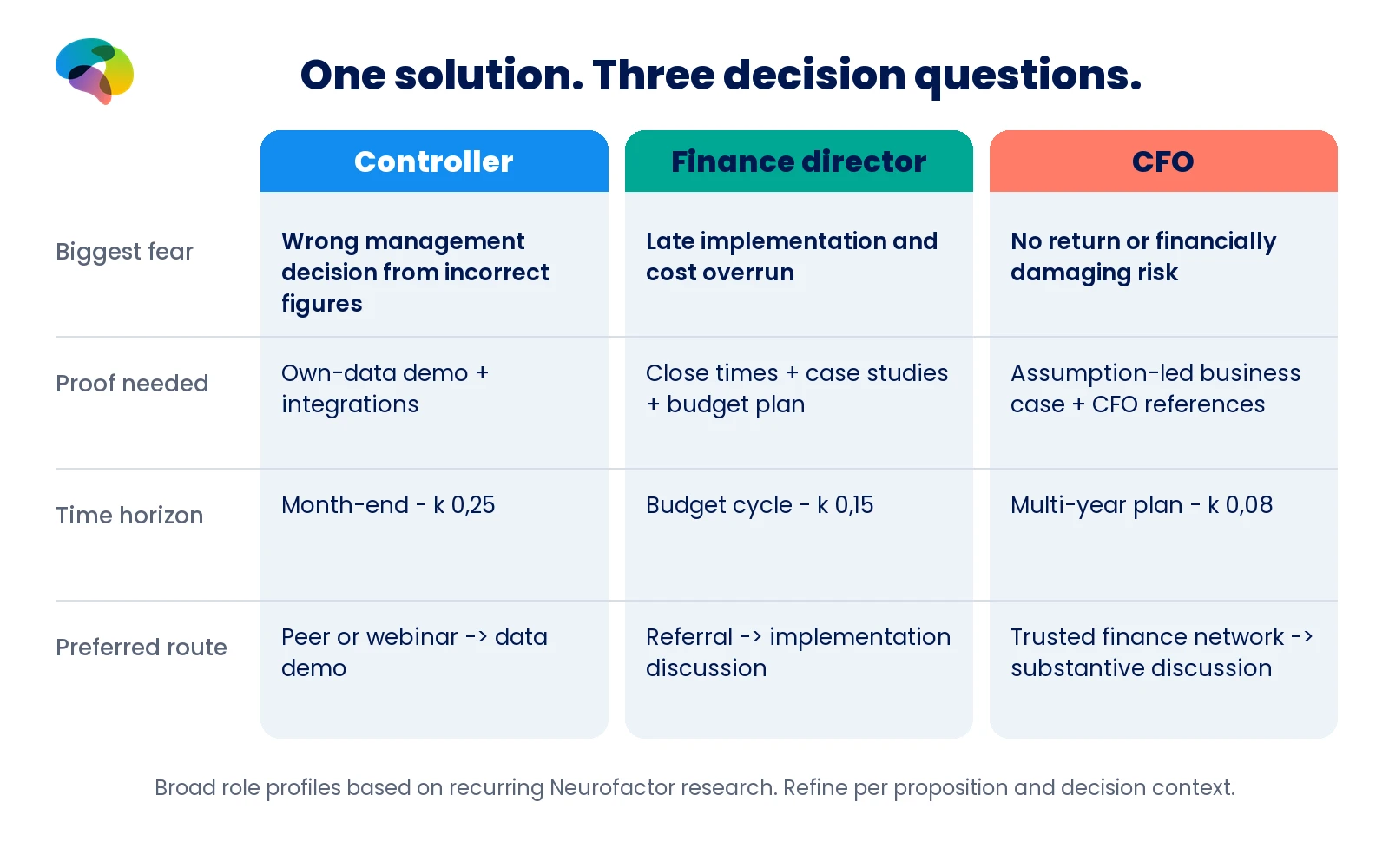
Controller: credibility starts with the actual spreadsheet
The card describes a controller caught between the information demands of the business and what finance systems can deliver. The underlying problem is fragmented systems and data that repeatedly needs cleaning. The biggest fear is not missing a nice new feature; it is an error in the numbers that causes management to make the wrong decision.
A generic ROI calculator is rarely the best first proof for that role. Show a demo on securely supplied company data or a representative sample. Demonstrate what steps disappear, how reconciliation works, how exceptions are flagged and which ERP integrations are established. Ask which report they struggle to deliver ahead of management meetings.
A useful first step may not be a purchase at all. It may be a clear problem inventory that lets the controller explain internally where time is lost and which risks the proposal would reduce.
Finance director: savings only count if the plan works
The finance director is responsible for financial processes, reliable figures and team workload. The source card points to outdated systems, missing integrations and too much processing work. Its objections are concrete: will it fit existing systems, how much does implementation cost, and what happens if the project slips?
Do not sell only the ideal destination. Make the route testable. Specify involved systems, the effect on month-end, the workload required from the internal team, implementation cost and what is fixed contractually. Provide close-time comparisons and similar-system references if you actually have them.
This role also operates within a budget cycle and defined authority. A decision that falls inside the finance director's mandate can follow a different route from one requiring the managing director or CFO. Establish that decision path before preparing the final proposal.
CFO: the proposal must survive financial scrutiny
For the CFO, the cards emphasise financial health, company value and risk management. The biggest pain is insufficient timely, dependable information for steering the business. Regulatory, banking and reporting requirements add another layer. The most serious fear is an investment that fails to deliver or an exposure that harms the organisation.
A deck featuring hours saved is therefore incomplete. Show total cost across licensing, implementation, internal capacity, maintenance and migration, along with the cost of doing nothing. Separate documented outcomes from assumptions. Make downside scenarios visible, including what happens if adoption or integration is slower than expected.
The source card highlights introductions through accountants, banks and fellow CFOs. That is not a universal rule for reaching every CFO. It does suggest that trusted references and independent credibility belong early in the sales strategy rather than at the end.
BIS, BAS and k: one category, three time horizons
These values come directly from rows 44-46 of the Finance cards. BIS and BAS use separate 0-10 scales. k is a different parameter describing the relative weighting of sooner versus later outcomes within the profile model. It is not a percentage, purchase probability or personal diagnosis.
BIS (0-10)
- Controller
- 7
- Finance director
- 7
- CFO
- 8
BAS (0-10)
- Controller
- 5
- Finance director
- 5
- CFO
- 4
k (separate scale)
- Controller
- 0,25
- Finance director
- 0,15
- CFO
- 0,08
What k changes is the order of your evidence
The cards give k 0,25 for the controller, 0,15 for the finance director and 0,08 for the CFO. Those values fit the different moments when results become meaningful: the next closing cycle, the current budget year and a multi-year financial plan. They do not define fixed purchasing deadlines. A CFO confronted with immediate liquidity or fraud exposure may act very quickly.
You can, however, change your presentation sequence. Start with the next closing cycle for the controller. For the finance director, address budget, implementation and process KPIs. For the CFO, lead with total value, assumptions and risk scenarios before descending into operational details.
Likewise, high BIS does not mean all three reject change. Their avoidance concerns differ: incorrect figures for the controller, implementation overrun for the finance director, and broader financial harm for the CFO.
One reporting platform, three different conversations
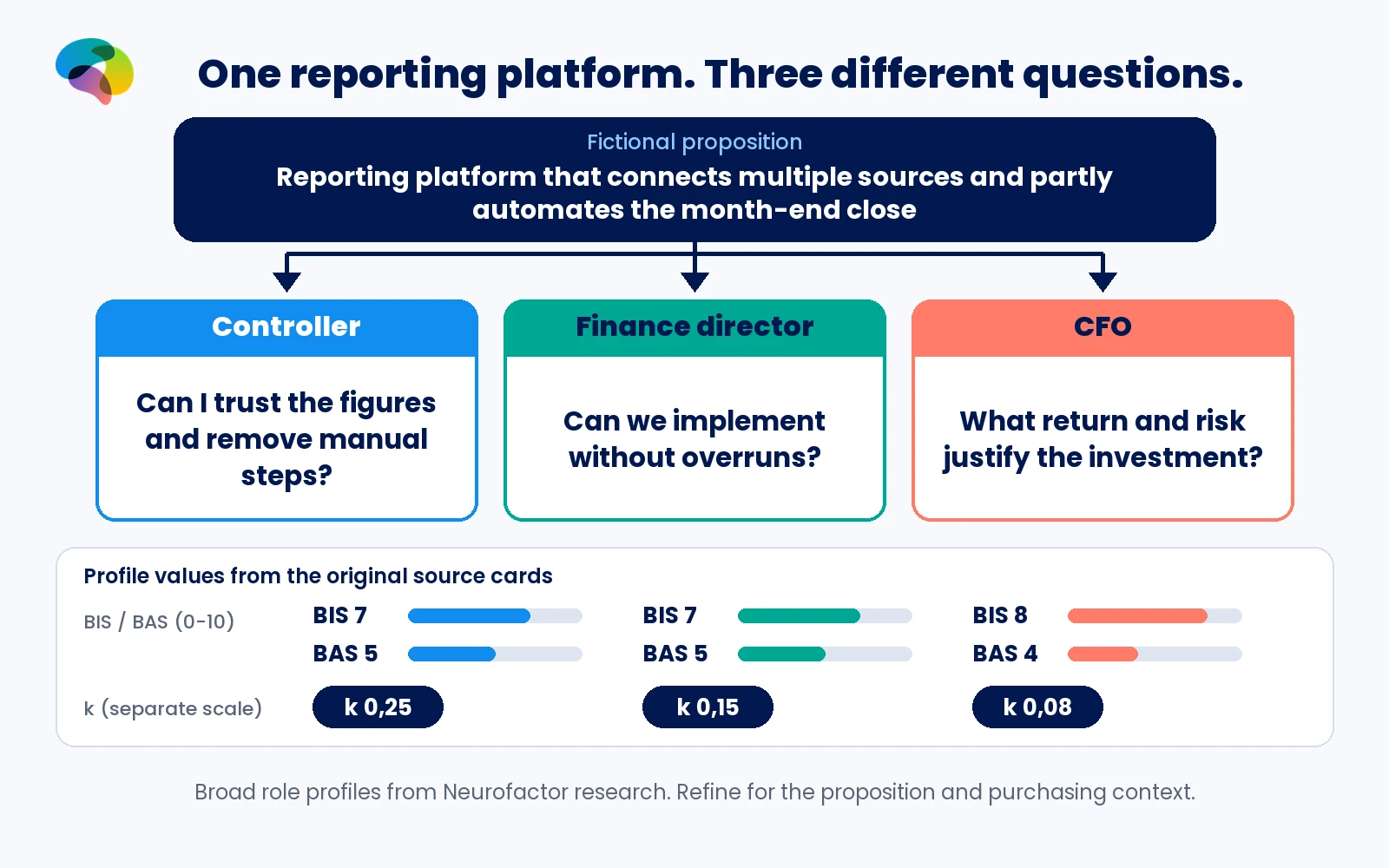
Imagine selling a platform that combines reports from multiple systems and automates parts of month-end. This is a fictional sales example, not an observed Neurofactor case or EEG finding.
The controller asks: 'Can I reconcile exceptions faster and still verify the figures?' The finance director asks: 'What will deployment cost, can we keep closing on schedule and will the team actually gain capacity?' The CFO asks: 'What return will this produce over the whole contract period, what risks are covered and how reliable will the management information be?'
Same software. Different conditions for taking the next step. Sending all three the same demo and same efficiency claim creates confusion. Keep the core proposition, but adapt the supporting evidence and the next decision.
Build a finance business case that can travel internally
Treat the purchase as a chain of decisions. Each role needs enough evidence to answer its own question and pass the proposal on responsibly.
- With the controller, map the files, corrections and checks that consume time or undermine confidence.
- Use a limited test with securely shared or anonymised data. Distinguish observed time saved from forecast future savings.
- For the finance director, translate findings into integrations, staffing, implementation milestones, fixed and variable cost, and month-end continuity.
- For the CFO, prepare a transparent case with total cost of ownership, assumptions, risk, alternatives and a lower-adoption scenario.
- Identify the true budget and sign-off authority. Do not treat the controller as the owner of a decision that sits elsewhere.
- Match the introduction: practitioner demo for controllers, informed peer referrals and implementation discussion for finance directors, credible introduction and financial case for CFOs.
Three useful opening lines for one proposition
These are editorial examples based on the cards' language anchors, not quotations measured in a campaign.
- Controller: 'How many manual reconciliations sit between your source files and the board report each month?'
- Finance director: 'What would change if month-end became more predictable without adding pressure to your team or budget?'
- CFO: 'What assumptions support the claim that this investment improves financial visibility and generates an acceptable return?'
- Internal handover: 'The pilot shows which manual steps can be removed; the next decision is about deployment risk, total cost and governance.'
Do not turn your champion into an unpaid salesperson
Winning internal support seems sensible. But there is a limit. The card gives the controller restricted purchasing authority and a heavy existing workload. Asking them to produce a lengthy internal sales case adds work to the very role you promised to help.
Make handover light: a one-page summary of the current problem, the test outcome, required integrations, implementation impact and open questions. Involve the finance director in the cost and deployment work. Once those elements hold up, a CFO discussion becomes more valuable.
In some organisations the CFO joins from the start; elsewhere the finance director can sign within their mandate. The cards describe patterns, not universal reporting structures.
From a broad finance profile to the buyer of your offer
These role profiles draw on recurring patterns across several years of Neurofactor research involving these and comparable audiences. They provide research-informed broad functional profiles, not a prediction about every CFO, finance director or controller. Sector, company size, price, the specific product or service, existing systems and purchasing context can all change the associations, risks and evidence that matter.
Broad profiles are the starting point rather than the final targeting decision. Use a target-group profile and association map to explore what your particular proposition evokes, who experiences the urgent problem, who can sponsor the purchase and what proof resolves their concerns. BIS, BAS and k are dimensions within these profiles, not individual diagnoses, EEG measurements or measured probabilities of purchase. In smaller firms, roles may overlap; in larger organisations, procurement, IT and risk functions may join the decision.
Want to know how controllers, finance directors or CFOs view your product or service? Contact Neurofactor and have the broad profile translated to your proposition.
LinkedIn: lead with the question each role owns
These three roles should not receive one generic 'finance transformation' message. A controller is more likely to find detailed month-end, reconciliation and analysis content relevant. A finance director weighs budget discipline, team capacity, integration and reliability. The CFO is better served by rigorous analysis of return, cash flow, compliance and downside exposure.
The cards also describe different preferred routes: practitioner webinars or peers leading to a hands-on demo for the controller; peer or accountant recommendations followed by implementation discussion for the finance director; and a trusted financial network introduction for the CFO. These are source-card preferences, not measured LinkedIn conversion rates.
So do not write three posts that change only the job title. Change the underlying question. For more depth, review evidence requirements, buyer objections and time preference k.
When the user, problem owner and budget owner align
It can be tempting to start with the controller, secure enthusiastic feedback and immediately request a CFO presentation. The cards suggest a more robust sequence. First validate which errors or manual tasks actually disappear. Let the finance director judge whether implementation and budget make sense. Then present the investment to the right decision-maker.
This changes your proposition. For the controller, sell fewer avoidable manual steps. For the finance director, a more dependable process. For the CFO, a decision that can withstand financial challenge. One product must answer three different accountability questions.
The follow-up articles CFO versus controller and CFO versus finance director explore those handovers in depth.
The person in the greatest hurry does not always hold the pen
Finance does not purchase time savings, efficiency and return as three unrelated products. The controller sees the error-prone task, the finance director the process that must keep running, and the CFO the capital and risk that must be justified.
If you only win the controller's enthusiasm, you do not yet have an approved business case. If you only speak to the CFO, you may miss the daily problem that makes the case credible. The strongest finance pitch starts with work that truly changes and ends where the investment can be defended.
Key terms
- Controller
- Finance specialist responsible for reports, forecasting, budgets and analysis, often influencing but not approving major purchases.
- Finance director
- Senior finance leader responsible for processes, the finance team and budgets, making decisions within a defined mandate.
- CFO
- Chief financial officer: senior executive accountable for financial health, capital, risk and reporting to leadership and owners.
- BIS
- Behavioral inhibition system: within this profile model, the weighting of possible adverse outcomes, shown on a 0-10 scale.
- BAS
- Behavioral activation system: within this profile model, orientation towards attractive outcomes, shown on a 0-10 scale.
- Delay-discount-rate (k)
- A parameter for how future outcomes are relatively discounted compared with earlier ones; not a probability of purchase or a percentage.
- Decision authority
- The formal ability to approve an investment under budget and accountability rules.
- Evidence requirement
- The data, demonstrations or references needed to make a proposed solution credible and decision-ready.
- Target-group profile
- A structured view of an audience’s problems, motivations, anxieties, objections and preferred routes.
- Association map
- Research into the meanings and associations an audience attaches to a particular proposition.
Frequently asked questions
How do you sell to finance when the controller does not own the budget?
Work with the controller to validate the operational problem and proof, then involve the finance director for delivery and budget and the CFO where financial authority or risk requires it.
How does a CFO differ from a finance director?
The CFO focuses on total financial value, capital and risk. The finance director focuses more on dependable processes, finance team efficiency and implementation within budget.
What evidence does a controller need?
The source card emphasises a demo on their own data, proven integrations and references from fellow controllers. Demonstrate actual month-end improvements.
Why is CFO k 0,08 while controller k is 0,25?
The broad profile describes a stronger multi-year orientation for the CFO and relatively greater weight on earlier results for the controller. It does not determine when a particular person will purchase.
Should you contact the CFO or finance director first?
It depends on organisational structure and authority. Establish the operational problem, implementation responsibility and decision mandate before selecting a route.
Do these profiles apply to every finance professional?
No. They are research-informed broad role profiles drawn from recurring Neurofactor studies. The specific product, price, sector and context require refinement through target-group and association mapping.
Sources
- 1.Behavioral Inhibition, Behavioral Activation, and Affective Responses to Impending Reward and Punishment: The BIS/BAS Scales - Carver & White / Journal of Personality and Social Psychology (1994)
- 2.Time Discounting and Time Preference: A Critical Review - Frederick, Loewenstein & O'Donoghue / Journal of Economic Literature (2002)
Related topics
Reviewed by: Martijn den Otter · Last reviewed: 10/9/2026
Martijn den Otter
Oprichter van Neurofactor. Expert in neuromarketing en consumentenpsychologie.
LinkedIn →