
CFO vs finance director: when does financial proof become strategic proof?
A finance director wants to know whether a solution can be implemented within budget and without disrupting reporting. A CFO asks whether that same investment provides a defensible return without putting the company at unnecessary financial risk. A good implementation case is therefore not automatically a compelling investment case.
This article compares the original Neurofactor role profiles and shows how to build both levels of proof from one coherent proposition.
A business case can be financially sound and still fail the CFO test
A finance director is considering a new platform to automate month-end reporting. The integration approach is clear, the project seems to fit this year's budget and fewer hours spent on processing look achievable. From the finance director's perspective, there is a practical case for moving forward.
The same proposal reaches the CFO. Now the questions change. What if deployment takes longer, forecast savings do not materialise or the investment ties up funds that could be allocated elsewhere? The CFO can recognise the process improvement and still question whether the investment is justified for the business as a whole.
This is where selling one generic finance business case falls short. One decision requires evidence of operational feasibility. The other requires a defensible judgment about returns, total costs and financial risk. They are connected, but they are not identical.
Two finance leaders, two standards of proof
| Dimension | Finance director | CFO |
|---|---|---|
| Responsibility | Planning, budgets, reporting, finance processes and team performance | Financial health, capital, risk, compliance and accountability |
| Main pain point | Laborious systems and processes consume too much time and staff capacity | Insufficient timely, reliable information for financial steering |
| Cause | Legacy systems, missing integrations and a team absorbed by transaction processing | Fragmented systems and business units, manual financial reporting |
| Emotional pressure | Always catching up using outdated tools | Fear of an irreparable financial surprise |
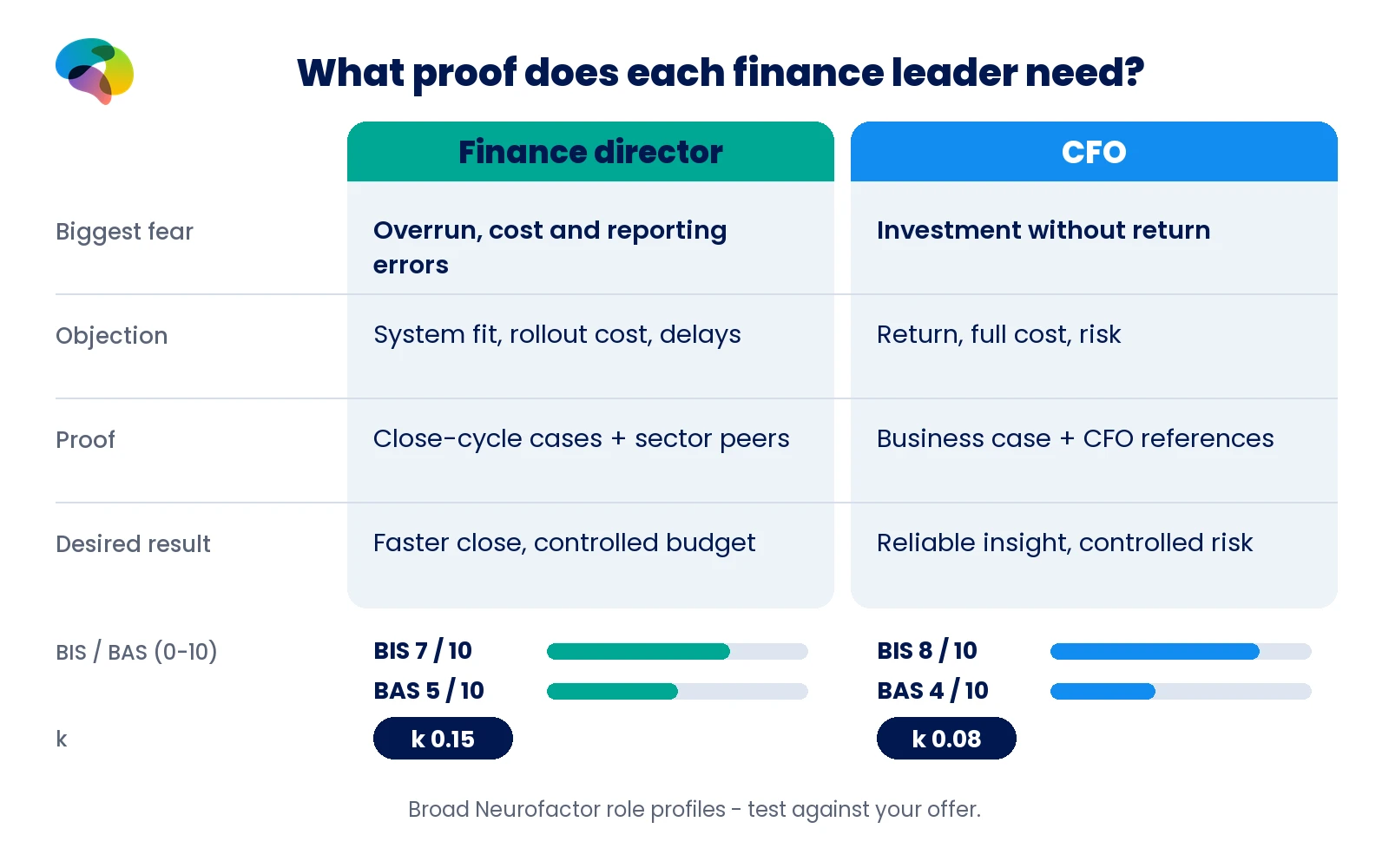
| Biggest fear | Delayed implementation, escalating cost and unreliable financial figures | An investment that fails to return value or financially harms the business |
| Objection | System fit, implementation cost and overruns | Return, full cost, risk and whether the investment is necessary |
| Proof | Savings and close-cycle evidence, references from finance directors in the same sector | Quantified business cases with assumptions, CFO references, relevant certifications |
| Desired state | A smoothly running finance function with quicker close and controlled costs | Reliable, timely insight, controlled risk and financial resilience |
| Preferred route | Recommendation from a peer director or accountant, then demo and implementation discussion | Introduction through accountant, bank or fellow CFO, then substantive business-case discussion |
They are not trying to prevent the same failure
The finance director's primary problem in the original profile is the number of hours and people required to run financial processes. Qualified finance staff are expensive and difficult to find. A better system is attractive, but only if its introduction does not damage reporting quality or create an additional project that the team cannot manage.
The CFO is accountable for a wider financial picture. The source profile identifies lack of timely, trustworthy information as a major pain point. Yet the largest feared downside is investing in something that does not pay back, or accepting a risk that can harm the organisation financially. There is also accountability to shareholders, lenders and other stakeholders.
This produces two entirely different decision questions. The finance director asks whether improvement is achievable without losing control of the operation. The CFO asks whether it deserves priority in the investment portfolio and leaves the organisation financially better off.
The finance director needs a controlled change, not another troubled rollout
The profile points to outdated systems, missing integrations and teams trapped in repetitive processing. Previous attempts such as standalone applications, temporary staffing and outsourcing without control have not consistently solved the underlying problem. One mistaken assumption is that buying new software will automatically improve the processes.
That makes an elegant product demo insufficient. The finance director wants to know which ERP integrations actually exist, who owns migration, how exceptions are handled and how much time the finance team must commit during implementation. The source specifically points to a practical plan, clear timing and a fixed or transparent implementation price.
If the rollout slips, will the team have to maintain parallel reports? Who signs off the first close on the new platform? Can the business recover when something goes wrong? These are useful practical questions for a sales discussion, not verbatim participant quotes.
For the CFO, the platform is a capital allocation decision
The CFO is looking for reliable financial information, controlled risk and the ability to fund the business strategy. The profile emphasises return for every euro invested, compliance and a stronger position with shareholders and banks. A solution that fits the finance director's departmental budget may still compete with other business-wide priorities.
The CFO's stated objections are straightforward: what is the return, what are the full costs, what are the risks and do we genuinely need this? The profile also mentions ERP projects that overran and cost programmes without lasting results. A glossy ROI estimate with hidden assumptions is therefore much less useful than a transparent calculation.
Separate demonstrated effects from plausible estimates and from benefits that cannot credibly be monetised. Compare the investment with realistic alternatives, including maintaining the current process. The strategic question is not only what changes but what that change is worth compared with the available options.
The original profile scores support this distinction
| Profile measure | Finance director | CFO |
|---|---|---|
| BIS - 0 to 10 | 7 - avoids overruns, extra costs and reporting errors | 8 - strongly focused on avoiding financial risk |
| BAS - 0 to 10 | 5 - values efficiency opportunities | 4 - requires a clear return before pursuing opportunity |
| Delay-discount rate k - separate measure | 0.15 - low time preference, works within budget cycles | 0.08 - very low time preference, thinks across financial years and multi-year plans |
These values describe broad Neurofactor role profiles. They are not population-wide measured averages, individual diagnoses, buying probabilities or predicted decision dates. The k parameter is not on the BIS/BAS scale.
A lower k does not mean the CFO always decides more slowly
The finance director has k 0.15 and the CFO k 0.08 in the source profiles. A lower delay-discount rate describes less relative devaluation of future outcomes. The finance director has a stronger connection to budget cycles; the CFO tends to consider several financial years and the organisation's longer-term financial position.
This does not mean that a CFO needs more meetings before making a decision. An immediate liquidity threat or serious compliance exposure can require rapid action. Equally, a finance director may postpone a system change if the next reporting cycle would be at risk. The figures concern broad time preferences, not approval speed.
For your communication, make the transition plan, workload and near-term milestones tangible for the finance director. For the CFO, add longer-term total ownership cost, financing implications, downside scenarios and value over time.
Operational proof comes first for the finance director
The original profile explicitly calls for case studies showing savings and shorter closing times, supported by references from finance directors in the same industry. Start with the process that currently consumes the team's effort. Identify manual steps, the number of corrections, review controls and how close-cycle performance would be tested.
Do not gloss over deployment. Provide a credible map of system integrations, migration responsibilities, training needs and implementation capacity. A transparent timeline also needs to make space for exceptions and fallback procedures. If the team needs to keep legacy reports running in parallel, show that work in the project plan.
The finance director needs more than confidence that the software works in a supplier environment. They need evidence that their own team can adopt it while producing reliable financial figures. That is why sector-relevant implementation references can outperform broad promises of transformation.
Investment proof comes first for the CFO
The CFO profile identifies quantified business cases, references from experienced CFOs and relevant certifications as important proof. This requires a different financial frame. Present licence and setup costs alongside migration, internal staff time, controls, ongoing administration, training and foreseeable risk exposure.
Offer a defensible base case and a downside case. Distinguish measurable cash effects from hours released and from wider operational benefits. Savings in staff time are not automatically cash savings; that difference should be made explicit rather than buried in a headline ROI number.
Then connect the result to the board-level priority: more reliable steering information, improved control, greater resilience or capital that can be directed to higher-value activities. The CFO must be able to explain not just why the implementation might succeed, but why this investment is worthwhile now.
Turn process evidence into an investment case in six steps
- Identify the finance process creating the most waste, errors or delayed management information.
- With the finance director, establish a baseline for time, corrections, integrations and realistic delivery capacity.
- Use a limited demonstration or pilot to validate operational claims and agree clear acceptance criteria.
- Build a full-cost model for the CFO and keep hard savings distinct from assumptions and qualitative value.
- Include operational and financial risks, alternatives, ownership and a credible downside scenario.
- Ask each stakeholder for the right next decision: an implementation step from the finance director, and an investment-priority decision from the CFO.
The bridge from efficiency to strategic value is not a bigger sales promise. It is a transparent link between verified operational change and the financial outcome that is relevant for the organisation.
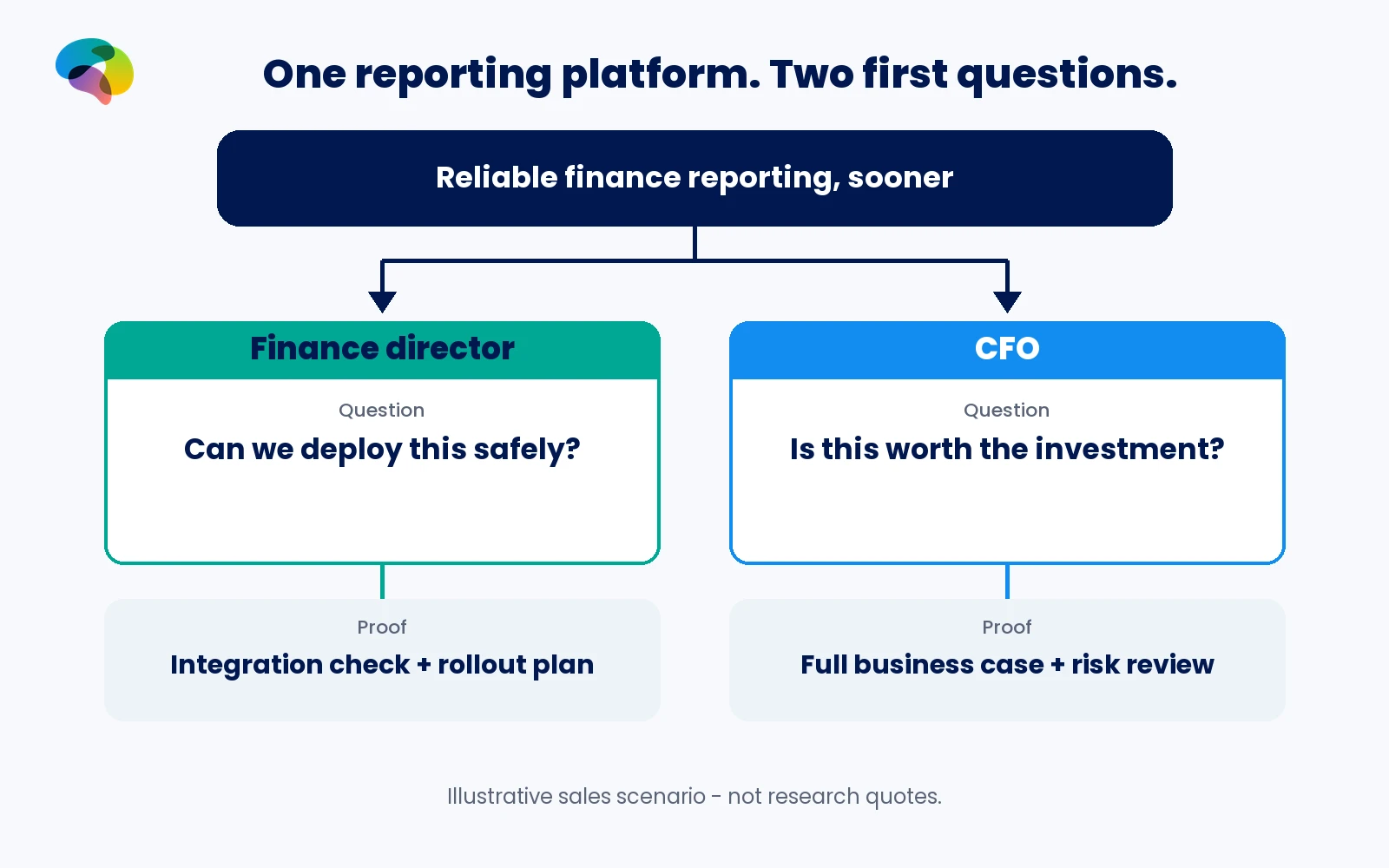
One finance reporting platform. Two very different questions
Illustrative sales scenario. A supplier offers a platform that consolidates information from several finance systems and promises a faster, more reliable month-end close. The opening message is: "Get reliable financial reports sooner, with less manual work."
The finance director asks: will this integrate with our ERP, can we roll it out within this year's budget, and what happens if our close is disrupted during migration? The relevant proof is a real integration check, a phased implementation plan, close-time case studies and clear fees.
The CFO asks: what is the full lifetime cost, how much value is truly measurable, which risks do we reduce and why should this project be funded instead of competing investments? The relevant proof is a business case with disclosed assumptions, scenarios, experienced peer references and a risk review.
The offering has not changed. The questions have, because the two roles are accountable for different consequences of one investment.
Two first messages for the same solution
To a finance director: "How much time does your team currently spend reconciling financial data? I can show how we approach integration, monthly close and deployment in a comparable environment, including the project plan and implementation cost."
To a CFO: "Accelerating financial insight only makes sense when the full investment is defensible. I would like to show you how we make total costs, risk exposure and return assumptions explicit for a finance reporting project."
These are illustrative opening messages, not recorded research quotes. They demonstrate how changing the proof frame can change the relevance of the same solution without pretending to predict the response of every individual.
Research-based broad role profiles are a starting point, not a portrait of your buyer
These profiles are based on recurring patterns from research Neurofactor has conducted over several years with these and comparable professional audiences. They therefore provide a research-grounded broad starting point for B2B sales and communication.
They remain generalised role profiles. Sector, organisation size, price, the specific service or product, the offer and the decision context can change which elements matter. In a small organisation, the CFO may also own implementation. In a complex group, a finance director may have broad investment authority. None of these profile figures is an individual diagnosis or buying probability.
For the strongest commercial and predictive relevance, connect the broad profile to the actual offering. Use a target group profile and an association map to establish which meanings, concerns and proof requirements are activated by your particular product or service.
Want to know how finance directors and CFOs view your product or service? Contact Neurofactor and have the broad profile translated to your proposition.
How to make the finance profile specific to your offer
- Identify whether the buyer is the CFO, finance director or a buying group and confirm the authority of each stakeholder.
- Map which fears and objections really apply to your category using the proof requirements and objection framework.
- Use association research to see how your audience connects words such as automation, savings, control and risk with your offering.
- For the finance director, make an implementation promise that can be tested; for the CFO, provide a defensible investment case.
- Keep the underlying facts consistent while adapting the sequence and emphasis of proof to each role.
For the technical meanings of the profile scores, explore BIS, BAS and delay discounting. Continue with the finance audience overview or the CFO versus controller comparison.
The same investment must pass two different tests
For the finance director, the attractive investment is the one that improves financial processes without compromising delivery, reporting or budget control. For the CFO, the attractive investment must also justify the use of capital and its impact on the organisation's long-term financial position.
Evidence that software can improve a workflow is not yet proof of strategic return. Equally, a strong return projection without a credible implementation path does not create operational confidence.
A convincing finance proposition proves both that the change will work and that it is worth making.
Also read Selling to finance for the full overview and CFO versus controller for the handover between user and decision-maker.
Key terms
- Finance director
- Leader responsible for financial planning, budgets, reporting, processes and the finance team.
- CFO
- Chief financial officer, responsible for capital, financial policy, financial risk and accountability.
- BIS
- Behavioural Inhibition System: in this profiling framework, a 0-10 indicator of sensitivity to potential negative outcomes.
- BAS
- Behavioural Activation System: in this profiling framework, a 0-10 indicator of sensitivity to opportunities and expected rewards.
- Delay-discount rate (k)
- A parameter describing the relative discounting of future outcomes; it is not a purchase probability or decision date.
- Total cost of ownership
- The relevant costs of acquisition, integration, use, maintenance and risk throughout the solution lifecycle.
- Proof requirement
- The evidence required to consider a specific decision credible and responsible.
- Target group profile
- A structured picture of audience decision patterns that can be tailored to a particular offer.
- Association map
- A research-based view of meanings and links an audience connects to a product, service, topic or brand.
- Strategic business case
- A transparent assessment of benefits, total costs, risks, alternatives and alignment with organisational priorities.
Frequently asked questions
What is the main buying difference between a CFO and a finance director?
A finance director focuses on implementation, process improvement, systems and budget control. A CFO also evaluates full investment return, financial risk and the organisation's longer-term financial position.
Why is an efficiency saving not enough to convince a CFO?
An operational saving is only one input. The CFO also needs total cost, clear assumptions, realistic downside scenarios and a comparison with other investment priorities.
What proof does a finance director prefer?
The source profile specifies savings and close-time case studies, references from finance directors in comparable industries and a practical implementation plan with transparent cost.
What proof does a CFO expect?
A quantified business case with explicit assumptions, CFO-level references, relevant certifications and evidence that the full costs and risks are understood.
What do BIS 8 and k 0.08 imply for an individual CFO?
They describe a broad role profile rather than an individual. BIS 8 refers to a strong focus on financial risk; k 0.08 reflects relatively lower discounting of future value. Neither predicts a purchase or timing.
How do I adapt these findings to my specific finance product?
Combine the research-grounded role profile with a proposition-specific target group profile and association map to identify the objections, meanings and proof that matter in the real buying situation.
Sources
- 1.202609 - LinkedIn doelgroepen - Doelgroepkaarten - Neurofactor.xlsx; tabblad 7 Finance; kolom D (CFO), kolom E (FID), rijen 7-46 - Neurofactor (2026-09)
- 2.Neurofactor_Sitemap_Master_Blogserie_39_2026-10-05(2).xlsx; tabblad Blogserie_LinkedIn_Doelgroepen; rij NF-BLOG-LI-FIN-02 - Neurofactor (2026-10)
This series
Who are you really selling to?Category synthesis
The person with the greatest urgency may not have the mandateRead next
Related topics
Reviewed by: Martijn den Otter · Last reviewed: 10/9/2026
Martijn den Otter
Oprichter van Neurofactor. Expert in neuromarketing en consumentenpsychologie.
LinkedIn →