
CFO vs controller: one feels the urgency, the other owns the risk
The controller wants less manual work and more reliable figures now. The CFO asks whether the investment will deliver value over several years without creating financial risk. That is why user enthusiasm is not the same as budget approval.
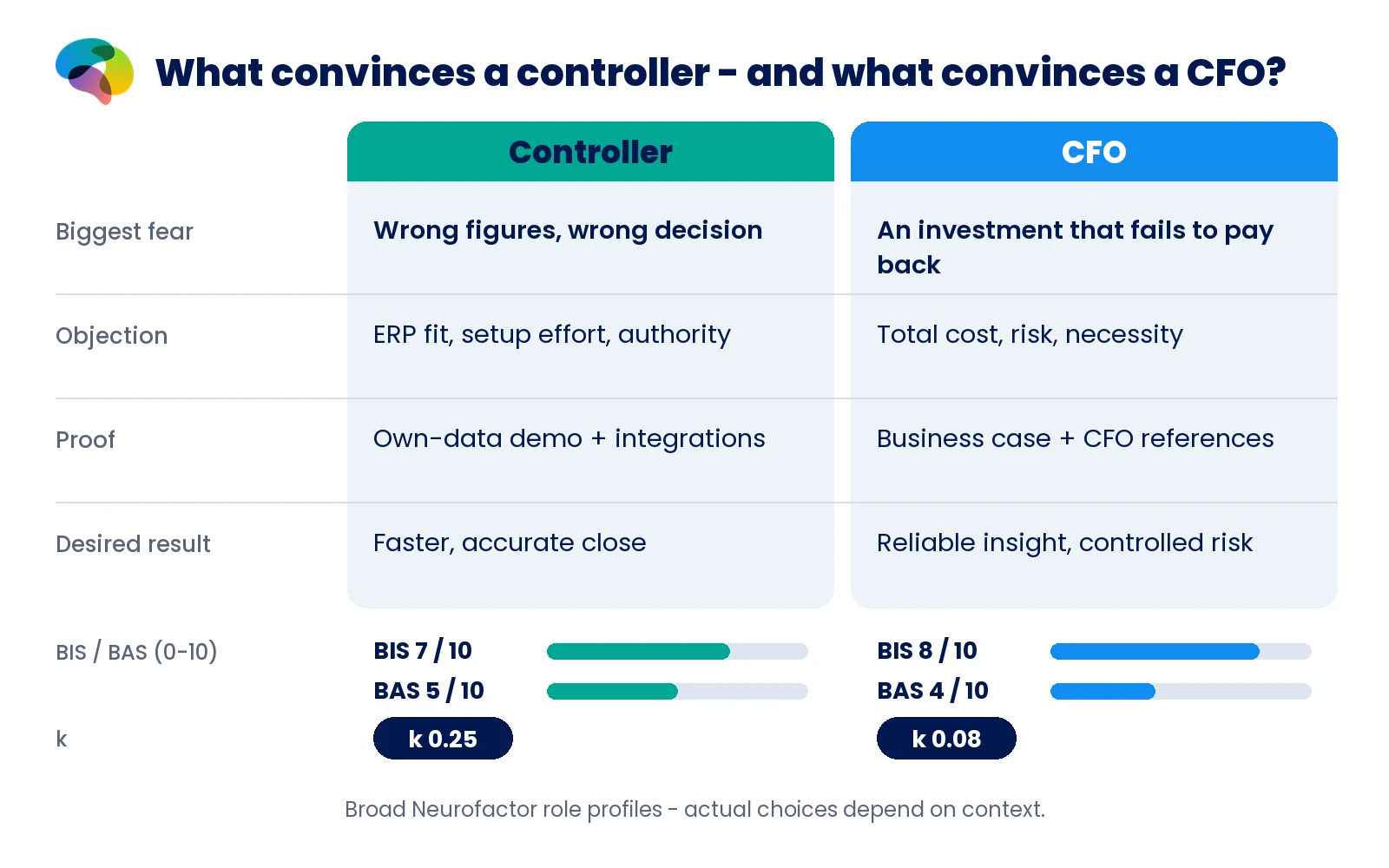
Neurofactor's original broad role profiles put the controller at BIS 7, BAS 5 and k 0.25, compared with BIS 8, BAS 4 and k 0.08 for the CFO. The scores support a difference in risk focus and time preference. The real buying insight comes from the documented fears, objections and proof requirements behind them.
The controller has found the solution. The CFO still has to approve the investment
A controller is working late on another month-end close. Figures from the ERP, the bank and reporting tools do not reconcile easily. A vendor demonstrates a system that automates much of this work. The controller immediately recognises the opportunity: fewer manual steps, fewer corrections and more time to analyse the numbers.
Yet the contract does not get signed. The CFO asks a different question: what will licences, implementation, security, maintenance and potential disruption cost in total, and what defensible return can the organisation expect? The same platform solves an operational problem for the controller but creates an investment decision for the CFO.
This is where many B2B sales conversations go wrong. The person with the strongest day-to-day need is treated as if they also own the budget. Then the CFO is shown the same demo when what they need is a different layer of proof.
Two finance functions, two forms of decision pressure
| Dimension | Controller | CFO |
|---|---|---|
| Responsibility | Reporting, month-end close, analysis and data accuracy | Financial health, capital, risk and accountability |
| Primary problem | Too much manual Excel work and too little time for analysis | Insufficient reliable, timely information to steer finances |
| Underlying cause | Disconnected systems and repeated data cleansing | Fragmented systems, business units and manual reporting |
| Emotional tension | The work never ends and receives little recognition | A damaging financial surprise that cannot be reversed |
| Biggest fear | An error that causes management to make the wrong decision | An investment that fails to pay back or financially damages the business |
| Initial objection | I cannot approve this; does it integrate with our ERP; how much setup? | What is the return, full cost, risk and real necessity? |
| Desired proof | Demo using own data, controller references, proven integrations | Transparent business case, CFO references, appropriate certifications |
| Preferred route | Fellow controller or webinar, then own-data demo | Introduction via accountant, bank or fellow CFO, then substantive discussion |
| Desired outcome | Faster accurate close and more time for advisory work | Timely reliable figures, managed risk and demonstrable value |
What the controller is actually afraid of
In the original Neurofactor card, the controller's biggest fear is not a long working day. It is a mistake in the figures that leads management to make a poor decision. Time savings therefore mean more than moving faster. The process must remain accurate, transparent and auditable. A supplier who promises only faster reporting has addressed just half the concern.
The card refers to Excel macros, homemade integrations and dashboards that were never maintained. Proof should therefore be concrete: run a representative dataset, show exceptions, demonstrate reconciliation and explain how corrections remain traceable. Only then does a claim about time savings become credible.
Another explicit concern is whether the controller can authorise the purchase, whether the tool fits the ERP and whether implementation creates more work. A strong trial needs a lightweight adoption route as well as reliable functionality.
What the CFO is actually afraid of
The CFO also needs trustworthy figures, but judges any purchase through a wider financial lens. The source profile identifies the greatest fear as a non-performing investment or a risk that harms the organisation financially. An impressive demo does not resolve that concern. The CFO needs a business case whose assumptions are visible, whose relevant costs are included and whose risks can be controlled.
This goes beyond hours saved. Consider project ownership, vendor dependency, continuity, reporting quality and compliance implications. The card also mentions ERP programmes that ran over budget and cost reductions without lasting results. Suppliers who ignore those experiences often lose credibility at precisely the moment when the decision becomes material.
The profile scores show a difference in time preference
| Profile measure | Controller | CFO |
|---|---|---|
| BIS (0-10) | 7 - seeks to avoid errors and failed work | 8 - strongly focused on avoiding financial risk |
| BAS (0-10) | 5 - values demonstrable time-saving opportunities | 4 - approaches opportunities with clear returns |
| Delay-discount rate k (separate scale) | 0.25 - relatively greater weight on earlier benefits | 0.08 - relatively greater weight on longer-term consequences and returns |
These values belong to Neurofactor's broad role profiles. They are not percentages, purchase probabilities, individual diagnoses or predicted approval dates. A higher k indicates a relatively greater weighting of earlier rewards, not a prediction that someone will impulsively sign a contract.
What BIS, BAS and k do and do not explain
Both profiles pay considerable attention to adverse outcomes. The controller scores BIS 7, the CFO BIS 8. The controller is not carefree about risk. The key difference is the feared outcome: inaccuracies and failed work in the monthly close versus financial exposure across the organisation.
The controller has BAS 5 and k 0.25, consistent with a stronger focus on benefits that can become visible relatively soon. The CFO has BAS 4 and k 0.08. In the broad source profile, longer-term return and downside carry relatively more weight. That supports a different proof sequence, but does not let us predict how an individual CFO or controller will behave.
For the controller, a demo is evidence. For the CFO, it is part of the evidence
The controller's source card names three relevant proof assets: a demonstration on their own data, references from other controllers and integrations that have actually been proven. Start with a recurring month-end task rather than a sweeping vision of finance transformation. Show which manual steps disappear, which exceptions remain and how they are checked.
The CFO's profile calls for quantitative business cases, CFO-level references and relevant certifications. A successful demo can support feasibility, but the investment decision still needs the full cost structure, transparent assumptions, implementation risk, ownership and a credible route to value. A cautious model that can be audited is stronger than an impressive ROI percentage without traceable inputs.
The objections require two different answers
The controller asks whether they can approve the spend, whether the tool works with the ERP and whether the setup will consume valuable time. Pressing for a quick signature does not solve any of these problems. Give the controller the technical and organisational facts needed to make a safe internal recommendation.
The CFO asks what the investment returns, what it costs end to end, what risks it introduces and why it is needed at all. This calls for a reasoned comparison with the status quo. You can quantify the cost of doing nothing, but only using defensible figures from the organisation. Label assumptions clearly rather than presenting estimates as measured results.
A sales sequence that helps both stakeholders
- 1. Start with actual work. Ask the controller where time is lost during close and where reconciliation or errors most often occur.
- 2. Make the pilot bounded and auditable. Test a representative process with the organisation's own data before promising full automation.
- 3. Record the baseline. Establish close time, number of corrections, systems involved and actual hours using mutually agreed definitions.
- 4. Build the decision document together. Separate hard savings, freed capacity and possible risk reduction rather than blending them into one inflated return.
- 5. Map actual authority. Establish who owns budget, IT interfaces, security, implementation and final approval.
- 6. Give the CFO a different first page. Lead with assumptions, total cost, downside scenarios and decision conditions, then link to the technical demo.
- 7. Keep the controller involved. Ask the person who knows the workflow to verify the evidence rather than using them merely as a route to the budget holder.
One reporting platform, two entirely different responses
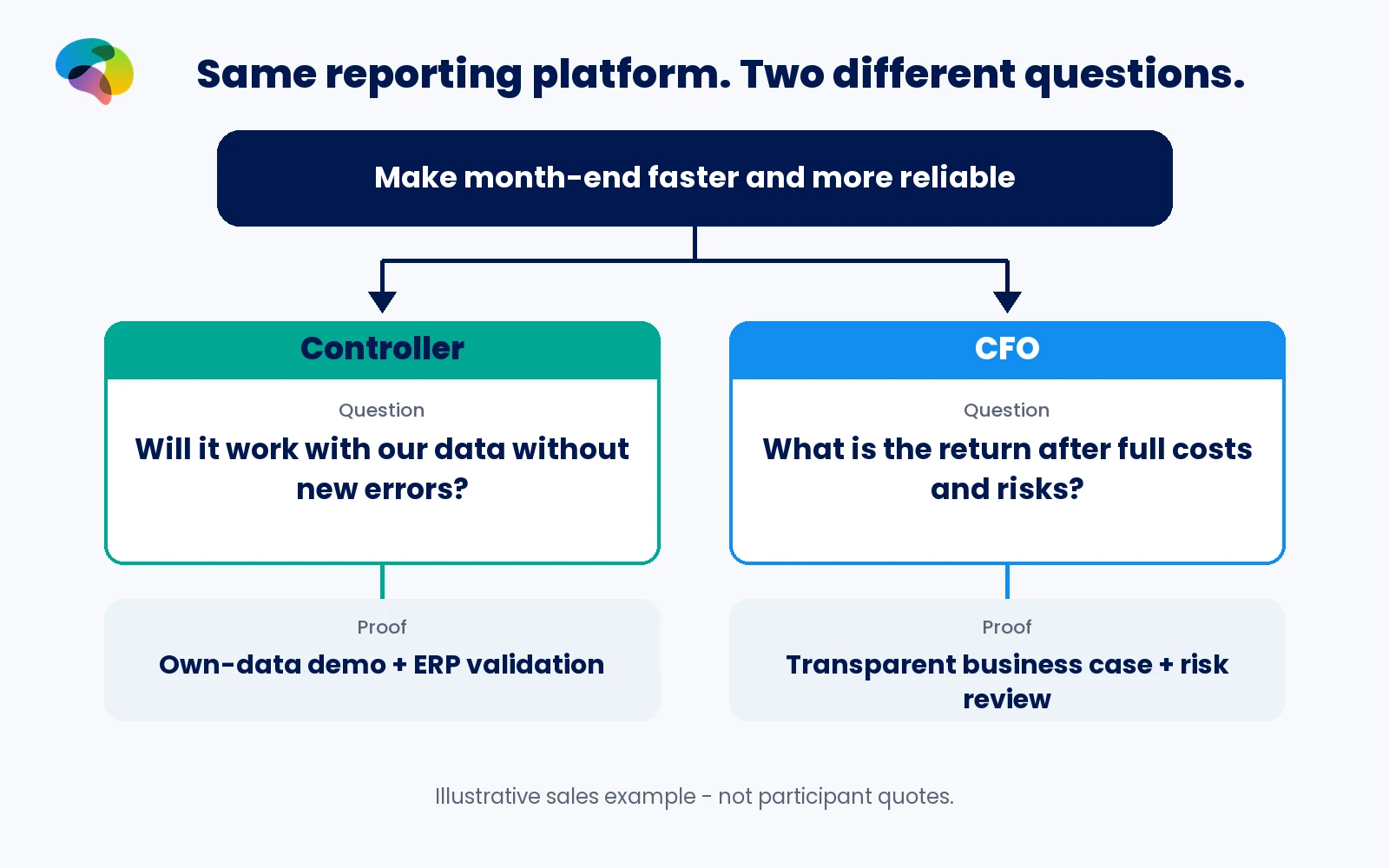
Illustrative scenario, not a research case: you sell software that creates month-end reports, reconciles figures and flags discrepancies. The shared promise is: "Make your month-end close faster and more reliable."
The controller hears: "Can I replace the spreadsheets without creating new errors? Will it work with our data, and could next month already be easier?" The preferred next step is a bounded demo on real datasets with a quick integration check.
The CFO hears: "What does this improve for the business, what is the total multi-year cost, and what could go wrong financially during the transition?" The next step is a defensible business case, with risks, references and approval criteria.
Neither reaction is a caricature. The sales mistake is replaying the same presentation for the CFO and hoping the controller's enthusiasm will do the rest.
Two opening messages that fit the responsibility
To a controller: "Which spreadsheet checks consume most of your team's time each close? If we can simplify one process on your own data while keeping the audit trail intact, you will have a useful basis for evaluating the tool."
To a CFO: "What demonstrable financial value would a more reliable close need to create before this investment is justified? I would like to put total costs, assumptions and implementation risks into the same business case."
These are fictional example messages, not quotations from study participants. The difference is not manipulation. It is answering the question each stakeholder is professionally responsible for answering.
An internal advocate is not necessarily the decision-maker
The controller may validate functional value, a finance director may assess implementation, and the CFO may evaluate the investment case. But job titles do not establish the actual approval process. One person may hold several roles in a smaller company. In a large business, IT, procurement, security and executive committees may add additional approval gates.
Map the real buying group. Identify who uses the system, experiences the pain, bears the downside, benefits from improvement and can veto the purchase. The role profiles help you ask better questions. They do not replace deal-specific discovery.
Research-based broad role profiles are not a diagnosis of your prospect
These profiles draw on recurring patterns from Neurofactor research conducted over several years with these and comparable audiences. They provide a research-informed broad role profile. Yet they remain generalisations: sector, company size, product, service, price, proposition and choice context can shift which aspects matter most.
A controller responsible for international consolidation may be highly focused on long-term downside. A CFO in a rapidly growing company may demand a demonstrable short-term result. A job title therefore cannot reveal the exact traits or future decisions of an individual person. Its value lies in guiding the questions you validate for the specific buying situation.
Want to know how controllers and CFOs view your product or service? Contact Neurofactor and have the broad profile translated to your proposition.
Make the finance profile specific to your product or service
A BI dashboard, accounting service, insurance product and automation platform activate different expectations. The controller may associate one product with data quality and another with migration work. The CFO may immediately think of capital commitments, regulatory exposure or long-term value. The role title alone cannot tell you which association will dominate.
A target-group profile helps determine which needs, concerns and proof assets matter for the concrete proposition. An association map explores the meanings customers already connect to that product or category. That is where broad role insight becomes more relevant to actual communication.
If you want to know what these role profiles look like for your specific service, start with the risks and proof your buyers associate with that decision, not simply their titles.
Feeling the problem does not mean carrying the investment risk
The controller wants a faster and more accurate month-end close. The CFO wants confidence that the business will not lose money or control through a poorly justified investment. The same solution can help both. The distance between urgency and authority closes only when demonstrated operational value becomes a financially defensible decision.
A successful finance pitch therefore connects proof from the daily workflow with the decision the executive is accountable for making.
See the overview of selling to finance. Explore B2B target groups on LinkedIn. Next: CFO vs finance director.
Key terms
- CFO
- Executive accountable for financial health, investments, risk management and financial reporting to key stakeholders.
- Controller
- Finance professional who prepares, checks and interprets information used for closing, reporting and decisions.
- Purchasing authority
- Formal power to approve expenditure or a contract under an organisation's actual governance.
- Internal advocate
- A stakeholder who supports and evaluates a solution but does not necessarily control its budget.
- Proof requirement
- The evidence a buyer needs to reduce uncertainty about a specific purchase.
- BIS
- Behavioral Inhibition System, describing sensitivity to potential negative outcomes; the role-profile scores used here range from 0 to 10.
- BAS
- Behavioral Activation System, describing orientation towards desirable rewards and opportunities; the role scores here range from 0 to 10.
- Delay-discount rate (k)
- Parameter describing relative preference for earlier rather than later rewards, on a separate scale from BIS and BAS.
- Target-group profile
- Research framework describing audience needs, obstacles, evidence requirements and decision context.
- Association map
- A map of the meanings and associations people already connect with a product, service, brand or choice.
Frequently asked questions
What is the main buying difference between a CFO and a controller?
The controller primarily evaluates whether the solution improves the accuracy and speed of month-end work. The CFO evaluates whether it is a financially defensible investment after full costs and risks.
Why might a controller be enthusiastic before a CFO is convinced?
The controller experiences manual work directly. The CFO is accountable for a wider investment decision. Their broad Neurofactor profiles also differ in k: 0.25 for the controller and 0.08 for the CFO.
What BIS, BAS and k scores do the source profiles show?
Controller: BIS 7, BAS 5 and k 0.25. CFO: BIS 8, BAS 4 and k 0.08. These are broad role-profile values, not percentages, population averages or individual predictions.
What proof convinces a controller?
An auditable demo using their own data, verified ERP integration and references from other controllers. Demonstrate both time savings and sustained accuracy.
What does a CFO need before approving finance software?
A traceable business case with assumptions, total cost, downside risks, credible value drivers and appropriate executive references or certifications. Actual approval rules vary by organisation.
How can I adapt these broad profiles to my solution?
Use a proposition-specific target-group profile and association map to establish which fears, associations, objections and proof assets matter for your specific decision context.
Sources
- 1.202609 - LinkedIn doelgroepen - Doelgroepkaarten - Neurofactor.xlsx; tabblad 7 Finance, kolom D (CFO), kolom F (CTR), rijen 7-46 - Neurofactor (2026-09)
- 2.Neurofactor_Sitemap_Master_Blogserie_39_2026-10-05(2).xlsx; tabblad Blogserie_LinkedIn_Doelgroepen; rij NF-BLOG-LI-FIN-01 - Neurofactor (2026-10)
This series
Who are you really selling to?Category synthesis
The person with the greatest urgency may not have the mandateRead next
Related topics
Reviewed by: Martijn den Otter · Last reviewed: 10/9/2026
Martijn den Otter
Oprichter van Neurofactor. Expert in neuromarketing en consumentenpsychologie.
LinkedIn →