
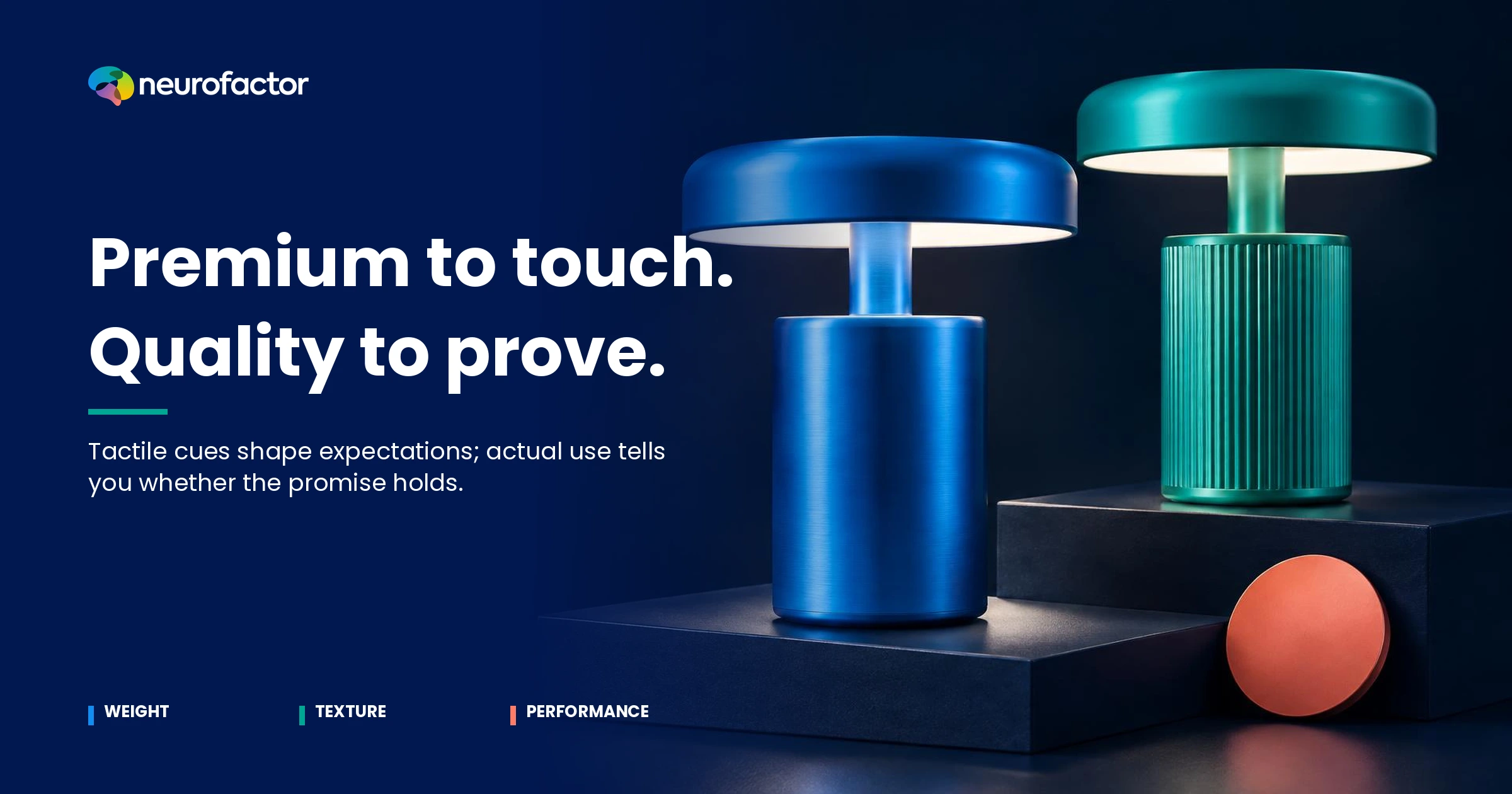
A product can feel premium. But what does that feeling actually prove?
Materials, weight and texture influence how people judge a product when they first handle it and put it to work. A rigid housing may suggest quality; a light construction can suggest convenience and engineering sophistication. Neither impression independently proves better performance. The useful question is which associations a physical design evokes among its intended users, whether those meanings match the job the product must perform, and whether the initial promise survives everyday use. Study what people expect, feel, do and conclude about quality, rather than relying only on photographs or immediate preference ratings.
The first quality test happens in someone's hands
The product looks convincing on a screen. The photographs show precise detailing and its specifications promise everything the buyer has been looking for. Then someone picks it up. The person can now feel the distribution of mass, the resistance of a control, the temperature of the surface and the way two parts fit together. Those signals may suggest reliability before the product has accomplished a single task. Someone else might experience the same physical features as unnecessary weight, poor grip or a rather old-fashioned design.
The important question is not whether heavy products always seem more luxurious. That would be a poor rule for design teams. The real question is which physical cues credibly communicate useful quality within this product category. A substantial desk lamp may seem stable when it is supposed to stay in one place, yet cumbersome when users move it every evening. A lightweight computer may signal fragility to one buyer and sophisticated engineering to another. Product meaning arises from the relationship between physical sensation, expected function and actual experience. Read how a showroom creates expectations before purchase.
A photograph cannot provide all the evidence that touch provides
Two products can be almost indistinguishable in an online listing. Once handled, their hardness, texture, thermal feel, weight and control resistance become more apparent. Peck and Childers showed that the relevance of haptic information varies across products, consumers and situations [S01]. McCabe and Nowlis found a difference between physically inspecting products and relying on descriptions particularly when material properties matter to evaluation [S05]. Neither study establishes that a store always outperforms an online shop. Both help explain why product teams should identify the sensory properties buyers need to assess.
For a furniture surface, the texture may contribute heavily to the experience. With a professional tool, mechanical feedback or secure handling may matter much more. Separate diagnostic information, which helps assess how something actually works, from associative information, which concerns what a cue is taken to mean. Sometimes those overlap. An integrative review of sensory marketing also places touch alongside vision, sound and other sensory cues rather than treating one modality as a universal driver of choice [S06]. Sometimes a cool metal surface suggests strength that the internal construction has not yet demonstrated. Sound offers a separate illustration: a controlled study found that changes in the crunch sound of potato crisps altered their perceived freshness, a food-specific finding that cannot simply be applied to electronics [S12]. A strong research design must allow for both possibilities.
Six physical cues and the meanings buyers might attach to them
This is a set of research hypotheses, not a universal ranking of desirable finishes. Context, task and familiarity may reverse the interpretation. Ask people what the physical cue brings to mind before explaining the designer's intention.
Greater weight
- Possible favourable association
- Substantial, stable, valuable
- Possible unfavourable association
- Tiring, outdated, wasteful
- What should be tested?
- Tasks, actual mass and balance
Low weight
- Possible favourable association
- Portable, efficient, innovative
- Possible unfavourable association
- Fragile, cheap, unstable
- What should be tested?
- Usability and verified durability
Cool metal
- Possible favourable association
- Precision, resilience, premium
- Possible unfavourable association
- Cold, slippery, impersonal
- What should be tested?
- Material recognition and grip
Soft warm surface
- Possible favourable association
- Comfort, approachability
- Possible unfavourable association
- Difficult to clean, less professional
- What should be tested?
- Cleaning and real-use context
Distinct control resistance
- Possible favourable association
- Reliable, deliberate, secure
- Possible unfavourable association
- Stiff, difficult to operate
- What should be tested?
- Error rate and sustained use
Visible surface grain
- Possible favourable association
- Crafted, genuine, tactile
- Possible unfavourable association
- Untidy, inexpensive finish
- What should be tested?
- Wear, audience and expectations
Why weight sometimes seems to communicate value
Weight requires physical effort to handle. Some experiments have suggested that handling a heavier object can affect judgments of an abstract quality, such as importance [S09][S10]. Other work has found that the mass of a container can influence expectations about the food it contains [S11]. An observational study of wine bottles additionally illustrates that a relationship between package weight and price does not establish that extra weight causes higher intrinsic quality [S17]. These studies are interesting evidence of possible mechanisms. They are not a recommendation to add ballast to every consumer product. Their experimental tasks and outcome variables differ from real-world product performance or repeated purchasing decisions.
Three questions are more useful to a design team than 'how heavy should premium feel?' Does the weight perform a function such as stability? Does it match what customers reasonably expect from this category? And does the positive impression remain after repeated handling? Weight can improve the behaviour of a fixed table lamp while making a travel accessory more frustrating. A meaningful sense of quality cannot be separated from the task a person wants the object to accomplish.
Heavier can feel safer and become more burdensome
Imagine that a prototype with a heavier housing receives higher initial ratings for perceived sturdiness in a small lab test. It might be tempting to end the design debate there. Now imagine the same object being carried between meeting rooms several times every day. The feature that initially suggested reliability may become the main reason people dislike using it. This is not inherently inconsistent consumer behaviour. The earlier article on why people experience the same event differently explores the role of differing meaning and context. It is a change in the question people are answering.
Distinguish perceived quality at first touch from quality across repeated use. Observe carrying, gripping, reaching and adjustment tasks. Ask whether people change their minds when the novelty wears off. The extra mass may create an impression without providing useful benefits. Conversely, a lighter design supported by objective durability tests may offer a better overall experience. The role of research is to connect the promise made by physical cues with the practical truth of what using the product feels like.
When additional or reduced weight is the sensible choice
Use the following matrix to generate design hypotheses. It is not a formula for predicting consumer preferences. Consider people with different strength, mobility and motor control requirements.
Stationary table lamp
- Weight may help because
- Improved stability
- Weight may hurt because
- Difficult to move or clean
- Appropriate outcome
- Stability and handling assessment
Portable speaker
- Weight may help because
- More secure while operating controls
- Weight may hurt because
- Extra load while travelling
- Appropriate outcome
- Carrying task and comfort
Premium wristwatch
- Weight may help because
- Feeling of substance
- Weight may hurt because
- Fatigue during sustained wear
- Appropriate outcome
- Wear trial and later preference
Cooking utensil
- Weight may help because
- Balance and control
- Weight may hurt because
- Higher strain on the wrist
- Appropriate outcome
- Task accuracy and perceived effort
Professional tool
- Weight may help because
- Impression of robust equipment
- Weight may hurt because
- Repetitive lifting fatigue
- Appropriate outcome
- Ergonomics and task performance
Premium packaging
- Weight may help because
- Initial value signal
- Weight may hurt because
- Unnecessary material and transport
- Appropriate outcome
- Protection, waste and expectations
Material is more than a line in a technical specification
A bill of materials lists aluminium, timber, polymer or textile. Users encounter temperature, friction, sound, smell, wear and the way components meet. Desmet and Hekkert distinguish aesthetic pleasure, attributed meaning and emotional response in their product-experience framework [S07]. The material choice therefore influences not only engineering properties, but also the inferences users may draw about the product. Research on product design similarly distinguishes aesthetics, functionality and symbolism instead of collapsing them into one quality rating [S13].
A matt coating can suggest restraint to a designer, refined simplicity to one buyer and a surface prone to fingerprints to another. Instead of asking only which sample looks more attractive, ask what performance people anticipate and then test whether that performance occurs. It is often useful to separate unaided sensory evaluation from evaluation after the material has been named. Telling someone that a surface is aluminium can influence their judgment before they have touched it. That distinction helps locate the point at which a physical sensation becomes a brand-related assumption.
Packaging can make promises on behalf of the product
A substantial box, carefully fitted insert and deliberate opening movement can convey attention to detail before the product is visible. Research by Krishna and Morrin demonstrates that tactile characteristics of a container can carry over into judgments about its contents, while also showing important differences across consumers and conditions [S04]. Packaging is therefore part of the experience, not a neutral wrapper.
This raises a credibility question. A visually impressive, very heavy box might create expectations that the product cannot meet. The first minute feels luxurious and the subsequent hour disappointing. A credible experience connects the packaging, first touch, performance and after-sales reality. Before increasing the weight or complexity of packaging, ask whether it improves protection, communicates genuine information or merely changes the impression of price. Research on packaging aesthetics has also linked visual design to price expectations through quality and attractiveness judgments, without proving that added weight is an improvement [S16]. Good unboxing design should reduce uncertainty and support a truthful first interaction, rather than conceal shortcomings behind sensory theatre. A mismatch can be investigated as negative associations across the customer journey.
A sensory signal is not the same as functional proof
This matrix can be used in a product review to prevent appearance, perceived value and genuine performance from being mixed into a single score. Record the practical cost as well as the possible positive meaning of every cue.
Package
- What a customer perceives
- Thick, heavy casing
- What the customer may infer
- High value or delicate contents
- What needs independent verification
- Protection, returns and materials
Housing
- What a customer perceives
- Cool, rigid finish
- What the customer may infer
- Durability and precision
- What needs independent verification
- Strength, lifetime and repairability
Switch
- What a customer perceives
- Clear mechanical click
- What the customer may infer
- Certainty and control
- What needs independent verification
- Error rate and component wear
Product mass
- What a customer perceives
- Heavy or light handling
- What the customer may infer
- Solid or portable construction
- What needs independent verification
- Stability, ergonomics and function
Surface finish
- What a customer perceives
- Soft, rough or smooth
- What the customer may infer
- Comfort, grip or refinement
- What needs independent verification
- Grip, cleaning and maintenance
Operating sound
- What a customer perceives
- Quiet, crisp or resonant
- What the customer may infer
- Precision, strength or poor construction
- What needs independent verification
- Actual operation and acoustic comfort
The expectation begins before the first touch
People often form a tactile expectation from visual information. Dark metallic finishes may look dense; fabric may look forgiving. A related article on colour associations in spaces examines another route by which sensory signals shape expectations. Ludden and colleagues studied how discrepancies between what people expect to feel and what they actually feel can create surprise [S08]. Surprise can be interesting or delightful. It can also erode confidence when a product is marketed as professional, precise or reliably constructed.
A surprisingly light object may be admired for its engineering. Another buyer may worry that its shell is too thin. When testing prototypes, separate the moment before handling from the moment after handling. Record what people expect while looking, their spontaneous associations once touching and their evaluation after performing a real task. If all those moments are reduced to a single average preference score, the interesting change in meaning may disappear. Design teams need to understand the transition, not merely the final number.
Turn a vague feeling into a specific design question
'It needs to feel premium' is not yet a research brief. Begin with a decision and a task. For example, a cordless table lamp should be easy to lift and reposition while remaining stable on a tabletop. That produces several testable questions: what weight is genuinely required for stability, what does that mass communicate, and how does the user rate the lamp after moving it repeatedly?
Specify hypotheses separately. A lighter version may be associated with convenience. A heavier version may initially seem more substantial. A textured finish may improve grip or merely change visual style. The design team must accept the possibility that none of these assumptions will hold in the intended setting. A study is not meant to prove the preferred material. It is meant to improve the decision under realistic functional, commercial and ergonomic constraints. State those constraints before participants begin reviewing variants.
Which research method actually adds useful evidence?
Not every product requires EEG or a neuroscience laboratory. For the question 'what does this feel like and what does it suggest?', a structured product test with unaided association questions and task observation may be sufficient. If the question concerns where customers look before handling a product, eye tracking can sometimes provide relevant information. If the experience changes over time during realistic activities, carefully justified mobile EEG may be considered as one component of a wider design.
Start with the decision and then select the method. The Neurofactor knowledge-base article on EEG in experience research discusses the contribution and limitations of neural measures. Ask what the proposed instrument explains beyond an interview, observation or straightforward usability assessment. The most sophisticated setup is not necessarily the most informative one. It becomes informative only when the measurement and the intended interpretation are explicit and defensible.
Fictional case: a portable cordless table lamp
This case is entirely fictional. An imaginary product team develops a cordless table lamp for homes and hospitality venues. Early prototypes produce the same light output, have the same dimensions and are designed for the same battery life. The team is uncertain whether a heavier base communicates better quality or merely makes the product difficult to carry. They also want to learn whether a subtler surface texture affects grip and perceived refinement. No actual client data or Neurofactor results are used in this illustration.
One hypothetical participant might say, 'It feels sturdy, but I wouldn't want to move it every evening.' Another might prefer the lighter model but worry about the switch. These are possible reactions, not fabricated research findings. The team decides that asking which prototype looks expensive is not enough. It wants to examine initial quality associations, handling comfort, stable placement and the durability evidence required to justify any claim. That reframes a debate about luxury into a practical product-design decision.
One product, four carefully defined test conditions
A simple 2x2 study can vary mass and finish separately. Use it only if prototypes can be kept functionally equivalent and safe. Research-only modifications must be documented; adding dead weight to a commercial product to imply quality would not establish actual quality.
A
- Mass
- Lighter
- Surface finish
- Smooth matt
- Hypothesis to examine
- Easy to reposition, possibly less substantial
B
- Mass
- Heavier
- Surface finish
- Smooth matt
- Hypothesis to examine
- Stable initial impression, perhaps more effort to lift
C
- Mass
- Lighter
- Surface finish
- Fine texture
- Hypothesis to examine
- Portability with better grip, different quality meaning
D
- Mass
- Heavier
- Surface finish
- Fine texture
- Hypothesis to examine
- Solidity with grip, possibly cumulative handling strain
Measure the first impression and the later task separately
Participants can first see the lamp without touching it. They then lift it, operate the switch and place it on another table. A short realistic task follows. The study records expectations, unaided associations, task completion, perceived effort and general product evaluation at clearly defined moments. This design separates a judgement made while looking from a judgement formed during use.
Order matters. Lifting an exceptionally heavy sample first may make the next one seem light, even if the second sample would have felt substantial in isolation. Balance or randomise exposure, or use separate participant groups when repeated handling would contaminate the comparison. Include customers who regularly move such products and those who keep them stationary. Without attention to tasks and audiences, the observed effect may reflect the chosen test sequence rather than a useful product characteristic. A later use trial can reveal whether first impressions remain meaningful.
Unboxing starts the product's evidence chain
A package is a brief part of the user journey, but it shapes the first conditions for handling. Protection, the resistance of an opening mechanism and the visibility of instructions can contribute to confidence or uncertainty. The classic endowment effect has also been investigated through actual possession and valuation, which is not the same as a causal effect of mere touch [S14]. Research on tactile experience and psychological ownership suggests that contact with an object can influence perception, but does not show that attractive packaging automatically drives repeat purchases [S02][S03].
Treat unboxing as a task. Can someone remove the product without damaging it? Do they know which protective elements to remove and which to retain? Is the additional packaging genuinely required for transport protection? And does the object live up to the expectations created by its box? A sustainable product presented inside excessive decorative layers may generate a mixed signal. The goal should be a consistent and demonstrable relationship between the opening experience, actual materials and performance over time.
Four stages of the experience require different evidence
A positive packaging reaction, first-touch response and long-term use rating do not describe the same thing. This table helps define what should be learned at each stage.
Online preview
- Relevant measure
- Expected mass and quality
- Common interpretation error
- An image is treated as material evidence
- Possible design action
- Honest product visuals
Unboxing
- Relevant measure
- Orientation, handling, expectation
- Common interpretation error
- Attractive packaging is mistaken for product quality
- Possible design action
- Better protection and clearer instructions
First operation
- Relevant measure
- Grip, resistance, errors, confidence
- Common interpretation error
- Pleasant switch feedback is taken as durability
- Possible design action
- Engineering and usability assessment
Continued use
- Relevant measure
- Carry comfort, wear, maintenance
- Common interpretation error
- First enthusiasm is assumed to persist
- Possible design action
- Longer use trial and ergonomic changes
Alternative comparison
- Relevant measure
- Value in a real choice context
- Common interpretation error
- Contrast effects are ignored
- Possible design action
- Balanced exposure and pricing
A pleasant feeling is not evidence of a better purchase
Affective valence describes how pleasant or unpleasant an experience feels. It is not identical to arousal, the strength of an association, objective performance or buying behaviour. A wonderfully soft finish may receive high immediate ratings while being difficult to clean. A less pleasant but secure surface may be preferred when the user's hands are wet. Neither pattern is paradoxical once the decision criteria are separated.
The Neurofactor knowledge base on affective valence outlines this distinction. Product studies should measure the hedonic response alongside usability and, when appropriate, a meaningful choice. People might say they like one variant more and choose another when prices, maintenance and tasks are made explicit. An association that changes with a prototype is informative, but it is not by itself proof that the prototype caused an increase in actual sales. That claim would require a suitable additional design and data.
People assess products through actions, not photographs
Products are lifted, rotated, pressed, held and cleaned. The sensation produced by a material can change during those activities. A rubber-like finish may feel pleasant in a showroom and awkward when dusty. A firm hinge can suggest precision yet demand too much effort when opened repeatedly. The properties that matter are not only visual attributes or isolated preference ratings.
Include representative tasks alongside open exploration. Record time, handling changes, failures, whether users need both hands and where discomfort occurs. Ask separately whether participants regard the product as reliable. That allows the team to distinguish the effectiveness of an interaction from its sensory appeal. Not every user needs the same configuration. Product category, task frequency and the users' actual needs should guide how much weight is attached to specific differences. The conclusion should remain attached to the tested situation rather than becoming a universal claim about materials.
A sustainable look does not establish sustainable materials
Wood, metal or a recycled-looking surface can suggest environmental responsibility. That is a perceived meaning, not a life-cycle assessment. Material origins, quantity, production, longevity, repairability and transport must be assessed separately. A heavier package might look luxurious yet require more resources. A light shell may use less material yet fail earlier. Neither statement can be settled by touch alone.
Use two evidence tracks. First ask which associations the physical design evokes and what the customer consequently expects. Then establish which environmental or functional benefits are actually verified. If the two diverge, change the claim or the design rather than manufacture a misleading sensory cue. Real sustainability arguments demand evidence beyond colour, texture and mass. In particular, extra weight added merely to feel premium should not be mistaken for greater durability or responsible design.
A nine-step research protocol for materials and weight
Step 1 - define the decision. Specify whether the choice concerns mass, surface finish, packaging, switch resistance or a combination. Step 2 - map real use. Identify how frequently people lift, operate, store and clean the product. Step 3 - establish boundaries. Fix safety, functional performance, ergonomic requirements and applicable constraints before reviewing prototypes.
Step 4 - set hypotheses. Write separate expectations for first impression and later use. Step 5 - control the prototypes. Change intended factors while documenting remaining differences. Step 6 - recruit relevant users. Include appropriate task experience and diverse physical needs. Step 7 - observe distinct stages. Combine unaided associations, explicit ratings, task behaviour and validated performance measures. Step 8 - examine uncertainty. Check order effects, variability and alternative explanations. Step 9 - test in context. Use a realistic follow-up to ensure that a positive initial cue does not come at the expense of safe and comfortable function. Each step must be adapted to the real product rather than copied as a rigid research recipe.
Keep associations and actual functioning in separate columns
Choose the primary outcome in advance. The matrix prevents a team from presenting a preference score as an engineering test or interpreting a behavioural measure as a direct readout of brand meaning.
What does weight suggest?
- Suitable observation
- Spontaneous associations
- When to collect it
- Immediately after lifting
- What it does not demonstrate
- Objective mechanical strength
Does the texture feel pleasant?
- Suitable observation
- Valence and sensory description
- When to collect it
- Initial contact
- What it does not demonstrate
- Product lifespan or conversion
Is the lamp easy to move?
- Suitable observation
- Task time, grip changes, errors
- When to collect it
- During the handling task
- What it does not demonstrate
- Complete brand identity
Can people identify the material?
- Suitable observation
- Unaided material assessment
- When to collect it
- Before and after touch
- What it does not demonstrate
- Proven origin of raw materials
Does use change preferences?
- Suitable observation
- Choice and reasons
- When to collect it
- After a realistic task
- What it does not demonstrate
- Permanent loyalty or repeat buying
Is the effect repeatable?
- Suitable observation
- Replication and uncertainty intervals
- When to collect it
- Separate test occasion
- What it does not demonstrate
- A universal law across categories
Not everyone seeks the same amount of tactile information
Peck and Childers describe differences in people's motivation to explore products by touch [S01]. For some users, the material is an important part of finding out what a product is like. Others may rely more on visual descriptions or evidence about performance. This does not justify labelling a particular person from a few clicks or claiming an unchangeable personality category.
Match the research sample to the intended tasks. Someone purchasing a lamp for a fixed side table may judge it differently from a hotel worker who moves it throughout the shift. A buyer who approves procurement budgets may assess different risks from the people who operate the product. Study patterns across groups and examine competing explanations. A user segment becomes useful only when it is linked to a testable decision and measured with adequate reliability. Demographics alone cannot replace an understanding of context, prior experience and practical needs.
EEG does not directly measure whether a product is good
Under an appropriately designed study, EEG may provide additional information relevant to time-varying responses or specific cognitive questions. It is not a direct meter for luxury, quality, trust or durable economic value. Lifting, pressing or turning an object introduces movement and muscle activity that may complicate recording. Interpretation requires a valid pre-specified measure, clear events and quality checks.
The Neurofactor article on real-world neuroscience puts behaviour and context alongside neural measurement. If recording is justified, combine it with task observation, meaningful event markers and later explanation. A report should be explicit about missing data, uncertain interpretation and findings already supported by simpler evidence. More activity in a recording is not proof of superior product experience, and an appealing brain visual does not establish causal effectiveness or predict a purchase.
A controlled lab result is not a complete working day
A quiet studio makes it easier to compare closely matched prototypes. It also leaves out circumstances such as wet hands, poor lighting, distraction, time pressure and fatigue. Follow a carefully designed comparison with the relevant real-world task where needed. Laboratory and field settings are not rivals; they provide different forms of information.
Ask users to complete the activities that genuinely define the intended application. Report the duration, exposure order, participant characteristics and range of tasks. Lemon and Verhoef's review of customer experience reinforces the point that interactions occur in a wider journey shaped by earlier expectations and subsequent experiences [S15]. A positive initial tactile association is one part of that journey, not the entire relationship. That is why an initial design choice should sometimes be checked after a period of ordinary use.
Four decisions for design, marketing, sales and procurement
For product design: distinguish the physical cues required for function from cues mainly intended to suggest a quality. Compare prototypes rather than relying on the team's own material preferences. For marketing: use mass or finish as proof only when there is a corresponding verified performance attribute. Never make a durability claim merely because a product feels substantial.
For retail and sales: help customers perform relevant tasks instead of allowing them only to admire the object. A salesperson who can demonstrate why a lightweight construction remains strong may correct an inaccurate first assumption. For sustainability and procurement: assess material quantities, serviceability and logistics beside the perceived value. Together, these decisions make a product more credible without defaulting to more raw material, greater heft or decorative packaging to create a sense of luxury.
What this approach cannot establish
A prototype comparison does not show how every population will respond to every material. Effects may depend on price, brand, product category, cultural experience, visual expectations, context and prior ownership. People may also give plausible explanations for decisions without knowing every contributing factor. Self-report, implicit association tasks, physiological measures, observation and purchase data therefore require separate interpretation.
The cited research describes possible mechanisms and bounded findings, not guarantees of commercial success. An experiment in which heavy objects affect an abstract social judgement is not evidence that all heavy products are better made. Record uncertainty, representativeness, sequence effects and deviations from the analysis plan. Never fabricate measured outcomes for the fictional example. And do not present a correlation between perceived premium quality and preference as proof of a causal revenue increase when the data cannot support that claim.
What should a product team do tomorrow morning?
Choose one crucial interaction: lifting, pressing, unpacking, adjusting or sustained carrying. Ask intended users independently what the physical experience suggests and which performance they expect from it. Then let them complete the task. Look for discrepancies that matter to a real decision, such as a product that feels strong but causes fatigue, or one that looks delicate but proves comfortable and robust.
If the decision is about associations, start with an association study and a controlled design comparison. If the experience unfolds over time in a setting where context is integral, consider which additional observations or measurements genuinely improve the decision. Neurofactor can support that process by connecting associations, physical product experience and observed behaviour. The objective is not a dramatic neuroscience graphic. It is an evidence-based choice that the design, marketing and product teams can explain and defend.
Quality is not the heaviest option, but the option that keeps its promise
Materials, mass and texture are meaningful signals. They give people clues about a product's value, usefulness and fit before it has been fully tested. Those clues can help customers make decisions, but they can also be misleading when the physical performance fails to match the first impression.
The design question should therefore not be 'which finish feels most expensive?'. It should be which combination of sensory characteristics creates a relevant expectation and then fulfils that expectation. Study associations at first touch, test function during use and examine what remains once novelty fades. That turns product experience from a cosmetic layer of premium positioning into a verifiable part of product quality.
Key terms
- Haptic product experience
- What a person perceives through touch and movement, including texture, temperature, mass and resistance.
- Quality association
- A meaning or expectation attached to a product feature without independently establishing objective performance.
- Diagnostic tactile information
- Touch-based evidence that may help someone assess a genuine material or functional property.
- Weight cue
- Perceived product mass that may signal stability, effort or other attributes depending on the task and context.
- Crossmodal expectation
- An expectation in one sensory modality created partly by information from another modality.
- Affective valence
- The positive or negative direction of a feeling, distinct from intensity, arousal and association strength.
- Functional product quality
- How safely, comfortably and reliably a product supports the tasks for which it is intended.
- 2x2 product test
- A four-condition comparison with two design factors, each varied across two levels.
- Real-world neuroscience
- Research on neural processes in everyday or purposefully realistic settings with behaviour and context included.
Frequently asked questions
Does a heavier product always feel more premium?
No. Weight may suggest stability or value in some settings but can be inconvenient when carrying matters. The meaning depends on product function, audience and context.
Can lightweight products still feel high quality?
Yes. Low mass may convey portability and sophisticated engineering when real performance and structural reliability are demonstrated.
How do you test the effects of material and weight?
Compare safe, functionally controlled prototypes, vary weight and finish separately, and measure unaided associations, expectations, task behaviour and comfort.
Does heavier packaging increase perceived product quality?
Packaging cues can change expectations in certain studies, but this is not proof of durability, protection or better intrinsic quality. Test the specific use case.
Can EEG measure how premium a product feels?
No. EEG is not a direct readout of luxury or quality. It may add narrowly justified information alongside behavioural observation and association research.
Is a good first-touch rating sufficient to select a design?
No. Examine handling, safety, maintenance, repeated use, material impact and genuine decisions. A favourable first impression may not survive everyday use.
Sources
- 1.To Have and To Hold: The Influence of Haptic Information on Product Judgments - Journal of Marketing (2003)
- 2.It Just Feels Good: Customers Affective Response to Touch and Its Influence on Persuasion - Journal of Marketing (2006)
- 3.The Effect of Mere Touch on Perceived Ownership - Journal of Consumer Research (2009)
- 4.Does Touch Affect Taste? The Perceptual Transfer of Product Container Haptic Cues - Journal of Consumer Research (2008)
- 5.The Effect of Examining Actual Products or Product Descriptions on Consumer Preference - Journal of Consumer Psychology (2003)
- 6.An Integrative Review of Sensory Marketing: Engaging the Senses to Affect Perception, Judgment and Behavior - Journal of Consumer Psychology (2012)
- 7.Framework of Product Experience - International Journal of Design (2007)
- 8.Visual-Tactual Incongruities in Products as Sources of Surprise - Empirical Studies of the Arts (2009)
- 9.Weight as an Embodiment of Importance - Psychological Science (2009)
- 10.Incidental Haptic Sensations Influence Social Judgments and Decisions - Science (2010)
- 11.The Weight of the Container Influences Expected Satiety, Perceived Density, and Subsequent Expected Fullness - Appetite (2012)
- 12.The Role of Auditory Cues in Modulating the Perceived Crispness and Staleness of Potato Chips - Journal of Sensory Studies (2004)
- 13.New Product Design: Concept, Measurement, and Consequences - Journal of Marketing (2015)
- 14.Experimental Tests of the Endowment Effect and the Coase Theorem - Journal of Political Economy (1990)
- 15.Understanding Customer Experience Throughout the Customer Journey - Journal of Marketing (2016)
- 16.Formation of Consumer Price Expectation Based on Package Design: Attractive and Quality Routes - Journal of Marketing Theory and Practice (2010)
- 17.The Weight of the Bottle as a Possible Extrinsic Cue with Which to Estimate the Price (and Quality) of the Wine? Observed Correlations - Food Quality and Preference (2012)
Read next
Reviewed by: Martijn den Otter · Last reviewed: 11/5/2026
Martijn den Otter
Oprichter van Neurofactor. Expert in neuromarketing en consumentenpsychologie.
LinkedIn →