
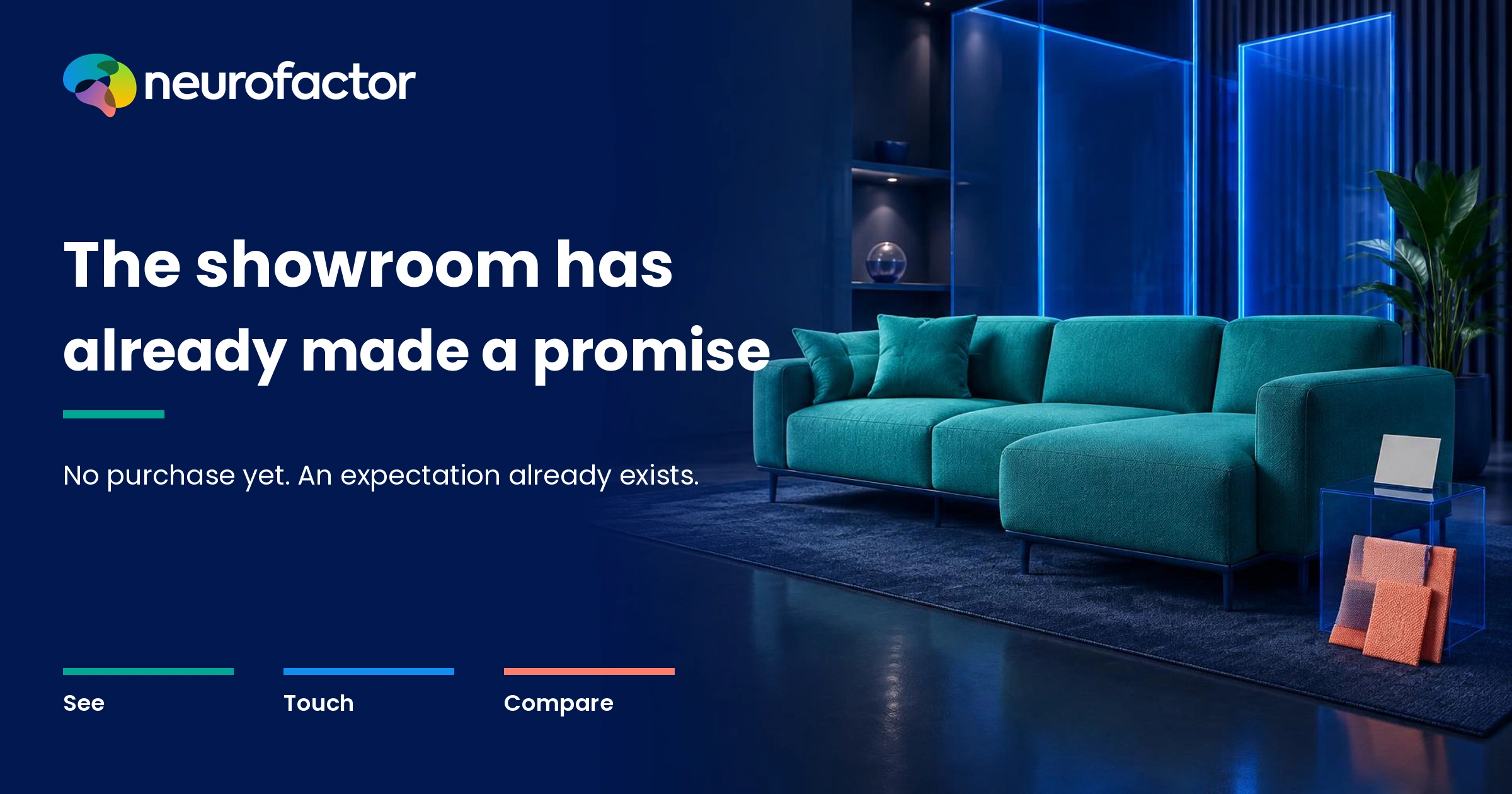
Your customer has not bought anything. Your showroom has already made a promise.
A showroom creates associations before a visitor chooses a product. Materials, lighting, room to move, staff behaviour, price information and the freedom to touch things may signal quality, trust, exclusivity or distance. The strongest association does not necessarily arise beside the most impressive object. It may emerge when someone connects an actual experience to three questions: is this right for me, can I trust it and can I make a decision here? That is why a showroom study should not stop at asking whether the interior looks attractive. Investigate what people associate with the space and the brand, which cues produce those interpretations and whether an improvement helps them compare, try and decide. A showroom is not simply the setting for a purchase. It is part of the evidence the purchase depends upon.
The showroom starts selling before anyone speaks
You step inside. Five seconds later you may not have read a single specification, yet you already have an expectation. Do these people know their products? Can I browse without pressure? Is this exclusive in a welcoming way, or exclusive in a way that suggests I do not belong? Such reactions can be provisional, contradictory and difficult to put into words. Nevertheless, they can shape how subsequent information is interpreted.
A crucial distinction in showroom design is the difference between an object that impresses and an environment that persuades. Tall windows, clean architecture and expensive finishes may suggest refinement, but they may also feel distant. A crowded presentation can communicate choice or confusion. No element carries one fixed meaning for every visitor.
Think of the showroom as a system of signals, not a collection of guaranteed effects. Bitner's servicescape framework explains why physical surroundings matter to customers and employees [S01]. Research on retail environments links social, design and ambient cues with perceived merchandise value and intentions to patronise a store [S02]. The applied question is not which design wins everywhere. It is which associations your visitors actually attach to your showroom.
Why people turn a physical environment into a story
A visitor never receives all the relevant information simultaneously. They see an entrance, touch fabric, overhear a conversation, look for a price tag and search for somewhere to sit. They interpret those fragments in light of previous experience. Someone who has made an expensive mistake before may look for warranty information almost immediately. Someone seeking creative inspiration might not want contractual details until much later.
Sensory marketing research describes how sensory cues can shape perception and judgement [S03][S04]. It does not prove that a specific scent, colour or musical track mechanically produces a purchase. It shows that those cues can become part of how consumers understand quality, value and atmosphere. The meanings attached to them need to be examined in the audience and product context for which a showroom is designed.
The commercial implication is uncomfortable. You may improve the styling without addressing the uncertainty that prevents people from moving forward. If the brand promises personal advice but visitors do not know how to approach anyone, the issue may not be the wall colour at all. It may be the missing connection between what the brand says and what the customer can experience.
Four questions that a showroom can activate
Use these as research directions rather than permanent customer types. One person can ask all four, and their priorities may shift during a single visit.
If you only measure an overall atmosphere rating, you can miss the distinction. Two visitors may both score the showroom eight out of ten and still have completely different reasons for leaving without buying.
Can I trust this?
- Possible association
- Expertise or opacity
- Observable cue
- Honest explanations, warranties, verifiable specifications
- What to investigate
- Is the supporting evidence recognised and understood?
Is this place for people like me?
- Possible association
- Welcome or exclusion
- Observable cue
- An approachable entrance, inclusive layout, accessible routes
- What to investigate
- Do people feel free to ask questions?
Can I judge for myself?
- Possible association
- Control or dependence
- Observable cue
- Trying products, comparing alternatives, material samples
- What to investigate
- Can people explore without sales pressure?
Is it worth the money?
- Possible association
- Quality or expensive staging
- Observable cue
- Product experience, origin, price and service
- What to investigate
- What tangible value justifies the price?
The experience begins before the door
A website, appointment confirmation, parking arrangement and facade all shape expectations. A showroom that promises relaxed advice online but appears to require an appointment for every visit may introduce doubt early on. The same can happen when a website claims to serve every budget but the physical showroom hides all price information.
These are hypotheses about expectation and interpretation, not evidence that everyone responds identically. Research on customer experience stresses that previous experiences and other channels influence a later visit [S11]. The visit therefore starts before a door sensor or eyetracker can collect the first data point.
Map the journey in the correct sequence: discovery, travel and arrival, entrance, first contact, independent browsing, product trial, comparison, advice, quotation and follow-up. Record the observable event separately from the meaning you want to investigate. If a visitor later says the place felt closed-off, you need to establish whether that expectation came from the website, the booking process or the entrance itself.
A good study traces where an expectation originates. It does not assign every reaction to the physical space simply because that is where the research equipment happens to be.
An entrance can be impressive and unwelcoming
A dramatic entrance is not automatically inviting. An unstaffed reception desk can suggest calmness or uncertainty. A salesperson approaching immediately can feel attentive or pushy. Even a door that requires assistance to enter may suggest exclusivity to one visitor and needless difficulty to another.
Hui and Bateson's work highlights perceived control in consumers' emotional and behavioural responses to crowded service environments and choice [S08]. That finding does not justify a universal rule such as greeting every visitor within three seconds. Being able to initiate contact yourself may be just as important. Test two separate questions: does the visitor feel acknowledged, and do they feel free?
Make the consequences observable. Provide a clear route without filling the room with arrows. Make assistance easy to find. Ensure pricing and appointment conditions are visible. Watch whether visitors can navigate independently or repeatedly need reassurance. The latter is an observation, not proof of anxiety. It is a reason to ask which interpretation lies behind the behaviour.
First impressions are not final judgements
An immediate response may be worth studying, but it is easy to overinterpret. Surprise is not necessarily delight. Looking at a price tag for a long time might reflect interest, confusion or disbelief. Walking slowly might signal enjoyment, hesitation or simply waiting for a companion. Without additional context these explanations cannot be separated.
Do not treat a recorded response as an established association. Even explicit questions about first impressions can be affected by question order, phrasing and a wish to appear agreeable. Physiological measures and attention data do not solve that interpretation problem by themselves. A responsible study combines observed behaviour, stated meaning and, when appropriate, other measurements.
Before purchase, maintain a clear distinction between impression, evaluation, intention and actual next step. A showroom can be a powerful setting for discovering hypotheses, but it is a poor setting for claiming to know thoughts that were never measured.
The room changes the context in which value is judged
Nobody evaluates a sofa, bicycle or watch in a completely neutral setting. Presentation, access to materials, available information and staff behaviour form part of the context in which quality is assessed. Baker and colleagues examined how retail environment cues relate to perceived merchandise value and patronage intentions [S02]. Zeithaml's earlier work distinguished perceived value from both price and objective quality [S07].
That creates an uncomfortable management question. A beautiful showroom may support an impression of quality without substituting for actual product performance. If a chair looks luxurious because of the platform on which it stands, the visitor must still be able to test whether it is comfortable and well made. Otherwise an attractive first impression risks becoming a broken expectation after purchase.
A persuasive showroom ties atmosphere to evidence. For made-to-order furniture, that might mean clear construction details, fabric samples, understandable lead times, warranty information and a chance to compare options. The word 'premium' on a wall does not constitute evidence. A desired association needs a link to something the product or service genuinely delivers.
Eight cues with more than one plausible meaning
Use this matrix as a starting point for an on-site audit, not a universal list of responses.
The table encourages designers to discuss possible meanings rather than personal aesthetic taste. When the same design can communicate trust to one person and distance to another, research is more productive than a debate about whose mood board is more beautiful.
Tall, spacious entrance
- Positive interpretation
- Calm, quality
- Negative interpretation
- Distance, intimidation
- Research question
- Do I feel comfortable entering?
Very limited display
- Positive interpretation
- Curated selection
- Negative interpretation
- Insufficient choice
- Research question
- Can I see alternatives?
Materials available to touch
- Positive interpretation
- Authenticity, control
- Negative interpretation
- Fear of damaging something
- Research question
- Am I really allowed to try this?
Salesperson approaches quickly
- Positive interpretation
- Attention
- Negative interpretation
- Sales pressure
- Research question
- Can I browse first?
No prices visible
- Positive interpretation
- Exclusivity
- Negative interpretation
- Lack of transparency
- Research question
- Is this within my budget?
Screens and dramatic lighting
- Positive interpretation
- Innovation
- Negative interpretation
- Noise and distraction
- Research question
- Does it make comparison easier?
Products behind barriers
- Positive interpretation
- Rarity, value
- Negative interpretation
- Not allowed to touch
- Research question
- What can I inspect?
Quiet, nearly empty showroom
- Positive interpretation
- Focus
- Negative interpretation
- Cold or unwelcoming
- Research question
- Do other customers belong here?
Touch can change the relationship with a product
A physical showroom offers something a product page cannot always provide: direct haptic information. What does the upholstery feel like? How does a drawer move? Does an armrest suit your body? Does a watch feel heavy or reassuringly solid? These questions concern more than specifications. They can also affect how close a person feels to owning the object.
Peck and Shu found in experimental settings that touching an object can increase perceived ownership under particular conditions [S05]. Peck and Childers showed that people differ in their preference for touch information when evaluating products [S06]. This supports giving customers choices between looking, touching and trying. It does not mean touch invariably increases sales or that everyone enjoys the same physical interaction.
The real advantage of touch is not a psychological trick. It gives customers a way to test an abstract brand claim. 'Comfortable' becomes more concrete when someone can sit for a while. 'Durable' still requires evidence, but the feel of a joint or material can give someone a reason to ask for that evidence.
Why product trial is not a psychological shortcut
A superficial reading of the touch literature might lead to a tempting instruction: make everyone touch everything and sales will rise. That is not what these studies establish. Product category, hygiene, the quality of the tactile experience, personal preferences and social context may all matter. With an expensive item, a visitor might be afraid of causing damage. A test product without a clear explanation can increase doubt rather than confidence.
The experiments on touch use specific research designs; they do not establish a guaranteed revenue effect in every showroom [S05][S06]. A good environment also gives equivalent information to people who cannot or prefer not to touch products: specifications, accessible demonstrations, descriptions and staff support. Trial should help customers assess suitability, not pressure them into a reaction.
The proper objective is better information and more perceived choice. Sometimes that requires less direction, not more.
Fictional example: one sofa, two different showroom experiences
Fully fictional illustration. Not Neurofactor client data or a measured result. A company sells modular sofas. Products, prices, lead times and warranties remain identical. In version A, three sofas are positioned on raised platforms. The room feels exclusive, employees answer questions after confirming an appointment and fabric samples are kept behind a counter. In version B, visitors may sit on several arrangements, samples are available on tables and price ranges and delivery times are displayed. Staff offer support but allow visitors to continue on their own.
Nora wants reassurance that her large purchase will last. She might admire version A while worrying about whether she may touch anything or afford it. In B, she might experience less glamour but more control. Milan is looking for creative inspiration and exclusivity and might find A more exciting. Both responses are plausible. Neither has been measured.
The research question is not whether A or B is objectively superior. It is which associations appear among the intended visitors, what information they can obtain and whether this supports informed next steps. A shift from A to B is worth recommending only when the evaluation also examines practical outcomes and any unintended disadvantages.
Five measurement points in the same fictional visit
This is a proposed study framework, not a table of existing findings.
Time spent near a product does not reveal why somebody stayed. A pleasant atmosphere score does not tell you whether the visitor gained enough evidence to make a purchase decision. Those are different questions and should be measured separately.
Entrance
- Observable event
- Visitor looks for direction
- Possible association
- Welcome or uncertainty
- Suitable measure
- Observation and short explanation
First product
- Observable event
- Visitor examines sofa and fabric
- Possible association
- Quality or staged luxury
- Suitable measure
- Association questions and product evaluation
Trying
- Observable event
- Visitor sits and compares
- Possible association
- Control or discomfort
- Suitable measure
- Voluntary trial observation and feedback
Advice
- Observable event
- Staff explain options
- Possible association
- Expertise or pressure
- Suitable measure
- Conversation evaluation and staff behaviour
Departure
- Observable event
- Visitor requests a sample or quotation
- Possible association
- Confidence or delay
- Suitable measure
- Voluntary follow-up and later contact
From product features to personal meaning
Showroom copy often consists of technical phrases: solid oak, eight seating positions, modular frame, five-year warranty. Those facts can matter, but visitors attempt to translate them into consequences. Will this adapt when my family changes? Will it last? Will the seller help if a part fails? A relevant association is often not the feature itself but the meaning the customer gives to its implications.
Babin and colleagues distinguished hedonic and utilitarian dimensions of shopping value [S09]. In a showroom, purposeful comparison and enjoyable discovery can coexist. One visitor values a technical specification sheet, another wants freedom to explore combinations. A fixed showroom script that tells everyone the same emotional story overlooks that distinction.
Provide evidence at two levels: the verifiable feature and the possible meaning for the customer. Investigate the link visitors actually make. 'This frame has replaceable components' is a product statement that can be substantiated. 'Everyone therefore feels secure with us' is an unsupported claim about other people's mental states.
Three shopping contexts can change the meaning of one room
Treat the contexts as research variables, not labels to attach permanently to people.
One person can move through all three contexts in a short visit. A fixed inspiration zone without service information can therefore be as one-sided as a showroom made entirely of technical specifications. Design several ways to progress without assuming everyone will follow the same sequence.
Early exploration
- Main task
- Discover possible solutions
- Possible positive association
- Inspiration, freedom
- Possible friction
- Confusing range
- Relevant evidence
- Clear layout and low-pressure exploration
Active comparison
- Main task
- Weigh specific alternatives
- Possible positive association
- Expertise, certainty
- Possible friction
- Incomparable information
- Relevant evidence
- Consistent specifications and fair demonstrations
Decision approaching
- Main task
- Reduce purchase risk
- Possible positive association
- Trust, responsibility
- Possible friction
- Unclear conditions
- Relevant evidence
- Price, delivery, service and honest advice
Employees are part of the showroom itself
Showrooms are made of more than architecture. The behaviour of staff gives the environment meaning. An employee who explains where to go, gives permission to try and openly describes a product limitation may support trust. An employee who appears to attend only to affluent-looking visitors can communicate the opposite, even unintentionally.
Bitner's servicescape framework explicitly includes employees' experience of the environment [S01]. Baker and colleagues distinguish social cues from design and ambient cues [S02]. Staff behaviour is therefore not a service layer to add after the interior is finished. It is part of the message that the room communicates.
Examine the gap between the designed visitor journey and actual sales practice. Is assistance offered when it is useful? Can customers discuss budgets without embarrassment? How do employees respond when somebody decides not to buy? Keep observations separate from interpretations. 'No employee was nearby' is an observation. 'They were not interested in me' is an interpretation that requires investigation.
Turning an attractive space into evidence for a brand promise
Do not start by choosing a new floor finish or ambient scent. Start with the promise that the showroom must deliver. For 'personal advice', convincing evidence might include staff asking about needs, comparing alternatives without steering everyone to the most expensive option and making it comfortable to leave without purchasing. For 'excellent quality', construction details, fair warranty terms and understandable material information are stronger than a luxury aesthetic on its own.
Test each core promise four ways. First: what does our communication promise? Second: which cue can the visitor actually observe? Third: which association might it create? Fourth: what fact or experience allows the visitor to verify it? If the fourth step is missing, the showroom may be better at admiring itself than helping customers.
This is where association research becomes valuable: it helps clarify which evidence matters rather than treating decoration as a way to force an emotional reaction. For the underlying methods, consult Neurofactor's knowledge base on EEG in experience research, real-world neuroscience and affective valence. Those links explain concepts; they do not mean every study should use EEG.
Digital and physical spaces can tell conflicting stories
A showroom allows people to feel a product, but the website often sets the expectations that guide the visit. Online messaging may suggest speed, transparency and openness while the physical space communicates ceremony, scarcity and exclusivity. Some customers appreciate this, but it becomes a problem when the gap is unintended and the brand promise stops making sense.
Verhoef and colleagues describe customer experience as dynamic and influenced by channels and prior experiences [S11]. Research on showrooming also shows that people may use physical product inspection as part of an eventual online purchase [S13]. That does not prove every online purchase represents a lost showroom sale. Product research and the transaction channel may simply be different stages in one choice.
For high-consideration purchases, a later informed decision may be a positive outcome. Evaluate whether the showroom answered questions the website could not, not only whether the visitor purchased at the till today.
One brand promise across two customer touchpoints
This is not a universal template for showroom design. It shows why brand meaning becomes fragile when expectations, physical cues and verifiable evidence do not align.
Choose independently
- Digital cue
- Filters and product comparison
- Physical cue
- Products only available with an appointment
- Possible contradiction
- Autonomy versus restriction
- Practical test
- Can visitors try products without a mandatory pitch?
Transparent
- Digital cue
- Full price range online
- Physical cue
- No price cards
- Possible contradiction
- Openness versus hidden costs
- Practical test
- Can a visitor estimate the total purchase?
Personal
- Digital cue
- Tailored advice promised
- Physical cue
- Standard sales script
- Possible contradiction
- Care versus procedure
- Practical test
- Are individual needs actually discussed?
High quality
- Digital cue
- Clear specifications
- Physical cue
- Products cannot be inspected
- Possible contradiction
- Claim versus proof
- Practical test
- Can someone assess materials and construction?
Accessible
- Digital cue
- Everyone welcome
- Physical cue
- Narrow routes or steps
- Possible contradiction
- Inclusion versus exclusion
- Practical test
- Can different visitors navigate with dignity?
State the hypothesis before choosing the equipment
One common mistake is to start with a tool: we have eye tracking, so let us record where people look. Gaze direction does not tell you what someone thinks about a product. EEG does not reveal a specific thought such as 'I trust this brand'. Instead, start with a question that could change an actual design decision. Do visitors interpret expensive materials as evidence of quality or as a social barrier? Does hidden pricing make comparison harder? Will visitors try more products if staff leave more space?
Write a measurable prediction and at least one rival explanation for each hypothesis. For example: 'Making fabric samples freely accessible may increase visitors' perceived ability to compare materials.' An alternative explanation could be the presence of helpful staff. Without comparing those explanations, a positive test result provides less actionable information.
This does not mean every study needs a questionnaire. It means knowing which decision you are trying to improve before reaching for a sensor.
An eight-step showroom research protocol
Step 1 - define the decision. Are you redesigning the entrance, product display, trial opportunity or advice process? Step 2 - recruit relevant visitor contexts. Include exploratory and comparison-focused shoppers, with accessible participation options. Step 3 - record the existing cues. Document routes, visible prices, product access and employee behaviour. Step 4 - set association hypotheses. Limit the main questions to a few meaningful dimensions such as trust, autonomy and inclusion. Step 5 - select suitable methods. Combine observation, interviews, structured questions and, where relevant, association tasks or physiological and attention measures.
Step 6 - keep product information equivalent. When comparing presentations, do not secretly change the actual price, products or conditions. Step 7 - include behaviour. Record whether visitors can find information, compare alternatives, try products and choose voluntary next steps. Step 8 - retest the proposed improvement. Define useful outcomes and possible unintended harms in advance, including what a null result would imply.
Do not present an association score as an automatic sales forecast. The analysis must distinguish observed behaviour, assigned meaning and actual purchasing decisions.
Which research method answers which showroom question?
The strongest study does not require the largest pile of equipment. It uses a set of methods that can support a clear decision. Sensory marketing literature [S03][S04] and value-perception research [S07] help formulate hypotheses, not choose the same tools for every showroom.
Interview or short debrief
- What it can investigate
- Reported meaning and objections
- What it does not automatically reveal
- Unconscious causes or behaviour
- Best use
- Explaining why a visit felt welcoming or distant
Association task
- What it can investigate
- Relative links between cues and concepts
- What it does not automatically reveal
- Exact buying motivation or individual decision
- Best use
- Comparing meanings when explicit answers are insufficient
Eye tracking
- What it can investigate
- Visual attention and viewing patterns
- What it does not automatically reveal
- Positive evaluation of what is seen
- Best use
- Finding prices, products and important information
EEG
- What it can investigate
- Time-resolved electrophysiological response
- What it does not automatically reveal
- Specific thoughts or a 'buy button'
- Best use
- Carefully defined research questions with adequate signal quality
Behaviour observation
- What it can investigate
- Routes, trials, comparisons, help-seeking
- What it does not automatically reveal
- Every internal motive
- Best use
- Studying actual interaction with space and staff
Controlled A/B test
- What it can investigate
- Effects of one intervention under defined conditions
- What it does not automatically reveal
- A universal explanation for all visitors
- Best use
- Evaluating a design or copy decision
EEG and eye tracking are not mind-reading
Real-world measurement can capture time-related responses during a showroom visit. But there are significant challenges: movement, muscle artefacts, cables, lighting, changing tasks and the requirement for meaningful baselines. An unusual EEG signal cannot simply be translated into 'this sofa makes visitors happy'. Looking longer is not the same as preferring, and arousal is not the same as positive affective valence.
Only use those techniques when the protocol explains what they add beyond interviews and observation. Record artefact handling, quality thresholds, synchronisation and unusable data sections. Report aggregated results where appropriate and do not turn an individual's brain signals into a psychological label. The knowledge-base guides on EEG in experience research and real-world neuroscience outline the context for responsible use.
It is perfectly possible to produce excellent showroom research without EEG. Method choice follows the decision, not the other way around.
Accessibility changes who can experience the promise
A design team can find a showroom beautiful while a visitor with limited mobility experiences it as hostile. Steps, unreadable pricing, excessive noise and a lack of quiet discussion areas are not merely functional details. They can communicate that the offer is not intended for you. By the same token, a quiet and accessible route does not imply that all visitors share one preference.
A study should not include only young, healthy people who can stand, walk and try products easily. Offer genuine choice in participation, limit measurements to what is needed and handle personal, health or neurophysiological data responsibly. Accessibility is not a decorative box to tick at the end of a redesign. It changes who gets a fair chance to evaluate the brand promise.
Also examine how employees interact with people who need different routes or explanations. Inclusion is produced jointly by physical facilities and human conduct.
Testing a change without misleading yourself
Suppose the team believes hidden prices create negative associations with transparency. Compare a version with clear price ranges against the existing presentation. Keep the range, products, staff approach and measurement moment as similar as practical. Measure both perceived transparency and the actual ability to compare alternatives. Track voluntary next steps without steering visitors toward a purchase.
Where possible, randomly assign visitors and account for crowding, time of day, purchase stage and prior brand familiarity. Decide beforehand what outcome would justify a change and what a null result would mean. If randomisation is not feasible, be cautious with causal language. An interior redesign introduced alongside a large advertising campaign and a new price promotion does not isolate the effect of the interior.
Look for variation between visitor contexts too. An unchanged average can conceal gains for some customers and new barriers for others. Good decisions require more than a pleasing overall score.
Seven showroom mistakes worth avoiding
Mistake one: treating an architect's personal preference as customer insight. Two: asking whether the room is beautiful but not what it communicates. Three: reading prolonged gaze as desire. Four: pushing visitors into a sales conversation before they can orient themselves. Five: making products inaccessible when physical inspection is the main reason to visit. Six: measuring only today's in-store revenue even when the decision is made later. Seven: presenting associations as fixed characteristics of age, income or personality.
All seven come from the same habit: deciding what the visitor's experience must mean before investigating. The temptation is especially strong in luxury products, technology, art and bespoke retail, where a striking object appears to tell an obvious story. The customer may hear a different one.
Use three columns in a design review: what we intended, what visitors actually did and what they reported or what additional evidence supports. Everything else remains a hypothesis. That is not weakness. It prevents a beautiful design presentation from being mistaken for research.
Five improvements you can put to the test immediately
Make trials explicitly welcome. Offer clear invitations to touch, sit, test or compare products, with alternatives for those who do not want to. Make value verifiable. Provide material facts, construction information, price ranges, warranty conditions and service details. Make the first route understandable. People should see where to begin and how to ask for help without embarrassment. Give staff a non-pressuring opening. For example: 'Would you like to look around first, or would a quick explanation help?' Measure what customers can actually do. Do not rely solely on an atmosphere score; determine whether people can fairly compare two alternatives.
For each improvement, state which association you want to investigate and which observable cue changes. Test ideas separately where possible, or use a design that can identify their combined effects. If you change everything at once, even a substantial improvement tells you little about which intervention mattered.
A persuasive showroom should improve a visitor's ability to choose, not simply accelerate their route to the till.
Sometimes the showroom is not the problem
A team can improve the physical environment and still see few purchases. Perhaps the products are too expensive for the audience, delivery times are unacceptable, customisation is missing or the range does not differ meaningfully from competitors. Changing the scent in the room does not change those facts. It might even widen the gap between the brand's image and what it actually delivers.
Separate three layers. The actual offer: what can customers truly buy? Perceived meaning: what do visitors expect from it? Behavioural consequence: what do they do next? Zeithaml's work on perceived price, quality and value helps explain why these concepts are not interchangeable [S07]. An attractive environment can provide a favourable context, but it does not alter a poorly fitting product, missing options or hidden costs.
Be prepared to conclude that the best showroom intervention happens outside the showroom: better pricing transparency, product changes, a realistic delivery promise or improved after-sales service.
What different teams can do with the findings
For the brand manager, the study shows where a physical visit reinforces or contradicts the brand promise. For the showroom manager, it reveals where visitors need support and where they prefer independence. For sales, it distinguishes useful explanation from unwanted pressure. For product management, it identifies which specifications people need to verify. And for the experience designer, it shows which spatial elements may carry a particular meaning and which alternatives deserve controlled testing.
Do not turn the findings into an unranked list of dozens of suggestions. Prioritise each point by relevance, quality of supporting evidence, effect on the visitor's actual task and the ease of testing a remedy. Keep data, interpretation and proposed design separate. Colleagues can then disagree about the right intervention without distorting what the research showed.
A showroom does not need the highest possible atmosphere rating. It needs to make the right promise visible, tangible and testable to people considering a consequential decision.
Evidence, limits and conclusions you cannot draw
The cited literature supports the view that physical environments, multisensory cues and product touch can matter for perception and some decision processes [S01][S02][S03][S04][S05][S06][S08][S09][S10][S11][S12][S13]. It does not establish that one layout works in every industry, that neural data reveals someone's specific thoughts or that a measured association causes a purchase. The studies also differ in settings, methods and outcome measures.
A responsible showroom study therefore reports recruitment, participant context, stimuli, measurements, exclusions and plausible alternative explanations. Do not invent numerical effectiveness claims in the absence of a suitable study. This article contains no client-confidential data and no proprietary effect size. Its modular-sofa showroom is fictional from beginning to end.
For related reading, see associations formed before entering, moments that remain associated with an experience and turning association research into experience design. These articles provide context, not validation of the fictional example.
A showroom works when its promise can be tested
A showroom can be beautifully styled and still fail to persuade. The decisive question is not whether visitors admire it, but what meaning they attach to it and whether that meaning is supported by what the product and organisation can actually deliver. An entrance may invite trust, materials may make quality tangible and an employee may reduce uncertainty. Without research, however, these are possibilities rather than proven effects.
The strongest showroom is not the place where everything makes the biggest impression. It is the place where a visitor finds enough freedom, information and evidence to make a good decision for themselves. Study that difference and you learn not only how a space feels, but what the brand promise must deliver before somebody buys.
Key terms
- Showroom association
- A mental link between a showroom cue and an expectation, feeling or meaning attributed to a product or brand.
- Servicescape
- The physical environment within which customers and employees experience a retail or service interaction.
- Haptic information
- Information gained through touching, holding or physically trying a product.
- Psychological ownership
- The feeling that an object is in some sense already yours without legal ownership.
- Perceived control
- The extent to which someone feels able to direct their route, interaction and decision.
- Affective valence
- Whether an affective response is positive or negative, rather than how intensely activated someone is.
- Eye tracking
- Recording eye movements and viewing patterns, which do not independently reveal preferences or thoughts.
- Real-world neuroscience
- Neuroscientific measurement in realistic environments with associated artefact and interpretation limits.
- Showrooming
- Examining a product in a physical store before buying it online, potentially through a different channel.
Frequently asked questions
What associations can a showroom create?
Visitors may connect it with quality, trust, exclusivity, inclusion, security or independence. The actual interpretation must be investigated in context.
Why is a luxurious showroom not automatically persuasive?
An impressive space can suggest quality but also distance or a lack of price transparency. Architecture and its perceived meaning are not identical.
Does touching a product help people decide to buy?
Under studied conditions, touch can influence perceived ownership and evaluation. It does not guarantee an individual purchase or measurable revenue gain.
How do you measure showroom associations?
Combine observation and targeted questions with, when justified, association tasks, eye tracking or EEG. Also measure how well visitors can try and compare products.
Can EEG reveal whether a customer intends to buy?
No. EEG measures electrophysiological activity, not specific purchase thoughts or independent predictions of individual buying decisions.
What is a practical first improvement?
Make trial, pricing and information accessible, then test whether this improves understanding, perceived control and meaningful next steps against a suitable comparison.
Sources
- 1.Servicescapes: The Impact of Physical Surroundings on Customers and Employees - Journal of Marketing (1992)
- 2.The Influence of Multiple Store Environment Cues on Perceived Merchandise Value and Patronage Intentions - Journal of Marketing (2002)
- 3.Store Atmospherics: A Multisensory Perspective - Psychology & Marketing (2014)
- 4.An Integrative Review of Sensory Marketing: Engaging the Senses to Affect Perception, Judgment and Behavior - Journal of Consumer Psychology (2012)
- 5.The Effect of Mere Touch on Perceived Ownership - Journal of Consumer Research (2009)
- 6.Individual Differences in Haptic Information Processing: The Need for Touch Scale - Journal of Consumer Research (2003)
- 7.Consumer Perceptions of Price, Quality, and Value: A Means-End Model and Synthesis of Evidence - Journal of Marketing (1988)
- 8.Perceived Control and the Effects of Crowding and Consumer Choice on the Service Experience - Journal of Consumer Research (1991)
- 9.Work and/or Fun: Measuring Hedonic and Utilitarian Shopping Value - Journal of Consumer Research (1994)
- 10.Brand Experience: What Is It? How Is It Measured? Does It Affect Loyalty? - Journal of Marketing (2009)
- 11.Customer Experience Creation: Determinants, Dynamics and Management Strategies - Journal of Retailing (2009)
- 12.Atmospheric Effects on Shopping Behavior: A Review of the Experimental Evidence - Journal of Business Research (2000)
- 13.Showrooming in Consumer Electronics Retailing: An Empirical Study - Journal of Internet Commerce (2017)
Read next
Reviewed by: Martijn den Otter · Last reviewed: 11/5/2026
Martijn den Otter
Oprichter van Neurofactor. Expert in neuromarketing en consumentenpsychologie.
LinkedIn →