
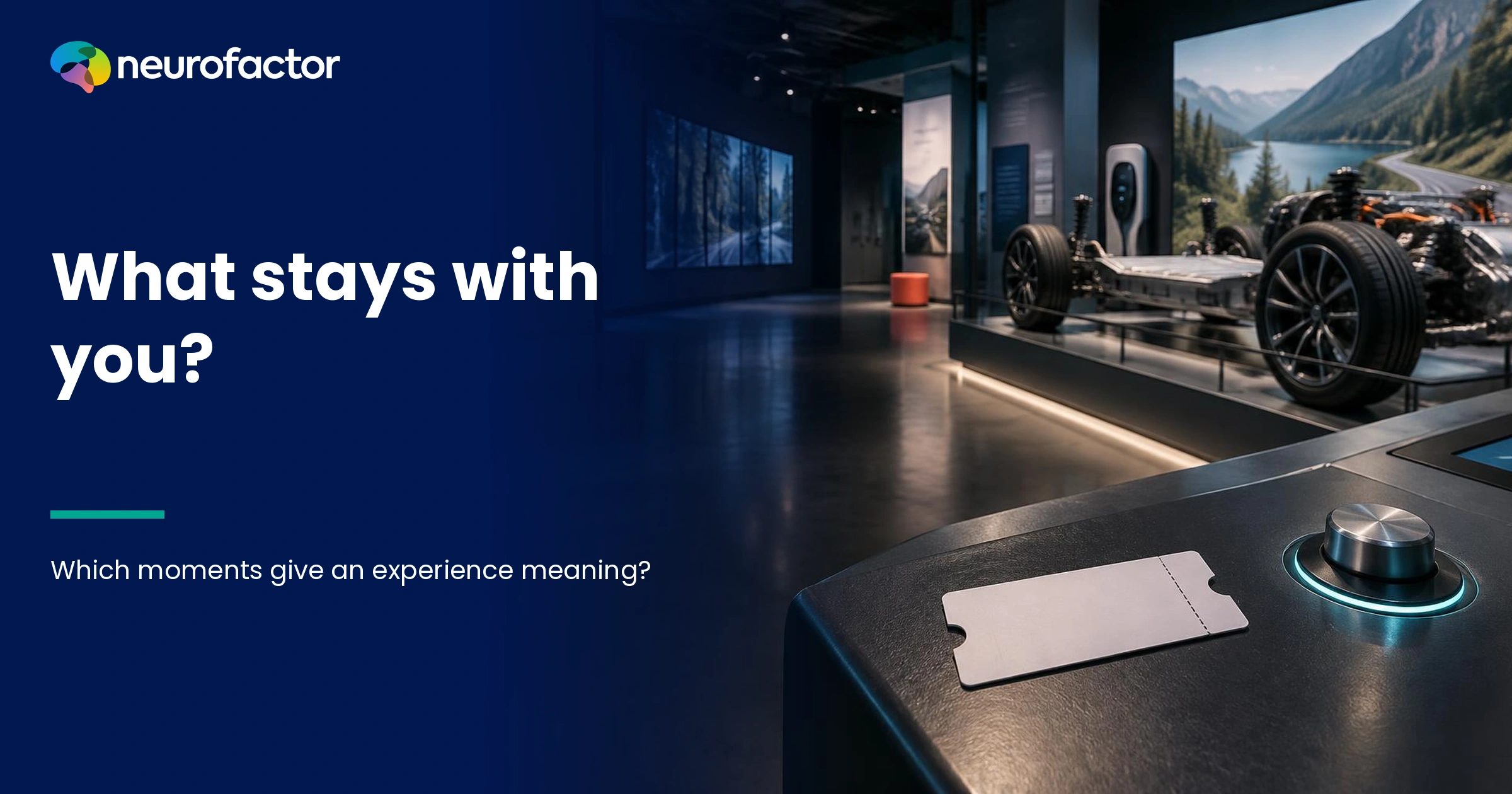
Which moments remain associated with an experience?
You visit an experience centre. The welcome is friendly, the route is clear and the central demonstration is impressive. Halfway through, a piece of equipment suddenly stops working. A member of staff starts fixing it, but nobody explains how long the interruption will last. At the end, the group receives a hurried, standard goodbye. Three days later, one visitor talks mainly about the extraordinary demonstration. Another describes the helpless feeling during the breakdown. The organisation sees a high average satisfaction score and wonders why their stories differ. An experience is what happens as you live through it. Remembering that experience involves selecting, reconstructing and interpreting moments afterwards. Which moments become connected with a brand, place or organisation, and how can you study that without confusing the memory with the entire experience?
A visit lasts two hours. Its memory can last much longer
A customer or visitor journey consists of more than an entrance, an activity and an exit. There are expectations beforehand, first impressions, conversations, choices, surprises, waiting periods, the central event and the transition back to everyday life. Yet someone describing a visit a week later rarely reconstructs every minute. They produce a story featuring a few scenes, an evaluation and details that carry personal meaning. The story may be sincere without being complete.
That difference matters commercially and creatively. A museum may want visitors to leave curious. A hotel may want guests to feel welcome and relaxed. A manufacturer may want its technology to become associated with reliability. Achieving these aims is not solely a matter of maximising the average experience across every minute. It also depends on which moments remain available later as evidence for a broader judgement: 'they really understood what I needed', 'that was extraordinary' or 'when something went wrong, I felt abandoned'. These statements express remembered meaning, not just observed behaviour.
A single exit survey cannot reconstruct that entire process. A satisfaction rating is an overall judgement, not an emotional timeline. Nor is the timing of a question neutral. Immediately after an activity, excitement may dominate. Several days later, what stands out may be a lack of guidance or an unresolved problem. The opposite can happen as well: an episode that felt demanding at the time may later acquire the meaning of achievement or personal growth.
That is not an excuse to neglect visitors' wellbeing while the experience unfolds. A positive memory does not retroactively make distress or poor service acceptable. Responsible experience design wants to know both things: what was it like to be there, and what meaning remained attached to the organisation afterwards? The gap between those answers can be one of the most useful findings in an evaluation.
Consider a visitor who enjoyed most of a tour but was left waiting without information for fifteen minutes. Another visitor may have experienced the same delay but received an honest explanation and a choice to continue later. The objective wait is similar. The associated meaning may differ substantially. You should not assume that difference in advance. It is exactly the kind of hypothesis that interviews, observation and follow-up measurements can investigate.
Image
What the peak-end rule does and does not establish
Research on retrospective evaluation suggests that people do not necessarily weigh every minute of an episode in proportion to its duration. In experiments involving pleasant and unpleasant film clips, Fredrickson and Kahneman found that episode duration contributed relatively little to the global retrospective evaluation under the studied conditions. [1] Redelmeier and Kahneman studied memories of painful medical procedures and found strong relationships between remembered overall discomfort, the most painful period and the final minutes. [2]
The finding is commonly summarised as the peak-end rule: the most intense phase and the ending may have disproportionate influence on a retrospective judgement. A 2022 meta-analysis by Alaybek and colleagues, drawing on many effects, found substantial overall support for peak-end influences in summary evaluations. [3] It makes sense, therefore, to consider strong moments and endings as potentially important components of a journey rather than treating them as incidental details.
But this idea is often pushed too far in commercial advice. A customer journey is not necessarily a controlled film clip or medical procedure. Some experiences unfold over several days, contain competing narratives or are discussed with friends afterwards. Kemp, Burt and Furneaux followed people on holiday using daily reports and then assessed their recollections. In that study, the peak-end rule was not an exceptionally strong predictor; subsequent accounts involved considerable reconstruction. [4]
The defensible conclusion is not: create one extraordinary climax and provide a delightful farewell, and customers will forget the rest. The conclusion is: test whether peaks and endings become disproportionately associated with the overall experience in your specific setting. A thoughtful ending may help. It cannot automatically erase an unsafe, unfair or persistently frustrating journey.
A further problem concerns the meaning of 'peak'. A peak in physiological activation is not automatically a peak in enjoyment. The response could reflect surprise, confusion, effort or fear. One visitor's central moment may be the dramatic simulation. For another, it may be the quiet explanation by a staff member who made an unfamiliar technology understandable. Identical intensity does not imply identical emotional meaning.
Image
Six kinds of moments that may remain memorable
The first is a moment of personal recognition. A visitor sees something linked to their own life, beliefs or previous experiences. A historical exhibition about migration may evoke family stories for one person and intellectual curiosity for another. The object is identical; the activated associations are not.
The second is an emotionally salient peak, such as amazement during a demonstration or relief after completing a challenging task. Emotional events can enjoy memory advantages, but not for every detail and not uniformly across contexts. LaBar and Cabeza describe mechanisms through which emotional arousal can shape encoding and later remembering. [5] Their review does not imply that designers can read a visitor's future memories from a single physiological signal.
Third is a break in expectations. Equipment fails, a route becomes blocked or an anticipated explanation never arrives. The moment may stand out because the normal sequence is interrupted. Event segmentation theory, discussed by Zacks and colleagues, proposes that people divide ongoing activity into events and that boundaries can arise when predictions are disrupted. [6] This does not prove that every small malfunction becomes memorable. It gives researchers a reason to pay attention to unexpected transitions.
Fourth is a social encounter. Someone is genuinely listened to, receives help from another visitor or feels embarrassed in front of a group. The action may be brief. Its personal meaning can concern recognition, dignity or trust.
Fifth is a moment of agency. The visitor chooses a route, has permission to skip a demanding activity or is forced to wait without explanation. Freedom, competence and helplessness are possible associations, not emotions to infer automatically from a timestamp.
Sixth is the closing episode and first retelling. Is the exit easy to find? Is it clear what happens next? Does the person leave feeling helped or dismissed? Do staff invite reflection without prescribing the correct response? The ending may shape the subsequent account. It should never be used as a cosmetic repair for genuine shortcomings earlier in the visit.
These categories are deliberately not a ranking. Their relevance must be assessed against the purpose and audience of the particular experience. A difficult museum exhibition may appropriately leave visitors unsettled. A medical consultation should not be engineered to maximise suspense. The desired meaning and ethical constraints matter.
Comparison: lived moments, recalled moments and later associations
One common research error is treating a measure collected at one stage as if it answers questions about all stages. The table below lists testable possibilities, not actual Neurofactor findings.
The matrix highlights why the most frequently mentioned moment is not necessarily the longest or most physiologically intense one. A sentence spoken by a guide may become the central memory of a brand experience. A costly, spectacular installation may barely feature in the later story if it has no meaning for that visitor.
That distinction challenges conventional dashboards. Viewing time, heart-rate variability and satisfaction scores can provide useful evidence for specific questions. None of them, in isolation, directly measures the association network that someone will have a week later. Conversely, relying only on retrospective questions means losing information about the visit itself. A strong design uses distinct measures that complement one another.
Welcome and orientation
- Possible experience while it happens
- Calmness or uncertainty
- What might later remain associated
- 'I knew where to go' or 'I did not belong'
- What helps test it?
- Route observation and open recall
Immersive demonstration
- Possible experience while it happens
- Wonder, effort or tension
- What might later remain associated
- 'That was extraordinary' or 'It overwhelmed me'
- What helps test it?
- Moment assessment and delayed associations
Unexpected interruption
- Possible experience while it happens
- Uncertainty and waiting
- What might later remain associated
- 'They left us alone' or 'They handled it openly'
- What helps test it?
- Incident log, staff response and later account
Personal conversation
- Possible experience while it happens
- Recognition or discomfort
- What might later remain associated
- 'They took me seriously'
- What helps test it?
- Conversation feedback and free recall
Final minutes
- Possible experience while it happens
- Closure or hurried departure
- What might later remain associated
- 'I left feeling confident'
- What helps test it?
- Exit observation and delayed recall
Later discussion at home
- Possible experience while it happens
- Reinterpretation
- What might later remain associated
- A stronger or altered meaning
- What helps test it?
- Follow-up without leading prompts
Why emotion is not the same as a strong or positive memory
'We want an emotional experience' is not yet a useful research objective. Which emotion, for whom, at which moment, and for what purpose? A museum dealing with injustice may reasonably create discomfort. A healthcare environment may need to reduce uncertainty. A thrill attraction may invite tension as long as participation is voluntary and the actual safeguards are sound.
Emotional arousal can support memory for central information while leaving peripheral details less accessible. Kensinger's review explains that emotion does not affect all aspects of an event equally, and that negative emotion can sometimes sharpen memory for certain details without making the full account complete. [7] In an experiment, Payne and colleagues found that stress exposure before a slideshow affected recall of emotional and neutral components differently. [8] These findings should not be turned into a universal formula about what all visitors remember.
Trying to maximise arousal can therefore be counterproductive. A powerful moment may be unforgettable yet produce an association you never intended. A dramatic performance may dominate the recollection so completely that the important product or educational message is missed. You may have optimised an impression while undermining the original objective.
A better question is whether, days later, the visitor remembers both the episode and the meaning the organisation sought to communicate. Do they associate the brand with clarity, reliability, discovery or personal relevance? Or do they primarily remember noise, confusion and pressure? A single spike in an EEG trace or physiological signal cannot answer that question. You need subsequent, appropriately designed recall and association tasks.
Memories may also change after a visit. Photographs, social media, reviews and conversations offer new language and interpretations. Reconstruction is part of how people create meaning in everyday life, not merely noise to remove from the data. But researchers should record the interval between the experience and the follow-up, and whether participants encountered substantial outside information.
Fictional case: the visitor centre designed around one spectacular peak
Imagine a fictional visitor centre introducing people to sustainable mobility. Guests walk past materials and prototypes, take a short interactive route and watch a demonstration of a new vehicle concept. The designers invest heavily in the spectacular middle section. Light, sound and motion create a coordinated show. At the end, guests are hurried through a small desk area because the next group is already waiting. This is an illustrative scenario, not a Neurofactor study or an account of measured outcomes.
Management asks which scene visitors will remember best. Designers assume it must be the immersive demonstration. The operations team suspects that overcrowding at the exit will leave a stronger mark. A host thinks the choice visitors made for themselves during the interactive section will matter most. All three suggestions are plausible. None has yet been tested.
The research team starts by mapping the actual visit: arrival expectations, the pace of the route, opportunities for choice, personal interactions, interruptions, the main demonstration and the final minutes. It observes queues, help requests and routes while documenting the situation. Some visitors provide free descriptions immediately afterwards. With appropriate consent, visitors are contacted again a few days later. Alternatively, different groups can be surveyed at distinct intervals if the design requires it.
The questions deliberately avoid telling participants which moment was supposed to be most memorable. First: 'Which moments come to mind?' Then: 'What did those moments mean to you?' Only later does the interviewer ask about particular stages or possible problems. The team may also use a structured association task to examine whether the centre has become linked with concepts such as openness, technical confidence, wonder or lack of control.
Suppose the exploratory interviews suggest a contrast: people often describe the demonstration as inspiring but the ending as rushed. This would justify a new hypothesis about the closing episode. It would not justify saying that the rushed ending caused lower loyalty or that changing it will increase repeat visits. Those outcomes still require a suitable comparison.
A meaningful design intervention might involve calmer departures, clear next-step information or giving each visitor a chance to complete the interactive choice. Before testing, the team must establish whether capacity, staffing and time actually allow that change. A pleasant script at the door cannot compensate for a bottleneck that continues to produce frustration.
Image
Diagnostic matrix: what can each signal tell you?
Research becomes weak when every signal is translated directly into 'greater impact'. The following matrix helps identify what a measure can and cannot legitimately establish.
For many museums and experience centres, well-designed interviews and observation are sufficient to generate useful hypotheses. Dynamic journeys may justify mobile EEG or eye tracking when moment-by-moment processes matter. Such methods bring requirements for motion artifacts, safety, calibration, privacy and interpretation. A complex method should be selected because it answers a defined question, not because it creates a visually impressive graph.
This separation also protects the integrity of the findings. An observed physiological response does not magically turn an interpretation into a fact. The value of combining methods is in relating behaviour, meaning and context while clearly marking what remains uncertain.
Behavioural observation
- What is actually recorded
- Route sequence, pauses, turning back, requests for help and waiting
- What else is needed
- Visit purpose and situation
- What cannot be concluded
- That standing still means admiration
Momentary self-report
- What is actually recorded
- Reported feeling or evaluation at one specific point
- What else is needed
- Clear timing, scale and context
- What cannot be concluded
- That it equals the later memory
Mobile eye tracking
- What is actually recorded
- Gaze position and visual attention patterns
- What else is needed
- Calibration, lighting, task and meaning questions
- What cannot be concluded
- That a fixation proves trust or enjoyment
EEG or other physiology
- What is actually recorded
- Task-dependent signal changes
- What else is needed
- Valid protocol, artifact checks and triangulation
- What cannot be concluded
- That one peak directly reads 'positive emotion'
Delayed free recall
- What is actually recorded
- Spontaneously reported scenes and narrative order
- What else is needed
- Time interval and external influences
- What cannot be concluded
- That an unmentioned moment was not experienced
Delayed association research
- What is actually recorded
- Links between the experience, brand and concepts
- What else is needed
- Suitable stimuli, comparison and method checks
- What cannot be concluded
- That every association is unconscious or causal
Later action
- What is actually recorded
- Repeat visits, recommendations or information requests
- What else is needed
- Alternative explanations and real opportunities
- What cannot be concluded
- That one remembered scene caused the action
An eight-step research protocol, from moment to lasting association
Step 1 - Define what should remain meaningful. Is the objective trust, comprehension, a sense of welcome, product understanding or a wish to return? Select a primary outcome and specify potential harms. Without this choice, every exciting moment can be celebrated as success after the event.
Step 2 - Map the actual journey. Include expectations, arrival, transitions, central activity, social encounters, interruptions, ending and subsequent discussion. Use operational data and observation rather than only the designer's ideal flowchart.
Step 3 - Write competing explanations. The peak may remain salient because of intensity, personal relevance or agency. Alternatively, an unresolved problem or disappointing ending may dominate. Register hypotheses before examining the findings to reduce after-the-fact storytelling.
Step 4 - Observe the experience with minimal disruption. Use observation, carefully timed questions and, where justified, suitable tracking or physiological methods. Explain participation clearly, protect personal information and check whether the measurement changes behaviour.
Step 5 - Capture spontaneous recall immediately afterwards. Ask visitors to describe moments in their own words before introducing a checklist. A prompt such as 'Was the finale fantastic?' can create the very response you intended to measure.
Step 6 - Repeat after an appropriate interval. Depending on the setting, follow up after several days and, if relevant, weeks. Record significant conversations, social posts or other exposures that may have influenced recall.
Step 7 - Examine differences and uncertainty. Compare first-time and experienced visitors, groups with different expectations, and people who faced different interruptions. Report the distribution of answers, not just the average. Avoid turning correlations into claims of causation.
Step 8 - Test a defensible design alternative. Compare a revised ending, a better explanation before an intense scene or another isolated change. Measure the intended association alongside immediate experience, operational outcomes and, where feasible, subsequent action. Only scale what the evidence supports.
A small exploratory study can be very useful for selecting what to investigate next. It cannot automatically establish a universal effect size. Strong causal claims need a suitable comparison, adequate data quality and a clear analysis plan.
Eight design decisions linking experience and memory
1. Give the central moment a purpose. Ask not only where visitors become most excited but what the scene teaches or means. A technical demonstration that only leaves a memory of loud sound may not support the intended product positioning.
2. Preserve agency. Tell people what is coming, what choices they have and how to opt out. This is especially important in intense experiences, but it also matters in ordinary customer onboarding or service processes.
3. Design transitions, not just attractions. Waiting, movement between rooms and unexpected changes can influence how a sequence is structured in memory. Operational handovers should be part of the experience design, not invisible logistical leftovers.
4. Fix problems where they occur. If the exit is overcrowded, a cheerful final message will not resolve the bottleneck. Examine capacity, timing, routing and staffing before polishing the script.
5. Allow personal meaning. A museum or educational experience should not demand one prescribed emotional response. Open-ended interpretation and meaningful choice can accommodate different associations without weakening the core purpose.
6. Make the ending credible. Provide closure, practical next steps and access to help. A useful ending does not need a gift or dramatic finale. Sometimes clarity is the most valuable closing experience.
7. Design for different starting points. First-time visitors and experts bring different expectations. A challenging activity may feel empowering to one visitor and overwhelming to another. There need not be one universal peak.
8. Measure meaning after the experience. Ask, after a suitable interval, which scene comes to mind first and why. Examine which concepts participants spontaneously connect with the organisation. Treat the answers as evidence to interpret, not a window into infallible memory.
The goal is not to maximise memorability at any price. A powerful memory is valuable when it reflects a genuinely good, meaningful and appropriate experience.
What memory does and does not tell us about later behaviour
It is tempting to move directly from positive recollection to repeat visits, product preference or recommendations. But other decisions sit between those stages. Someone can find a museum visit moving and still not return because travelling is difficult. A visitor may vividly remember a vehicle demonstration while deciding not to purchase because the cost is unsuitable. A negative recollection may lead to a complaint, but also to a constructive conversation that restores trust. Memory may contribute to behaviour; it is not a complete behavioural explanation.
A careful evaluation should therefore define three distinct outcomes. First, quality of the lived experience, examined during the visit and in immediate evaluations. Second, lasting meaning, assessed through delayed free recall and association research. Third, subsequent behaviour, such as a voluntary repeat visit, recommendation, further participation or information request. Every measure has its limitations. An intention is not the same as an observed action, and the action may depend on circumstances that have nothing to do with the experience.
A useful dashboard can consequently contain a timeline of operational and experiential moments, a qualitative map of recurring associations, and a small number of relevant subsequent actions. It need not collapse them into one invented 'experience impact score'. Differences between these layers are often the most informative findings. A powerful memory without comprehension may indicate that the content needs clearer explanation. A pleasant one-off visit without repeat attendance may be perfectly acceptable when the purpose was a unique educational encounter.
For a design comparison, choose the primary outcome before testing. If the goal is comprehension, correct delayed recall of the essential message is more relevant than a higher arousal signal. If the goal is trust, examine suitable associations and real decisions under realistic conditions. This prevents teams from redefining success afterwards according to whichever number happened to increase.
Methodological and ethical limits: there is no memory button
The brain does not store a visit as an unedited recording. Nor can an EEG trace reveal exactly which story a visitor will tell next week. EEG can measure time-dependent electrical activity under suitable conditions; eye tracking can record where visual attention is directed. Neither is, by itself, a validated meter for 'lasting positive brand association'. That requires investigating memory and associations later.
The peak-end rule should also be used carefully. Meta-analytic evidence supports a general effect in retrospective evaluations, but its size and relevance depend on context and measurement. The holiday study illustrates that the simple version of the rule does not always predict memories of long, complex experiences particularly well. [3][4] Those findings are not contradictory. They tell us to test a useful hypothesis in the actual setting rather than turn it into an absolute rule.
Causal claims require their own evidence. If visitors mention a crowded exit and are less likely to return, the exit may matter. But they may also differ in travel distance, price perceptions, earlier expectations or reasons for visiting. An association can be linked to an outcome without being its proven cause. Randomised or otherwise well-controlled comparisons can help test a proposed redesign where feasible.
Real-world research brings responsibilities concerning privacy, informed consent, accessibility and safety. Do not collect unnecessary individual psychological profiles. Make participation voluntary. Do not expose vulnerable people to additional distress to manufacture an impressive research signal. The ethical question is not how to make every moment unforgettable. It is how to create a useful experience without manipulation, deception or avoidable pressure.
The final trap is treating 'the peak' as a fixed object in the journey. People interpret events through their histories, goals, social surroundings and later conversations. Experience design can create conditions in which meaningful memories form. It cannot program the exact content of every visitor's later account.
Conclusion: design meaning and investigate what remains
Not every moment of an experience remains equally available when people tell their story afterwards. High points, unexpected interruptions, social recognition, loss of control and the ending may all matter. Their relative importance depends on the person and the situation. That is why good research begins not with the ambition to create the biggest emotional spike, but with a clearer question: what should visitors genuinely understand, feel or take away?
Study the journey as it unfolds, then ask for spontaneous memories after time has passed. Examine which associations remain linked to the brand, place or organisation. Compare those layers with the behaviour you are actually trying to improve. That leads to a testable design decision: which friction needs removing, which meaning needs clarifying, and what evidence would show that a change helped?
A dramatic moment is not necessarily a meaningful moment. A wonderful ending is not permission to provide a poor experience beforehand. The strongest visitor experience does not merely generate a good story. It earns that story.
Key terms
- Lived experience
- what someone encounters and experiences during an episode, including reactions that may be interpreted differently later.
- Remembered experience
- a later reconstruction and evaluation of a previous event, which is not necessarily the average of all its moments.
- Peak-end rule
- the finding that the most intense and final episodes can receive disproportionate weight in some retrospective evaluations; not a universal rule for every journey.
- Associative memory
- a link someone later makes between a brand, place or episode and concepts, feelings or personally significant meanings.
- Event boundary
- a perceived transition between segments of ongoing activity, such as an unexpected interruption or change of context.
- Triangulation
- combining different sources of evidence, such as observation, self-report, association tasks and later action, to clarify what a conclusion can support.
Frequently asked questions
What is the difference between an experience and remembering it?
The experience concerns what happens while someone is there. Remembering involves reconstructing it later. A visitor may recall a few striking scenes rather than the full sequence. Study both if you need to understand the journey and what remains associated with it.
Does the peak-end rule prove that the ending matters most?
No. Research supports peak and ending effects in some retrospective evaluations, but their relative strength differs across settings. A good ending does not cancel poor safety, deceptive promises or unresolved friction earlier in the journey.
Are negative moments remembered more strongly than positive ones?
Some negative and emotionally intense episodes can be memorable, but there is no single ranking that applies to every individual or setting. Attention, meaning, intensity, context and later reconstruction all matter. Test what people in your particular experience actually recall.
Can EEG identify the moment visitors will remember later?
EEG can record electrical brain activity during an event with a suitable protocol and acceptable signal quality. It cannot independently tell you which brand association someone will form a week later. Delayed memory and association measures are needed for that question.
When should you measure memory again?
Choose the interval around your objective and the nature of the experience. An immediate free-recall task may be followed by another after several days and, if relevant, weeks. Record intervening discussions and media exposure when possible.
How can you improve a memorable moment without making it artificial?
Start with the real problem or intended meaning. Design a credible change, such as clearer guidance, genuine choice or a calmer departure. Compare alternatives and measure the live experience as well as subsequent recollection instead of assuming that a new finale fixes everything.
Sources
- 1.Duration neglect in retrospective evaluations of affective episodes - Journal of Personality and Social Psychology, 65(1), 45-55 (1993)
- 2.Patients' memories of painful medical treatments: Real-time and retrospective evaluations of two minimally invasive procedures - Pain, 66(1), 3-8 (1996)
- 3.All's well that ends (and peaks) well? A meta-analysis of the peak-end rule and duration neglect - Organizational Behavior and Human Decision Processes, 170, 104149 (2022)
- 4.A test of the peak-end rule with extended autobiographical events - Memory & Cognition, 36, 132-138 (2008)
- 5.Cognitive neuroscience of emotional memory - Nature Reviews Neuroscience, 7, 54-64 (2006)
- 6.Event perception: A mind-brain perspective - Psychological Bulletin, 133(2), 273-293 (2007)
- 7.Remembering the details: Effects of emotion - Emotion Review, 1(2), 99-113 (2009)
- 8.The impact of stress on neutral and emotional aspects of episodic memory - Memory, 14(1), 1-16 (2006)
Read next
Reviewed by: Martijn den Otter · Last reviewed: 11/1/2026