
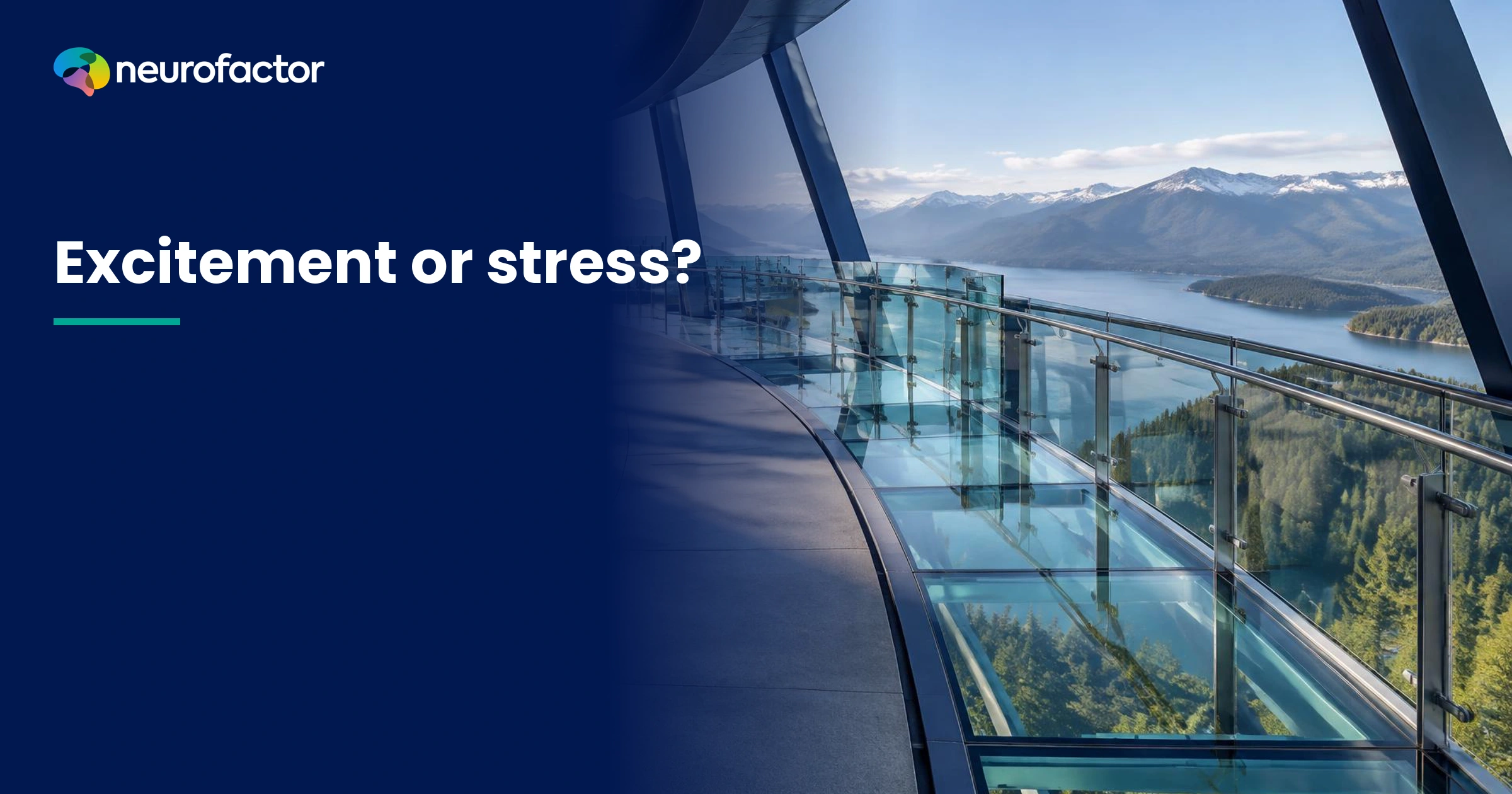
When does excitement become an attractive experience, and when does it become stress?
Two visitors are standing in front of the same observation platform. A glass floor stretches out beneath their feet, revealing the city below. One visitor laughs and steps forward immediately. The other stops at the doorway. Both feel their hearts beat faster. But the first visitor may connect that feeling with freedom, discovery and pride, while the second associates it with height, danger and the possibility of being unable to get out. The stimulus is much the same. Its meaning is not. For people who design experiences, that distinction is more important than whether a moment looks spectacular. More stimulation does not necessarily mean a better experience. Sometimes excitement makes an encounter irresistible. Sometimes the very same intensity produces avoidance, uncertainty or stress. To understand where the experience changes direction, you have to investigate what people associate with the moment, how much control they believe they have and what they actually do. Asking whether it was fun afterwards is useful, but not enough.
The same heartbeat can tell two different stories
Imagine that you are designing a premium test drive, an interactive installation, a festival programme or an immersive museum room. You have light, sound, movement, surprise and a powerful narrative at your disposal. The team increases the intensity and sees that people react. The room becomes more engaging, at least in the team presentation. But what, exactly, have you increased? One visitor may feel curious and alert. Another may feel overwhelmed and eager to escape. From a distance, those two responses can look unexpectedly similar.
Psychological research distinguishes arousal, which concerns the level of activation, from valence, which concerns how pleasant or unpleasant an emotional state feels. Russell's circumplex model positions excitement and distress differently even though both are associated with relatively high activation [1]. That model does not mean every lived experience can be reduced to two perfect measurements. It does provide a useful warning: intensity and pleasure are not interchangeable indicators.
This has an uncomfortable implication for an experience designer. A prominent peak in a timeline may be the very moment people remember fondly, or the point at which they decide not to return. A longer gaze, a quickened pace or an elevated pulse has several possible interpretations. None demonstrates, on its own, that a visitor is having a good time. An interview may reveal that someone found an experience fascinating and, at exactly the same time, wanted it to stop. Treating either response as the only truth would discard essential information.
A better brief asks three questions. What should the person encounter? What should that encounter mean to them? What can they do when it happens? A high-intensity moment might be precisely what someone books an extreme sports activity for. The same level of activation would be inappropriate in a hospital waiting area or a service environment that should support calm decision-making. Designing the right experience is not about maximizing a universal scale of stimulation.
This distinction also changes which outcome you consider successful. In a voluntary high-adrenaline activity, successful participation and enjoyment may be central. In a museum, access, comprehension and exploration may matter more. In a showroom, the experience must leave the visitor able to assess a product. A dramatic reaction is not enough unless it helps achieve a purpose that makes sense for the setting and the participant.
Where excitement can turn: six signals and six possible meanings
There is no universal heart-rate threshold, sound pressure level or duration at which excitement becomes stress. The turning point depends on the person, the experience and the context. A loud effect that visitors expect in an immersive attraction may feel intrusive in a gallery. A steep ascent might represent freedom to an experienced climber and being trapped to someone who has never tried the activity before.
This is a set of hypotheses for research, not a diagnostic instrument or a list of causes that apply to every individual. The same characteristic can support entirely different interpretations. Ask more than whether the moment was exciting. Investigate which words participants spontaneously connect with it, what they expected to happen and how they behaved when the intensity increased.
Order matters as much as content. Someone who knows that leaving is always possible may approach the challenge differently from a visitor who only discovers a stopping mechanism halfway through. Equally, telling people they can leave is meaningless if there is no credible route to do so. The physical arrangement, the service procedure and the communication have to support one another.
A meaningful experience therefore requires more than a carefully edited sensory sequence. It requires attention to what people believe they are choosing and what they can actually choose. Neither a simple physiological score nor a creative team's intuition can substitute for that investigation.
Strong physical activation
- Potential attractive meaning
- Energy, challenge, anticipation
- Potential stressful meaning
- Panic, overload, losing calm
- What to test independently
- Reported emotion alongside physiology
An unexpected event
- Potential attractive meaning
- Discovery, surprise, adventure
- Potential stressful meaning
- Unpredictability, danger
- What to test independently
- Expectations and safety information
Visible height or speed
- Potential attractive meaning
- Freedom, achievement, thrill
- Potential stressful meaning
- Vulnerability, risk, hesitation
- What to test independently
- Risk associations and participation
Attention from other people
- Potential attractive meaning
- Pride, connection, shared discovery
- Potential stressful meaning
- Embarrassment, judgement, shame
- What to test independently
- Social safety and freedom to refuse
Limited advance information
- Potential attractive meaning
- Mystery and curiosity
- Potential stressful meaning
- Uncertainty and no perceived exit
- What to test independently
- Information needs and perceived control
A difficult task
- Potential attractive meaning
- Mastery, progress, personal achievement
- Potential stressful meaning
- Failure, helplessness, being stuck
- What to test independently
- Perceived ability and actual support
What research tells us about emotion, control and risk
Several scientific perspectives help explain why intensity can become attraction or resistance. None offers a universal formula for the precise moment when pleasure turns into stress. Each helps identify a distinct part of the experience.
Russell's model separates the level of activation from the direction of emotion [1]. Scherer's appraisal perspective adds the idea that emotional responses relate to how people evaluate an event's relevance, expected consequences and their capacity to deal with it [2]. In other words, the experience is not simply the sum of speed, volume, movement and brightness. Meaning and interpretation are central components.
Folkman's theoretical analysis cautions against a simplistic slogan that greater perceived control always reduces stress [3]. The relationship depends on circumstances, the kind of control involved and how people cope. Some visitors actively choose a surprise and do not want every detail revealed. Control, in that context, is not the removal of every unexpected event. It is having adequate boundaries and a credible option to act when the experience becomes unwelcome.
Research on risk as feelings, developed by Loewenstein and colleagues, shows why emotions felt during a choice may diverge from cognitive assessments of its consequences [4]. A platform can comply with applicable engineering requirements while someone still feels unsafe. Conversely, enthusiasm can make a person underestimate genuine risks. The crucial lesson for designers is that perceived safety and objective safety are separate questions. Emotional research can inform the first. It must never replace technical safety assessment of the second.
Lerner and Keltner found different patterns of risk evaluation linked to fear and anger, with appraisals of certainty and control playing a role [5]. That research is not a ready-made prediction for individual visitors to an exhibition. It supports a narrower but valuable point: specific emotions are more informative than a single label such as 'high activation'.
Dickerson and Kemeny's meta-analysis of laboratory stressors shows how uncontrollability and social-evaluative threat relate to certain physiological stress responses, including cortisol, in motivated performance tasks [6]. That does not establish that the same mechanism produces the same result in every public attraction. It does help explain why an activity performed in front of an audience may feel very different from a similar task performed privately.
Brooks investigated another striking possibility. Across experiments involving speaking, singing and mathematics, reframing anxious activation as excitement improved performance relative to trying to calm down [7]. This finding concerns the studied tasks and conditions. It does not justify telling a frightened visitor that an objectively unsafe or overwhelming situation is 'just excitement'. Changing a label cannot eliminate physical danger, sensory overload or an inadequate exit.
Maier and Seligman review research into controllability and stress responses, including substantial evidence from animal studies [8]. The work adds a mechanistic perspective, but it cannot be converted into a rule that a specific brainwave pattern reveals an individual museum visitor's emotional state. Human experience research still needs context, appropriate measures and cautious interpretation.
Together, these sources support a more useful design principle than 'more stimulation creates more engagement'. What matters is the interaction between stimulation, interpretation, control and the situation. That interaction needs to be investigated in the environment in which the experience actually takes place.
The association behind the thrill is the design variable
Consider a short dark passage followed by a sudden burst of light. To a designer it might represent a dramatic transition. One visitor connects it with science fiction and discovery. Another connects it with losing their bearings, possible danger or having nowhere to go. The physical event may be identical. The mental networks activated by that event are not.
This is where association research becomes relevant. Instead of relying solely on a question such as 'How exciting was this, from one to ten?', investigate what people connect the moment with. What words do they produce before seeing the installation? What do they associate with the actual passage? What emerges after they have completed the experience? Free associations, carefully designed comparative tasks and appropriate implicit measures can contribute to that picture. No single method reads an emotion directly from the mind.
Associations are not always neatly positive or negative. 'Control' may mean freedom, but it can also mean being left to deal with a difficult task alone. 'Surprise' may evoke curiosity as well as unease. 'Height' may represent personal achievement and real danger simultaneously. When a concept receives an average score of seven out of ten, those competing meanings can disappear into the average.
The audience's situation matters. Compare visitors who deliberately booked a thrilling experience with people who happen to encounter the same installation while walking through a museum. The first group may anticipate strong stimulation. The second may feel that the activity was introduced without a meaningful warning. Compare experienced participants with first-timers, but avoid treating an audience segment as a psychological or medical classification. Research can reveal recurring patterns; it does not entitle you to decide that every person in a group will respond the same way.
It is equally important to distinguish association from cause. A person may mention 'danger' and still choose to participate because they value the challenge. Someone else may say 'adventure' but leave because they have limited time. A strong association is a clue about interpretation, not definitive proof of the reason behind an action. Place it alongside observed behaviour, practical barriers and participants' own accounts.
This distinction turns research into useful design work. If people associate a doorway with 'no way back', changing the soundtrack may not solve the problem. If they understand the exit but find the experience underwhelming, clearer safety signage will not necessarily improve enjoyment. The appropriate change depends on identifying the meaning that matters in that particular decision.
Fictional case: a glass observation platform at a science centre
This case is entirely fictional and illustrates a possible research design. Its organisation, participants and outcomes are not Neurofactor research findings or client data.
A science centre is planning a new visitor route to a glass observation platform. People move through a dim passage into a room with a transparent floor. A dynamic projection reveals the city below. The creative team wants visitors to feel wonder, discovery and a welcome dose of tension. The initial concept is well received in design meetings. It looks spectacular, photographs well and provides a dramatic finale to the exhibition.
In an imagined exploratory session, the words 'freedom', 'wow' and 'discovery' appear alongside 'depth', 'unsafe' and 'how do I get back?'. Some visitors like the fact that the reveal only becomes clear at the final moment. Others want a better view of the route before entering. One person turns around halfway through, while another stays longer to share the view with a companion. There are intentionally no invented conversion percentages, physiological scores or participant counts in this example.
The team could simply reduce the sound or change the transparency of the floor. But it has not yet established what produces the hesitation. Perhaps the stimulus itself is not the main issue. Perhaps people need a choice before committing to the route. The team therefore prepares three versions: the original unexpected reveal, a version with clear information and a visible exit, and a version with a voluntary alternative route through the same content.
Each version tests a different proposition. The first retains the surprise. The second reduces uncertainty without hiding the height. The third makes a self-directed decision possible without publicly labelling anyone as fearful. Every version must meet real safety and accessibility requirements before visitor testing begins. Experienced safety specialists, not an emotion score, determine whether the design is suitable for use.
The main outcomes in this fictional protocol would be voluntary participation, completing the chosen route independently and experiencing the option to stop as credible. Secondary outcomes would be spontaneous associations, reported tension, enjoyment and post-visit evaluation. Average dwell time would not be a sufficient success measure. Someone who remains still because they feel trapped is not evidence of positive engagement.
The same logic could apply to a premium test drive, an immersive exhibition, a branded live event or a guided product demonstration. The right intervention is not necessarily to remove the spectacular moment. It may be to improve the conditions under which visitors choose to experience it. Whether that works must be measured rather than asserted in advance.
Safety and choice do not have to remove the excitement
There is a common assumption about high-intensity experiences: that clear information, a quiet entry or a visible stopping option will ruin the magic. In some situations, the opposite may be true. Knowing what a challenge involves and how to leave may enable people to take part more confidently. Not because a sign can erase fear, but because it makes a more informed and genuinely voluntary choice possible.
Distinguish three levels: objective safety, perceived safety and freedom to choose. An installation may meet technical requirements but still be difficult to understand. A space may feel reassuring while being operationally poorly managed. A visitor may have a nominal choice but feel pressured because an entire group is watching. You need to design responsibly at all three levels.
Group experiences have an additional complication. If declining requires someone to announce their fear in front of everyone, the supposed option can feel humiliating. Design alternative routes as equally legitimate ways to discover the experience. Avoid signs that mark a quieter option as the route for people who are 'too scared'. A meaningful choice should not come with a social penalty.
Do not overpromise safety either. A guide should not claim that nothing could possibly go wrong when genuine risks remain. Clear and accurate information is more useful than absolute reassurance. Some participants may have medical, sensory or accessibility needs that require additional consideration by qualified professionals. Experience design cannot replace risk management or appropriate accessibility arrangements.
The objective is not complete control over every second. It is an appropriate challenge with understandable boundaries. Visitors may decide that a particular activity is not for them. If they can make that decision with dignity and still have a meaningful visit, the overall experience may have succeeded even without a dramatic moment.
These choices are relevant beyond intense attractions. A client demonstration can be overwhelming if it puts people on the spot. An interactive gallery may exclude people who cannot identify a quiet route. A festival may unintentionally turn surprise into distress when its entrances, warnings and staff support are unclear. Designing for agency is not the same as designing for boredom.
A diagnostic matrix: identify the problem before changing the stimulus
When an experience disappoints, the obvious temptation is to change the volume, brightness or duration. But without diagnosis, that mainly tests the design team's preference. A structured comparison helps identify the most plausible mechanism and the first outcome to measure.
The final column is deliberately labelled first outcome. Before collecting every available signal, decide which behavioural question matters. Voluntary participation may be central in one attraction. Independent exploration may matter in a museum. Safe learning and later task performance may matter in training. A spike in physiological activation is rarely an appropriate primary business outcome.
Timing is also essential. A rise in activation immediately before a voluntarily chosen challenge need not indicate a problem. A similar rise after an unexpected exit closure has a very different context. The environment, the sequence and the opportunities to act are part of the explanation, not incidental background variables.
The table should therefore guide hypothesis testing rather than be treated as a lookup sheet that diagnoses an individual visitor. If the observed behaviour and stated associations disagree, take the disagreement seriously. It may reveal missing information, inadequate measurement, a practical barrier or genuine ambivalence.
High tension and voluntary participation
- Possible associative explanation
- Challenge, adventure, pride
- Design option to test
- Preserve intensity and protect clear boundaries
- First outcome to assess
- Enjoyment, participation and safe completion
High tension and avoidance before starting
- Possible associative explanation
- Danger, no exit, embarrassment
- Design option to test
- Advance information and a credible alternative
- First outcome to assess
- Voluntary starts and felt choice
Excitement beforehand, withdrawal halfway
- Possible associative explanation
- Experience differs from expectation
- Design option to test
- Gradual transition and usable stopping point
- First outcome to assess
- Where withdrawal happens and why
Low tension and disappointment
- Possible associative explanation
- Boredom, predictability, little challenge
- Design option to test
- Test a more intense optional variant
- First outcome to assess
- Enjoyment and voluntary variant choice
Strong attention but negative evaluation
- Possible associative explanation
- Overload, pressure, loss of control
- Design option to test
- Adjust pace or sensory demands
- First outcome to assess
- Comfort, meaning and task completion
Major differences between visitor groups
- Possible associative explanation
- Different expectations or risk meanings
- Design option to test
- Adapt information or route to context
- First outcome to assess
- Outcomes for relevant groups without stereotyping
Measuring the turning point without pretending to read minds
Good measurement starts with a behavioural question and a design decision. 'We want more emotion' is not precise enough. Are visitors supposed to begin voluntarily, navigate a route without confusion, understand an available choice, enjoy a moment or want to participate again? Specify one primary outcome and select a small number of supporting measures.
Before the event, explore expectations and associations. Which words come to mind when people hear the description? What reward and what risk do they anticipate? How much control do they believe they will have? Concept comparisons and appropriately designed association tasks can show whether the unfamiliar experience is already interpreted as 'adventure' or 'threat'. This does not turn pre-event statements into predictions that are certain to come true.
During the experience, record clear event markers: the introduction, first encounter, intensity change, a potential stopping decision, any request for assistance and the end. Observe what participants actually do: begin, wait, pause, ask for help, choose another route or leave. Short, minimally disruptive questions at suitable breaks may help distinguish welcome intensity from unwanted distress. Do not interrupt a participant during a risky physical action merely to collect better data.
Afterwards, connect the retrospective account with the recorded journey. Ask about uncertainty, recovery, moments of doubt and the credibility of the choice to stop. A participant can feel proud after a difficult experience while having felt serious stress during it. Both observations matter. Retrospective enjoyment, willingness to return and voluntary participation are different outcomes.
Depending on the question, Neurofactor can combine association research, profiling, observation, eye tracking and mobile EEG for dynamic real-world experiences. Its research methods overview describes why the research question determines the method stack. The applications overview places this work in the wider context of customer journeys and experience design.
Mobile EEG can add time-resolved information about brain responses when the experimental setup is appropriate. It does not automatically identify fear, pleasure or safety. Heart rate, skin conductance and pupil size also have multiple possible explanations and can be affected by movement, heat, exertion and environmental conditions. Height experiences and physical activity create additional artefacts and safety requirements. A one-signal 'stress detector' is not a credible research design.
For that reason, align behavioural events, contextual observations and reported meaning before drawing conclusions. Use a method because it makes a specific uncertainty easier to resolve, not because a sensor will produce a dramatic visual for a presentation. Inexperience with complex signals should never lead to more confidence than the data support.
An eight-step research protocol from stimulation to design decision
Step 1 - Define the decision. What must the team be able to decide after the research? Keep the sudden reveal, introduce a calmer approach, add a voluntary alternative or adapt guidance? Research without a decision can generate an impressive report without changing the experience.
Step 2 - Specify the intended behaviour. Choose a primary measure such as starting voluntarily, navigating independently, finishing safely or deciding to return. Define outcomes to avoid, including unwanted sensory overload, unclear instructions and social pressure to take part.
Step 3 - Make the associative hypotheses explicit. Write down the meanings you expect, such as adventure versus danger, freedom versus lack of control, achievement versus embarrassment. Treat them as hypotheses requiring evidence rather than descriptions of what participants 'really think'.
Step 4 - Select relevant participants and contexts. Separate people who deliberately book a high-intensity attraction from incidental visitors. Consider prior experience, group size, accessibility, safety requirements and vulnerable users without turning behavioural or neural data into personal labels.
Step 5 - Build interpretable variants. Change one meaningful element at a time where feasible: information, sequence, available choice or intensity. Keep other elements comparable. Every variant must be genuinely safe and ethically acceptable before it is tested.
Step 6 - Measure before, during and after. Use comparable questions and behavioural measures. Synchronise event markers if recording dynamic signals. Document crowding, staff intervention, equipment changes and interruptions because they may influence outcomes.
Step 7 - Analyse patterns beyond the mean. Compare moments and relevant groups. An average rating can conceal two opposing experiences. One striking participant also cannot establish a universal segment. Report uncertainty, possible alternative explanations and the limitations of the sample.
Step 8 - Make and validate a design change. Choose an intervention based on the most defensible interpretation. Test whether the primary outcome improves without creating new problems. If anxiety declines but genuine enjoyment disappears, the team may have solved the wrong problem.
This protocol is a practical research framework, not a clinical assessment and not a guarantee of a particular effect. Sample size, analytical method and feasible comparisons depend on the setting, risks and intended decisions. A small exploratory study may generate useful hypotheses, but it does not automatically prove reliable differences across all visitor groups.
Eight design decisions that can keep excitement attractive
1. Make the promise concrete. 'Spectacular' does not tell people what they are agreeing to. 'Walk across a glass floor with an option to turn back' makes the decision more informed. Communication should not remove every surprise, but it should be honest about conditions that materially affect participation.
2. Offer a choice before the pressure begins. Telling someone that another route is possible after they have reached a stage in front of their peers may be too late. Explain the options near the beginning. Check whether visitors understand the alternatives and can select them without embarrassment.
3. Build intensity in meaningful stages. A gentler first encounter may help some people assess a later, stronger challenge. Others actively seek an immediate surprise. Test whether graduated intensity creates better participation and enjoyment instead of assuming more steps are always preferable.
4. Make staff support non-coercive. A guide who asks what someone needs can support agency. A guide who says 'everybody else dares to do it' may introduce social-evaluative pressure. Observe the effect of real staff behaviour rather than treating scripts as proof of hospitality.
5. Design moments for recovery. A journey does not need to become more intense every minute. Pauses, visible exits and room to process an encounter can add to its quality. Measure whether visitors then choose to continue rather than interpreting longer dwell time as positive engagement by default.
6. Give alternative routes equal dignity. Do not describe the quieter version as the option for weak or fearful visitors. Design different ways of accessing the same subject matter. A quieter path can be a worthwhile experience in its own right rather than a diminished emergency substitute.
7. Measure positive tension separately from unwanted stress. Ask about curiosity, enjoyment, discomfort and control. Place these responses alongside actual choices to continue or stop. In that way, high activation cannot silently become a universal success indicator.
8. Optimise for the purpose, not the strongest reaction. A premium vehicle experience, a public museum and a workplace training exercise have different goals. Choose evidence that reflects what people should gain, and never make visitor wellbeing secondary to an impressive chart.
None of these eight choices can be assumed to produce the same effect everywhere. A theatre production may deliberately use ambiguity. A public service centre should make essential information easy to understand. Research helps determine which choices fit the purpose, population and context.
Methodological and ethical limits: intensity is not evidence of quality
It is tempting to look at an EEG timeline or a skin-conductance graph and say: 'Here activation increased, so this must be the best moment.' That inference is insufficient. Physiological variation has several possible causes. Movement, temperature, effort, attention, fatigue, novelty and recording artefacts may all contribute. Without appropriate validation, you cannot reliably infer the direction of an emotion from a single measure.
Self-reports are limited too. People reconstruct an experience afterwards, may wish to appear brave or struggle to describe intense feelings. That is a reason to combine approaches, not to replace the participant's account with an allegedly objective brain value. An association offers evidence about meaning; it is not a proof of causation. A comparison between two designs becomes more informative when the variants are controlled and the behavioural outcome is defined in advance.
There are also ethical limits to the goal itself. An experience that depends on genuine danger, humiliation, misleading safety information or participation under pressure should not be optimised for greater intensity. Objective safety, accessibility, informed participation and meaningful freedom of choice take priority. Children, people with disabilities and visitors with particular sensitivities may require different safeguards. Qualified specialists should address individual medical or safety concerns where necessary.
Handle data responsibly. Video, audio, physiological signals and neuroscience measures can be sensitive in identifiable settings. Determine what is actually necessary, how information and consent are handled and which privacy and research obligations apply. Do not create individual psychological classifications from weak signals or use them to exclude visitors without a legitimate basis.
Perhaps the most important ethical warning is a change of objective. The team began by trying to offer a meaningful experience, but after installing sensors it may begin chasing the highest peak. A peak is a measurement feature, not a mission. Experience quality lies in what people could choose, what they actually encountered and what they meaningfully took away.
Conclusion: do not maximise the stimulus, design its meaning
Excitement is neither inherently beneficial nor inherently harmful because it is intense. It can become attractive when people perceive a welcome challenge within understandable boundaries and retain meaningful freedom to participate. The same stimulus may become stressful when associations with danger, social judgement, uncertainty or loss of control dominate. That is why two visitors can experience the same designed moment in profoundly different ways.
If you want evidence-based experience design, start with three questions: What does this moment mean to this visitor? What choice do they believe they have? What do they actually do next? Investigate those layers separately, then bring them together. You will be better equipped to design a compelling moment without mistaking a spectacular reaction for a successful experience.
Related articles and methods
- Learn how Neurofactor combines research methods around the behavioural question behind an experience.
- Explore applications in journeys, physical environments and experience design.
- Associations in experience: why the same event feels different · How does an experience begin before anyone walks through the door? · What does the entrance to a space make people associate with it immediately?
Key terms
- Arousal
- The degree of bodily or psychological activation; high arousal does not by itself establish pleasure or stress.
- Valence
- The pleasant or unpleasant quality of a feeling, distinct from its activation level.
- Appraisal
- The interpretation of an event in relation to goals, consequences and perceived capacity to deal with it.
- Perceived control
- How much influence a person believes they can exert on the course or consequences of a situation.
- Risk association
- A mental connection between a stimulus and potential threat, uncertainty or negative consequences.
- Real-world validation
- Testing an experience or intervention in its actual context using predefined behavioural and experience measures.
Frequently asked questions
Are excitement and stress the same thing?
No. Both may involve high physiological activation, but their subjective meaning and emotional valence differ. A heart-rate increase alone cannot establish whether someone feels excited or distressed.
When does a stimulating experience become too much?
There is no universal threshold. Investigate whether people understand the situation, can choose freely, perceive sufficient control and consider the stimulation welcome. Objective safety must be established independently of those perceptions.
Does providing control make a thrilling experience boring?
It can if all uncertainty is removed, but credible options to stop or choose another route may also enable participation. Test the balance between challenge and agency within the specific setting.
How can you distinguish pleasant excitement from unwanted stress?
Combine associations, short questions about enjoyment and discomfort, perceived control and observed behaviour before, during and after the experience. Physiological measures can add context but are not standalone emotional diagnoses.
Is EEG necessary for experience research?
No. Observation and association research may already answer the practical question. Mobile EEG can be useful when time-resolved processing in a real environment matters and the setup is safe and technically robust.
Why do people react differently to the same attraction?
Previous experience, expectations, social setting, perceived risk and opportunities to act may differ. Study relevant patterns without assigning fixed psychological labels based on a single profile or signal.
Sources
- 1.A Circumplex Model of Affect - Journal of Personality and Social Psychology, 39(6), 1161-1178 (1980)
- 2.Appraisal Considered as a Process of Multilevel Sequential Checking - In Appraisal Processes in Emotion: Theory, Methods, Research, 92-120 (2001)
- 3.Personal Control and Stress and Coping Processes: A Theoretical Analysis - Journal of Personality and Social Psychology, 46(4), 839-852 (1984)
- 4.Risk as Feelings - Psychological Bulletin, 127(2), 267-286 (2001)
- 5.Fear, Anger, and Risk - Journal of Personality and Social Psychology, 81(1), 146-159 (2001)
- 6.Acute Stressors and Cortisol Responses: A Theoretical Integration and Synthesis of Laboratory Research - Psychological Bulletin, 130(3), 355-391 (2004)
- 7.Get Excited: Reappraising Pre-Performance Anxiety as Excitement - Journal of Experimental Psychology: General, 143(3), 1144-1158 (2014)
- 8.Learned Helplessness at Fifty: Insights from Neuroscience - Psychological Review, 123(4), 349-367 (2016)
Read next
Reviewed by: Martijn den Otter · Last reviewed: 10/30/2026