
From association research to experience design: how do you turn insights into design?
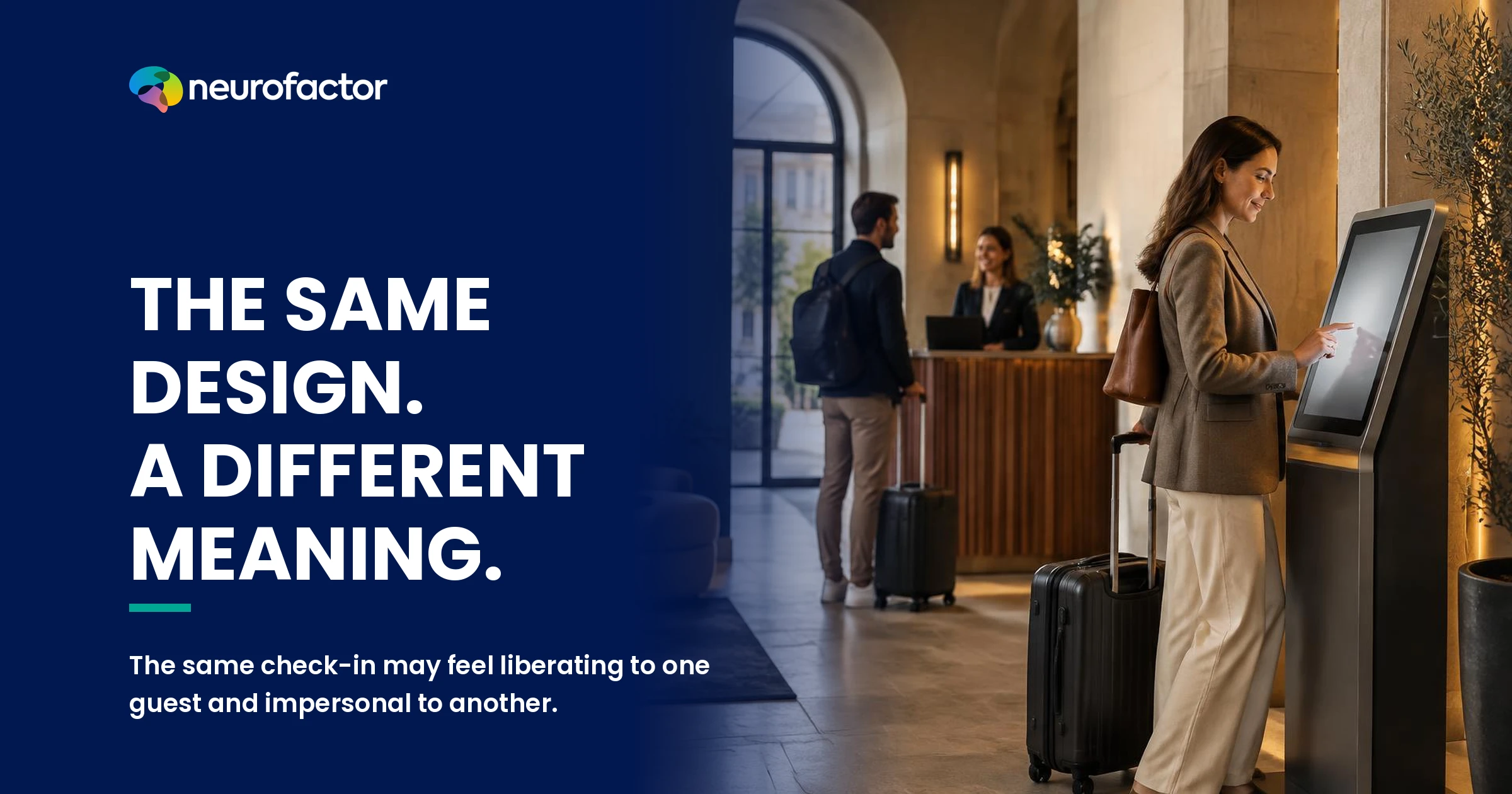
A guest walks into a hotel and sees a screen saying, 'Check in yourself and go straight to your room.' For one person, that is excellent hospitality: no queue, no unnecessary conversation and control over their own arrival. For another, the same screen is disappointing. They expected someone to say, 'Welcome. It is good to have you here.'
The hotel could make the check-in faster, write a friendlier message or place an employee beside the screen. But which change would address the real problem? Without research, any design decision remains an assumption. Even when average satisfaction looks acceptable, two groups may respond to the same improvement in opposite ways.
This is where association research becomes useful for experience design. The purpose is not merely to find out which elements people like or dislike. It is to understand what a moment means to them, translate that understanding into an explicit design hypothesis, make a tangible change and assess whether the change works in a realistic service setting.
That process sounds straightforward. In practice, organisations regularly skip three steps: they turn a diagnosis into a solution too quickly, evaluate prototypes on stated liking rather than behaviour and present an interesting observation as proof of an effect. This article shows how to avoid those mistakes and keep the customer's experience connected to the operation that delivers it.
The problem: a useful insight is not yet a useful design
A research report may show that visitors feel uncertain on arrival, while management proudly describes the entrance as efficient. The finding matters because it reveals a difference in perspective. It does not, however, establish whether better signage, earlier communication, a different process or personal contact would solve the problem.
Experience design starts by taking that uncertainty seriously. Instead of choosing the intervention that seems most intuitive, you reconstruct the situation in which a meaning emerges. Where is the customer standing? What are they trying to achieve? What do they believe will happen next? Which information is available? What can employees actually provide? What happens when something goes wrong?
Lemon and Verhoef (2016) emphasise that customer experience develops across multiple touchpoints, channels and periods of time. De Keyser and colleagues (2020) distinguish touchpoints, context and experience qualities. These distinctions matter in practical design. A feeling of welcome may be affected by a screen, but also by a message received before arrival, a queue, fatigue after travelling and the way a team member responds. Changing an interface cannot always repair the entire service chain.
The central design question is therefore not 'How do we make the association more positive?' It is 'Which concrete interaction might change a relevant meaning without undermining other customer needs?'
Start with the meaning people attach to the moment
Associations connect situations, objects and actions with expectations and evaluations. Fazio (2007) describes attitudes partly as object-evaluation associations that vary in strength. That does not mean every association directly produces behaviour. It does mean that the meaning activated by an experience can offer a relevant clue about attraction, hesitation or avoidance.
Consider hotel self-check-in. 'Doing it yourself' may evoke independence, speed and privacy. The same action may also evoke a lack of personal attention, fear of technical problems or concern that help will not be available. The function of the screen has not changed. The consequences that people imagine have.
A sound diagnosis keeps four levels separate: the stimulus or encounter (self-check-in), the practical expectation (getting a room key without help), the activated meaning (control or abandonment) and the possible outcome (successful check-in, uncertainty or a request for assistance). These levels cannot simply be treated as interchangeable.
When developing an association map, investigate which experiences and situations are linked to the meanings people mention. A negative association is not a fixed personality trait. It may depend on the setting, the person's immediate goal or a previous experience with a similar service.
Put the association back into the complete customer journey
A service encounter rarely stands alone. For a hotel, arrival may start days earlier with a confirmation email. It continues with finding the entrance, parking, recognising the reception area, checking in and locating the room. Each interaction changes the context in which the next one is interpreted.
A useful journey map therefore records more than steps and emotions. It describes the customer's task, missing information, organisational dependencies and consequences of failure. That makes it possible to distinguish a communication problem from an operational problem.
Suppose a guest cannot find their access code. A clearer message may be enough. But if the system frequently fails to issue a valid code, changing the wording will not solve the underlying problem. A beautifully designed screen that fails at the critical moment could damage the customer's trust further.
Bitner's servicescape framework (1992) draws attention to the physical environment. Patrício and colleagues (2011) show that service design needs to connect the service concept, the system and the individual encounter. For the experience designer, that means coordinating digital, physical and human touchpoints. The customer does not experience these as separate departments, even when the organisation manages them that way.
Investigate attraction and resistance independently
Design teams often receive a single satisfaction average for a particular touchpoint. Contradictory needs may sit behind that number. A fast digital check-in can feel efficient to a traveller in a hurry and impersonal to a guest who is unsure about the property. The same interaction may contain both attraction and resistance.
Do not only ask which association is strongest. Ask among whom, in which situation and compared with which realistic alternative. Consider guests arriving for the first time, people with accessibility needs, guests with complex reservations and those who actively prefer self-service. These categories are possible research segments, not predetermined psychological profiles.
A core conflict between associations is especially useful in the design phase. Customers may find speed attractive while fearing that a fast system will remove the opportunity to ask for assistance. Increasing speed alone may not be the correct design goal. A visible and optional support route could conceivably reduce the anticipated disadvantage without removing autonomy.
Put the attraction and resistance hypotheses side by side before deciding on the concept. Otherwise, an organisation may optimise the feature people like most while unintentionally strengthening the reason another group avoids the service.
Turn an association map into a design hypothesis
The table below illustrates how a possible finding could be linked to a design change. Every example is hypothetical, not a measured Neurofactor result. A design hypothesis describes what should be tested, not what will necessarily happen.
| Possible association | Potential meaning conflict | Design alternative | Outcome to test |
|---|---|---|---|
| Handling it myself | Autonomy versus being left alone | Digital check-in with visible optional staff support | Independent completion and support requests |
| Getting in quickly | Efficiency versus being rushed | Express route plus optional welcome | Perceived calm and processing time |
| A personal welcome | Recognition versus forced conversation | Genuine choice of two arrival routes | Choice comprehension and feeling welcomed |
| Privacy | Independence versus uncertainty | Shielded input and clear data explanation | Privacy understanding and entry errors |
| Modern service | Innovation versus technical risk | Preview of the steps and clear recovery path | Task completion and recovery from failure |
| A relaxing stay | Convenience versus loss of control | Confirmation, status overview and help point | Confidence and unresolved incidents |
A strong design hypothesis includes four elements: context and audience, a specific change, a proposed mechanism and an outcome selected in advance. For instance: 'Among guests choosing digital check-in, a visible optional support point may reduce reported uncertainty without increasing median check-in time.' This statement is specific enough to prototype and appropriately uncertain until it is tested.
Select a design principle before choosing colours or copy
Association research can lead to several different kinds of design decision. You may change information, reorganise a process, introduce meaningful choice or improve the service itself. Not every finding calls for a new slogan, a different button or an additional illustration.
Suppose customers value independence. One possible principle is 'Give control while keeping help accessible.' In practice, this might translate into two genuinely visible routes: self-service and a direct conversation with a team member. The principle describes how the interaction should work; prototypes determine the form.
The distinction matters because the same association can be supported through different interventions. Calm might come from less information, but it might also come from clearer expectations or better acoustics. Control could be supported by an undo option, a visible confirmation or a transparent explanation of what will happen next. A good team develops contrasting alternatives instead of translating a word from an association map into a visual metaphor.
The associative value proposition offers a useful related perspective. A promise only becomes credible when the organisation can demonstrate it in the service being delivered, rather than relying on attractive communication alone.
Build a service blueprint, including employees and backstage operations
A customer journey mainly follows the customer's perspective. A service blueprint adds the delivery system: visible and backstage employee actions, technology, handovers, policies and exception handling. Many promising design concepts fail precisely at the boundary between the customer's experience and the operation behind it.
In the hotel, a guest may encounter an error message on the check-in screen. A staff member must not only be friendly but also have the tools and authority to correct the reservation. Without that capability, the visible help option creates a promise the organisation cannot keep. The customer's experience and the operational reality therefore need to be designed and evaluated together.
Patrício, Fisk and Falcão e Cunha (2008) introduced the Service Experience Blueprint for multi-interface services. Their multilevel design work with Constantine (2011) connects the service concept with the overall architecture and the individual encounter. This helps teams consider the screen, room-access technology, front desk, telephone support and reservation system as one service rather than unrelated interfaces.
Map exceptional situations explicitly. What happens when a document cannot be read, the guest has forgotten a booking reference, the interface is inaccessible or someone needs language assistance? A good design is not limited to the ideal customer following the ideal sequence.
Combine four forms of evidence before selecting an intervention
Association research helps identify possible meanings and tensions. Interviews can clarify why people connect an experience with a particular idea. Observation reveals what they actually do in physical and digital environments. Operational data shows where tasks fail, are abandoned or require assistance.
These sources do not answer the same question. A guest associating self-service with 'cold' may nevertheless complete it successfully. A customer who likes technology may struggle with an unclear button. Combining these observations reduces the risk of treating an association map as a complete diagnosis.
Depending on the research question, Neurofactor can combine interviews, association tasks, eye tracking, behavioural observations and potentially EEG. Eye tracking can provide information about visual attention under appropriate conditions, not directly read feelings of welcome. EEG records electrical activity in the brain; without a validated task and analysis framework, it does not produce a universal score for experience quality or preference.
For a clearer explanation of methodological roles, see how associations are measured and triangulation in research. Method selection should follow the decision that needs to be made, not the equipment available in a laboratory.
Segment by relevant needs rather than stereotypes
An ideal experience does not look identical for everyone. Yet design conversations can slip into easy categories: technologically confident versus anxious, young versus old, efficient versus sociable. Such labels may appear practical but obscure the situations that matter most.
Instead, investigate the need that is salient at the specific moment: speed, privacy, reassurance, accessibility or human attention. Then examine whether findings differ by context, such as travel purpose, prior experience, booking complexity or the presence of children and luggage. These are possible explanatory variables, not fixed features of a person's character.
Offering meaningful choice can help when needs genuinely differ. Too many options can also introduce new uncertainty. Test whether guests understand the options and whether the extra decision increases difficulty. Neither 'always offer choice' nor 'always remove choice' is a universal design law.
When reporting differences between segments, state whether they are exploratory, supported by a sufficiently strong comparison or merely hypothetical. Do not assume that every older guest wants a reception desk or that business travellers never value human contact.
A fictional hotel case: from meaning to prototype
Imagine an independent city hotel redesigning its arrival experience. Management wants to reduce queues. Employees associate hospitality with a personal conversation. Friday afternoons are busy; some guests already have their access details, while others arrive tired from a long journey. This case is entirely fictional and contains no Neurofactor field measurements.
The research team starts with two hypothetical association patterns that still need testing. Pattern A links self-check-in with independence, time savings and privacy. Pattern B links it with distance, technical uncertainty and the risk of receiving no assistance. The team examines whether those meanings actually appear under different arrival circumstances.
Three prototypes emerge. Alternative A keeps self-check-in but shortens the steps. Alternative B adds a clearly signposted, voluntary support route with a staff member within reach. Alternative C begins with a brief personal greeting, then lets the guest continue digitally if preferred. The designers do not predict that B or C will win. Instead, they specify the differences they want to investigate.
A suitable prototype evaluation would ask whether guests understood the route, obtained a working key and could get help if necessary. These are proposed measures, not observed results in the fictional example. Only after such evaluation would the hotel decide whether an alternative deserves comparison in a controlled field pilot.
Prototype at three different levels of reality
A concept can look convincing on paper but fail in a crowded hotel entrance. That is why experience design should prototype the entire interaction, not only the screen or written instructions. Physical space, employee behaviour and exceptional situations may become decisive when the service is used in practice.
An early storyboard or journey sketch can test whether the intended promise is understood and whether certain words trigger unexpected meanings. A clickable prototype can then show whether users complete the required action. A simulated or actual reception area allows the team to study signage, sound, queues and whether assistance is readily available.
The question changes with each level. A sketch mostly tests interpretation. An interactive prototype tests task performance and errors. A real-world setting also reveals behaviour under time pressure, staff workload, accessibility barriers and unexpected events that do not occur in ideal demonstrations.
Hassenzahl and Tractinsky (2006) emphasise that user experience extends beyond instrumental usability. This does not make usability optional. It means that a task working smoothly and the interaction feeling meaningful should be investigated separately. A design that is faster but excludes a smaller group should not automatically be called better.
Move from prototype to impact measurement
An enthusiastic reaction during a prototype presentation does not establish that the design works in practice. Select outcomes that represent behaviour, experience and operational requirements. The following measurement matrix is illustrative, not a universally applicable hotel KPI framework.
| Research question | Predefined measure | Suitable method | Interpretation limit |
|---|---|---|---|
| Can guests enter independently? | Completed check-ins and requests for help | Process logs plus observation | Asking for help is not always negative |
| Do guests feel welcomed? | Open explanation plus targeted experience rating | Short interviews and association questions | Self-report is not observed behaviour |
| Do guests understand their options? | Accurate explanation of route differences | Task test and comprehension question | Understanding does not prove preference |
| Does recovery work when something fails? | Resolved incidents and recovery time | Incident log and service simulation | Small samples create uncertainty |
| Is the interaction accessible? | Task completion in relevant usage situations | Inclusive usability evaluation | One participant cannot represent a group |
| Can staff deliver the service? | Staff time and required escalations | Process observation and team interviews | A pilot may miss peak periods |
Measure undesirable consequences as well. A lower average check-in time says little if a smaller group now struggles for much longer. Higher satisfaction among successful users may partly reflect the absence of people who abandoned the process before reaching a survey. Include unsuccessful attempts and non-users wherever the design and privacy arrangements allow.
How can you test whether the change really makes a difference?
Early qualitative tests may be sufficient to identify substantial usability problems or reinterpret a weak hypothesis. But if you want to claim that alternative B improves outcomes compared with A, you need an appropriate comparative design. Where feasible, randomise the conditions and collect the same outcomes in the same way.
Kohavi and colleagues (2009) explain why predefined success measures, randomisation and adequate statistical sensitivity matter for controlled experiments. These principles can inform service testing beyond websites, although physical environments add complications: guests influence one another, employees learn and busy periods differ from quiet ones.
A realistic hotel pilot therefore considers time of arrival, booking complexity, guest mix, staff availability and system failures. A comparison between 'last month' and 'this month' can reveal patterns, but it protects less well against alternative explanations than a carefully structured comparative test.
Specify the primary outcome, safety or stop criteria and handling of missing data before implementation. Do not deliberately deny necessary help to guests in the name of scientific purity. Accessibility, informed participation where required and ethical service delivery take priority over an elegant experimental result.
Who decides which design is best?
The researcher, experience designer, marketer and operations manager may value different qualities. Designers want an understandable and meaningful interaction. Operations must deliver it during a busy shift. Marketing needs consistency with the brand's promise. Guests want to accomplish their purpose without unpleasant surprises.
Make those interests explicit before comparing concepts. A decision matrix could combine task success, perceived welcome, recovery options, privacy, accessibility, employee effort and operating costs. The weights will differ between organisations, but they should be discussed in advance rather than invented after the results are known.
Selecting only the most appealing concept can lead to an unworkable process. Optimising efficiency alone can undermine the promise that made the brand attractive. Experience design is not an emotional layer added to unchanged operations. It connects meaning, interaction and service delivery.
The question is not which prototype receives the most positive comments. It is which feasible alternative demonstrably addresses the defined problem, in relevant conditions, without unacceptable disadvantages for other guests or employees.
Six common mistakes when translating associations into design
Mistake one: treating a strong association as causality. A relationship is a hypothesis about meaning, not proof that changing a screen or sign will alter behaviour.
Mistake two: turning a single word into an interface. 'Calm' does not automatically mean less copy. Sometimes a clear explanation is more reassuring. 'Personal' does not invariably require a staffed desk.
Mistake three: testing only fans or experienced customers. This leaves the difficulties of first-time users and those who abandon the process largely invisible.
Mistake four: changing several elements at once. If you alter interface, staffing and layout simultaneously, it becomes difficult to identify which change contributed to the outcome.
Mistake five: reporting only averages. An improved overall average may conceal a serious accessibility or support problem affecting a smaller group.
Mistake six: mistaking the prototype for everyday service delivery. An ideal demonstration without queueing, technical failure or competing employee demands will not automatically generalise to a busy operational setting.
These are not annoying caveats added after the exciting design work. They are the conditions for learning responsibly and making claims that withstand scrutiny.
What can association research, eye tracking and EEG contribute?
Association research can reveal meanings, potential audience differences and conflicts activated by a service encounter. When carefully designed, it informs useful intervention hypotheses. On its own, it cannot tell whether a new check-in process works better or demonstrate a causal mechanism.
Eye tracking can help investigate visual discoverability. Do users notice the help option, overlook key information or alternate their gaze between the screen and the desk? A fixation, however, is not proof of comprehension, trust or positive emotion. Without task results and interpretive questions, gaze data can be misleading.
EEG can contribute to selected research questions about brain activity during experiences when tasks, data processing and validation are appropriate. It is not a direct measure of hospitality, customer happiness or design quality. The hotel may have no good reason to use EEG at all. The method is only justified by a specific question that it can credibly help answer.
Self-report has limitations as well. People can provide a plausible explanation after the event that does not perfectly match the reasons behind their actions. This is one reason triangulation matters. Multiple methods do not automatically reveal one objective truth; they help researchers identify where evidence agrees, where it conflicts and what remains uncertain.
A practical seven-step process for experience design teams
The following process does not turn association research into a magical design engine. It makes assumptions, decisions and evidence easier to inspect.
- Define a behavioural and experiential objective. Identify the relevant journey moment, the people affected and the purpose of improvement.
- Map the existing encounter. Document tasks, expectations, physical environment, employees, systems and exception handling.
- Investigate attraction and resistance separately. Combine association findings with behaviour and context, and examine competing explanations.
- Write an explicit design hypothesis. Specify what changes, what meaning may shift and how the outcome will be measured.
- Develop at least two genuinely different alternatives. Consider changes to information, process, choice and operational support.
- Test prototypes and a realistic field variant. Measure task outcomes, experience, accessibility and operational effects within defined limits.
- Decide, document and iterate. Record what worked, what failed, what remains uncertain and the conditions required for scaling.
The sequence is iterative. If the results contradict the hypothesis, the research has not necessarily failed. It may have revealed that the original explanation was incomplete or the intervention did not affect the experience in the expected way. Go back to the diagnosis rather than rewriting the results to fit the concept.
Conclusion: design the experience, not merely the feeling
Associations matter because they can reveal why a service moment means more than the action taking place. Digital check-in is not just a screen. For one guest, it may represent independence; for another, a missing welcome. The design challenge is not to erase one feeling through cosmetic changes, but to create meaningful interactions that accommodate relevant needs.
The route goes from observation to meaning, from meaning to hypothesis, from hypothesis to prototype and from prototype to tested evidence. Employees, technology and exceptional situations belong in that route, because they make the service experience possible.
The central insight is simple: a good association map helps an organisation ask a better design question, but it does not automatically produce a better design. That becomes credible only when the changed interaction works, is understood and creates value under realistic conditions.
Read more in the introduction to associations in experience and why two people experience the same event differently.
Key terms
- Experience design
- The design of interactions and services around user goals, context and intended experiential qualities.
- Association map
- A research representation of connections between concepts, situations and meanings under a defined method.
- Design hypothesis
- A testable expectation about a specific design intervention and outcomes defined in advance.
- Service blueprint
- A representation of customer interaction, staff activity, systems, handovers and backstage delivery.
- Prototype
- A provisional design used to investigate interpretation, actual behaviour or delivery feasibility.
- Triangulation
- The careful combination of evidence from different methods to strengthen interpretation.
- Field experiment
- A comparison of alternatives in realistic settings, with controlled assignment where feasible.
Frequently asked questions
Is an association map the same as a customer journey map?
No. An association map examines possible connections between meanings, situations and evaluations under a particular research design. A customer journey map organises goals, touchpoints and experiences over time. Combined, they can help identify where a meaning becomes relevant, but neither proves that a specific design change will have a causal effect.
How do you turn a negative association into an improvement?
First establish when it appears, which concrete encounter may activate it and whether there is an operational cause. Then develop several possible solutions with explicit hypotheses. A feeling of impersonality might be addressed through optional assistance, a different greeting or a more reliable recovery path. Test which alternative actually improves the selected outcomes.
Can experience design be based entirely on interviews?
Interviews are valuable for identifying meanings and expectations. They may not reveal whether customers can complete a task or what happens during a busy shift. Where appropriate, combine them with observation, usability tests, process data and field evaluation. The necessary mix depends on the design decision and the consequences of getting it wrong.
Is eye tracking required to test experience design?
No. Eye tracking is useful for visual questions, such as finding instructions, buttons and signs. It is often less central to problems involving waiting time, personal welcome or staff authority. Use eye tracking when gaze data is genuinely needed to answer a defined question, not as a default substitute for observation or testing actual task performance.
Can EEG show which customer experience is better?
Not as a universal verdict. EEG records electrical brain activity and requires appropriate tasks, analysis and validation. It may add information in a carefully defined study, but it does not directly measure how welcomed, satisfied or independent someone feels. Most design decisions require several independent forms of evidence and may not require EEG at all.
How do you demonstrate that a redesigned experience works better?
Define the desired outcome before testing and compare alternatives under suitable conditions wherever feasible. Include both experience measures and practical results such as task completion, errors and support needs. Consider shifts in guest mix, staffing and busy periods. A simple before-and-after difference without relevant controls is not conclusive proof of causality.
What can a small business do without a large research budget?
Start with one problematic moment, observe a few real interactions with appropriate permission and ask targeted questions. Make two inexpensive prototypes and test whether people understand and complete the task. Record limitations and avoid treating a small, convenient sample as representative of everyone. Limited but honest evidence is better than confident assumptions.
Sources
- 1.Lemon, K. N.; Verhoef, P. C., Understanding Customer Experience Throughout the Customer Journey - Journal of Marketing
- 2.De Keyser, A.; Verleye, K.; Lemon, K. N.; Keiningham, T. L.; Klaus, P., Moving the Customer Experience Field Forward: Introducing the Touchpoints, Context, Qualities (TCQ) Nomenclature - Journal of Service Research
- 3.Bitner, M. J., Servicescapes: The Impact of Physical Surroundings on Customers and Employees - Journal of Marketing
- 4.Patrício, L.; Fisk, R. P.; Falcão e Cunha, J.; Constantine, L., Multilevel Service Design: From Customer Value Constellation to Service Experience Blueprinting - Journal of Service Research
- 5.Patrício, L.; Fisk, R. P.; Falcão e Cunha, J., Designing Multi-Interface Service Experiences: The Service Experience Blueprint - Journal of Service Research
- 6.Hassenzahl, M.; Tractinsky, N., User experience - a research agenda - Behaviour & Information Technology
- 7.Oliver, R. L., A Cognitive Model of the Antecedents and Consequences of Satisfaction Decisions - Journal of Marketing Research
- 8.Verhoef, P. C.; Lemon, K. N.; Parasuraman, A.; Roggeveen, A.; Tsiros, M.; Schlesinger, L. A., Customer Experience Creation: Determinants, Dynamics and Management Strategies - Journal of Retailing
- 9.Fazio, R. H., Attitudes as Object-Evaluation Associations of Varying Strength - Social Cognition
- 10.Bate, P.; Robert, G., Experience-based design: from redesigning the system around the patient to co-designing services with the patient - Quality & Safety in Health Care
- 11.Kohavi, R.; Longbotham, R.; Sommerfield, D.; Henne, R. M., Controlled experiments on the web: survey and practical guide - Data Mining and Knowledge Discovery
- 12.Zeithaml, V. A., Consumer Perceptions of Price, Quality, and Value: A Means-End Model and Synthesis of Evidence - Journal of Marketing
- 13.Ajzen, I., The Theory of Planned Behavior - Organizational Behavior and Human Decision Processes
Reviewed by: Martijn den Otter · Last reviewed: 10/29/2026