

Head of sales vs commercial director: better sales is not always better business
Imagine pitching a programme to help sales teams close more deals. The head of sales asks whether the forecast will become more reliable and whether representatives will actually follow the method. The commercial director looks at the same proposal and asks a different question: what happens to our margins and the customers we have spent years building?
Both leaders care about growth. Yet the Neurofactor audience profiles distinguish a head of sales who wants a scalable, predictable sales operation from a commercial director who must protect customer value and market position. Improved sales performance may therefore be the deciding argument for one person and merely the start of the business case for the other.
A higher win rate does not always mean a healthier business
A sales team can become more effective while the business case remains wrong. A higher win rate is less impressive when each deal requires a deeper discount, existing customers become less profitable or delivery teams absorb extra costs to fulfil what sales promised.
Both roles value better selling. The distinction is where that improvement becomes convincing. A head of sales looks for a process that performs consistently across the team. A commercial director wants a business that preserves customer value and margin as it grows.
That difference comes from the source cards themselves: unreliable forecasting and limited scalability sit at the centre of one profile, while price pressure and margin erosion define the other. Those are different problems, even if the proposed solution is identical.
Two commercial leaders, two different pressures
This comparison comes from the original Neurofactor audience workbook, Sales sheet, HOS column E and CDR column G. Evidence requirements refer to the proof that makes a decision defensible for a given role, not a universal sales checklist.
Responsibility
- Head of sales
- Sales organisation, process and targets
- Commercial director
- Commercial strategy, marketing, sales and key customers
Primary pain
- Head of sales
- Forecast rarely holds; growth is hard to scale
- Commercial director
- Price pressure damages margin and major accounts
Underlying cause
- Head of sales
- Individual heroes instead of a shared process
- Commercial director
- Weak differentiation and discount-led selling
Greatest fear
- Head of sales
- Sales organisation cannot scale when required
- Commercial director
- Lose margin and major accounts to cheaper rivals
Objection
- Head of sales
- Previous tools never gained traction
- Commercial director
- Will this fit our culture, customers and margins?
Desired outcome
- Head of sales
- Accurate forecast, clear method, growing team
- Commercial director
- Value-based selling, stronger margin, loyal accounts
Evidence
- Head of sales
- Forecast and growth cases, same-sector peers
- Commercial director
- Margin improvement, retention, industry peers
Preferred route
- Head of sales
- Sales-leader network, discussion and demo
- Commercial director
- Personal referral or industry event, then executive team
Vocabulary
- Head of sales
- Pipeline coverage, win rate, ramp-up, forecast accuracy
- Commercial director
- Margin, pricing, key accounts, share of wallet, churn
Why the head of sales is buying predictability
A head of sales manages the sales operation as a system. In a growing business, processes may have developed around individuals and their personal selling methods rather than a shared approach. The source profile points to insufficient data, inconsistent methodology and CRM routines that do not reliably guide behaviour.
The emotional effect is uncertainty. A forecast that changes every month makes leadership reporting difficult and leaves the head of sales defending projections that are not fully under control. Strong individual performers may conceal the issue for a while, but growth exposes a lack of repeatable methods, especially when new sellers join or good people leave.
This is why a programme promising more deals is not necessarily enough. The leader wants a process that makes results less dependent on a few people, gives new hires a clearer path to productivity and allows future growth without losing control.
Why the commercial director does not want revenue at any price
In the source card, the commercial director oversees sales, marketing and customer relationships in an established company. The role sits on the executive team and therefore carries responsibility beyond the number of deals signed.
Discounting may keep revenue up while eroding contribution margin. A campaign may bring in new customers while established accounts receive less attention. An attractive contract can become a commercial problem if operations cannot deliver the promises that sales made.
The relevant question is therefore broader than whether sellers perform better. Will this approach improve pricing discipline, strengthen customer relationships and support a sustainable market position? The target state in the profile is value-based selling with protected margin and retained major accounts.
BIS, BAS and k: use the real profile scores
BIS and BAS are scored from 0 to 10 in the original card. Reading BIS and BAS together requires context: a number alone cannot identify the particular fear or incentive. Delay-discount rate k is a separate preference parameter, not a percentage.
BIS (0-10)
- Head of sales
- 5
- Commercial director
- 6
BAS (0-10)
- Head of sales
- 7
- Commercial director
- 6
Delay-discount rate k
- Head of sales
- 0.25
- Commercial director
- 0.15
Time orientation in source
- Head of sales
- Quarters, processes and scalable growth
- Commercial director
- Annual plans, margin and enduring relationships
Core tension
- Head of sales
- Predictability and real adoption
- Commercial director
- Commercial position and value preservation
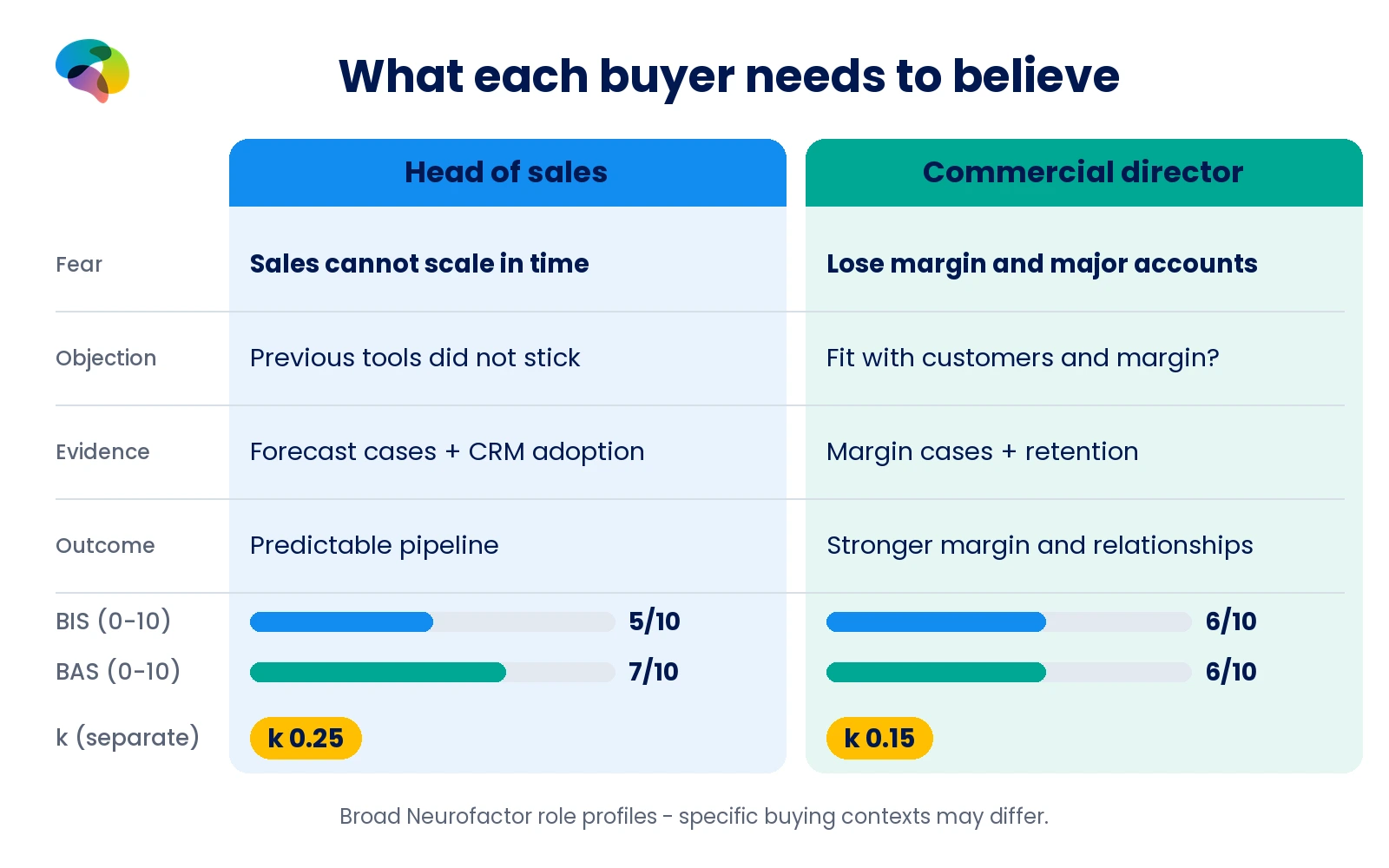
BIS 5 versus 6: the type of loss matters more than the gap
The head of sales has BIS 5, accompanied by concern over solutions that teams fail to adopt. The source describes previous investments in CRM systems without real use and training programmes without reinforcement. A new supplier must prove how work routines change and why this implementation will be different.
The commercial director has BIS 6, tied to the danger of losing margin and relationships built over many years. Aggressive discounting or a short-term acquisition push may trigger concern even when an initial sales chart looks promising.
The score gap is small. The practical distinction comes from the underlying fears and objections. A generic message that simply describes one buyer as more risk-averse than the other misses what the supplier actually needs to demonstrate.
Approach motivation and time preference: scale versus durable value
BAS 7 for the head of sales is paired with opportunities that increase predictability. Make the improvement tangible: a shared method, a better-maintained CRM, more accurate forecasting and faster onboarding for new sellers.
The commercial director scores BAS 6, with a stronger focus on opportunities that protect position and customer relationships. The broad k values also differ: 0.25 for the head of sales, described in terms of quarters, and 0.15 for the commercial director, whose profile looks further ahead to annual plans and established accounts.
None of these values is a deadline predictor. A commercial director can act quickly when an important client is at risk, and a head of sales can invest for the long term. Product, price, decision authority and the specific buying context determine how the broad profile should be applied.
Their objections reveal what a convincing decision looks like
The head of sales asks what is different from earlier tools that never took hold. A useful proof asset will demonstrate adoption: which routines change, how the CRM reflects those changes and how progress is checked without adding a layer of administrative burden.
The commercial director asks whether the approach fits the culture and customers and what happens to margin. A case about shortening the sales cycle will not settle that objection if it cannot also show that pricing, customer expectations and operational delivery remain sound.
A product demo may therefore resolve uncertainty for one buyer and raise new questions for the other. A convincing demo is not simply a longer demo. It is one that answers the particular business risk facing the decision-maker.
Change the opening, the evidence and the next step
For the head of sales, open with pipeline volatility and the problem of results depending on a few top performers. Show a same-sector forecast accuracy case and the specific mechanisms for adoption, including how the method fits the CRM. The source favours a peer referral, followed by a substantive discussion and a demo. See preferred contact channels for the distinction between audience preference and an automatic rule.
For the commercial director, open with margin, customer value and market position. Explain how improved sales effectiveness will remain valuable after pricing pressure, customer retention and delivery costs are considered. Start from a trusted introduction or industry event, and be ready for a presentation to the executive team.
Design different next steps. The head of sales can test workflow adoption and forecasting signals with a defined team. The commercial director needs a decision discussion that may include finance, operations and key-account owners, because the commercial outcome crosses organisational boundaries.
One offer, two ways of reading it
Imagine offering a programme that helps sellers have stronger value-based conversations, supported by coaching and CRM insight. This is an illustrative situation, not a reported Neurofactor customer case.
The head of sales wants to know whether new employees will learn a common process faster, whether CRM data will improve and whether forecasts become more dependable. A tightly scoped trial can track usage, process adherence and forecast quality before expanding.
The commercial director sees the same promise and asks whether sellers will offer fewer discounts, whether major customers recognise the value and whether account retention remains strong. The first relevant evidence concerns margin and relationships, not just activity recorded in a dashboard.
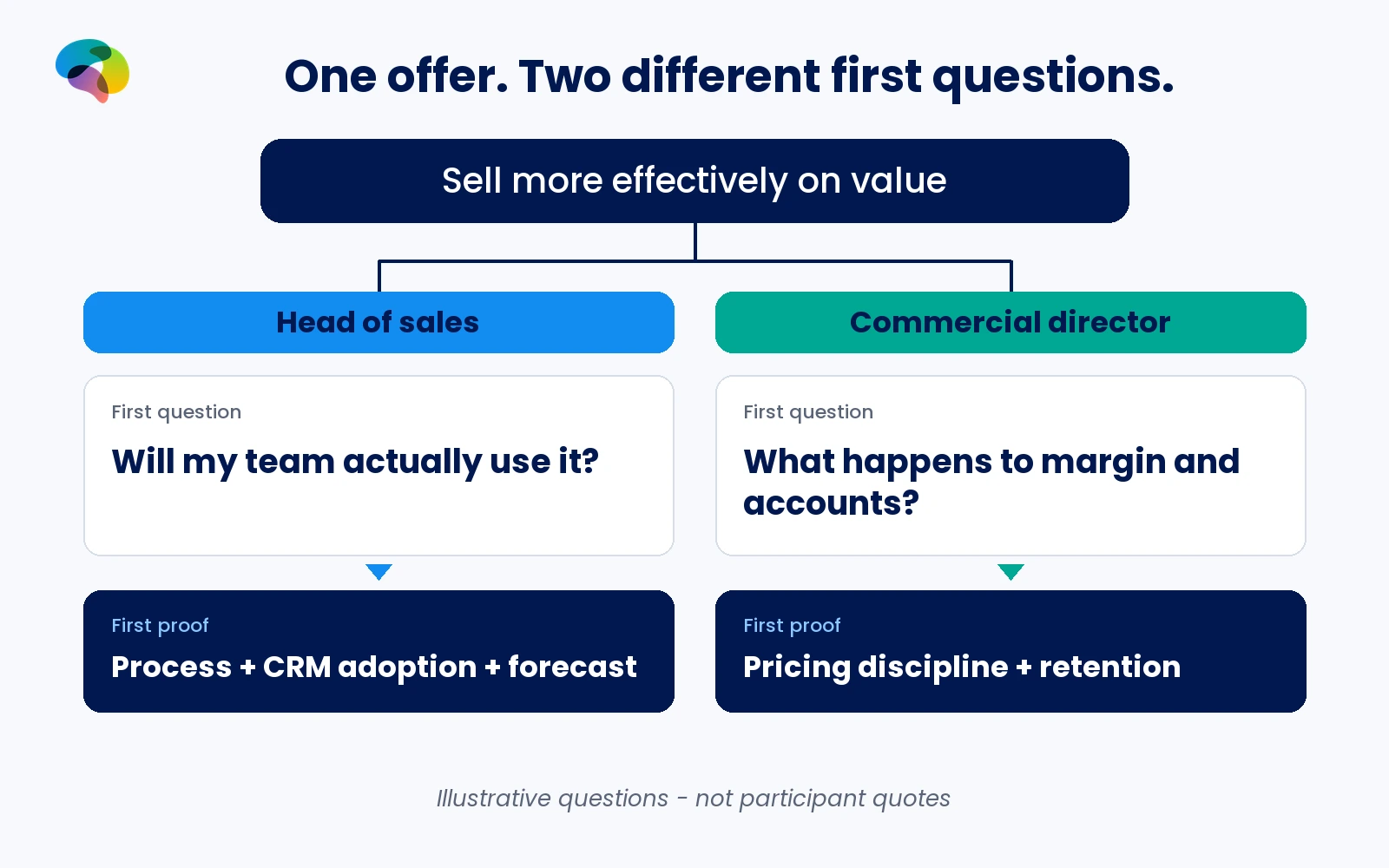
How the same offer becomes two different emails
To the head of sales: "A forecast only becomes useful when the team follows a repeatable process. In a short session, we can show how that process fits your existing CRM and which signals tell you whether adoption is actually happening." That directly addresses the source objection about tools that fail to stick.
To the commercial director: "More revenue only helps if margin and important customer relationships remain intact. We can show how value-based selling is reinforced across teams and which metrics reveal what happens to margin and account retention." That opens with the asset this role wants to protect.
These are editorial examples of sales messaging. They are not respondent quotations, verified conversion improvements or claims that either email has already been tested.
When both decision-makers are in the same buying committee
Larger purchases can involve both a head of sales and a commercial director. A single deck with additional charts does not necessarily satisfy both. Their concerns are connected, but they are not interchangeable.
Start with a common business problem: the sales organisation must become better without becoming more fragile. Then create two evidence tracks. One shows shared methodology, CRM adoption and forecast accuracy. The other shows pricing discipline, customer value, margin and feasibility across other departments.
Agree on definitions before interpreting results. Better forecast accuracy does not by itself prove margin improvement, and better margin does not prove the selling method has been adopted. Let both stakeholders specify which evidence would make a decision credible.
What these Neurofactor profiles support - and what they do not
These role profiles draw on recurring patterns from Neurofactor research conducted over multiple years with these and comparable audiences. They are evidence-informed broad role profiles, rather than descriptions of every individual head of sales or commercial director.
Industry, company size, offer, price, product or service, authority and buying context can shift the relative importance of a given fear, benefit or proof requirement. Raising prices for existing customers is a different decision from improving how a team uses CRM.
To obtain the greatest predictive and commercial value, connect the broad profile to a specific offer through an {a("en","target","audience profile and association map")}. That helps establish which meanings and concerns the actual product triggers, rather than assuming that a job title is sufficient.
Want to know how a head of sales or commercial director looks at your product or service? Contact Neurofactor and have the broad profile translated into your proposition.
The research question to ask before you sell
Define the actual decision first. Are you asking for a trial, a contract, a system change or a different method of selling? Describe what failure would mean to the buyer and to the wider organisation rather than segmenting on title alone.
Then investigate the associations activated by the offer. The head of sales may connect new tools with administrative burden; the commercial director may associate the same proposition with pressure on pricing or loss of personal account contact. Those are examples of questions to investigate, not claims that those associations have been measured for your brand.
Translate the findings into different opening messages, sequences of evidence and follow-up decisions. The step-by-step approach is covered in the knowledge base article on {a("en","strategy","turning an audience profile into a communication strategy")}.
Do not just sell better sales. Protect what the buyer is accountable for
For a head of sales, an improvement is credible when the team adopts it and the pipeline becomes more predictable. For a commercial director, the same improvement becomes convincing when margin, customer value and commercial position are protected.
One offer can deliver both outcomes. But one generic promise and one generic proof point are unlikely to explain why both decision-makers should support it. The difference is not whether they want growth. It is which result they must be able to show will last.
Continue in this series: sales audiences, sales manager versus CRO and the series introduction.
Key terms
- Head of sales
- Leader responsible for the sales operation, processes, reliable forecasting and commercial team targets.
- Commercial director
- Senior commercial leader who connects strategy, sales, marketing, margin and major customer relationships.
- Forecast accuracy
- The degree to which a sales forecast matches subsequent realised revenue under a consistent measurement definition.
- CRM adoption
- The consistent use of agreed customer and sales routines within a customer relationship management system.
- BIS
- A 0-10 avoidance-motivation indicator in a broad Neurofactor role profile, not an individual fear assessment.
- BAS
- A 0-10 approach-motivation indicator for how opportunities are valued within a broad role profile.
- Delay-discount rate (k)
- A separate parameter describing the relative valuation of future outcomes, not a percentage or purchasing deadline.
- Audience profile
- A structured account of an audience's decision context, pains, fears, objectives, proof requirements and language.
- Association map
- A structured representation of meanings an audience connects with a product, brand or issue in a specific context.
Frequently asked questions
What is the main difference between a head of sales and a commercial director?
A head of sales is primarily accountable for sales processes, team adoption and predictable forecasting. A commercial director also weighs pricing discipline, margins, market position and the retention of key customers.
What are their BIS, BAS and k values?
The head of sales profile has BIS 5, BAS 7 and k 0.25. The commercial director profile has BIS 6, BAS 6 and k 0.15. BIS and BAS use a 0-10 scale; k is a separate parameter.
What proof matters most to a head of sales?
Evidence of forecast accuracy, scalable growth and real implementation, preferably from comparable companies. The buyer needs to see the method embedded in working routines and CRM.
What proof does a commercial director want?
Evidence of improved margins and customer retention, with relevant industry references, alongside a clear account of cultural and commercial fit.
Why does one sales pitch not convince both roles?
The decision criteria are different. Predictability addresses the head of sales' uncertainty; the commercial director must also protect margin, customer relationships and long-term commercial value.
Do these profiles describe every individual in these roles?
No. These are evidence-informed broad profiles based on recurring Neurofactor research patterns. Offer, industry, company size, price and buying context can shift the relevant needs. An audience profile and association map provide the necessary specificity.
Sources
- 1.202609 - LinkedIn doelgroepen - Doelgroepkaarten - Neurofactor.xlsx, tabblad 3 Sales, HOS (kolom E) en CDR (kolom G), rijen 7-46 - Neurofactor (2026-09)
- 2.Neurofactor master-sitemap blogserie 39, NF-BLOG-LI-SAL-02 - Neurofactor (2026-10)
This series
Who are you really selling to?Category synthesis
Everyone in sales wants growth. But they do not buy growth the same wayRead next
Related topics
Reviewed by: Martijn den Otter · Last reviewed: 10/9/2026
Martijn den Otter
Oprichter van Neurofactor. Expert in neuromarketing en consumentenpsychologie.
LinkedIn →