

Sales manager vs CRO: more revenue is not the same business case
You present the same sales solution twice. The sales manager asks: “Will my reps close more deals this month?” The CRO asks: “What changes across the funnel, and how much incremental revenue do we gain for every euro invested?”
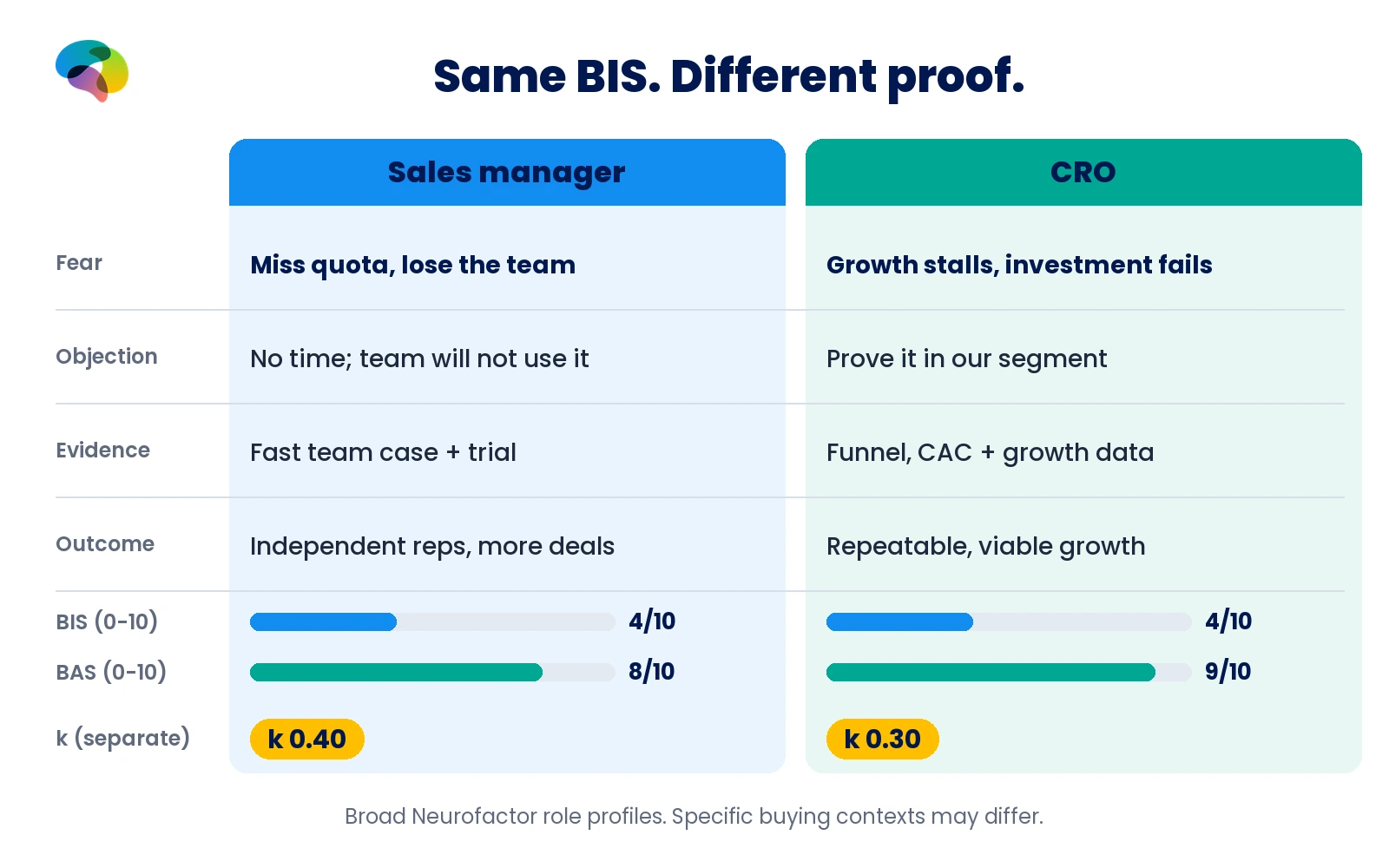
Both want growth. Both score BIS 4 in Neurofactor’s source profiles. Yet the pitch that feels compelling to the manager does not necessarily establish a business case for the CRO. What changes is the failure they need to avoid, the evidence they require and the result they are accountable for.
Same BIS. Different downside.
BIS 4 is the striking shared value. It does not mean these two buyers worry about the same outcome. In the original cards, the sales manager fears missing the team target and losing the confidence of the people they lead. The CRO fears stalled revenue growth and an investment that never pays back.
Both can be open to trying something new, but they need very different reassurances. For the manager, a change that burdens the team without helping close deals is itself a risk. For the CRO, growth that looks impressive but becomes too expensive to acquire is not necessarily a win.
The error is to build a generic “low-risk sales leader” pitch from one score and ignore what the profiles actually say.
One offer, two sets of accountability
This comparison follows the original sales audience workbook, columns D (SAM) and F (CRO). The evidence requirements refer to the type of substantiation each role looks for.
Responsibility
- Sales manager (SAM)
- Frontline sales team; monthly and quarterly quota
- CRO
- Total revenue; alignment of sales, marketing and customer success
Primary pain
- Sales manager (SAM)
- Inconsistent team results, dependence on star performers
- CRO
- Growth stalls or costs too much per revenue euro
Greatest fear
- Sales manager (SAM)
- Miss quota and lose the team
- CRO
- Growth stops; investment does not pay back
First objection
- Sales manager (SAM)
- No time; team may not use it; already have CRM or trainer
- CRO
- Prove impact in our segment; no assumptions
Desired outcome
- Sales manager (SAM)
- Independently performing team meeting targets
- CRO
- Healthy funnel and measurable, repeatable growth
Proof
- Sales manager (SAM)
- Quick comparable-team results, peer references, trial
- CRO
- Funnel and CAC figures, growth data, benchmarks, CRO peers
Preferred route
- Sales manager (SAM)
- Colleague referral, brief demo or trial
- CRO
- Investor or peer-community introduction, data-driven discussion
Vocabulary
- Sales manager (SAM)
- Quota, conversion, deals, coaching, CRM
- CRO
- CAC, LTV, churn, pipeline velocity, RevOps
The sales manager buys a change the team can use now
The source profile describes someone who often moved into management from selling and remains close to the pipeline. Results are inconsistent because capabilities differ across reps, coaching time is scarce and CRM records are not always kept up to date. Lead quality varies as well.
“Better sales performance” is therefore too vague. Which daily behaviour improves? Will follow-up become more consistent? Can the manager coach instead of creating another report? Can people start without having to rebuild their entire workflow?
The fear is personal and immediate: another missed target, another difficult team meeting, and the possibility that the group no longer follows its manager. A heavy rollout can worsen exactly the problem the supplier claims to solve.
The CRO buys an improvement in the revenue system
The CRO is accountable for the full revenue engine. The underlying profile highlights funnel leakage, high customer acquisition costs, limited insight into performance by segment and misalignment between marketing and sales. The board expects both growth and cost discipline.
A win-rate increase within one sales team may matter, but it is not the entire result. What happens to acquisition cost, downstream retention, lead mix or time to value? If those parts deteriorate, the apparent gain may fail to improve growth economics.
The CRO wants transparent measurement, meaningful comparison periods and a reason to believe the improvement will recur. BAS 9 indicates a strongly opportunity-oriented role profile. Asking for evidence is not the opposite of ambition; it is how the CRO decides which opportunity is worth scaling.
The exact BIS, BAS and k values
The following values come from the original sales sheet, rows 44-46. BIS and BAS use the source model’s 0-10 scale. Delay-discount parameter k is separate, not a percentage and not another score out of ten. These are broad function-level profile values, not direct individual measurements.
BIS (0-10)
- Sales manager
- 4
- CRO
- 4
BAS (0-10)
- Sales manager
- 8
- CRO
- 9
Delay-discount parameter (k)
- Sales manager
- 0.40
- CRO
- 0.30
Time orientation described in source
- Sales manager
- This month; immediate team impact
- CRO
- Quarters; sustained growth curve
BAS 8 versus 9: both pursue opportunities, but which ones?
The sales manager sees opportunity in better conversion, more deals and fewer missed follow-ups. The CRO sees opportunity in a growth lever that can be repeated across the revenue process. The cards make this difference in objective explicit.
It would be misleading to conclude that a CRO is simply “more ambitious” because BAS is one point higher. Responsibilities, time horizon and acceptable forms of proof shape what makes an opportunity attractive. The question is not merely how strongly each buyer pursues reward, but which reward they are buying.
k 0.40 versus 0.30: what does faster value mean?
In the source, sales manager k is 0.40, associated with a high preference for near-term results and a focus on this month. CRO k is 0.30, described as moderate to high time preference with a quarterly perspective. Both value momentum, but they will ask you to demonstrate it differently.
These values do not predict how many days a contract will take to sign, and 0.40 is not a 40% chance of purchase. They point to a different useful first milestone: a quick, observable change in the team for the manager, and a measured, repeatable improvement over segments or periods for the CRO.
Their objections tell you what your story is missing
The sales manager’s stated concerns are lack of time, low adoption and existing CRM or coaching tools. These objections are grounded in operational reality, not a general dislike of change. A supplier must show how the team can use the offering without adding more work.
The CRO’s first objection is evidential: “Prove it works in our segment. I want data, not assumptions.” A beautiful demo or an unrelated customer story will rarely close that gap. The source recommends a measured pilot, clear KPIs and an honest dashboard.
An elaborate ROI spreadsheet is premature if the manager doubts the team will use the product. A short live demo is incomplete if the CRO still cannot trace the commercial mechanism and economics.
Design proof for the decision being made
For the manager, the source calls for rapid results from comparable sales teams, references from other sales managers and a trial. A useful proof path could show adoption, response behaviour and conversion in one defined group. These are proposed measures, not claims that this fictional solution has already delivered an uplift.
For the CRO, the source asks for quantified funnel improvement, customer acquisition cost (CAC), revenue growth, benchmarks and references from other CROs. Explain the baseline, attribution limits, period, segment and underlying spend.
Both need tangible evidence. But the manager’s proof asset demonstrates practical team value, while the CRO’s evidence package supports a repeatable investment decision. This is why the {link("en","proof_assets","evidence anchor and proof asset")} cannot always be identical.
Same hypothetical offer, different first question
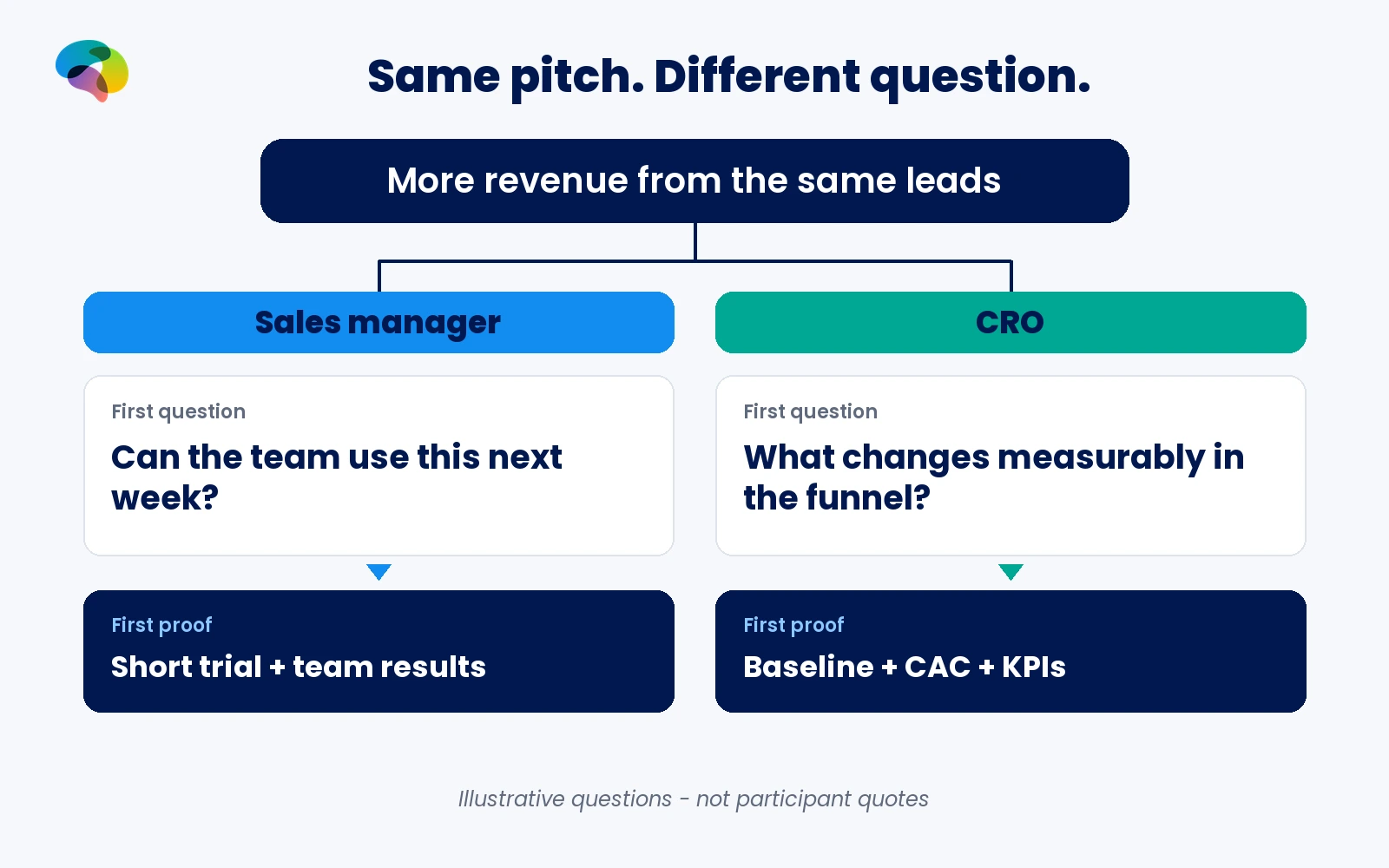
Imagine a fictional service that reviews sales conversations, suggests coaching actions and improves lead follow-up. The headline says “More revenue from your existing leads.” The questions below are illustrations derived from the role profiles, not observed participant quotes or validated outcomes of such a service.
The sales manager asks: “Can my team start next week without additional admin, and how soon will we see whether it closes more deals?” The CRO asks: “What does this do to conversion by segment, what is the cost and how confidently can we link it to incremental revenue?”
The offering has not changed. The opening, demonstration, evidence and next-step meeting must. Audience adaptation is about choosing the right business question, not merely replacing the recipient’s job title.
What to change in the first conversation
With the manager, start from inconsistent team conversion. Show a short workflow, address time and adoption and suggest a limited trial that fits the team’s schedule. Measure indicators the manager recognises from daily coaching.
With the CRO, start from a bottleneck in the revenue engine. Establish the baseline, segment, metrics and decision threshold before discussing a wider roll-out. Show how the offer would connect to the funnel rather than claiming that a dashboard by itself creates growth.
The source also describes different introductions: a colleague recommendation followed by a brief demo for a sales manager, versus an investor or peer-community introduction followed by a data-focused meeting for a CRO. These are profile-level preferences, not guaranteed channels for each individual.
Two first-touch messages that do not pretend proof already exists
Sales manager: “Your team has leads, but follow-up and conversion are not consistent. We are exploring ways to improve both without another admin burden. Would a short team-focused demo be relevant?”
CRO: “Revenue growth becomes expensive when funnel leakage and acquisition costs are unclear. We could first map the baseline by segment and identify what is worth measuring. Is a data-led discovery conversation useful?”
These are editorial examples for a hypothetical offer. They must not be presented as tested customer quotes or as evidence of an achieved outcome.
When both stakeholders are in the buying group
In some organisations, the manager can sponsor adoption while the CRO evaluates the economic case. This is one possible buying-centre structure, not a universal reporting arrangement.
Create two distinct proof layers: practical usability and coaching value for the sales team, plus funnel metrics, cost impact and a measurement plan for leadership. Make it clear what each layer demonstrates and what remains uncertain.
A positive team trial is not automatic proof of a company-wide financial return. Conversely, a compelling revenue model is not sufficient if the people expected to use the offer will not adopt it.
Research-grounded profiles, not a template for every buyer
These profiles are based on recurring patterns observed by Neurofactor over multiple years of research involving these and comparable audiences. They provide an evidence-informed broad view of job functions. They do not literally describe every sales manager or CRO; the profile values are not individual neural readings or predictions of an individual purchase.
Industry, company size, go-to-market model, product category, price, offer maturity and buying context may shift the relevant concerns. A CRO in a smaller business can care deeply about frontline adoption, while a sales manager with broad authority may need sophisticated investment evidence.
To make the profiles commercially useful, connect them to your actual product or service. A target-group profile and association map help reveal which associations, fears, claims and evidence become meaningful in the specific decision. Want to know what the profile looks like for your offer? That requires this contextual layer.
Want to know how a sales manager or CRO looks at your product or service? Contact Neurofactor and have the broad profile translated into your proposition.
Turn a job title into an evidence strategy
Start with the problem the role owns, not the title on LinkedIn. Identify the change your solution proposes, the feared downside, what counts as believable evidence and who needs to approve the next step.
For a sales manager, the result may be a workflow demo and a short, observable team trial. For a CRO, it may be a measured baseline and a business case tied to funnel conversion and acquisition economics.
The {link("en","strategy","link between audience profiling and communication strategy")} then guides the opening message, landing page, demo and follow-up.
More revenue is an outcome, not yet a reason to buy
The sales manager buys a team that can perform more consistently under immediate pressure. The CRO buys evidence that the revenue engine can grow repeatedly without losing economic discipline. Both want opportunity, but they are accountable for different consequences.
“More revenue” only becomes persuasive when you specify which revenue, through which mechanism, proven how, and to whom. Explore the sales audience overview, head of sales versus commercial director or the complete B2B target-group series.
Key terms
- Sales manager
- Leader accountable for a sales team, coaching, conversion and near-term quotas.
- CRO
- Chief Revenue Officer, accountable for total revenue and coordination across sales, marketing and often customer success.
- BIS
- In these Neurofactor profiles, a 0-10 indication of avoidance motivation; it does not identify which specific fear matters.
- BAS
- In these Neurofactor profiles, a 0-10 indication of approach motivation and responsiveness to opportunity.
- Delay-discount parameter (k)
- A separate measure of time preference for outcomes delayed into the future, not a purchase percentage.
- CAC
- Customer acquisition cost, calculated with an explicitly defined cost and acquisition boundary.
- Target-group profile
- Structured broad function-level profile of pain points, fears, objections, evidence needs and buying context.
- Association map
- Map of the meanings and associations a specific audience connects to a product, service, brand or theme.
Frequently asked questions
How do sales managers and CROs differ as buyers?
A sales manager focuses on team conversion and near-term quota performance. A CRO focuses on repeatable revenue growth, funnel economics and returns on commercial investment.
Why do both roles score BIS 4?
The original Neurofactor cards assign BIS 4 to both roles. This broad avoidance-motivation score does not imply identical fears: a manager fears missing quota and losing the team, while a CRO fears stalled growth and poor investment payback.
What are the BIS, BAS and k values?
Sales manager: BIS 4, BAS 8, k 0.40. CRO: BIS 4, BAS 9, k 0.30. BIS and BAS use a 0-10 profile scale; k is a separate time-preference parameter.
What proof does a sales manager need?
Quick results from comparable teams, references from fellow sales managers and a short trial showing practical use and improvement in daily selling.
What evidence does a CRO expect?
Clear funnel, CAC and growth figures, relevant benchmarks, references from other CROs and ideally a measured pilot with transparent KPIs.
Does the profile describe every sales manager or CRO?
No. These are research-grounded broad role profiles. Industry, company size, product, price, proposition and choice context can change what matters. Offer-specific audience and association mapping adds the necessary detail.
Sources
- 1.202609 - LinkedIn doelgroepen - Doelgroepkaarten - Neurofactor.xlsx, tabblad 3 Sales, SAM en CRO, rijen 7-46 - Neurofactor (2026-09)
- 2.Neurofactor - master-sitemap blogserie 39, NF-BLOG-LI-SAL-01 - Neurofactor (2026-10)
This series
Who are you really selling to?Category synthesis
Everyone in sales wants growth. But they do not buy growth the same wayRelated topics
Reviewed by: Martijn den Otter · Last reviewed: 10/9/2026
Martijn den Otter
Oprichter van Neurofactor. Expert in neuromarketing en consumentenpsychologie.
LinkedIn →