
Procurement is not just the department that pushes prices down
Procurement wants a lower price. That assumption makes for a simple sales deck, but a poor buying strategy. A buyer needs a clear quote and a supplier that delivers on time. A procurement manager needs a defensible process and measurable savings. A purchasing director needs to know whether the decision could create supply-chain or reputational risk for the organisation.
The same supplier can meet all three needs, but not with the same opening argument. Lead with availability and terms for the buyer; process fit and documented results for the procurement manager; and long-term supply resilience for the purchasing director. This article shows how the original Neurofactor audience profiles translate those differences into communication, evidence and the right next step.
One supplier. Three very different first questions.
You introduce a supplier with competitive prices, an online ordering tool and performance reporting. The buyer interrupts: "What does each order cost and when does it arrive?" The procurement manager has a different concern: "Does this fit our process, and how will we prove the savings?" The purchasing director asks: "What happens to our operation if this supplier fails in two years?"
None of these questions is less commercial than the others. The buyer processes requests. The procurement manager makes the system of purchasing work. The purchasing director must protect the organisation from long-term exposure. If you hear only the first question, you may mistake the entire department for a discount desk.
Price can even conceal the very risk the buyer needs to manage. A cheaper supplier is not necessarily a better decision if deliveries fail, audit requirements cannot be met or a critical category becomes dependent on one fragile partner. The starting point is not the discount. It is the consequence of being wrong.
Price, procedure and supplier resilience are different buying questions
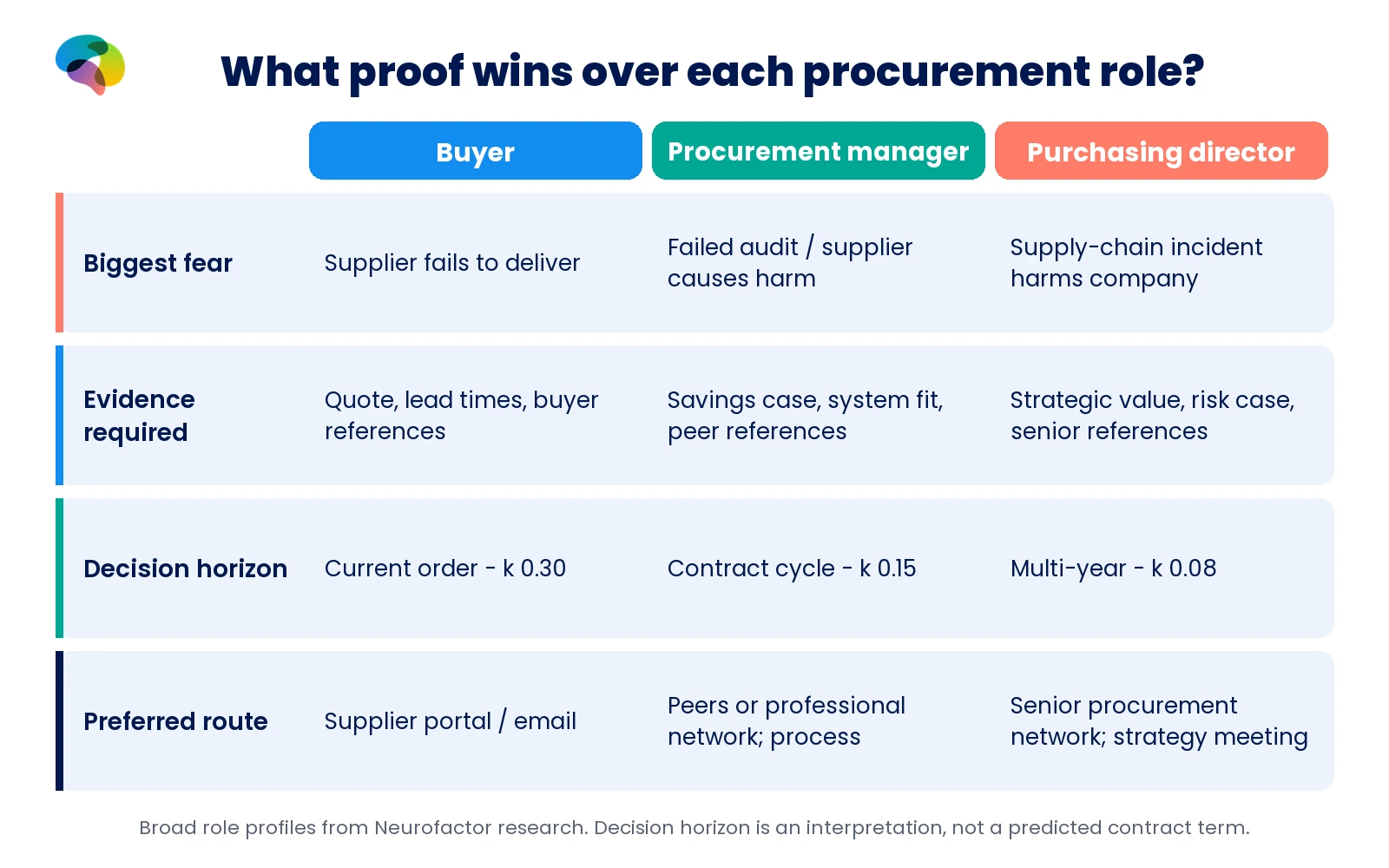
This comparison is drawn from the original Neurofactor Procurement audience cards. Each line condenses the recorded pain points, fears, objections, proof requirements and preferred routes.
| Dimension | Buyer | Procurement manager | Purchasing director |
|---|---|---|---|
| Accountability | Quotes, orders and supplier communication | Policies, contracts, vendors and procurement teams | Category strategy and organisational supply risk |
| Primary frustration | Too many requests, too little time | Departments buy outside procurement; savings are hard to demonstrate | Procurement is brought in too late for strategic decisions |
| Biggest fear | A selected supplier fails to deliver and the buyer is blamed | Failed audit or supplier causing serious problems | Supply-chain incident harms the organisation and its reputation |
| Typical objection | Too expensive; existing supplier; follow the process | Process fit, proven savings, compliance | Strategic value, category fit, downside risk |
| Required proof | Comparable quote, delivery track record, buyer references | Savings cases, procurement references, system compatibility | Strategic value cases, supply-risk evidence, director-level references |
| Preferred route | Supplier portal, email or colleague; then RFQ | Peer or professional network; discussion and formal process | Senior procurement or CFO network; strategic meeting, then formal process |
Job titles alone do not define contractual authority. Purchasing thresholds, category rules and organisational structure determine who can sponsor, approve or sign. Use the profiles to anticipate concerns, then verify the actual decision process.
The real contrast is not appetite for deals
Across these three profiles, BAS is identical at 5. A stronger drive towards opportunity is therefore not what separates them in this dataset. What changes is the outcome each role fears having to explain.
For the buyer, a missed delivery becomes a problem today. An internal requester is waiting, and the buyer receives the call. For the procurement manager, the transaction could look successful while the procurement process is bypassed, an audit fails or savings cannot be documented. For the purchasing director, the same contract may affect supplier dependence, continuity, sustainability expectations and reputation over several years.
This changes what an effective proposal looks like. A competitive price matters, but the relevant evidence only becomes clear when you identify the downside the person is accountable for.
Buyer: a good deal is one that actually arrives
The buyer works with incoming requests, quotes, negotiations and supplier portals under constant time pressure. The source card points to manual workflows, poor specifications and slow supplier responses. The emotional burden is the sense of never finishing and rarely being recognised for all the problems avoided.
The buyer voice in the profile is direct: "Just give me a good price, a good lead time and no hassle." Delivery reliability and easy administration are part of value, not extras. A low unit price is not useful when commercial terms are unclear or nobody can answer a delivery exception.
Start with an easy-to-compare quote, current availability and delivery dates, and a named contact for exceptions. Show actual delivery performance when available. Follow the RFQ and supplier onboarding route. Circumventing the buyer by going straight to a requester may make the supplier look pushy rather than helpful.
Procurement manager: savings that cannot be shown are hard to defend
The procurement manager often has to prove that the function adds value while internal departments continue purchasing around it. The cards describe processes perceived as slow and tools that do not serve the business well. Meanwhile this role must deliver documented savings and control supplier risk.
The central fear is a failed audit or a vendor that creates trouble for the business. The leading objections are whether an offer fits the process, whether the savings are real and whether compliance requirements are satisfied. A new procurement platform nobody adopts or a savings programme with no lasting ownership is a familiar disappointment within this profile.
Show how purchasing flows integrate with existing systems, how contract compliance will be tracked and how finance can distinguish forecast savings from realised savings. Include adoption and exception handling. Without that, your solution simply adds another administrative step to the very process you promised to improve.
Purchasing director: a lower price may increase tomorrow's exposure
The purchasing director wants procurement involved where strategy is set. The source card describes responsibility for category choices, supplier risk, sustainability and strategic value, typically with accountability to the CFO or CEO. Being treated as a late-stage administrative checkpoint is a core frustration.
This role fears a supply-chain incident that harms the organisation. Discount promises alone do not address continuity, supplier concentration, alternative capacity, contract exposure or reputational damage. The questions concern strategic value, category fit and the risks being accepted.
Build a multi-year supplier case. Discuss dependencies, contractual safeguards, resilience during disruption and total value, including costs beyond the purchase price. Use relevant senior references and scenarios, not just a table of negotiated discounts.
The pattern in BIS, BAS and k
These are values from the original broad Neurofactor functional profiles. They provide direction for understanding the roles, not measurements of every individual or probabilities of conversion.
| Role | BIS (0-10) | BAS (0-10) | k (time preference) | What to emphasise |
|---|---|---|---|---|
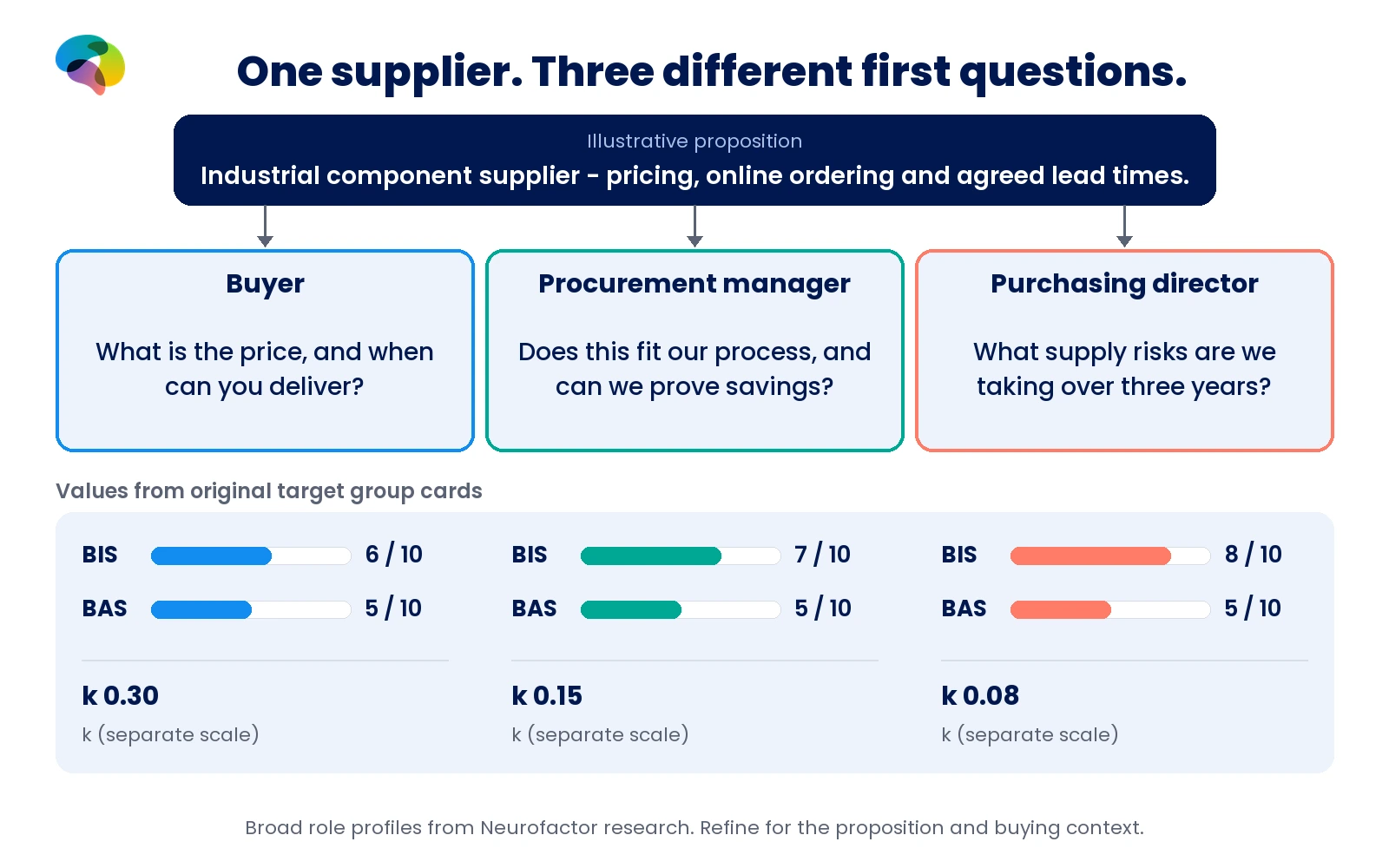
| Buyer | 6 | 5 | 0.30 | Immediate clarity on price, delivery and execution |
| Procurement manager | 7 | 5 | 0.15 | Time for procedure, documented outcomes and coordination |
| Purchasing director | 8 | 5 | 0.08 | Multi-year value and exposure across the supply chain |
BIS reflects avoidance motivation within the profile. BAS reflects approach motivation rather than budget authority or purchase intent. A higher k signifies a comparatively stronger weighting of nearer-term outcomes in the profile model. It does not mean a buyer has a 30% chance of purchasing or will sign in 30 days. A low k does not mean a particular deal must progress slowly.
A longer decision horizon is not the same as a slower response
The buyer handles current requests, delivery commitments and urgent orders, with k 0.30 in the source card. The procurement manager operates across formal procedures, contract reviews and internal reporting, with k 0.15. The purchasing director evaluates strategic categories and multi-year dependencies, with k 0.08.
Yet a purchasing director facing a critical supplier failure may need to act today. A buyer with an urgent operational problem may still be subject to a long tender. The value of these profiles lies in anticipating what kind of outcome matters, not forecasting an exact procurement timetable.
Ask when the decision is actually due, what contract obligations apply, who must be involved and which risks are time-critical. A fast follow-up is helpful only when it matches the next legitimate step.
One fictional supplier. Three readings of the same promise.
Imagine a supplier of standardised industrial components. Its offer includes competitive pricing, an online ordering portal, agreed lead times and supplier performance reporting. The opening line is: "Lower your purchasing costs and make ordering easier."
The buyer asks: "What is the landed price, what is available now, and who responds when a delivery goes wrong?" The procurement manager asks: "Will this follow our procurement process, how will savings be documented, and can we report on supplier performance?" The purchasing director asks: "Does this create a single-source dependency, how does it fit our category strategy, and what is the three-year risk?"
This is an illustrative sales scenario, not a measured Neurofactor case study. The questions are derived from the respective profiles. You do not need three different products. You need three credible forms of proof for the same one.
What to change in your pitch and follow-up
- Open with accountability. Ask which commercial, delivery or governance failure the role must avoid.
- Give the buyer an executable offer. Quote clear terms, lead times and who handles exceptions.
- Give the procurement manager an auditable case. Include process fit, integration, realised savings and reporting.
- Give the purchasing director a strategic supplier case. Show category fit, total cost, concentration risk and alternatives.
- Confirm authority. Identify requester, sourcing lead, budget owner, approver and contract signatory.
- Respect the formal process. A warm introduction does not replace procurement rules.
- Make the evidence transferable. Help each internal advocate explain the decision to the next stakeholder.
A strong supplier proposal reduces not only uncertainty about the product, but also uncertainty around the choice the procurement professional will later need to defend.
Three opening lines for the same offer
For the buyer: "Here are the comparable total price, available delivery window and what happens if something is late."
For the procurement manager: "Let me show how this fits your procurement flow and how you can report savings and supplier compliance."
For the purchasing director: "I would like to show the long-term value of this category partnership and the safeguards if the supply chain comes under pressure."
These are editorial examples of commercial copy, not verbatim interview excerpts. The follow-up question matters just as much: what would you still need to see before this could be a defensible decision?
LinkedIn may create awareness, but the procurement route still matters
The buyer profile mentions occasional LinkedIn use, while day-to-day supplier engagement happens via email, portals, colleagues and RFQs. The procurement manager uses LinkedIn more regularly and turns to professional networks, peers and supplier webinars. The purchasing director is a reader and contributor on LinkedIn, but senior procurement and CFO networks can be more relevant routes towards a strategic conversation.
These distinctions suggest different content. For the buyer, show comparable terms, lead times or straightforward ordering. For the procurement manager, demonstrate measurable savings, compliant adoption and lessons learned. For the purchasing director, discuss strategic category value and how to manage supplier exposure under pressure.
Do not mistake LinkedIn engagement for permission to bypass procurement. The cards also describe what happens after first contact: the quote, the conversation and often a formal purchasing procedure. The channel opens the door; your conduct afterwards builds trust.
The person comparing quotes is not always the final decision owner
Buyers normally operate within an assigned mandate. Procurement managers may coordinate selection with business stakeholders and finance. Purchasing directors can be accountable for strategic purchasing but may still report to a CFO or CEO. In smaller organisations, one person might hold several of these roles.
Map the internal requester, the procurement process owner, the budget holder and the person accountable if a supplier fails. In many sales processes, only the first and third are discussed, while the last is left invisible.
When the business wants speed and procurement wants control, do not position compliance as an obstacle to be worked around. Show how the same offer can reduce delays while preserving required approvals. That helps procurement deliver value to its internal customer.
Research-informed broad roles, not a script for every individual
These profiles are based on recurring patterns identified over several years of Neurofactor research involving these and comparable audiences. They provide an evidence-informed broad functional starting point, not a literal description of every buyer, procurement manager or purchasing director.
Industry, organisation size, proposition, price, product or service and the specific buying context can all shift which fears, associations and proof requirements matter most. Buying everyday consumables differs from signing a multi-year contract for a business-critical service. To increase predictive and commercial relevance, the broad profile must be adapted to the offer in question.
We do that with a target group profile and an association map. BIS, BAS and k are profile dimensions, not EEG recordings of these job groups, individual diagnoses or predictions of purchase probability. Wonder what this role would look like for your product or service? Start with the specific decision your customer is facing.
Want to know how buyers, procurement managers or purchasing directors view your product or service? Contact Neurofactor and have the broad profile translated into your proposition.
Translate a general procurement profile into offer-specific evidence
A broad functional profile helps you anticipate likely tensions. For critical components, availability and supplier concentration may dominate. For a simple digital subscription, process integration and internal adoption could matter more. One purchasing director can assess both categories differently because the consequences are different.
An association map shows what your own brand, solution and evidence currently evoke. Does the buyer associate you with dependable delivery or more administration? Does the procurement manager see your portal as control or as unnecessary work? Does the purchasing director see a resilient partner or a new dependency?
Connect those meanings to an appropriate proof asset and an objection-handling approach. You are testing the meaning of a particular proposition in a buying context, not assuming that every person with a job title will react alike.
A competitive procurement price only matters when the downside is manageable
For the buyer, a good choice means clear terms and delivery without problems. For the procurement manager, it means measurable savings and a defensible purchasing process. For the purchasing director, it means strategic value without reckless supply-chain exposure. All three work in procurement, but they do not defend the same decision.
When you reduce procurement to a department that negotiates down prices, you often withhold your strongest evidence. Effective B2B selling connects price to the consequence that the individual buyer is responsible for managing. That is what turns a good quote into a defensible supplier decision.
Key terms
- Buyer
- Procurement professional who compares quotations, manages orders and suppliers and operates within an assigned category or mandate.
- Procurement manager
- Manager responsible for procurement procedures, contracts, supplier relationships, policy and often a procurement team.
- Purchasing director
- Senior leader responsible for procurement strategy, strategic supplier value, categories and supply-chain risk.
- BIS
- Behavioral inhibition system: the avoidance-motivation dimension represented here by a broad functional score from 0 to 10.
- BAS
- Behavioral activation system: the approach-motivation dimension represented here by a broad functional score from 0 to 10.
- Delay discount rate (k)
- Profile parameter for the relative weighting of sooner and later outcomes. It is not a purchase probability or procurement deadline.
- Maverick buying
- Purchasing outside the agreed procurement policy or without involving the appropriate purchasing function.
- Total cost of ownership (TCO)
- All relevant costs associated with a solution or supplier relationship over its expected use or contract period, not just the purchase price.
- Target group profile
- Evidence-informed profile capturing an audience's needs, fears, objections, desired outcomes and decision context.
- Association map
- A structured view of the meanings and associations a target audience connects with a specific brand or proposition.
Frequently asked questions
Why is a lower price not enough to win procurement?
Procurement must also evaluate delivery reliability, process requirements, documented savings and supplier risk. The relative importance of each differs by role and purchasing context.
What is the difference between a buyer and a procurement manager?
A buyer handles quotations, orders and supplier delivery, while a procurement manager is also accountable for policy, contract compliance, supplier management and reporting procurement outcomes.
What proof matters most to a purchasing director?
Evidence of category fit, long-term strategic value, supply resilience and risk management, supported by suitable senior references and plausible disruption scenarios.
How should I interpret BIS, BAS and k for procurement roles?
The broad profiles share BAS 5. BIS rises from 6 for a buyer to 7 for a procurement manager and 8 for a purchasing director, while k falls from 0.30 to 0.15 and 0.08. These indicate functional patterns, not individual conversion predictions.
Should I bypass procurement if a business stakeholder wants to buy?
Usually that damages trust. Confirm the purchasing mandate, required approvals and formal procurement route, then help business stakeholders make a well-supported case within those requirements.
How do I adapt a general procurement profile to my product?
Use a proposition-specific target group profile and association map to test which risks, needs and proof points dominate for your industry, price point, contract and buying decision.
Sources
- 1.Behavioral Inhibition, Behavioral Activation, and Affective Responses to Impending Reward and Punishment: The BIS/BAS Scales - Carver & White / Journal of Personality and Social Psychology (1994)
- 2.Time Discounting and Time Preference: A Critical Review - Frederick, Loewenstein & O'Donoghue / Journal of Economic Literature (2002)
Related topics
Reviewed by: Martijn den Otter · Last reviewed: 10/11/2026
Martijn den Otter
Oprichter van Neurofactor. Expert in neuromarketing en consumentenpsychologie.
LinkedIn →