
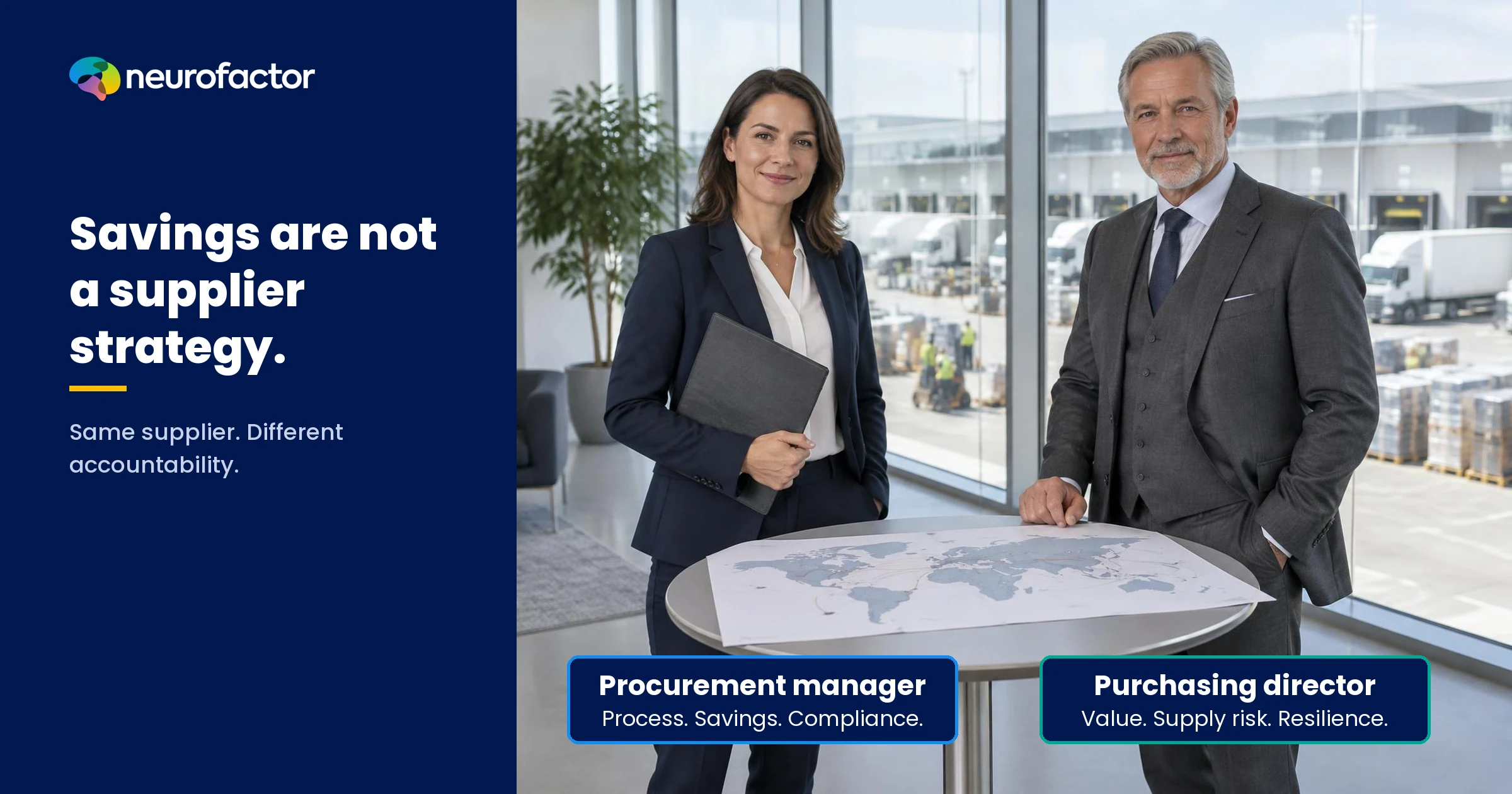
Procurement manager vs purchasing director: a saving is not a supplier strategy
You lower the purchasing cost, provide a sound business case and show that your solution works with the existing procurement systems. For a procurement manager, that is a promising start. Yet a purchasing director may still ask why this supplier belongs in the company's future strategy.
The distinction is not that one role cares about price while the other does not. Neurofactor's original audience cards show a procurement manager needing defensible savings, compliant processes and supplier control. A purchasing director must also consider strategic supplier value, supply continuity and reputational risk. The same proposal means something different when the conversation moves from a contract to a category or supply-chain strategy.
You can win the savings case and still lose the strategic decision
A supplier can demonstrate credible cost reductions and still be overlooked for the next multi-year contract. That can happen when the proposal explains how purchasing becomes cheaper but says nothing about critical parts availability, dependency on one partner or what happens when market conditions change.
The difference follows the role's accountability. A procurement manager needs to show that business units follow the process and that savings can be traced. A purchasing director needs to prevent a future situation in which the organisation is locked into a supplier relationship that no longer fits its strategy.
A competitive price is not the final argument. It is evidence for one part of the decision. The next question is what risk-and-value choice the organisation is making through the contract.
What the original Neurofactor profiles actually show
This comparison draws on the original Neurofactor procurement cards, columns D and F. They are broad role profiles, not psychological diagnoses of individual decision-makers.
| Dimension | Procurement manager | Purchasing director |
|---|---|---|
| Accountability | Procurement policy, suppliers, contracts, team and procedures | Procurement strategy, category policy, supply risk and reporting to CEO/CFO |
| Primary pain | Business units bypass procurement; savings are hard to prove | Procurement is engaged too late and seen as a bottleneck |
| Underlying cause | Processes appear slow; systems do not support business users | Procurement has traditionally had a largely operational position |
| Emotional driver | Control, recognition, avoiding compliance failures | Strategic influence; avoiding supply risk and reputational damage |
| Biggest fear | Failed audit or supplier causing serious business problems | Supply-chain incident harming the company on their watch |
| Initial objection | Does it fit our process? Proven savings? Compliant? | What is the strategic value and risk? Does it fit category strategy? |
| Evidence needed | Procurement peer references, savings cases and systems fit | Strategic value and supply-risk cases, senior procurement references |
| Desired result | A recognised procurement function with governed spend | Procurement as a strategic function that protects continuity |
| Preferred contact | Procurement peer and NEVI networks, discussion, formal procedure | Purchasing director/CFO network, strategic meeting, formal procedure |
| BIS / BAS / k | BIS 7 / BAS 5 / k 0.15 | BIS 8 / BAS 5 / k 0.08 |
Their difference is not simply appetite for opportunity
Both role cards show BAS 5. So the strength of the general opportunity orientation is not the defining difference here. The procurement manager is interested in opportunities that deliver savings and control. The purchasing director is interested in opportunities that increase procurement's strategic contribution.
The risk side differs: BIS 7 for the procurement manager and BIS 8 for the purchasing director. The source descriptions connect these values to compliance and process risk in the first case, and supply-chain risk and reputational damage in the second.
What one role must be able to defend in an audit, the other must be able to defend as a decision that remains sound when conditions change.
The procurement manager wants proof that procurement works
The original card describes business units buying outside procurement while savings remain difficult to demonstrate. The process is seen as slow, and systems do not adequately support internal users. The procurement manager is therefore asked not only to assess suppliers but repeatedly to prove why the department adds value.
A vendor who bypasses procurement and approaches business units directly touches that pain point. By contrast, a vendor that makes requests, contracts and reporting easier within the procurement process helps generate evidence for the department's value.
Do not sell only a lower price. Show how your offer supports internal customers while making procurement more controllable.
The purchasing director needs a seat at the earlier decision
The purchasing director faces another organisational challenge. Procurement is often invited only after a product direction or supplier preference has largely been decided. The remaining conversation is then about discounts and contractual terms, although the larger choices about dependency and category strategy have already been made.
The emotional tension concerns strategic influence and reputation. This role does not want a supply incident to reveal that nobody considered the wider risk. Talent shortages in procurement, sustainability goals and supply-chain responsibility are additional concerns in the original card.
An offer claiming strategic value must therefore connect the supplier choice to the organisation's direction, critical categories and supply resilience.
The proof each role needs is not interchangeable
Procurement managers value recommendations from peers, documented savings and compatibility with familiar purchasing systems. They need to know where savings were achieved, how they will be recorded and whether staff can keep following the process after implementation.
Purchasing directors require an additional level of proof: cases in which supplier decisions created strategic value or reduced an identifiable supply risk, ideally supported by a purchasing director from a comparable organisation. Those consequences should be discussable with the CFO or CEO.
One reference case can therefore be presented twice. First as a process and savings case, then as a resilience and strategic-value case. The underlying facts remain the same; the consequence that matters changes.
When should a sales conversation move beyond the discount?
Price remains relevant to both roles. A purchasing director still has savings goals and will not choose a supplier simply because the supplier tells a compelling strategic story. The transition is therefore not triggered by a job title but by the material consequences of the decision.
For an isolated contract, price, service performance and process fit may dominate. For a critical supplier, a new sourcing strategy or a multi-year dependency, total cost, continuity, flexibility and risk over the whole relationship become much more important.
Start with the evidence the immediate decision requires. Introduce long-term implications when they are genuinely material, rather than turning every purchasing discussion into an executive strategy deck.
Time preference: k 0.15 versus k 0.08
In the Neurofactor cards, the procurement manager has k 0.15, associated with procedures and contract cycles. The purchasing director has k 0.08 and is described as thinking in multi-year agreements. The lower value is a broad profile parameter indicating relatively less discounting of delayed outcomes.
These numbers are not contract-length predictions, individual brain measurements, purchasing probabilities or guaranteed decision speeds. A purchasing director may move quickly when a critical supplier fails.
The commercial implication is to make longer-term consequences concrete for senior procurement: what remains robust when prices change, a supplier exits the market or a disruption occurs?
The right contact route is part of the evidence
The procurement manager's source profile names professional referrals, including Dutch NEVI peers, then a discussion followed by the formal procedure. LinkedIn, professional media and supplier webinars appear as information channels. Being bypassed by suppliers is explicitly listed as a frustration.
The purchasing director tends to enter through senior procurement and CFO networks, then a strategic conversation and the formal selection procedure. The card also mentions LinkedIn as a reading and sharing channel. A senior introduction does not mean you can ignore procurement governance.
Use the first interaction to understand the decision path and build the right evidence package, not to short-circuit internal stakeholders.
Two familiar assumptions can sabotage a supplier case
A procurement manager may assume that a strict process automatically produces better procurement outcomes and that internal departments will follow it. The source card warns that system roll-outs without adoption and savings initiatives without sustained execution have failed before. Usability and real adoption therefore matter.
The purchasing director faces a different mistaken assumption: that senior leadership will automatically recognise procurement's strategic value. Strategy programmes without ownership and category plans that remain on paper do little to secure influence.
A supplier selling only controls or attractive strategic slides may reinforce exactly those past disappointments. Explain who changes what, who owns the result and how performance will be assessed.
How to adapt the same supplier offer for both roles
Imagine you offer a supplier-management platform that records contracts, performance, purchasing commitments and early risk signals. Keep the product consistent. Change which accountability and evidence you bring forward.
- With the procurement manager, lead with less off-contract purchasing, auditable savings reporting and integration into existing systems.
- With the purchasing director, open with critical supplier dependency, supply resilience and alignment with the category strategy.
- For procurement managers, show a process demonstration, implementation plan and peer reference first.
- For purchasing directors, show a risk scenario, full-life-cycle cost and a credible strategic supplier case.
- Be clear about what remains unproven: projected savings are not realised savings, and a risk dashboard does not itself prevent disruption.
- Follow the preferred relationship route, while respecting formal sourcing and approval procedures.
One offer. Two very different first questions
Fictional scenario: a company is considering a supplier-management platform for critical maintenance components. The proposed platform could centralise agreements, track suppliers and flag emerging risks. This is an illustration, not a documented research case with measured results.
The procurement manager asks: “Will it fit our purchasing workflows and systems? How will we demonstrate savings? How do we prevent teams buying around it?” The decision becomes credible through reporting, user adoption and compliance.
The purchasing director asks: “Which dependencies will become visible earlier? How does this support our category strategy? What happens if a critical supplier fails, and how will we explain this choice to the CFO?” The director is evaluating the supply network's future resilience, not simply a software feature.
Both could buy the same solution. They should not receive an identical opening slide: one needs to evidence the process, the other must defend the long-term supply decision.
Two opening pitches that speak to the actual responsibility
For a procurement manager: “You can show which supplier agreements have been followed, which savings have been realised and where orders still bypass the approved process. Let us validate it against one of your current purchasing workflows.”
For a purchasing director: “You can identify where critical categories are becoming overdependent on suppliers and where alternatives need development. Let us assess how that changes resilience, strategic value and category plans over several years.”
These are illustrative sales messages, not verbatim quotes from Neurofactor studies. Each message starts with the consequence the relevant decision-maker must manage.
When should both roles be involved?
Major contracts and critical suppliers often require both perspectives. A procurement manager can help make the process and performance auditable; a purchasing director can judge whether the choice fits the organisation's supplier strategy. Actual authority varies across organisations. A job title does not reveal the entire decision structure.
- Identify who defines requirements, owns risk and approves each stage of the purchase.
- Build one evidence dossier that covers costs, implementation, supply risk and strategic value.
- Let process and strategic arguments challenge and improve one another.
- Use procurement feedback to strengthen a director-level case rather than going around procurement.
- Separate immediate savings, total lifetime costs and risks borne by the organisation.
What to say on LinkedIn changes with the role
Content for procurement managers can address off-contract buying, provable savings, contract management, procure-to-pay processes and genuine adoption. An effective opening question might be: where does your organisation lose control over its procurement process?
For purchasing directors, useful topics include category strategy, total cost of ownership, supplier risk, supply-chain accountability and procurement's role in corporate decisions. A more relevant question might be: which supplier risk does your board only discuss after something goes wrong?
The original profiles also distinguish preferred language and networks. This is not a claim that a particular LinkedIn post will convert. Validate which language and associations matter for the actual supplier offer.
What the broad profiles do and do not claim
These profiles are based on recurring patterns from research Neurofactor has conducted over several years with these and comparable audiences. They are evidence-informed broad role profiles that can guide messaging, positioning and proof.
They remain generalisations. A procurement manager may hold strategic authority in a smaller company, and a purchasing director may prioritise immediate delivery during a supply emergency. Industry, company size, offering, pricing, contract, mandate and decision context can shift the relevant concerns. BIS, BAS and k are profile parameters, not observations of or predictions about a particular buyer.
To find out what these roles look like for your offering, refine the broad profile using an audience profile and association map. Translate the result into a concrete evidence-led communication strategy for the decision being made.
Want to know how procurement managers and purchasing directors view your product or service? Contact Neurofactor and have the broad profile translated into your proposition.
Savings alone do not make a supplier decision strategic
Procurement managers and purchasing directors are not merely looking for different price points. They must prevent different failures: a purchasing process that cannot be defended versus a supplier relationship that may leave the organisation exposed in the future.
A supplier becomes more than a competitive quotation when it can demonstrate both that savings are real and that the relationship remains sound when circumstances change. Lead with the proof that matches the role's accountability. That is where strategic supplier value begins.
Key terms
- Procurement manager
- A manager responsible for procurement processes, supplier management, contracts, reported savings and procedural compliance.
- Purchasing director
- A senior leader connecting procurement, category strategy and supplier risk to corporate objectives.
- Maverick buying
- Purchasing goods or services outside the agreed procurement policies or approval routes.
- Category strategy
- Longer-term decisions about suppliers, value, performance and risk across a purchasing category.
- Strategic supplier value
- A supplier's overall contribution to continuity, risk reduction, quality, adaptability and financial results.
- TCO
- Total cost of ownership, including relevant acquisition, operating, maintenance and exit costs.
- Evidence requirement
- The facts, cases or experiences a decision-maker needs to assess and justify a supplier choice.
- BIS
- Behavioral Inhibition System: a behavioural-science concept for sensitivity to potential negative outcomes, used here as a broad role-profile dimension.
- BAS
- Behavioral Activation System: a behavioural-science concept for responsiveness to opportunities and rewards, used here as a broad role-profile dimension.
- Delay-discount-rate (k)
- A parameter describing relative discounting of delayed outcomes. It is not a buying probability or an exact purchasing timeline.
- Audience profile and association map
- Research tools that tailor broad role patterns to an offering and identify specific associations, objections, fears and proof needs.
Frequently asked questions
How does a procurement manager differ from a purchasing director?
Procurement managers focus on demonstrable savings, process fit, compliance and supplier management. Purchasing directors connect procurement to category strategy, supply resilience and wider organisational value.
When should a supplier move beyond price to strategic value?
When contract duration, dependency, continuity or category direction have material consequences. Price still matters, but is no longer sufficient evidence of a supplier's total value.
What BIS, BAS and k values appear in the Neurofactor profiles?
Procurement manager: BIS 7, BAS 5, k 0.15. Purchasing director: BIS 8, BAS 5, k 0.08. These are broad role-profile parameters, not individual measurements or conversion probabilities.
What evidence does a procurement manager need?
Procurement peer references, documented savings cases, compatibility with existing systems and a process that withstands audits and compliance checks.
What evidence matters to a purchasing director?
Strategic supplier value and supply-risk cases, director-level references, alignment with category strategy and defensible multi-year implications.
Do these profiles apply to every company and purchasing category?
No. They reflect evidence-informed broad role patterns from recurring Neurofactor research. Industry, company size, category, offering, price and purchasing context may change the relevant risks and proof requirements. An audience profile and association map provide the necessary refinement.
Sources
- 1.>5 years of Neurofactor target group research - Neurofactor
- 2.Carver & White (1994), Behavioral Inhibition, Behavioral Activation, and Affective Responses to Impending Reward and Punishment - Journal of Personality and Social Psychology (1994)
- 3.Frederick, Loewenstein & O'Donoghue (2002), Time Discounting and Time Preference: A Critical Review - Journal of Economic Literature (2002)
This series
Who are you really selling to?Category synthesis
Procurement is not just the department that pushes prices downRead next
Related topics
Reviewed by: Martijn den Otter · Last reviewed: 10/11/2026
Martijn den Otter
Oprichter van Neurofactor. Expert in neuromarketing en consumentenpsychologie.
LinkedIn →