
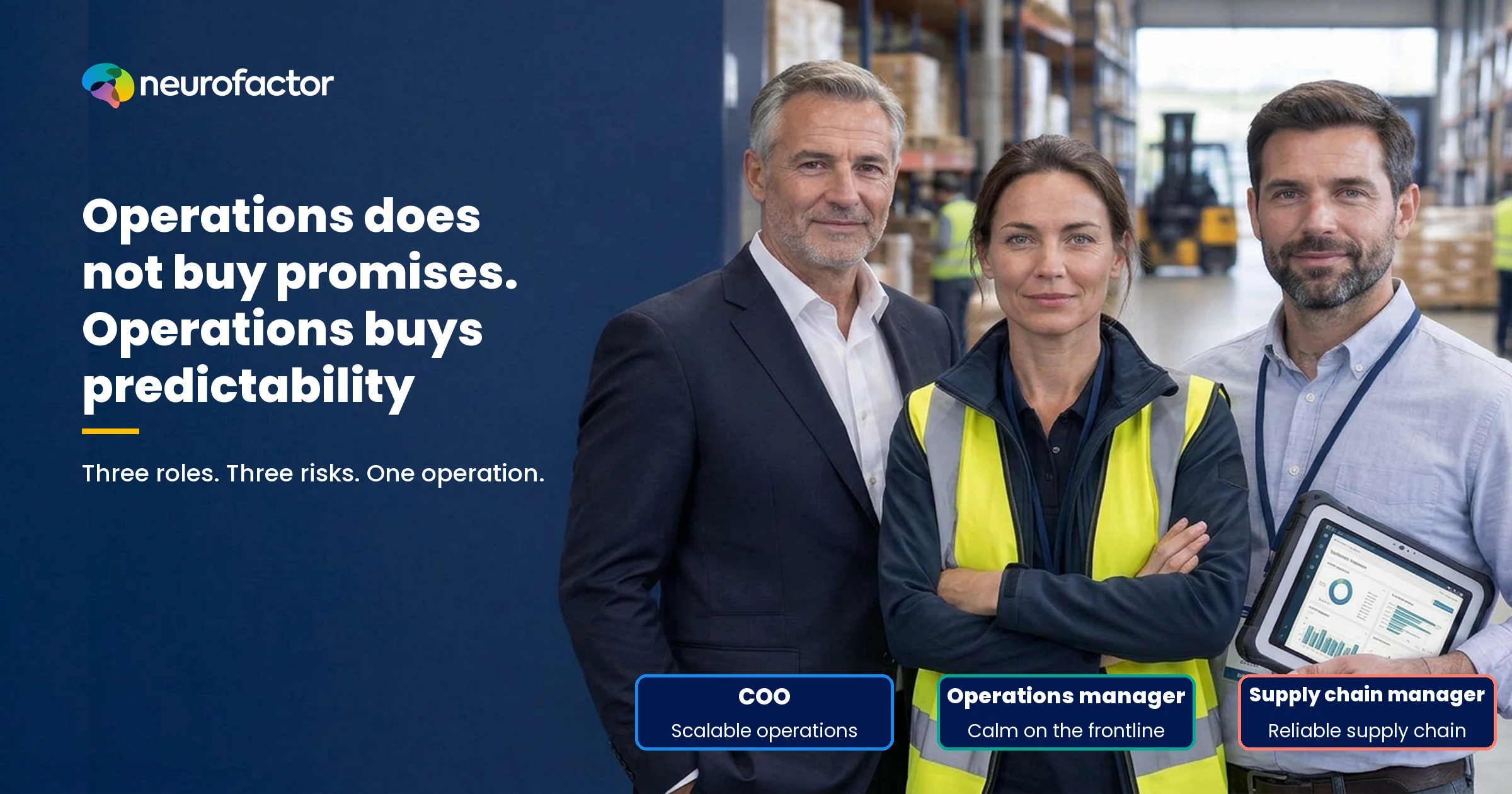
Operations does not buy promises. Operations buys predictability
A COO needs the business to scale without losing cost control. An operations manager wants fewer frontline disruptions without creating more work. A supply chain manager needs reliable deliveries even when demand and suppliers deviate from plan. One generic efficiency pitch will not persuade these three operations stakeholders in the same way.
The original Neurofactor profiles make the distinction visible: the supply chain manager has the highest BIS value (8), the COO the strongest BAS value in this set (6), and the operations manager the highest k (0.30). Selling to operations means linking each role's specific downside to credible evidence and an appropriate decision horizon.
The operation cannot grind to a halt on Monday
A vendor presents a platform that connects scheduling, capacity and delivery data. Every slide promises less waste, more control and better performance. Yet three different questions arise in the same operations meeting. The COO asks whether the business can grow without a rising cost per unit. The operations manager asks whether tomorrow's shift can run without extra work. The supply chain manager thinks about a late supplier and inventory that no longer matches demand.
This is the real issue when selling to operations. Efficiency only becomes persuasive when you demonstrate which disruption is prevented, which outcome improves and who is responsible for making the change work. Neurofactor's three operations profiles share a need for predictability, but at different levels: the entire business, the daily operation and the supply chain.
The common sales mistake is not a lack of features. It is offering one abstract benefit to three people who carry different consequences when implementation fails. Show what can go wrong for each role first. Only then can you make improvement genuinely attractive.
Three roles. Three definitions of reliable operations
The comparison below is grounded in the original Neurofactor Operations cards. Descriptions condense the recorded pain points, biggest fears, objections, proof requirements, desired outcomes and preferred contact routes. They are broad functional profiles, not fixed attributes of every individual. In smaller organisations, one person may cover more than one role.
Pain point
- COO
- Operations cannot scale at acceptable unit cost
- Operations manager
- Daily firefighting prevents structural improvements
- Supply chain manager
- Unreliable forecasts and suppliers
Biggest fear
- COO
- Growth or change disrupts delivery
- Operations manager
- Major disruption on their watch
- Supply chain manager
- Stockouts or downtime from a supply-chain misjudgement
Desired result
- COO
- Scalable operations at controlled unit cost
- Operations manager
- Stable flow and a capable team
- Supply chain manager
- Reliable deliveries and balanced inventory
Proof
- COO
- Productivity and unit-cost cases; peer COO references
- Operations manager
- Visible outcomes in a comparable frontline setting
- Supply chain manager
- Delivery and inventory evidence from comparable supply chains
Objections
- COO
- Proven at our scale? Who embeds it in the line?
- Operations manager
- No time; overloaded team; frontline fit
- Supply chain manager
- ERP/WMS integration, supplier cooperation and data reliability
Preferred route
- COO
- COO peer network or industry event, then business case
- Operations manager
- Manager referral, then onsite demonstration
- Supply chain manager
- Supply-chain peers or event, then integration demo
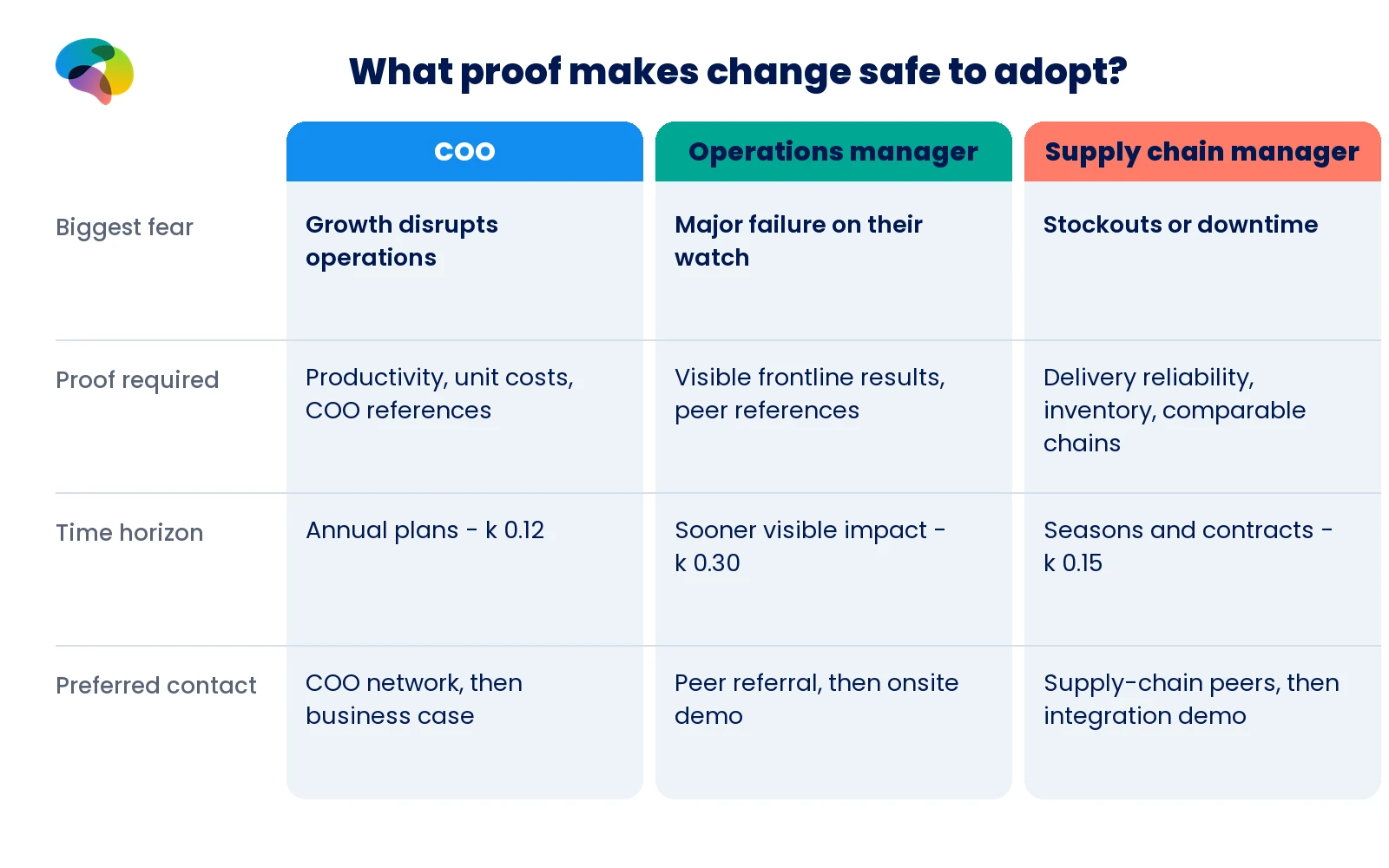
Efficiency means three different improvements
The COO owns performance across functions, sites and processes. The source card identifies the key problem as operations failing to scale with growth while unit costs remain too high. An efficiency programme is attractive only if it works across the business, controls costs and survives beyond the launch phase. The profile's characteristic voice asks what happens to cost per unit and whether the improvement scales.
The operations manager feels the bottleneck at the point of work. Staff shortages, downtime, ageing equipment and dependence on a few experienced employees create constant firefighting. A programme can look brilliant financially, but if an overloaded team must add more steps during a difficult shift, improvement becomes another operational risk. Their first test is straightforward: will this help the people and reduce disruptions?
The supply chain manager operates across a different boundary. The damaging event may happen outside the company's walls: a supplier, carrier, poor forecast or missing data. Here, efficiency is not simply the lowest possible stock. Reducing inventory only counts as progress when service levels remain reliable. The source profile's central concern is avoiding unwelcome surprises throughout the chain.
COO: show that change works at scale
The COO's source profile prioritises scalable output, productivity and controlled unit costs. Emotionally, the role seeks confidence that the organisation will deliver what it has promised; poor execution can damage customer trust. That concern drives the biggest objection. A pilot at one site does not show that the intervention can work across the wider operation or be embedded in everyday management.
Explain where current capacity is lost, how cost per unit is calculated and what it takes to roll out across sites. Bring real productivity and cost evidence from comparable organisations where available. Put a delivery and adoption plan beside the business case: accountable owners, training requirements, quality limits, escalation and review points.
The source card specifically records previous disappointment with large improvement programmes that were never embedded and consultants who left after the presentation. A promise of inspiring transformation therefore carries less weight than evidence that performance will still be reliable months after launch. Sell sustainable operational performance, not the implementation project itself.
Operations manager: an overloaded shift is not the place for extra work
The operations manager is responsible for a department that must run today. The source profile records breakdowns, absence, staffing pressures and little time to make lasting improvements. The biggest fear is a major failure on their watch. The main objections reveal what matters: no time, an already stretched team and uncertainty about whether a solution fits frontline work.
Do not open with an executive dashboard. Show a familiar failure that becomes easier to prevent, a schedule that requires fewer last-minute changes or a manual step that disappears. Involve frontline leaders in the trial and make the workload of deployment explicit. An onsite demonstration and a reference from a fellow operations manager follow the contact route described in the card.
The desired end state is not a permanent improvement workshop. It is a reliable department whose people can resolve problems without constant escalation. If your product introduces another form, dashboard and meeting, the supposed benefit may be outweighed by the extra burden on the shift.
Supply chain manager: lower inventory is not a win if deliveries fail
The supply chain manager balances the right inventory, dependable suppliers and controlled costs. The source card identifies inconsistent chain-wide data, fluctuating demand, poor forecasts and unreliable suppliers. The biggest fear is downtime or empty shelves caused by a wrong judgement. That makes a generic promise of leaner inventory potentially unconvincing.
Your first proof should demonstrate how delivery performance remains reliable when stock or lead times change. Bring actual service-level and inventory evidence, ideally from comparable supplier networks and systems. Demonstrate ERP and WMS integration, input-data quality and what happens when a supplier misses an agreed milestone.
The objections in the original card are exactly those integrations, suppliers' cooperation and data reliability. A polished forecast chart with no visibility into missing supplier information does not close that gap. This stakeholder wants to know how early a disruption becomes visible and what corrective action is possible. Lower inventory without a credible recovery route is not a stronger supply chain.
What BIS, BAS and k reveal in these profiles
The original cards use common dimensions across all three roles. The supply chain manager has the highest BIS value (8), consistent with the explicit concern about supply-chain disruptions. The COO has the strongest BAS orientation in this group (6), linked to productivity and scale. The operations manager has the highest k value (0.30), aligned with the preference for visible relief from everyday problems sooner rather than later.
These figures support the analysis; they do not replace the source descriptions. BIS is not the probability of an incident, BAS does not predict purchase intent and k is neither purchase probability nor a fixed sales-cycle length. A k of 0.30 does not mean a contract will be signed within thirty days. Use the values to ask better questions about downside, appealing outcomes and timing; let the recorded pain points, objections and proof requirements shape the actual pitch.
BIS (0-10)
- COO
- 7
- Operations manager
- 6
- Supply chain manager
- 8
BAS (0-10)
- COO
- 6
- Operations manager
- 5
- Supply chain manager
- 4
k (separate parameter)
- COO
- 0.12
- Operations manager
- 0.30
- Supply chain manager
- 0.15
Indicative time framing
- COO
- Annual programmes
- Operations manager
- Sooner practical impact
- Supply chain manager
- Seasons and contracts
Predictability can mean a performance metric or peace of mind
An exclusively financial pitch misses part of the decision. For the COO, the emotional reward is confidence that the organisation will deliver on customer promises. For the operations manager, it is a calmer shift, a capable team and recognition for a department that works. For the supply chain manager, it is control over suppliers and chain-wide dependencies before a problem becomes too late to fix.
The same metric can therefore carry different meaning. Higher overall equipment effectiveness may tell a COO something about capacity and unit economics. The operations manager needs to see fewer stoppages and escalations in practice. For a supply chain manager, improved factory output is not sufficient evidence if critical materials arrive late or orders still cannot be delivered in full.
This does not mean that one role only cares about figures and another only cares about people. All three source profiles combine operational measures with consequences for colleagues and customers. What differs is the first outcome each role must protect.
Scenario: one planning and forecasting platform
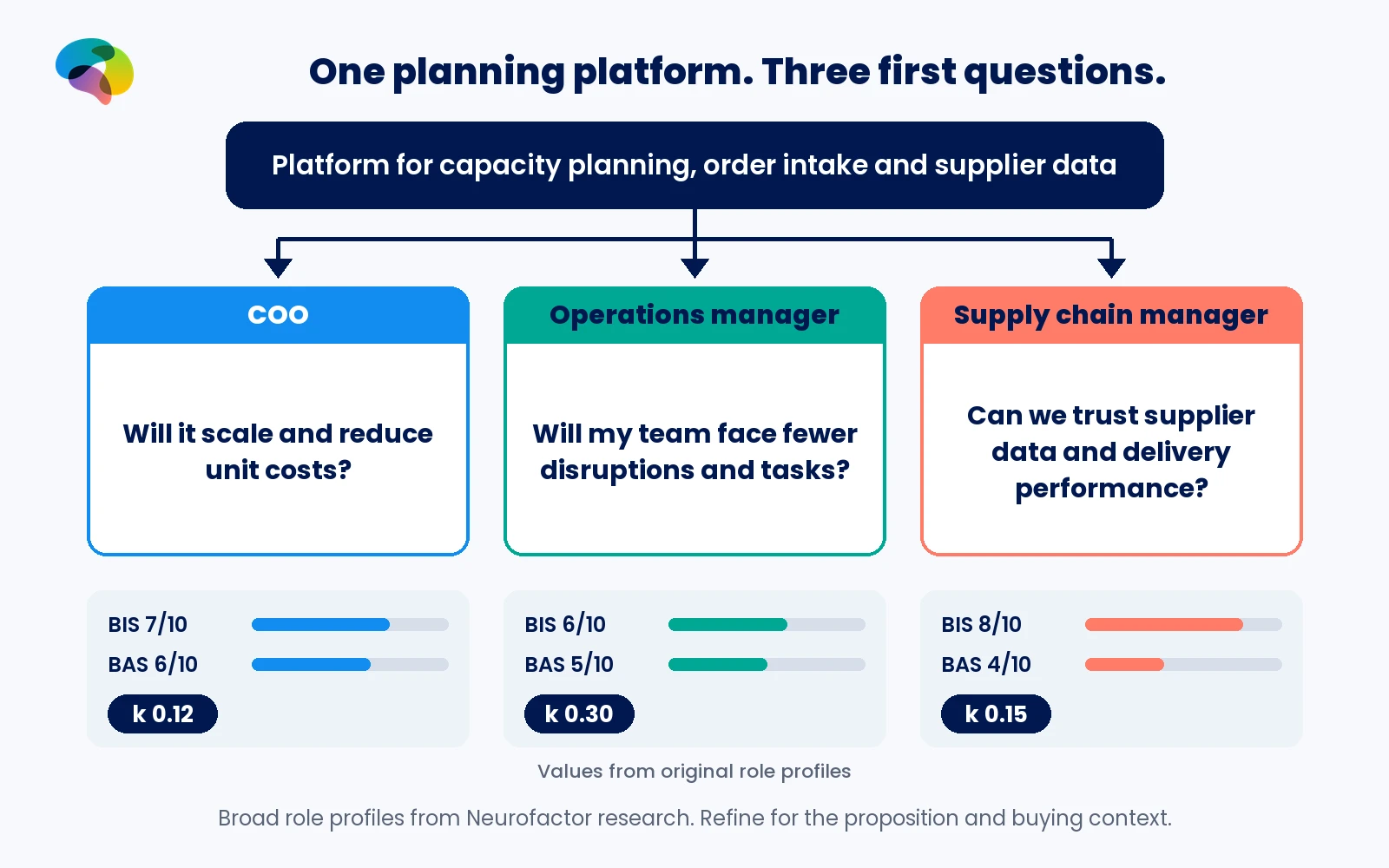
Imagine selling a platform that brings capacity planning, order volumes and supplier data together. It includes dashboards, automated alerts and planning suggestions. Your pitch says: 'Gain control of your operations and work more efficiently.' It sounds reasonable, yet it does not answer any of the three decision-makers precisely.
The COO asks: 'What happens to throughput and cost per unit when this works across every site? Who embeds the change after rollout?' The operations manager asks: 'What will my shift supervisors notice tomorrow, and how many additional steps are required?' The supply chain manager asks: 'How reliable is the supplier data, will it connect to ERP and WMS, and can we reduce missed deliveries?'
This is an illustrative sales scenario, not a Neurofactor experiment or evidence of product performance. The questions are derived directly from the existing role cards. Give each stakeholder a first slide answering their own question. You do not need three products. You need one product with three credible routes to value.
How to change your sales approach tomorrow
Start with responsibility rather than the software. Ask the COO where growth is putting execution or unit economics under pressure. Ask the operations manager which disruption keeps coming back. Ask the supply chain manager where a deviation was last detected too late to correct.
Then bring role-specific proof. For the COO: results that scale, cost per unit, quality limits and an ownership plan. For the operations manager: a short frontline trial with real users, the burden of deployment and changes in operational flow. For the supply chain manager: documented delivery performance, inventory implications, ERP/WMS connections and what happens with exceptions.
Match follow-up to the source card as well. A COO may respond to a peer introduction or industry event followed by a transferable business case. An operations manager is more likely to value an onsite demonstration after a recommendation. A supply chain manager needs a focused integration discussion involving whoever owns supplier and chain data. LinkedIn may open the door, but it cannot replace those proof routes.
Finally, establish who can approve the purchase, who will implement it and who carries the consequences. These are not necessarily the same person.
Three opening lines for the same product
You do not need three entirely different presentations. Change the opening question, first proof asset and appropriate next step.
For the COO: 'Where does cost per unit start rising as volumes increase? I can show how comparable organisations have approached scaling without compromising quality.' Only use this line if you have genuinely relevant evidence.
For the operations manager: 'Which recurring breakdown creates the most rework for your team? We can visit the site and examine which steps could disappear without adding a major project.' That offers a discovery session, not a guaranteed outcome.
For the supply chain manager: 'Where is uncertainty greatest today - the forecast, the supplier or the data connection? Let's test ERP/WMS compatibility and one delivery exception first.'
These are illustrative sales lines informed by the customer voices and objections in the original cards. They are not literal respondent quotations or measured conversion winners.
Do not confuse user, sponsor and decision owner
All three roles may take part in one purchase, but they do not form a fixed organisational chart. In a mid-sized company, an operations manager may buy a small departmental tool independently. A company-wide platform may be sponsored by the COO while IT, finance and procurement join the decision. A supply-chain solution may originate with the supply chain manager and only later reach executive approval.
Map the actual buying process. Ask who first experiences the problem, whose KPI deteriorates if nothing changes, who can validate the data and who must absorb the implementation workload. Then find the person who can make the business case credible to colleagues. That is not always the most senior person in the room.
Avoid the false choice between speed and caution. An operations manager with k 0.30 may place relatively greater value on near-term improvements and still reject a risky deployment during a critical shift. A supply chain manager with BIS 8 may strongly support a new solution once it demonstrably reduces disruption risk. Read the profile dimensions alongside the purchasing context and available proof.
Research-informed profiles, refined for your buying context
These functional profiles are based on recurring patterns observed across several years of Neurofactor research involving these and comparable audiences. They provide research-informed broad role profiles, not claims about every individual COO, operations manager or supply chain manager.
Industry, company size, proposition, price, product or service and the specific purchasing context can all shift which associations, objections and forms of evidence matter most. A production environment with strict quality requirements may face different risks from a service operation. A small departmental purchase may have a very different approval route from a multi-year platform commitment.
We therefore refine the broad profile through a target-group profile and association map for the actual proposition. This reveals what the product evokes and which proof is credible. BIS, BAS and k are dimensions of the broad profiles, not individual diagnoses, role-specific EEG readings or measured purchase probabilities. Want to know what these profiles look like for your product or service? Start with the actual decision context.
Want to know how COOs, operations managers or supply chain managers view your product or service? Contact Neurofactor and have the broad profile translated to your proposition.
Which LinkedIn content opens the right door?
LinkedIn is relevant to discovery for all three roles in the source cards, but their preferred paths towards a commercial conversation differ. The COO reads LinkedIn regularly and also uses specialist media and industry events. The operations manager is an occasional LinkedIn user who relies more on fellow managers and practical demonstrations. The supply chain manager uses LinkedIn regularly alongside trade publications, logistics media and industry peers.
Match the content to that behaviour. For the COO, offer a concise unit-cost and productivity case with evidence of rollout and quality safeguards. For the operations manager, show one recurring breakdown that a team could avoid, along with the burden of deploying the solution. For the supply chain manager, explain a specific forecast or delivery exception and how reliable data and integrations support a response.
Do not use LinkedIn merely to direct every role to the same lead form. A useful post answers one opening question and leads to the next credible proof asset. The source profiles describe contact preferences, not observed click-through or conversion rates.
For a more focused comparison, continue with COO versus operations manager and operations versus supply chain. Both comparisons show how the same operational proposition can lead to different buying questions.
From broad audience profile to proposition-specific proof
A role profile gives structure to the conversation, but the strongest pitch depends on what your audience associates with your actual offering. For a scheduling platform, integration and data reliability may dominate. For a consultancy programme, sustainable adoption and the workload of change may matter more. For a training intervention, the deciding concern may be whether people use new practices once the trainers leave.
Start by mapping the people involved in the purchase. Find out which risk each one spontaneously associates with your proposition and which evidence could reduce that uncertainty. An association map then separates the terms you favour, such as innovation or automation, from what the customer actually hears: disruption, control or calm.
This is why a BIS score alone is never the entire answer. The broad profiles provide the starting point; your product and decision context determine the relevant proof and wording. You are not inventing a different story for every stakeholder. You are building a credible case for the same offer from the right starting point.
You are not selling efficiency. You are making the next disruption manageable.
The COO needs the business to keep delivering as it grows. The operations manager needs the next shift to run without additional chaos. The supply chain manager needs to spot and resolve disruption before the chain fails. Three roles share a desire for predictability, yet face different consequences and require different evidence.
The strongest operations pitch therefore does not begin with the product's features. It begins with what must stop going wrong, proves what can improve and identifies who will sustain that improvement in day-to-day work. That is when efficiency becomes a defensible decision rather than a polished promise.
Key terms
- COO
- Chief operating officer: executive accountable for operational delivery, productivity, cost and scalability.
- Operations manager
- Leader responsible for daily operational flow, staff and performance metrics at departmental level.
- Supply chain manager
- Professional responsible for suppliers, inventory, planning, logistics and delivery performance across the chain.
- BIS
- Behavioural inhibition system: within this broad profile model, attention to potentially negative outcomes on a 0-10 scale.
- BAS
- Behavioural activation system: within this profile model, orientation towards attractive outcomes on a 0-10 scale.
- Delay-discount rate (k)
- A parameter describing how strongly later benefits are discounted relative to earlier benefits; not purchase probability or sales-cycle length.
- Unit cost
- Cost calculated per unit of output or service, useful when examining whether operational improvements scale.
- OTIF
- On time in full: a delivery-performance measure indicating whether orders arrive as promised and complete.
- ERP / WMS
- Enterprise resource planning and warehouse management systems; integrating them supports more reliable supply-chain information.
- Target-group profile
- Structured overview of functional, emotional and behavioural characteristics of a business audience.
- Association map
- A map of meanings and associations an audience links to a proposition, product or category.
Frequently asked questions
Why does one efficiency pitch not work equally well for all three operations roles?
The COO protects scalability and unit economics, the operations manager seeks fewer daily disruptions, and the supply chain manager must safeguard delivery reliability. Each role therefore needs different evidence.
What evidence convinces a COO?
Documented productivity and unit-cost outcomes, comparable executive references, a scalable business case and a clear plan for sustained implementation.
What is the main objection from an operations manager?
Time and workload: the team is already stretched and any solution must work on the frontline. Offer a practical demonstration with limited implementation burden.
What proof does a supply chain manager need?
Evidence of delivery reliability and inventory outcomes, working ERP/WMS integration, trustworthy source data and relevant cases from similar chains or sectors.
What do BIS, BAS and k indicate in a role profile?
BIS relates to attention to downside, BAS to attractive rewards and k to relative weighting of earlier versus later outcomes. They are not purchase probabilities or individual diagnoses.
Do these profiles apply to every operations professional?
No. They are broad research-informed profiles drawn from recurring Neurofactor findings. Industry, company size, offering and decision context may change the concerns and proof that matter. A target-group profile and association map support proposition-specific refinement.
Sources
- 1.Behavioral Inhibition, Behavioral Activation, and Affective Responses to Impending Reward and Punishment: The BIS/BAS Scales - Carver & White / Journal of Personality and Social Psychology (1994)
- 2.Time Discounting and Time Preference: A Critical Review - Frederick, Loewenstein & O'Donoghue / Journal of Economic Literature (2002)
Related topics
Reviewed by: Martijn den Otter · Last reviewed: 10/11/2026
Martijn den Otter
Oprichter van Neurofactor. Expert in neuromarketing en consumentenpsychologie.
LinkedIn →