
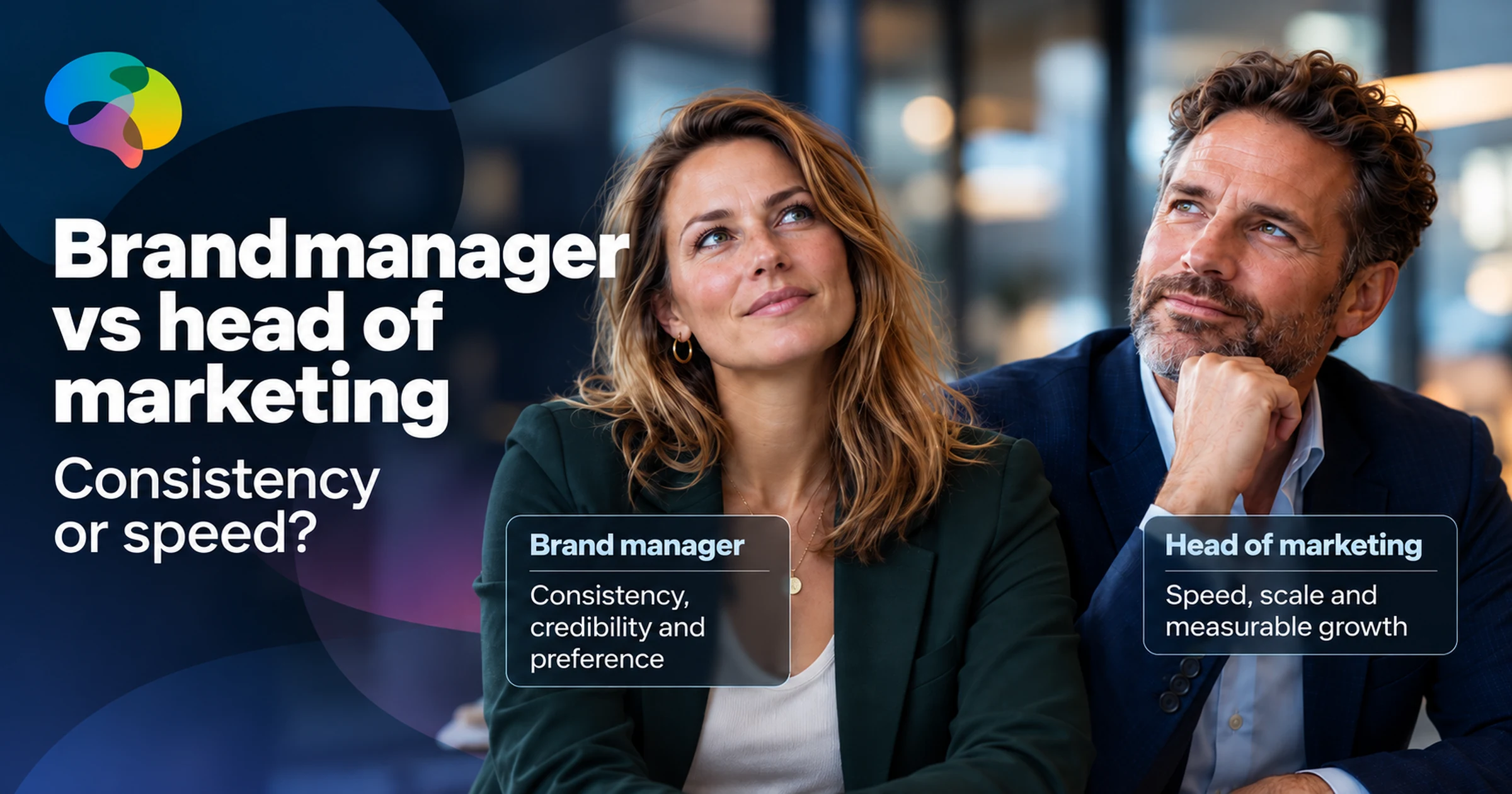
Brand manager vs head of marketing: consistency or speed?
A brand manager and a head of marketing can look at exactly the same solution and both say: this has to deliver results.
But they do not mean the same thing by results.
The brand manager first looks at consistency, credibility and whether a new approach fits what the brand needs to mean over time. The head of marketing looks more strongly at pace, scalability and whether the solution can create movement quickly enough across team, channels and performance.
For the brand manager, changing too quickly can be a risk. For the head of marketing, changing too slowly can be the bigger risk.
If you sell to both roles, the proposition is not the only thing that changes. The evidence, order and explanation of risk change with it.
One protects what the brand becomes, the other what marketing moves
The roles sit close enough together to be treated as one audience, yet they are accountable for different things.
The brand manager protects whether communication, propositions and activation fit the identity and desired position of the brand. A quick win can still be a poor choice when execution creates inconsistency or the wrong association.
The head of marketing is more often accountable for the total of team, channels, performance and growth. A solution can be strategically strong and still fail when implementation is too slow, the effect is too small or scaling takes too much effort.
The difference is not brand versus results. Both roles want both. The difference is which risk sits at the front of the decision.
The same proposition, two first questions
Imagine you offer a new marketing solution with this promise:
We help you test messages faster, align them more closely with your audience and then roll them out across multiple channels.
The brand manager may first think: how do we know this fits our brand identity and does not build the wrong associations?
The head of marketing may first think: how quickly can we see results and how easily can we scale this?
The proposition stays the same. The mental risk calculation does not.
Brand manager and head of marketing side by side
In Neurofactor's broad role profiles, a recognisable contrast appears between brand protection and growth pace. The comparison below summarises that difference without suggesting that every person with the same title decides identically.
Primary responsibility
- brand manager
- brand position, consistency and recognisability
- head of marketing
- team, channels, performance and scale
First question
- brand manager
- does this fit the brand and is it safe to roll out broadly?
- head of marketing
- how quickly will we see impact and can we scale it?
Evidence need
- brand manager
- brand fit, reliability, consistent execution and effect on brand preference
- head of marketing
- fast measurable impact, repeatability, scalability and efficiency
Biggest risk
- brand manager
- reputational damage, dilution or execution that conflicts with brand identity
- head of marketing
- lost momentum, slow implementation or too little commercial effect
Time horizon
- brand manager
- more often medium to long, with attention to brand building
- head of marketing
- more often short to medium, with emphasis on rapid learning and scaling
Typical objection
- brand manager
- this does not feel like our brand or the risk to brand value is too high
- head of marketing
- this takes too long, needs too much alignment or does not create enough scalable impact
Desired result
- brand manager
- a stronger, more consistent brand and higher preference
- head of marketing
- measurable growth and a marketing engine that works faster and more efficiently
For the brand manager, damage can be harder to reverse than delay
A brand manager does not only look at what a campaign delivers today. The role also protects what repeated communication leaves in the audience's mind tomorrow.
That makes reliability and consistency important. A campaign can generate a strong CTR and still be undesirable if it activates the wrong brand association, introduces a conflicting tone or buys short-term conversion at the expense of recognisability.
Evidence becomes stronger when it shows not only that the solution works, but that it works within clear brand guardrails. Useful proof can include association testing, controlled rollout, cross-channel consistency and evidence that performance does not undermine the intended brand meaning.
You are not only selling results. You are selling results without unnecessary loss of accumulated brand value.
For the head of marketing, delay is also a risk
The head of marketing more often faces a different problem. Marketing has to be right, but it also has to move.
Teams have targets. Channels change. Competitors keep testing. Campaigns do not wait until every uncertainty disappears. A methodologically strong solution can therefore still meet resistance when time-to-value is too long.
Questions such as time to first usable result, team capacity, ease of scaling, measurable effect and efficiency become part of the business case.
Here, speed is not a superficial preference. It is part of the value calculation.
The same word results, two different standards
When both roles ask for results, do not immediately show the same case. First ask what problem they need the evidence to solve.
What does result mean?
- brand manager
- stronger and more consistent brand meaning without unwanted damage
- head of marketing
- visible growth, efficiency and faster learning
What must a case prove?
- brand manager
- the approach works within brand guardrails and supports brand value
- head of marketing
- the approach creates impact quickly and can be repeated at scale
What reduces risk?
- brand manager
- brand testing, checkpoints, clear guardrails and controlled rollout
- head of marketing
- short pilot, clear KPI, implementation path and concrete scaling route
Which language works better?
- brand manager
- aligned, reliable, consistent, brand-safe, substantiated
- head of marketing
- fast, measurable, scalable, executable, return
Common sales mistake
- brand manager
- showing performance without the brand consequence
- head of marketing
- showing nuance and brand logic without clear pace or business impact
How to change the same pitch for each role
You do not need two different products. You need two different entrances to the same product.
- For the brand manager: start with the brand consequence. Show how the approach strengthens desired associations, prevents drift and keeps control over brand fit.
- For the head of marketing: start with the growth problem. Show how quickly value appears, what effect is measurable and how it can then scale.
- For the brand manager: use cases that make consistency, preference, positioning or controlled rollout visible.
- For the head of marketing: use cases with time-to-value, KPI impact, efficiency and scale.
- For both: show that speed and brand protection do not have to compete. A strong approach can accelerate decision making by making the relevant risks visible early.
When both sit at the table, the same proposal can be judged twice
In larger organisations, the brand manager and head of marketing often participate in the same decision.
A proposal may already be green for the head of marketing because the business case is strong, while the brand manager still doubts the fit. The reverse can also happen: the brand manager likes the content, but the head of marketing rejects it because the approach looks too slow or labour-intensive.
That is not internal resistance. The two roles defend different forms of value.
A strong sales story therefore makes two things visible at once: why this is safe enough for the brand and why this is fast enough for the organisation.
Who should you approach first?
For a brand-sensitive solution, the brand manager is often an important early validator. Think of rebranding, naming, tone of voice, campaign concepts, positioning or communication that directly affects identity.
For tooling, performance improvement, automation or an approach that immediately touches several teams and channels, the head of marketing may be the more logical first sponsor.
When a solution affects both brand and performance, it is usually a mistake to treat one role as the endpoint. The evidence should be transferable from one buying logic to the other from the start.
From a broad role profile to your product or service
The patterns in this article come from recurring findings across years of Neurofactor research into these audiences. That allows us to describe broad differences between brand managers and heads of marketing.
They remain generalised role profiles. A brand manager evaluating a rebrand can respond differently from one choosing software, research or media. The same applies to the head of marketing.
For the best result, examine how your specific product, service or proposition fits the broad profile. Neurofactor combines a target group profile and association map: who is the buyer, and which associations does your offer trigger for that buyer?
Need help sharpening these two roles for your offer? Contact Neurofactor and translate the broad profile into your own proposition and buying context.
Conclusion: the best pitch makes speed safe for the brand and brand protection workable
Brand managers and heads of marketing do not want opposite outcomes. Both want stronger marketing.
The brand manager primarily protects growth from eroding the brand. The head of marketing primarily protects carefulness from turning into delay.
One generic evidence story is therefore rarely optimal. Show the brand manager why the approach fits and protects. Show the head of marketing why the same approach moves and scales.
When those two evidence routes fit into one story, brand consistency does not have to slow down speed. It becomes a condition for moving faster responsibly.
Key terms
- Brand protection
- In this article: protecting intended brand identity, associations and consistent execution from unwanted dilution or reputational damage. This is broader than the advertising term brand safety.
- Scalable evidence
- Evidence that shows not only a local effect, but also that an approach can be repeated across campaigns, teams, markets or channels.
- Time-to-value
- The time between starting a solution and the point at which the organisation experiences the first usable or measurable value.
Frequently asked questions
What is the main difference between a brand manager and head of marketing as a buyer?
Brand managers tend to evaluate a solution more strongly on consistency, credibility and risk to brand value. Heads of marketing tend to evaluate the same solution more strongly on speed, scalability, team impact and measurable growth.
What evidence convinces a brand manager?
Evidence that the solution fits the brand identity, supports consistent associations and reduces unnecessary risk to reputation or brand value. Controlled testing and clear brand criteria help.
What evidence convinces a head of marketing?
Evidence about time-to-value, measurable KPI impact, implementation effort, efficiency and scalability is usually more persuasive than a strong brand story on its own.
Do you have to choose between brand consistency and speed?
No. A strong approach makes relevant brand risks visible early and creates a route to scale more quickly with control. The goal is to combine care and speed rather than choose one.
Are these role differences researched?
Yes. The broad patterns in this series are based on recurring findings from years of Neurofactor research into these audiences. They are intentionally generalised and are refined for a specific product, service, proposition and buying context.
How do I apply this to my own product or service?
Use the role profile as a broad base, then investigate which associations, risks, benefits and forms of evidence your specific offer triggers for the audience. A target group profile and association map combine those two layers.
Sources
- 1.Conceptualizing, Measuring, and Managing Customer-Based Brand Equity - Journal of Marketing (1993)
- 2.Behavioral inhibition, behavioral activation, and affective responses to impending reward and punishment: The BIS/BAS Scales - Journal of Personality and Social Psychology (1994)
- 3.Making Fast Strategic Decisions in High-Velocity Environments - Academy of Management Journal (1989)
This series
Who are you really selling to?Category synthesis
You sell to marketing. But who is actually buying?Read next
Related topics
Reviewed by: Martijn den Otter · Last reviewed: 10/6/2026
Martijn den Otter
Oprichter van Neurofactor. Expert in neuromarketing en consumentenpsychologie.
LinkedIn →