
You sell development. But what does development mean to the buyer?
A learning programme can be excellent and still trigger three different reactions from three development professionals. The L&D manager asks how people will apply it at work. The talent manager asks whether it will help prepare the right people for future critical roles. The HR development specialist asks whether the facilitator understands this team and its culture.
These are not interchangeable HR buyers. Development can mean measurable learning transfer, protecting critical talent, or an intervention that actually works in a particular team. If you sell training, coaching, assessments or development programmes, an inspiring brochure is not enough. You need to provide evidence for the outcome and risk each role is responsible for.
One development programme. Three entirely different questions.
Imagine pitching a leadership programme with an initial assessment, six workshops, coaching and an online learning environment. Each of the three professionals can see its relevance, yet each asks something different.
The L&D manager asks what people will do differently on the job and how you will measure it. The talent manager wants to know whether the programme can help prepare future successors and whether any assessment rests on defensible evidence. The HR development specialist wonders if the facilitator can work with a team where the line manager has little time and trust is already fragile.
A description of the curriculum does not resolve any of those questions. A development offer becomes meaningful when it is connected to the buyer's specific problem, authority and exposure if the decision goes wrong.
Three development roles compared
This comparison draws on the original Neurofactor target group cards for L&D and organisational development. It condenses the source fields covering role context, pain points, fears, objections, evidence and preferred routes.
| Dimension | L&D manager | Talent manager | HR development |
|---|---|---|---|
| Scope | Learning portfolio, systems and budget | Talent programmes, career paths and succession | Team and manager development close to the line |
| Main pain | Training happens, but workplace impact is unclear | Top talent leaves or remains unidentified | Managers ask for quick fixes too late |
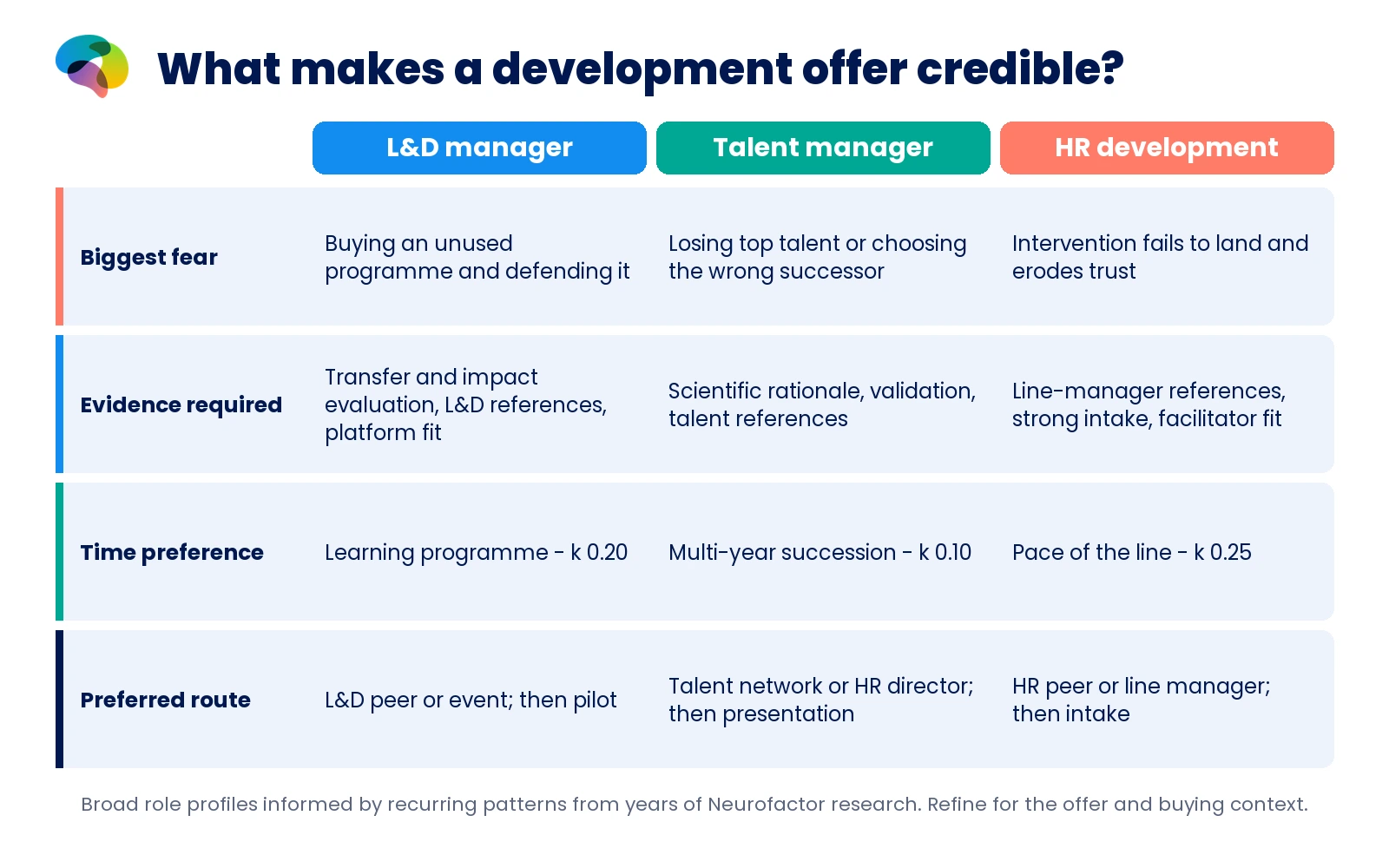
| Biggest fear | Buying a programme nobody uses and having to justify it | Losing top talent or appointing the wrong successor | An intervention fails to land and costs line-manager trust |
| Objection | Impact, scalability, fit and cost per learner | Scientific basis, objectivity and managerial acceptance | Tailoring, facilitator fit and no independent budget |
| Evidence | Transfer/evaluation cases, L&D references, platform fit | Scientific rationale, validation, talent-manager references | Line references, strong intake and credible facilitator |
| Preferred route | L&D peer or professional event, then pilot | Talent/HR leadership network, then expert presentation | HR peer or line manager, then intake |
Job titles are not contracts of authority. An HR director may be involved in a major programme, while funding for a smaller team intervention may sit with the line manager.
The surprising pattern: similar motivation, different proof
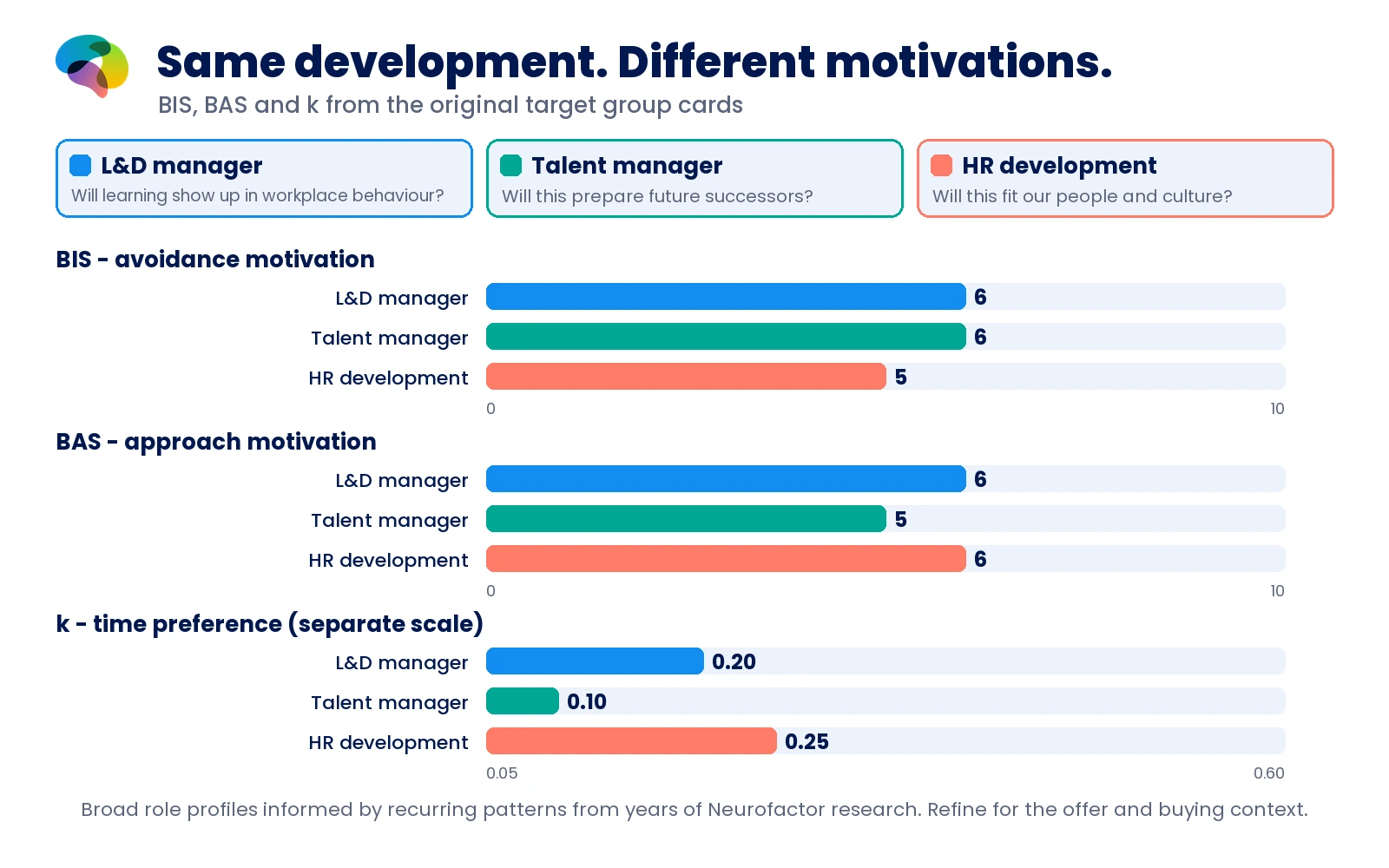
Both the L&D manager and the HR development profile have a BAS score of 6. That does not mean they respond to the same upbeat sales message. The L&D manager is attracted to making learning demonstrably more effective. HR development is attracted to helping a particular team or manager move forward with an intervention that fits.
The talent manager scores BAS 5 in this broad profile. This does not mean the role values development less. The card points to a different emphasis: well-founded talent identification, careful judgement and future coverage of key positions. A lively promise of fast personal growth may be much less relevant than a valid assessment and a robust follow-up plan.
The sales question is not which function is most enthusiastic. It is which kind of progress the function can credibly pursue and defend.
L&D manager: show what changes after the course
L&D managers own the learning portfolio, infrastructure and usually an allocated budget. The source card identifies a recurring frustration: employees attend training, yet its impact on day-to-day work remains unclear. Courses may have accumulated in response to departmental requests rather than strategic priorities; learning platforms are not always well used either.
Their biggest fear is purchasing a programme that sees little take-up and then explaining the decision to senior management. Participant satisfaction therefore does not settle the issue. Explain how learning objectives translate into observable workplace behaviours, how line managers support application and what will be measured before and after the programme. Show how the solution fits existing platforms and learning pathways.
A convincing case covers starting conditions, measurement design, actual outcomes where available, and limitations. 'What does it cost per participant?' then becomes part of a more useful conversation about the value of learning in practice.
Talent manager: develop people and protect the succession pipeline
For talent managers, development is closely linked to future coverage of critical positions. The original card describes talent leaving or remaining invisible while succession is insufficiently planned. Line managers may work with different definitions of potential and make judgements that are difficult to compare.
This calls for more than an appealing programme. How sound are the tools? What does an assessment actually measure, for which intended use has it been validated, and how should its results be interpreted? What does the organisation do after the assessment? A score detached from an employee's development context can create a false sense of objectivity.
A one-off assessment with no follow-through is not a complete answer in this buying context. Show the sequence: define talent, assess carefully, support development, involve managers and review succession readiness over time. Do not claim a tool can identify talent without error or guarantee retention.
HR development: the intervention must work with these people
HR development specialists work closely with managers and teams and often do not hold their own budget. The source card describes a difficult situation: the line asks for help late, when a problem has already escalated, and expects a quick training solution even though the causes may lie in leadership, collaboration or working arrangements.
The biggest fear is that an intervention fails to fit and further damages trust with the line. That makes the initial diagnosis commercially important. Ask what is happening, who owns the problem, what has already been attempted and what improvement would look like for the people involved.
The facilitator matters greatly in this broad profile. A reference from a recognisable line manager, an introduction to the coach and an approach that speaks the team's language may count for more than an extensive training catalogue. Selling the same standard workshop to every client can reinforce the very risk this buyer wants to avoid.
What BIS, BAS and k do - and do not - tell you
The three scores help describe a contrast in broad role-level buying motivation. They are not population averages or individual measurements.
| Profile value | L&D manager | Talent manager | HR development |
|---|---|---|---|
| BIS (0-10) | 6 | 6 | 5 |
| BAS (0-10) | 6 | 5 | 6 |
| Delay-discount-rate k | 0.20 | 0.10 | 0.25 |
BIS helps describe avoidance-related concerns: unused training, unreliable talent tools or interventions that do not fit. BAS helps frame the opportunities each role pursues. The parameter k concerns how future outcomes are weighted; it is not a predicted procurement date or purchase probability.
The talent manager's relatively lower k is consistent with a longer-term succession focus. HR development often has to respond to the pace of the line. Actual decisions can be much faster or slower depending on urgency, funding, mandate and the organisation.
Decision horizon: immediate team needs versus future succession
You cannot determine the duration of a sales cycle from a job title. The original role cards do, however, clarify what the buyer is trying to protect across time. HR development is often close to an active team issue, with little time to analyse it. The initial question can therefore be immediate: can this particular facilitator help us now?
The L&D manager looks at impact across learning programmes, infrastructure and budget cycles. A provider must show what happens not only during a workshop but in the weeks and months afterwards. The talent manager looks further ahead, at leadership pipelines and successors for key roles. Reliable assessment and consistent follow-through matter because the value of an intervention may only become visible later.
This does not mean pressuring HR development into a rushed decision or assuming talent management can wait. It means providing evidence for the period over which the buyer is accountable.
One fictional leadership programme, three paths to credibility
Consider a fictional leadership offer: six workshops, a learning platform, an optional assessment module and coaching. This illustrates a sales conversation; it is not a Neurofactor experiment or a claim of measured results.
L&D manager. Start with the learning objectives, transfer strategy and integration into existing systems. Present a possible baseline, workplace-behaviour indicators and follow-up. Ask what information senior leadership will need to assess the investment.
Talent manager. Clarify the succession question. Show which parts of the assessment are suitable for the intended use, including evidence and limitations. Explain how assessment, feedback, development and managerial involvement connect over time.
HR development. Begin with an intake alongside the relevant line manager. Determine whether training is even the right intervention. Let the buyer meet the facilitator and adapt the design only after understanding the people and context.
The underlying service need not become three unrelated products. The opening question, sequence of proof and internal decision path must change.
Turn the role card into a message, evidence and route
Effective sales communication starts with the intended result and the downside the role must avoid, rather than a job-title segment alone.
| Component | L&D manager | Talent manager | HR development |
|---|---|---|---|
| Lead message | Learning that changes workplace behaviour | Identifying and preparing talent responsibly | An intervention that fits this team |
| First proof | Transfer case, evaluation plan, platform fit | Scientific basis, validation, development path | Intake approach, facilitator profile, line reference |
| LinkedIn topic | Beyond training satisfaction: learning transfer | What an assessment can and cannot establish | Why training is sometimes the wrong solution |
| First discussion | Learning objectives, scale, systems and budget | Talent definition, succession and data use | Real issue, culture and funding authority |
| Next step | Small pilot with agreed measures | Expert session on methods and limitations | Joint intake with line manager |
These are suggested routes derived from the profiles, not a claim that a particular message delivers a measured conversion uplift.
Three ways to open the conversation
With an L&D manager: 'How will you demonstrate that this leadership programme changes what people do at work, rather than simply earning positive course feedback?' This speaks to transfer and accountability.
With a talent manager: 'How can you tell whether the programme is developing the people who could take on critical roles - and whether the judgement is sufficiently well founded?' This opens a conversation about definitions, evidence and succession.
With HR development: 'What would need to change in this team before we could say training is the right intervention?' This respects the need for diagnosis and context.
These are editorial examples based on the source cards. They are not experimentally tested, best-performing hooks.
LinkedIn may start the journey. It rarely completes the decision.
All three source profiles identify LinkedIn as a relevant place to encounter ideas and evidence. But their preferred decision routes extend beyond the platform. L&D managers value recommendations from peers or professional events, followed by an introduction and a pilot. Talent managers draw on talent and HR leadership networks before requesting substantive presentations. HR development often relies on colleagues or line managers, then moves to a diagnostic intake.
A strong LinkedIn post can earn attention. It does not replace documentation, a credible peer reference or the involvement of a line manager. Give each topic a logical next step: a transfer-evaluation case for L&D, an evidence briefing for talent management, or a problem-definition meeting for HR development.
Budget authority matters too. An L&D manager may purchase within a training allocation, whereas HR development may need the line to sponsor the intervention. A person without a budget can be a critical champion rather than an irrelevant lead.
Five questions to ask before pitching development
- Which result must this person defend internally? Workplace transfer, succession readiness or meaningful change within a team.
- What would make the purchase a failure? Unused programmes, misleading assessment or lost line-manager trust.
- What evidence is actually available? Present your evaluation design and validated measures without inventing outcomes.
- Who pays and who must participate? L&D, HR leadership and the line have different roles across organisations.
- What decision follows the first meeting? A pilot, an expert presentation or an intake may matter more than sending a quote immediately.
These questions also sharpen your LinkedIn editorial plan. Instead of writing to 'HR people', you can address a concrete decision.
Evidence-informed broad profiles are not predictions about individuals
These Neurofactor target group cards draw on recurring patterns observed over years of research involving these and comparable audiences. They provide evidence-informed broad role profiles across forty attributes. That is different from an unsupported guess based on a job title, but it is not a set of measured population averages or a literal description of every individual.
Industry, organisation size, budget, buying mandate, product, price and choice context can change what matters. Mandatory compliance training and voluntary leadership coaching are bought under different conditions. One person may also hold more than one of these responsibilities.
For a specific proposition, combine the broad role card with a target group profile and an association map. BIS, BAS and k are not EEG readings for these job functions, individual diagnoses or purchase predictions.
Want to know how L&D managers, talent managers or HR development view your training, coaching or programme? Contact Neurofactor and have the broad profile translated into your proposition.
Why an association map adds the missing layer
A broad role profile explains recurring responsibilities and concerns, but it cannot tell you what your particular course, coach or assessment means to your audience. The word assessment might evoke scientific rigour or helpful insight; it might also evoke surveillance, selection or a judgement that feels impersonal. Which associations actually dominate must be researched with the intended audience.
An association map provides that additional layer. Explore the meanings linked to the offer and the situation, compare them with the desired positioning, then translate the findings into content, evidence and tone of voice. An L&D provider might discover that 'measurable learning' evokes credibility and additional administration at the same time. A coach might need to demonstrate that tailored facilitation is both personal and professional.
Without this step, a good role-based pitch remains generic. With it, the messaging can reflect the specific associations your customer needs to overcome or reinforce.
You are not selling development. You are helping someone defend a decision.
The L&D manager needs to show that learning is applied and produces relevant impact. The talent manager wants to identify, develop and retain future successors with appropriate care. HR development wants a solution that fits the people, the manager and the organisation. One offer can support all three, but a single generic promise will not answer all three buying questions.
The next step is not merely a more creative sales deck. It is identifying the outcome the buyer owns, the failure they must avoid and the evidence that makes the decision defensible.
Explore the related articles on L&D managers versus talent managers and HR development versus L&D.
Key terms
- L&D manager
- The professional accountable for a learning portfolio, learning infrastructure, budget and demonstrable relevance to work.
- Talent manager
- The professional responsible for identifying and developing talent, career paths and succession for critical positions.
- HR development
- An adviser or specialist supporting line managers and teams with development interventions, often without independent funding authority.
- Learning transfer
- Applying newly learned knowledge or skills in actual workplace behaviour after training.
- Impact evaluation
- A structured attempt to assess predefined outcomes, recognising measurement limitations.
- Talent identification
- A careful process for identifying relevant abilities and potential for an explicit development or succession purpose.
- Validity
- How well evidence supports the intended interpretation and use of an assessment tool.
- Cultural fit
- The extent to which a facilitator and intervention suit the organisation and its working practices.
- BIS/BAS
- Framework dimensions used to describe avoidance and approach motivation; here represented as broad role-profile scores.
- Delay-discount-rate (k)
- A time-preference parameter used when weighing later outcomes; not a predicted deal date or purchase likelihood.
- Target group profile and association map
- Combining broad audience characteristics with researched meanings and associations relating to a specific offer.
Frequently asked questions
Why do three development buyers ask for different evidence?
Because L&D managers must defend workplace learning impact, talent managers must manage succession and retention, and HR development must select interventions that fit the needs of the line. Each is exposed to a different type of failed decision.
What evidence convinces an L&D manager?
Workplace transfer and evaluation cases, references from comparable L&D teams, a realistic measurement plan and evidence that the programme fits existing learning systems.
How should an assessment provider approach a talent manager?
Explain the scientific rationale, validation for the intended use, limitations, interpretation safeguards and development follow-up. A test without an appropriate next step rarely resolves a succession problem.
Why does HR development care so much about the intake?
The issue may involve leadership, collaboration or working practices rather than a lack of training. A careful intake shows whether the approach and facilitator suit the actual situation.
What do BIS, BAS and k mean in these profiles?
They are broad role-profile dimensions for avoidance motivation, approach motivation and time preference. L&D manager: 6/6/0.20; talent manager: 6/5/0.10; HR development: 5/6/0.25. They do not predict individual behaviour.
How can I tailor these profiles to my own service?
Investigate the meanings your intended audience associates with the concrete proposition, the decision context, buying group and required evidence. Combine the role profile with target group and association research.
Sources
- 1.Behavioral Inhibition, Behavioral Activation, and Affective Responses to Impending Reward and Punishment: The BIS/BAS Scales - Carver & White / Journal of Personality and Social Psychology (1994)
- 2.Time Discounting and Time Preference: A Critical Review - Frederick, Loewenstein & O'Donoghue / Journal of Economic Literature (2002)
Related topics
Reviewed by: Martijn den Otter
Martijn den Otter
Oprichter van Neurofactor. Expert in neuromarketing en consumentenpsychologie.
LinkedIn →