
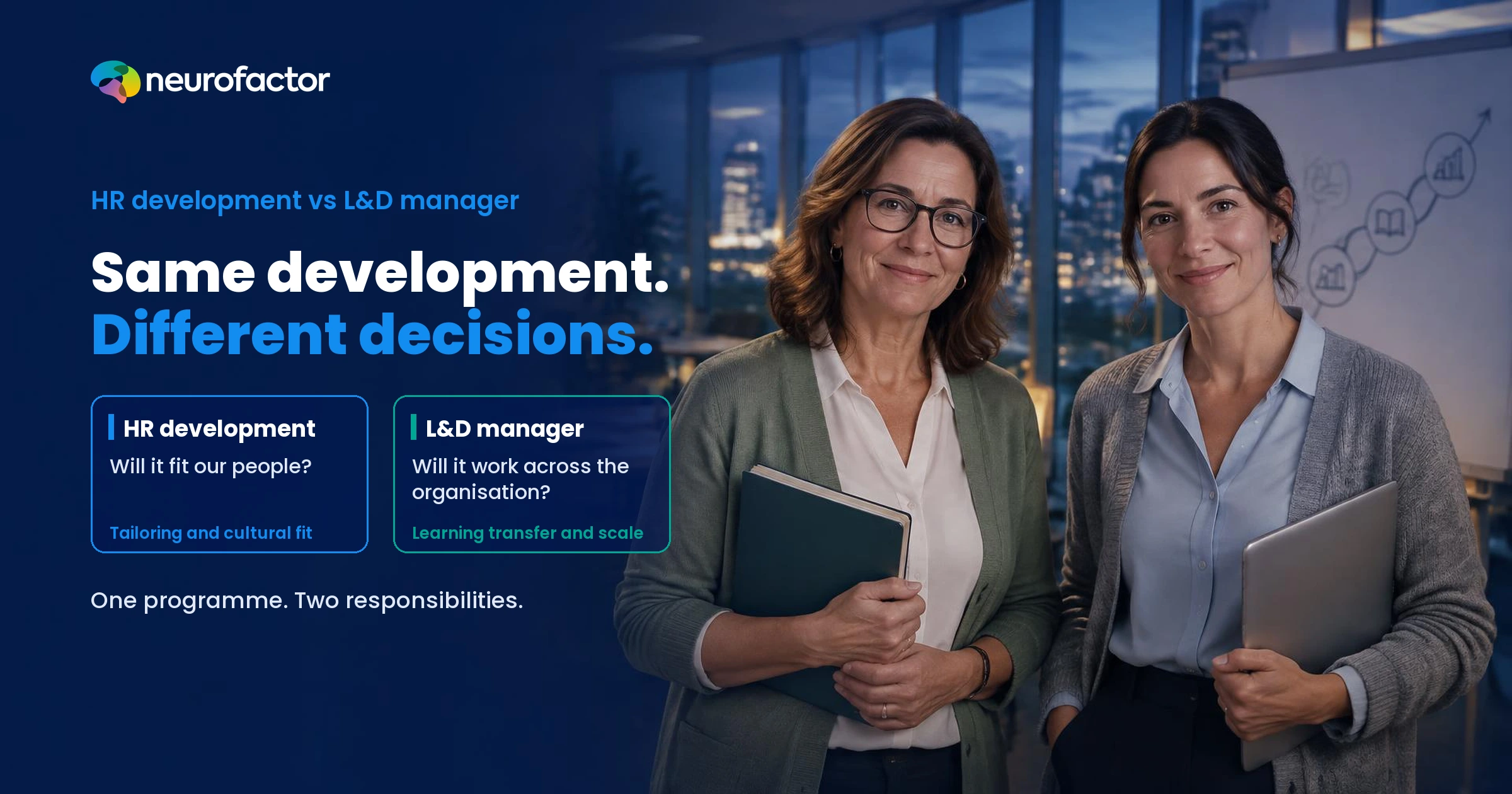
HR Development vs L&D: individual development or organisational change?
You present a leadership development programme to a company with several departments. The HR development specialist asks: will this facilitator work with our teams, and is training even the right answer? The L&D manager looks at the same proposal and asks how it fits the learning portfolio, how transfer will be measured and what it will cost per participant.
One buyer needs to protect trust and relevance in a specific team. The other must avoid rolling out an unused programme whose benefits cannot be demonstrated. The offer may be identical, but the evidence and approval route should not be.
One programme. Two very different conversations.
A provider offers leadership training with feedback practice, coaching and digital workplace assignments. An HR development specialist sees a specific team struggling with collaboration. The L&D manager sees a topic recurring across departments and wonders whether it could become a coherent learning pathway.
Neither buyer necessarily rejects the offer. Their first questions simply concern different failures. HR development cannot afford an intervention that undermines trust in the line. L&D cannot afford another poorly used programme that delivers no clear workplace result.
What do the original Neurofactor audience cards say?
This comparison uses the forty fixed attributes in the source workbook’s L&D and organisational development tab. The fears, objections, evidence and contact routes below are explicit fields, not inferences from BIS, BAS or k.
| Dimension | HR development (HDV) | L&D manager (LDM) |
|---|---|---|
| Responsibility | Supports line managers and teams; budget usually sits with the line | Owns learning portfolio, infrastructure and training budget |
| Main pain | The line asks too late for a quick answer to a complex problem | Courses are completed, but their effect at work remains unclear |
| Biggest fear | An intervention fails to land and trust from the line is lost | Buying an unused programme and having to defend it to leadership |
| First objections | Is it tailored? Will the facilitator fit? I have no budget. | Portfolio fit? Effectiveness? Scalable? Cost per learner? |
| Expected evidence | Manager and adviser references; strong intake; credible facilitator | Transfer and impact cases; L&D references; platform compatibility |
| Preferred route | Peer adviser or manager recommendation, then intake | L&D peer or professional event, then meeting and pilot |
| BIS / BAS / k | 5 / 6 / 0.25 | 6 / 6 / 0.20 |
Both support development. They are accountable for different outcomes.
HR development often begins with a concrete line-management challenge: tension within a team, poor cooperation or leadership behaviour that does not suit the people involved. In the source card, this specialist typically has no independent budget. The line therefore needs to recognise the problem and sponsor the chosen approach.
An L&D manager must oversee learning across departments, providers and platforms. A satisfied local manager or a well-reviewed workshop is not enough. The programme must make sense within the learning strategy, reach the intended users and demonstrate that something changes beyond attendance.
HR development: will this work for these people and this culture?
The card identifies a recurring frustration: line managers seek help late and want a quick training solution to a complex issue that may have other causes. Standard courses, isolated team days and coaches who failed to understand the culture have not always helped. This buyer must establish what the real problem is before selecting an intervention.
The provider should ask detailed workplace questions, clarify stakeholder roles and introduce the actual facilitator. What works for one team can feel superficial or inappropriate to another. Tailoring is not simply a premium feature here; it is part of the case that the intervention will actually land.
L&D manager: does it fit our offer and can we prove impact?
The source describes training that is completed while workplace impact remains unclear. Learning platforms can see little adoption, and portfolios may have grown through scattered departmental requests rather than strategic choices. The professional frustration is having to defend the value of learning again and again.
A stronger offer specifies job-relevant learning goals, integration with existing systems, manager involvement, workplace practice and a credible evaluation design. Explain how learners will be reached, what will be reused at scale and which elements remain adaptable for different teams.
A convincing intake is not the same evidence as an impact evaluation
For HR development, the first conversation is itself a source of trust. The provider should demonstrate curiosity about the issue behind the training request, facilitator competence and an understanding of line-management responsibilities. A reference from a comparable manager can be more persuasive than a generic training brochure.
For L&D, the evidence must go further. What workplace outcome was targeted, how was behaviour followed, how did the intervention fit the learning system and what can the results actually support? A good intake is necessary in many cases, but it does not establish learning transfer or scalability on its own.
The BAS score is identical. The decision is not.
Both profiles have BAS 6. That does not make the buying context interchangeable. BIS and BAS are separate descriptive scales from 0 to 10, while k is a separate time-preference parameter.
| Source parameter | HR development | L&D manager |
|---|---|---|
| BIS | 5 - avoids an intervention that does not fit | 6 - avoids an unused learning offer |
| BAS | 6 - seeks opportunities to help the line | 6 - seeks opportunities for more effective learning |
| k | 0.25 - follows the pace of the line | 0.20 - works across learning years and programmes |
k is not a contract length, percentage or buying probability. Role-specific concerns and proof requirements come from the qualitative source fields, not from the figures alone.
Time horizon: the line-management question is often more immediate
HR development may be asked to step into a current team problem when managers already want a quick fix. The source profile records k 0.25. L&D often operates within annual plans, programme budgets and infrastructure decisions; its card records k 0.20. These patterns suggest different ways of framing the first useful step.
They do not predict which buyer will sign sooner. HR development may be unable to proceed without the line manager’s budget; L&D may be able to launch a pilot under an existing supplier agreement. Offer a diagnosis and stakeholder discussion for the former, or a bounded learning pilot with an evaluation plan for the latter.
Fictional case: one leadership programme, two approval routes
Imagine a twelve-week programme on difficult conversations and collaboration: an intake, practice sessions, workplace assignments and follow-up with managers. This is an illustrative scenario, not a measured Neurofactor case.
HR development route. One team has recurring problems with feedback. The supplier meets the team leader and adviser, tests whether training is the right intervention and lets them meet the coach. Progress depends on line-management trust, sponsorship and budget.
L&D route. Several departments need better feedback skills. The supplier specifies learning goals, LMS integration, opportunities to apply skills, transfer observations, scalability and cost per learner. Approval depends on a defensible pilot and credible reporting to leadership.
Change the pitch, demonstration, proposal and next step
You do not necessarily need to create two products. You do need to show evidence in the order that matches the buyer’s responsibility.
- Opening: a recognisable team problem for HR development; the gap between course attendance and workplace application for L&D.
- Demonstration: needs assessment and meeting the facilitator for HR development; the learning pathway, platform fit and measurement approach for L&D.
- Proposal: scope, cultural context and line involvement for HR development; learning objectives, repeatability, impact evaluation and per-learner cost for L&D.
- Follow-up: include the budget-owning line manager for HR development; discuss a pilot and reporting with the learning or HR leadership team for L&D.
Clearly separate demonstrated results from expected outcomes that still need to be tested.
Two opening questions for the same offer
To HR development: “Where does this team get stuck in everyday work, and how do we know that training is the right answer? I would first want to speak with the manager and the person facilitating the sessions.”
To L&D: “You are already investing in leadership development. How do we make visible which behaviours change afterwards and whether this can fit your existing learning environment at scale?”
Both openings reflect the source profiles. The first invites diagnosis and local ownership; the second invites evidence of application and responsible implementation.
LinkedIn can reach both. Trust follows different routes.
The HR development card describes regular LinkedIn use, professional reading, podcasts and peer reflection. Its preferred route to a provider is a recommendation from a fellow adviser or line manager, followed by an intake. Content showing how to distinguish a training need from a broader team issue is therefore more useful than general claims about learning.
The L&D manager uses LinkedIn daily, alongside learning communities, podcasts and specialist media. The card names peer L&D recommendations and professional events followed by a meeting and pilot. Content about learning transfer, platform adoption and measurement can prepare that substantive discussion.
Five questions before adapting a development proposal
- Is this a problem in one team or a recurring learning goal across departments?
- Who owns the budget and who must make the intervention work in practice?
- What failed before: a standard intervention without cultural fit, or an unused learning platform?
- What supports approval: facilitator references, a convincing intake, transfer evidence, adoption data or a combination?
- How will the organisation decide whether training is actually the right response and what will happen if the diagnosis says otherwise?
The answers can differ from a broad role profile. A good discovery conversation should be part of your evidence, not just the first stage in an automated sales funnel.
Where HR development and L&D overlap
Both roles support employee growth and want development to matter in real work. Both have BAS 6 in the source cards and use professional networks and references. L&D may require deeply tailored interventions; HR development may measure effects or work on programmes used across several teams.
The distinction is not between a people-focused and a commercially minded personality. It is between responsibilities within an organisation. In smaller organisations, one person may carry both, which means the offer needs to be locally relevant and organisationally defensible.
What these Neurofactor role profiles do and do not establish
Neurofactor’s broad role profiles reflect recurring patterns from years of research with these and comparable professional audiences. They provide a research-grounded starting point, not measurements of a particular organisation, population averages for every role holder, a diagnosis or a prediction of who will buy.
The concerns, objections, preferred channels and evidence needs are separately documented in the original cards; they were not calculated from BIS, BAS or k. Industry, company size, proposition, price and decision situation can change what matters most. Use an audience profile and association map to investigate a specific offer.
Want to know how HR development and L&D managers view your training, coaching or programme? Contact Neurofactor and have the broad profile translated into your proposition.
Investigate what development already means to this audience
“Development” is not automatically a positive association. In one organisation coaching may mean being trusted to grow. In another it may trigger memories of a mandatory workshop that achieved nothing, or concerns about being judged. Neither reaction can be determined from a job title.
An association map helps establish which expectations and reservations are attached to your specific offer. It may show that the most credible message concerns a safe team context, the expertise of a facilitator, applied skills or a practical rollout plan. That is why generic role profiles and offer-specific research complement each other.
Tailoring and scalability are not competing promises
HR development is not simply buying a personal coach. It needs a credible intervention that fits the line-management problem, people and culture. An L&D manager is not merely buying a larger programme either: learning must be used, its impact understood and its delivery manageable at scale.
Do not open with the same brochure for both roles. Start with the outcome each must justify and select evidence accordingly. Continue with the Learning & Development category overview and the L&D manager versus talent manager comparison.
Key terms
- HR development
- An HR adviser or development specialist working with managers and teams on development, collaboration and organisational change, often without a dedicated budget.
- L&D manager
- A manager responsible for the learning portfolio, learning infrastructure, development budget and evidence of learning impact.
- Cultural fit
- How well an approach and facilitator align with the organisation’s practices, relationships, values and day-to-day realities.
- Tailored intervention
- A development intervention designed around the diagnosed needs of the participants, commissioning manager and working environment.
- Discovery or intake
- A structured exploration of the actual problem, the intended outcome and the people who need to support the intervention.
- Learning transfer
- Application of newly acquired skills or knowledge in real work after the learning activity.
- Learning infrastructure
- The connected platforms, processes, learning pathways and support used to deliver development.
- Impact measurement
- An assessment of what changed after an intervention, with clear methods and limitations.
- BIS and BAS
- Two separate descriptive dimensions covering sensitivity to adverse outcomes and orientation towards opportunities, each scored 0 to 10 in these profiles.
- Delay-discount rate (k)
- A distinct parameter describing time preference, not a conversion rate, purchase likelihood or expected sales-cycle duration.
- Audience profile and association map
- Complementary Neurofactor research tools that refine broad role patterns for a particular proposition, audience and decision context.
Frequently asked questions
What is the difference between HR development and an L&D manager?
HR development helps line managers and teams address specific development and collaboration needs. An L&D manager owns the learning offer and evaluates use, transfer, integration, impact and scalability.
When is a tailored intervention preferable to scalable learning?
Start with the problem. Complex team or cultural issues call for diagnosis, stakeholder involvement and appropriate facilitation. Recurring learning needs across departments require a repeatable offer, infrastructure fit and credible impact evidence.
What proof does HR development expect?
The source profile calls for references from managers and HR advisers, a proper intake and a facilitator who inspires confidence. The line manager’s involvement and budget responsibilities also matter.
What evidence matters to an L&D manager?
The source card specifies transfer and impact case studies, peer L&D references and compatibility with established platforms, alongside reach, scalability and cost per learner.
How do the BIS, BAS and k figures differ?
HR development is BIS 5, BAS 6, k 0.25; L&D manager is BIS 6, BAS 6, k 0.20. These are broad role indicators, not individual test results, percentages, buying probabilities or forecasts of signing time.
How should B2B sales and LinkedIn content change?
For HR development, begin with the line manager’s actual problem, intake and facilitator fit. For L&D, begin with learning transfer, adoption and verifiable impact. Validate the specific proposition through an audience profile and association map.
Sources
- 1.>5 years of Neurofactor target group research - Neurofactor
- 2.Carver & White (1994), Behavioral Inhibition, Behavioral Activation, and Affective Responses to Impending Reward and Punishment - Journal of Personality and Social Psychology (1994)
- 3.Frederick, Loewenstein & O'Donoghue (2002), Time Discounting and Time Preference: A Critical Review - Journal of Economic Literature (2002)
This series
Who are you really selling to?Category synthesis
You sell development. But what does development mean to the buyer?Read next
Related topics
Reviewed by: Martijn den Otter · Last reviewed: 10/11/2026
Martijn den Otter
Oprichter van Neurofactor. Expert in neuromarketing en consumentenpsychologie.
LinkedIn →