
Premium positioning: which associations justify a higher price?
A higher price can make a product appear more prestigious without necessarily making it more valuable to a buyer. In an experimental study, higher prices increased perceived quality while lowering perceived value and willingness to buy [S1]. Credible premium positioning therefore requires more than an elegant visual identity. Investigate which brand meanings matter to specific customers, what evidence supports them and whether those meanings change real choices. Craftsmanship, confidence, identity and scarcity can all play a role, but none automatically earns a premium. What matters is demonstrable additional value, not a luxury claim repeated by the brand.
A higher price is not a reason to pay more
A brand manager slides a new price list across the table. The premium edition will cost more, its packaging will become quieter and the photography more refined. Everyone can see that the brand wants to move upmarket. Yet nobody can answer a simple question: what does the buyer actually gain? That is the weakness of many premium strategies. They begin with a price and search for a story afterwards. Reverse the sequence. Investigate which outcomes customers value, which associations make the difference meaningful and what evidence makes the promise credible. A higher price can imply quality while simultaneously reducing perceived value and willingness to buy [S1]. A price tag is a signal, not a certificate of quality.
The same product image triggers two different comparisons
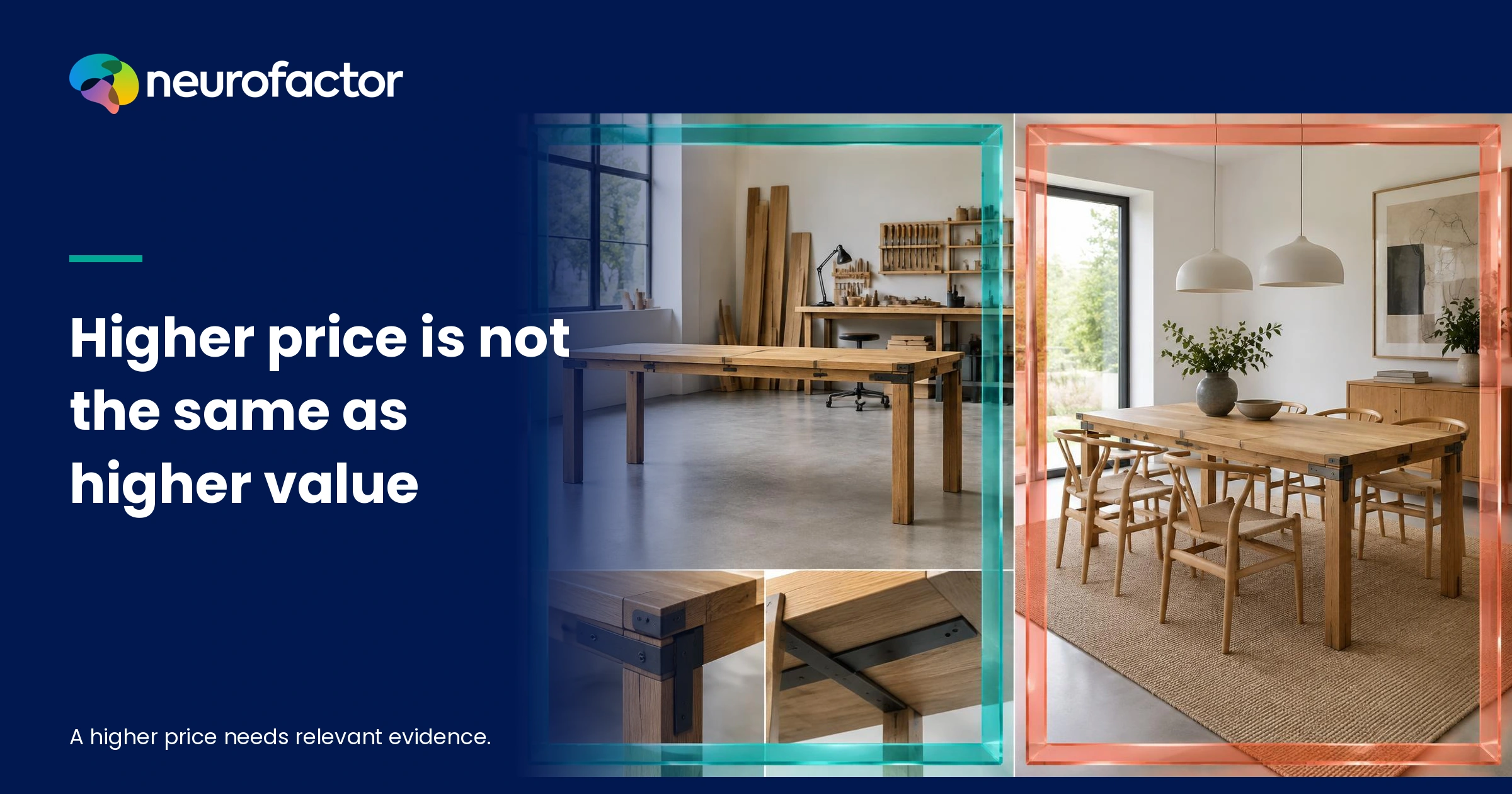
Picture a dining table with a restrained silhouette, neatly finished edges and a price above the mid-market. One visitor compares it with inexpensive furniture that becomes unstable after several moves. Premium means longevity, confidence and the possibility of repairs. Another compares exactly the same table with striking designer pieces seen in friends' homes. Premium means taste, recognition and an interior that expresses an identity. Both may love the product and still abandon the purchase for different reasons. The first cannot find details about construction or service. The second cannot see how the design belongs in a distinctive room. Writing 'superior quality' on the page answers neither question. Meaning is always relative to the comparison in mind.
What exactly is a premium association?
A premium association is a meaning linked to a brand or product that might make a higher price acceptable in a particular decision. Examples include 'will last for years', 'fits who I am', 'made with care' and 'takes a difficult task off my shoulders'. These are not universal psychological buttons. Their importance depends on personal needs, knowledge, competing options, available money and social setting. Crucially, an association is not yet an established purchase driver. Moving from meaning to price strategy requires evidence that customers actually recognise the association and that it contributes to preference or willingness to pay. Without that second step, a brand has an interesting list of words but not a validated premium proposition.
Why an association network matters more than luxury vocabulary
A brand name can activate a network of meanings in memory. Craftsmanship can sit next to inconvenience, exclusivity next to arrogance, and innovation next to fragility. Keller's associative model of brand knowledge is a useful conceptual framework for understanding those connections [T1]. The research question is not simply whether a word feels positive. It is whether the meaning is accessible, distinctive and relevant when a genuine choice must be made. Almost every premium brand says 'quality'. An association such as 'my bike feels dependable on a long climb' is more specific. Also record the comparison target. A promise that distinguishes a brand from budget alternatives may not distinguish it from an established design specialist.
Four association clusters that support premium value differently
A higher price can rest on very different meanings. Functional reassurance requires a different form of evidence from social recognition or personal identity. The four clusters in the table are proposed diagnostic categories, not a validated taxonomy of every buyer. A person can use several in the same purchase, and their priorities may change with the situation. Use them to formulate hypotheses about promises, evidence and reasons for rejection. Then test whether the proposed association is truly relevant and makes any difference in choice behaviour. A cluster is not a personality label, nor does it authorise covert profiling or automatic price discrimination.
Functional reassurance
- Proposed additional value
- Long life and repairability
- Potential counter-association
- Fragile or unclear warranty
- Evidence to investigate
- Demonstration, service, explicit terms
Personal identity
- Proposed additional value
- Feels like a reflection of me
- Potential counter-association
- Generic or designed for others
- Evidence to investigate
- Material experience, customisation, language
Social recognition
- Proposed additional value
- A visible sign of taste or status
- Potential counter-association
- Showy or unapproachable
- Evidence to investigate
- Test brand visibility in a realistic context
Design connoisseurship
- Proposed additional value
- Distinctive details understood by insiders
- Potential counter-association
- Beautiful but impractical
- Evidence to investigate
- Design rationale, detail and use tests
A higher price can help and hurt at the same time
In a classic experiment, Dodds, Monroe and Grewal found that price positively influenced perceived quality but negatively affected perceived value and willingness to buy [S1]. There is no contradiction. A customer can believe a product is probably good and still decide that the extra cost is not justified. Premium positioning cannot therefore be built around a quality impression alone. The buyer also weighs sacrifices, uncertainty and available alternatives. High-end visual styling may draw attention and elevate expectations without providing additional benefits. Keep four outcomes separate when evaluating a premium strategy: quality perception, overall value, price fairness and actual choice. They may move in different directions.
Prior knowledge changes which signals people trust
A novice may use a familiar name or high price as a quick clue. An experienced buyer may inspect joinery, material grades or other intrinsic attributes. Rao and Monroe experimentally studied how familiarity affects the use of price and product cues [S2]. Their results depend on the particular task and cannot be reduced to 'experts ignore prices'. They do, however, raise a practical question: are you giving experienced and inexperienced buyers evidence they can interpret? A detailed engineering video may reassure an expert while confusing a newcomer. The newcomer might benefit more from an intelligible demonstration and a clear service promise. Test both explanations rather than assuming identical purchase criteria.
Evidence must match the value being promised
If the premium pays for longevity, buyers need evidence about durability, maintenance and repair. If it pays for self-expression, material character, form and distinctive design context may matter more. The commercial opportunity lies in linking a relevant association to a credible proof asset, not repeating one blanket claim. For every audience, specify which meaning is expected to justify the difference and which doubt could undermine it. Verify that the proof actually exists: technical specifications, clear service terms, demonstrations or transparent manufacturing information. A beautifully filmed workshop does not establish superior product performance on its own. A premium promise that fails under scrutiny can damage both trust and willingness to pay.
Visible status is not the only language of premium
Some buyers want others to recognise the product immediately. Others prefer cues that only insiders appreciate. Han, Nunes and Drèze examined the relationship between luxury-brand prominence and status motives [S3]. Berger and Ward demonstrated in four studies why consumers with domain-specific cultural capital can prefer subtle signs [S4]. These findings concern particular products and social situations. They do not show that every wealthy consumer wants quiet design or that visible branding is universally inferior. For a brand manager, the important implication is that a prominent logo can strengthen the desired association for one audience and weaken it for another. Ask what recognition is supposed to accomplish before making the logo bigger.
One price, four different purchase questions
A coherent premium brand does not need four incompatible identities, but its customers may ask very different questions. A practical purchaser wants evidence of usefulness and reliability. A design-focused buyer wants a coherent aesthetic. A status-oriented buyer may seek visible social recognition. A connoisseur may care about details most outsiders will not notice. These are hypotheses for research, not diagnoses of individuals. People also change their questions across situations: the same person may want quiet quality at home and a more legible symbol when buying a gift. The table translates these different questions into suitable evidence, so marketing and sales can begin with the buyer's decision rather than a generic luxury script.
Will it last?
- Possible core association
- Reliable and solid
- Useful proof to lead with
- Construction and repair evidence
- What may miss the point
- Exclusive photography alone
Does it fit my taste?
- Possible core association
- Distinctive and refined
- Useful proof to lead with
- Samples and design context
- What may miss the point
- Generic premium claim
Will others recognise it?
- Possible core association
- Recognisable and social
- Useful proof to lead with
- Context and genuinely visible cues
- What may miss the point
- Invisible technical specifications
Will insiders recognise quality?
- Possible core association
- Subtle distinction
- Useful proof to lead with
- Verifiable design decisions
- What may miss the point
- Making the logo bigger
Beautiful design can suggest luxury without better performance
In three studies, Hagtvedt and Patrick found that visual art can influence luxury perceptions when incorporated into products and communications [S5]. Reimann and colleagues also studied how aesthetic package design affects choices and neural responses under their experimental conditions [S6]. These studies demonstrate possibilities, not a guarantee that adding art or minimalist packaging will support a higher price. Design can also conflict with usability. An elegant box that is frustrating to open may destroy the expectation it created. Premium should be evaluated both before purchase and after real use. Aesthetic value is a potential benefit in its own right, but it must not be confused with independently demonstrated functional superiority.
Perceived value is not a single dimension
Sweeney and Soutar developed a multidimensional measure of consumer-perceived value [S7]. Their primary scale-development research is useful because a single value score can conceal quite different motivations. For a premium brand, value may be functional, emotional or social, alongside the judgement of whether the money is well spent. Ask about these separately. Does ownership reduce uncertainty? Does use bring pleasure? Does it communicate something to others? Does the price still feel fair once alternatives are visible? A high average score may conceal a decisive missing element. Identifying that missing element is more actionable than repeating that customers generally appreciate premium design.
Authenticity cannot simply be purchased with a story
If a premium claim rests on origin, craftsmanship or ethical production, the underlying facts need to be checked. Beverland examined how luxury wine firms crafted impressions of authenticity through production practices and communication [S8]. This qualitative study illuminates branding strategies; it does not produce a universal formula for price premiums. A credible craft narrative may be meaningful in one market and irrelevant in another. Begin with real materials, processes, suppliers and services. Do not invent an artisanal origin or stage small-scale production that does not exist. The story needs to remain true when customers visit the workshop, examine the product or contact service years after buying.
Newer experiments question the automatic authenticity premium
Kokkoris and Kamleitner compared authentic, inauthentic and neutral brand presentations in three experiments [S9]. Authentic brands generated more favourable responses than inauthentic brands, yet did not outperform a neutral baseline on the measured outcomes. That is a strong caution against telling management that 'authenticity' itself reliably creates a premium people will pay. In some contexts authenticity may be the expected minimum, with perceived inauthenticity punished. The finding does not mean being authentic is unimportant. It means marketers must establish whether authenticity is genuinely differentiating or simply necessary to stay in the consideration set. Never turn a specific experimental result into a universal commercial promise.
From premium claim to verifiable proof
Craftsmanship, exclusivity, convenience and identity all sound persuasive in a positioning meeting. Each requires a different kind of evidence and has a different potential counter-association. The table maps these promises to plausible proof, what could make them collapse and how to test them. Every claim also needs legal and factual review. A 'lifetime' quality statement requires clear definitions and terms. A 'limited edition' requires genuinely constrained availability. A claim about identity cannot be proven by listing technical tolerances. And a positive association still does not prove additional willingness to pay. Use the table as a checklist for hypotheses, not as a claim that any one proof asset guarantees conversion.
Craftsmanship
- Verifiable claim
- Real joints, materials and process
- Potential counter-association
- Staged artisanal theatre
- Suitable test
- Document check and product evaluation
Exclusivity
- Verifiable claim
- Actual limited capacity or access
- Potential counter-association
- Manufactured scarcity
- Suitable test
- Inventory audit and randomised claims
Convenience
- Verifiable claim
- Actual service and repair options
- Potential counter-association
- Hidden costs
- Suitable test
- Terms review and realistic service scenario
Identity
- Verifiable claim
- Recognisable design and personal fit
- Potential counter-association
- Not for someone like me
- Suitable test
- Spontaneous association and choice task
Image
Entirely fictional case: Atelier Verdan launches a dining table
Atelier Verdan is an invented company making modular wooden dining tables. Every person, conversation, quotation and decision in this case is fictional and does not represent Neurofactor data or the results of a client study. The new table is priced above common mid-range alternatives. The team says the finish is refined and components can be replaced, but wants to lead with the phrase 'premium design'. Two imaginary customers react differently to that message. One is choosing furniture for a family whose needs will change. The other wants a distinctive object in a carefully designed home. The same physical table does not automatically represent the same value proposition to both.
Fictional buyer Emma needs confidence through repeated moves
In this fictional scenario, Emma has owned tables that became unstable when dismantled and moved. Her preferred associations are solid, repairable and straightforward to rebuild. Her main negative association is fragile. Atmospheric studio photography does little for her. She wants to inspect the joining mechanism, know whether spare parts can be ordered and understand the warranty. When a salesperson focuses on exclusivity, Emma begins to worry about hard-to-replace components. This is a proposed qualitative hypothesis, not a measured persona. The price may become reasonable to her only when the long-term functional benefit is demonstrated. Otherwise a less expensive competitor may be a rational choice.
Fictional buyer Julian wants a design that fits his identity
Julian values an understated shape, a considered material selection and details recognised by people who appreciate design. He does not want a huge logo carved into the tabletop. His concern is different: will the object still feel distinctive in five years, or is its appeal just a passing trend? A convincing design rationale, physical material samples and personal finishing options may help him more than an inventory of screws and bolts. Again, this is a fictional hypothesis, not evidence that every design enthusiast will pay more. A credible choice test would have to establish whether the meaning actually supports the premium for this buyer group.
Image
Two routes to premium, one credible brand
Atelier Verdan does not have to create two brands. It can start with a single verifiable product truth: a modular table whose construction, material and maintenance options all support its design intent. Communication can then lead with different evidence. For Emma, durability and service are the starting point. For Julian, the story begins with design decisions and material experience. The risk is that these become merely interchangeable visual campaigns. If the underlying product does not support both promises, the position will not survive use. This case illustrates how association research can guide content and sales hypotheses; it does not establish a psychological law or demonstrate a conversion uplift.
Scarcity and value are not synonyms
Limited availability may suggest exclusivity, but scarcity can also signal popularity rather than craftsmanship. Van Herpen, Pieters and Zeelenberg demonstrated experimentally how signs of previous demand can affect product preference [S10]. That mechanism differs from superior durability or an original design. Artificial stock alerts can also create an association with manipulation. Establish whether scarcity is real, material to the choice and interpreted positively by the target group. A small workshop might genuinely have limited capacity. A fabricated countdown timer does not make the product more valuable. Scarcity claims must be demonstrable, and their effect should be tested instead of assumed.
Price information can influence experienced enjoyment
Plassmann and colleagues studied twenty participants tasting wines labelled with different prices during fMRI [S11]. Higher displayed prices were associated with greater reported pleasantness and activity in a brain region implicated in experienced value. The experiment was small and specific to wine tasting. It does not provide an EEG formula for luxury pricing or prove customers will repeatedly buy a product. Shiv, Carmon and Ariely similarly investigated expectancy effects of price information in experiments involving an energy drink and mental tasks [S12]. Together, the studies suggest that price expectations can shape experience in some settings. They do not show that raising every price improves every product.
EEG, attention and association measures address different questions
With a suitable design, Neurofactor could combine explicit judgements, association measures, attention tracking and physiological signals. But those measures are not interchangeable. EEG captures time-varying electrical activity under particular conditions; it cannot directly reveal that a brand is 'premium'. Eye tracking reveals where a participant looks, not the monetary value they assign to what they see. Reaction times can inform carefully defined association hypotheses, not directly forecast individual purchases. Pair methods with realistic choice tasks, direct experience and a credible benchmark. Select each instrument because it helps answer a specific question, and state its limitations before any conclusions are presented to the client.
Start by identifying negative associations
Premium research often begins with desired words: exclusive, elegant, exceptional. That is a good way to overlook the meanings that cause rejection: delicate, impractical, pretentious, difficult to repair or overpriced for what it delivers. Begin with spontaneous associations before prompting participants with your preferred terminology. Ask for concrete memories and situations. When did something feel reliable? What would contradict that impression? Which alternative forms the buyer's reference point? A statement such as 'excellent finish' becomes useful only when the team understands why it matters in a choice. Record disagreement as well as consensus. Averages can hide segments with mutually incompatible definitions of premium value.
Four research designs for understanding a premium
Open association tasks generate candidate meanings but cannot establish a price premium. Standardised association measures may compare structured conditions but require reliable administration and cautious interpretation. Randomised price and evidence experiments can test causal questions about specific cues. Realistic choice tasks come closer to behaviour yet depend on incentives, alternatives and setting. The table explains how to match designs to decisions and limits. Serious research sometimes combines several methods rather than claiming one method is sufficient. A single brain signal, focus group or satisfaction score cannot determine an optimal premium price across a market.
Open associations
- What it can tell you
- Unaided meanings and doubts
- What it cannot prove alone
- Willingness to pay a premium
- Relevant outcome
- Coded themes and differences
Standardised association task
- What it can tell you
- Conditional associative availability
- What it cannot prove alone
- Individual buying certainty
- Relevant outcome
- Latency, validity and reliability
Randomised price-and-proof test
- What it can tell you
- Effects of specified cues in the experiment
- What it cannot prove alone
- Universally optimal pricing
- Relevant outcome
- Quality, value and choices by condition
Realistic choice or field test
- What it can tell you
- Behaviour with alternatives and price
- What it cannot prove alone
- All future market settings
- Relevant outcome
- Choice share and uncertainty intervals
Measure willingness to pay separately from admiration
The sentence 'this looks expensive' is not a financial commitment. Ask separately about perceived quality, value, price fairness, preference and willingness to pay. Where feasible, use realistic or incentive-compatible comparisons with the option of not buying. Manipulate price, brand and proof separately so that the most expensive option is not also the best photographed and most fully featured. Pre-register the commercial decision criterion and report uncertainty. If a participant values the product but cannot afford it, that does not automatically mean the brand has failed. If a participant praises the design but never chooses it, applause must not be reported as incremental revenue.
Explain the price on the product page without being defensive
A premium product page does not have to open with an argument about why the brand is expensive. It can answer the actual purchase question. Show construction to people concerned about durability, material in natural light to design-oriented buyers, and transparent service terms to those avoiding future hassle. Do not bury every meaningful answer under poetic brand copy. Verify images, certifications, production quantities and performance claims. Observe whether visitors find the proof before leaving, and study the questions raised in customer service or returns. The final experience should match validated associations, not simply the aesthetic preferences of the creative director.
Teach sales to investigate the comparison behind 'too expensive'
When a prospect says that an offer is expensive, many salespeople immediately repeat the feature list. A more useful response is to explore the comparison behind the judgement. Expensive relative to what, for which use, and over what expected lifetime? Ask open questions and then present proof relevant to the answer. This is not a technique for hiding shortcomings or pressuring customers. A discount may sometimes be appropriate, but it cannot repair an unclear value proposition by itself. Document recurring objections so marketing, service and product teams can learn. A collection of sales notes generates hypotheses; it is not a representative market survey.
Premium also requires admitting what you do not offer
Not every buyer needs the additional value you promise. Someone furnishing a short-term rental may quite rationally select a cheaper table. A credible premium brand can acknowledge where its offer is not the best fit. Do not imply that budget-conscious buyers have less taste, status or intelligence. Keep functional quality, subjective meaning and social symbolism separate. Avoid exaggerating scarcity, craft or environmental performance. Local rules governing promotional prices and comparative claims must also be respected. A robust premium strategy can tolerate an informed 'no'. The objective is not to make everyone pay more, but to demonstrate relevance to buyers for whom the difference genuinely matters.
Test meaning throughout the customer journey
An association expressed in an interview may not carry weight at checkout. Investigate expectations before discovery, observe which evidence people examine during product exploration, and test how the price changes comparison behaviour. After use, examine whether the experience still supports the brand's story. An impressive unboxing followed by frustrating assembly, for example, may overturn an earlier quality assumption. Association diagnosis should connect touchpoints instead of treating the first impression as the whole decision. The question is not how to add more content, but what proof reduces uncertainty at the exact moment a buyer needs it.
Privacy and research ethics are part of the strategy
Do not collect unnecessary personal data for premium segmentation. Understanding a person's information need is more defensible than secretly inferring status anxiety or financial vulnerability. Participants in explicit or implicit research should know what is recorded, how long it will be kept and who can access results. Individual neurological or psychological measures should never be given to a salesperson as a supposed purchasing instruction. Report aggregated patterns with suitable safeguards and an appropriate legal basis. Distinguish exploration from proof and disclose uncertainty. The ethical difference between research and manipulation depends not only on instruments but on transparency and application.
Research protocol step 1 - Define the pricing decision
Specify what management actually needs to choose: a price tier, product bundle, design, claim or audience-specific proof. Record which associations are expected to support the premium and which might undermine it. Separate perceived quality, perceived value, stated intentions and actual choice. Define the competitive alternatives and the usage context. Where possible, agree in advance on the size of a commercially meaningful effect. This is a proposed protocol, not an experiment that has already been conducted. Without a decision question, research easily becomes an attractive map of adjectives that nobody knows how to use.
Research protocol step 2 - Recruit relevant decision-makers
Recruit people who could realistically consider the purchase. Include meaningful variation in prior product knowledge, use case and buying role. Define eligibility and segments before fieldwork rather than inventing premium personalities after observing the results. Estimate a sample size appropriate for the main contrast, using power analysis when warranted. If the study is exploratory, say so openly. Randomise exposure order and check language and cultural equivalence across NL, EN and DE. Avoid unnecessary sensitive personal information. Establish consent, recruitment and retention rules before participants are approached.
Research protocol step 3 - Establish baseline associations
Before showing new claims, record spontaneous meanings associated with the category, competitors and known brands. Supplement free associations with carefully phrased scales or a pretested reaction-time task where relevant. Record brand familiarity and prior ownership. Keep reliability, aesthetics, status, repairability and sustainability conceptually separate. Do not make price the first prompt if price priming would distort the baseline. Establish coding rules before analysing open responses and check agreement between coders. Present anonymised examples in the report, but do not confuse association strength with the amount someone is willing to pay.
Research protocol step 4 - Experiment with price and proof
Design controlled variation in price, type of evidence and, when appropriate, brand attribution. Use credible price differences. Do not let the expensive version simultaneously gain better photos, more features and a limited-edition badge, unless that bundle is explicitly the question. Randomly allocate conditions or use a properly balanced repeated-measures design with order controls. Record quality perception, perceived value, proof comprehension and choice. If EEG or eye tracking is included, specify separate hypotheses and signal-quality criteria. Avoid deceptive public price statements, and review the legal and ethical framework before any field intervention.
Research protocol step 5 - Observe choices and follow-up
Do not stop after asking whether participants like the concept. Present a credible trade-off among alternatives, ideally including the opportunity to choose none. Record choice, price difference and the explanation where appropriate. For products used over time, consider a later assessment of whether experience validates the premium promise. Track attrition and potential selection bias. Clearly distinguish hypothetical willingness to pay from a choice with real financial consequences. A small study in one product category or country does not establish universal premium effects, no matter how visually impressive the dashboard appears.
Research protocol step 6 - Analyse evidence and decide
Compare pre-specified outcomes by condition and relevant segment. Report effect sizes and uncertainty, not simply an attractive percentage. Determine whether greater perceived quality actually accompanies greater value and choice, or whether price resistance rises instead. Label exploratory patterns clearly and address the risk of multiple comparisons. Use qualitative accounts to explain possible mechanisms, without treating them as causal estimates. End with decisions: which claim to retain, what proof to add, what price to test and which promise to abandon. Repeat testing where the commercial stakes are high and uncertainty remains substantial.
Turn the association map into a provable premium proposition
A useful association map describes meanings people actually bring to the brand. The next step is turning those meanings into a precise offer backed by evidence. A brand manager might remove the word 'exclusive' and make ease of repair the lead benefit because that addresses the decisive concern. Another audience may need the design story to be more visible. Marketing, sales, customer service and product development must agree on what the brand can deliver. Premium is the alignment of meaning, product, proof and price. It is not a decorative layer over an unchanged offer or a reason to assume every customer will pay more.
Five questions to ask your premium team tomorrow
Which precise association is supposed to justify the extra cost? For whom is that meaning relevant? What objective evidence supports the claim? What negative association might reverse the intended effect? And do those same customers actually select the higher-priced option when a credible alternative is available? If the answers are opinions, identify the smallest responsible test that could resolve the uncertainty. Replace 'how do we make this look more luxurious?' with 'what additional value is demonstrably meaningful to this buyer?'. That question makes conversations about design, content, pricing and sales much more productive.
A premium price must survive a genuine choice
Strong premium positioning is not achieved when everyone describes a brand as luxurious. It is achieved when a relevant buyer recognises additional value, can verify the promise and chooses it over a credible alternative at a higher price. Price information can influence expectations, but it cannot sustainably replace product truth. Craftsmanship, identity, convenience and scarcity are possible routes, not guaranteed recipes. Look beyond attractive words to the moment a person would actually spend money. That is where the meaning of a premium position meets its commercial limit.
Key terms
- Premium positioning
- A market position built around additional value that relevant customers consider sufficiently distinctive and credible to justify a higher price.
- Premium association
- A meaning linked to a brand that might justify paying more in a specific decision context.
- Perceived quality
- The buyer’s expectation or judgement of quality, distinct from independently measured performance.
- Perceived value
- A buyer’s assessment of benefits and sacrifices relative to credible alternatives.
- Willingness to pay
- The amount someone would sacrifice under specified conditions; hypothetical statements are not identical to real purchases.
- Counter-association
- An unfavourable meaning that can undermine the intended position, such as fragile alongside elegant.
Frequently asked questions
Does a higher price prove better quality?
No. Price can change quality expectations without demonstrating superior performance. It may even lower perceived value and willingness to purchase. [S1]
Which associations can support a premium price?
Examples include long-term reliability, craftsmanship, identity, convenience and social recognition. Their relevance depends on context and competitors. They are hypotheses until tested against actual choice.
Are exclusivity and scarcity the same thing?
No. Exclusivity is a meaning of distinction; scarcity concerns availability or its appearance. Scarcity can also signal popularity. Never invent stock shortages as evidence of value. [S10]
Can EEG show that buyers will pay more?
No. EEG records electrical activity under controlled circumstances, not an individual purchasing decision. Pricing claims require credible choice and price measures. [S11]
How do you test premium positioning?
Measure spontaneous and negative associations, manipulate price and proof separately, and observe realistic choices. Track quality judgement, value and willingness to pay as different outcomes.
Sources
- 1.Effects of Price, Brand, and Store Information on Buyers’ Product Evaluations
- 2.The Moderating Effect of Prior Knowledge on Cue Utilization in Product Evaluations
- 3.Signaling Status with Luxury Goods: The Role of Brand Prominence
- 4.Subtle Signals of Inconspicuous Consumption
- 5.Art Infusion: The Influence of Visual Art on the Perception and Evaluation of Consumer Products
- 6.Aesthetic Package Design: A Behavioral, Neural, and Psychological Investigation
- 7.Consumer Perceived Value: The Development of a Multiple Item Scale
- 8.Crafting Brand Authenticity: The Case of Luxury Wines
- 9.Is Authenticity Rewarded or Inauthenticity Penalized? Reconsidering the Value of Brand Authenticity
- 10.When Demand Accelerates Demand: Trailing the Bandwagon
- 11.Marketing Actions Can Modulate Neural Representations of Experienced Pleasantness
- 12.Placebo Effects of Marketing Actions: Consumers May Get What They Pay For
- 13.Measuring Perceptions of Brand Luxury
Read next
Reviewed by: Martijn den Otter · Last reviewed: 11/6/2026
Martijn den Otter
Oprichter van Neurofactor. Expert in neuromarketing en consumentenpsychologie.
LinkedIn →