
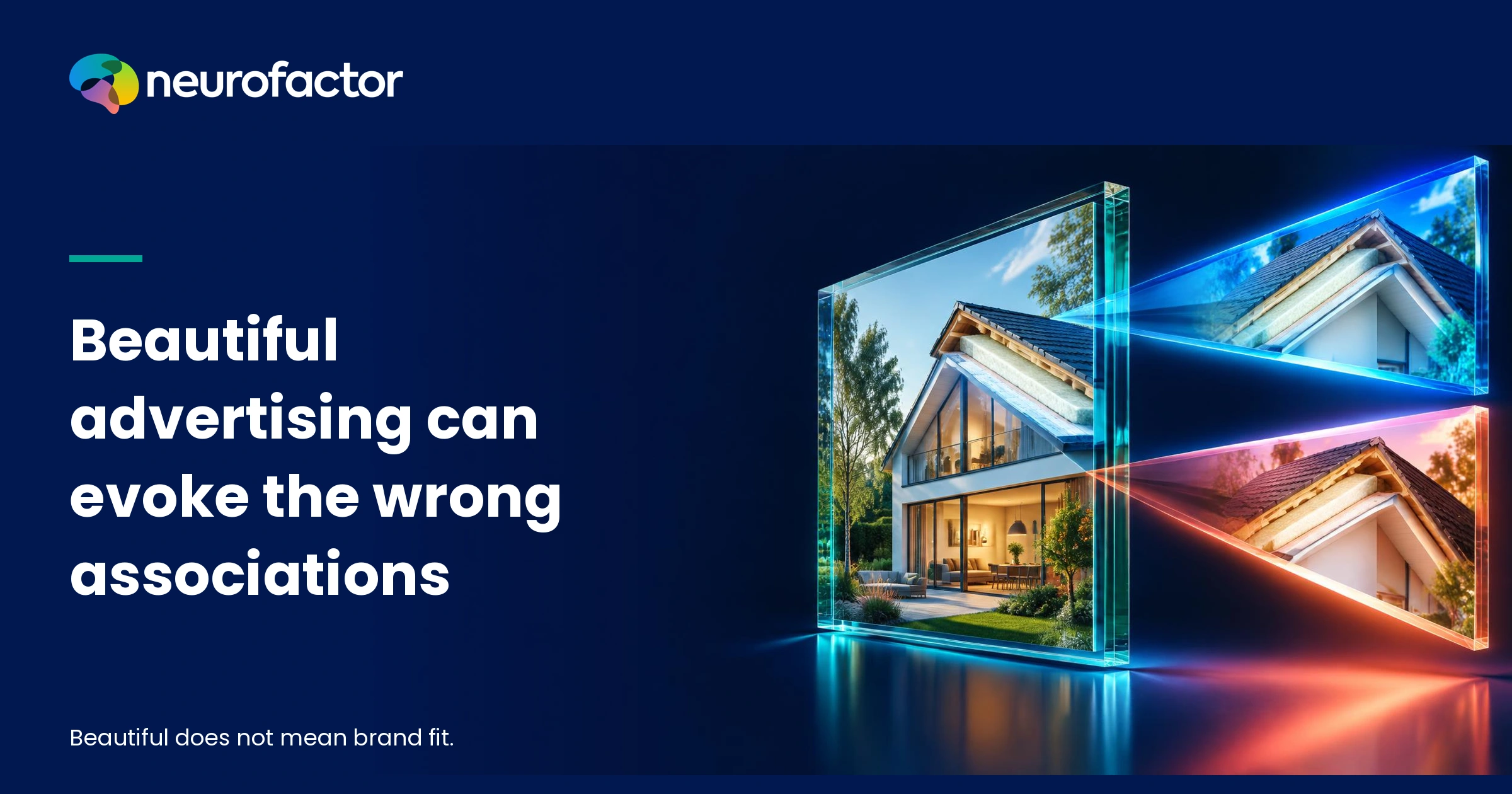
Why can a beautiful advertisement trigger the wrong associations?
Everyone in the meeting room loves the campaign. The imagery feels premium, the editing is sophisticated and nobody looks at their phone. Yet a structured test could reveal that people mostly think about travel, luxury and freedom, while the brand wants to stand for reliability and simplicity. The execution has triggered a response, but not necessarily the intended one. The relevant question is therefore not merely whether people like the ad. It is which associations remain, and which brand receives them.
A beautiful ad can deliver the wrong result
Everyone in the meeting room loves the campaign. The imagery feels premium, the editing is sophisticated and nobody looks at their phone. Yet a structured test could reveal that people mostly think about travel, luxury and freedom, while the brand wants to stand for reliability and simplicity. The execution has triggered a response, but not necessarily the intended one. The relevant question is therefore not merely whether people like the ad. It is which associations remain, and which brand receives them.
- This is the article’s central distinction: creative appreciation and strategic brand fit require separate outcomes.
Three outcomes that should never be treated as one
Attention concerns where people look and what they attend to. Emotional response describes what the communication evokes. Brand associations concern the links activated or formed between the brand and a meaning. A viewer may watch the entire commercial, feel moved and name the wrong advertiser. Another may remember the brand but link it to an unwanted quality. Those are different failures and require different diagnoses.
- Predefine attention, affect, unaided recall, aided recognition and meaning associations as distinct measurements.
Why an enthusiastic creative review can mislead
People evaluating a concept internally already know the brief and the brand. They can supply meaning that a new viewer does not possess. The intended promise is in their minds before the video begins. For an unfamiliar audience, a character, soundtrack or setting may become the strongest cue instead of the advertiser. This is a hypothesis to test, not an effect that can be assumed for every campaign.
- An internal review can identify problems but cannot replace blinded exposure among real target audiences.
Creative success versus brand success
This editorial comparison makes clear which question belongs to which layer of measurement. It does not present observed campaign data.
Experience
- What looks successful
- Strong emotion
- What is strategically needed
- Emotion linked to the right brand
Attention
- What looks successful
- Long viewing
- What is strategically needed
- Noticeable brand elements
Recall
- What looks successful
- Remembering the scene
- What is strategically needed
- Naming the correct advertiser
Liking
- What looks successful
- High likeability
- What is strategically needed
- Intended brand associations
Image
Attention is not the same as attention to the brand
Pieters and Wedel (2004) studied attention to images, copy and brand elements in print advertising. Those components played different roles. It is therefore misleading to equate an eye-catching image with successful brand transfer. Eye tracking can show where eyes move, but not directly what viewers believe, feel or later purchase.
- Treat gaze as one layer; combine it with spontaneous associations and correct brand attribution. Source S1.
Emotion does not automatically become brand emotion
A surprising or moving video can hold attention. In a specific study of internet video ads, Teixeira, Wedel and Pieters (2012) investigated how joy and surprise relate to visual attention and viewing retention. Their results do not establish that every emotional video builds desired brand values. The emotional peak may remain attached to the protagonist, plot or category instead.
- Ask what receives the emotion, not merely how much emotion was evoked. Source S2.
The visuals can resemble a different product category
Imagine a B2B software ad featuring mountain peaks, drones and epic music. Viewers might think of tourism, sport or automotive advertising. That possibility does not prove the concept is bad. It does provide a testable question: does the creative activate clarity, control and reliability strongly enough?
- Measure unaided category and brand identification before asking for aesthetic ratings.
Four distinct ways an association may miss its target
These are diagnostic scenarios suitable for pretesting, not results of an original experiment.
Category confusion
- Where it arises
- Strong generic imagery
- Diagnostic question
- What kind of brand was this?
Wrong attribution
- Where it arises
- Story without brand cues
- Diagnostic question
- Who advertised?
Unwanted positioning
- Where it arises
- Luxury visuals for an accessible offer
- Diagnostic question
- Which traits come to mind?
Creative overshadows offer
- Where it arises
- Beautiful plot, unclear product
- Diagnostic question
- What was offered?
A distinctive film is not necessarily a distinctive brand memory
An unusual scene can attract attention without being recognisably yours. Viewers might retell the scene in detail and attribute it to a competitor. Meanwhile, a simpler execution might reinforce established brand cues. The question is whether recognisable brand assets and desired meanings become linked.
- Test free attribution, delayed recognition and competitor associations as separate outcomes.
Start with the association, not the production
Before writing the creative brief, identify two or three meanings the campaign must strengthen, such as simple, expert and approachable. Name the associations it must avoid, such as confusing, expensive or distant. Translate abstract positioning words into language respondents can use. “Premium” and “innovative” are often too broad to serve as precise test criteria.
- Record associations as hypotheses rather than treating them as confirmed effects; do not move the goalposts after seeing the results.
Fictional case - Verdan’s beautiful campaign
This case is entirely fictional and contains no Neurofactor client results. Verdan is an invented provider of accessible home insulation. Its team produces a stunning film featuring a luxury villa, designer interiors and serene cinematography. The strategic ambition, however, is to show ordinary homeowners that insulation is manageable. In an imagined pretest, viewers mainly mention exclusivity, architecture and high prices. That is not the desired positioning.
- The scenario illustrates a potential interpretation gap, without claiming actual percentages, significance or causality.
Two homeowners may take away different meanings
A homeowner focused on cost control may appreciate the film while deciding that the offer is not for them. “For wealthy people” may overshadow “practical and achievable”. Another viewer may interpret the execution quality as a signal of expertise. That contrast explains why an average liking score is not enough to choose the ad.
- Need-based interpretation differences are hypotheses that require empirical examination.
Image
One campaign, two possible interpretations
Both responses are fictional illustrations, not predictions of real audience segments.
Fictional Verdan film
- Possible reading A
- Luxury and unaffordable
- Possible reading B
- Expert and careful
Main character
- Possible reading A
- Not relatable
- Possible reading B
- Inspirational
Production quality
- Possible reading A
- Distant
- Possible reading B
- High-quality
Brand promise
- Possible reading A
- Not for me
- Possible reading B
- Relevant to me
Change one associative anchor at a time
Verdan could test an alternative showing a typical terraced house, a simple explanation of the process and a concrete installation visit. The objective is not to make the ad less beautiful. It is to learn whether affordability and trust become more accessible associations without an unacceptable loss of attention or brand recall.
- Randomise exposure to variants and consider whether differences stem from images, pricing statements or clearer branding.
How to measure spontaneous associations
Show the creative without naming the desired associations in advance. Ask what first came to mind, which brand it belongs to and why. Code open responses using a written coding manual, and check agreement between coders on a subset. A spontaneous association is a reported thought, not a direct reading of unconscious neural content.
- Do not bias the first measure with suggested adjectives. Record exposure sequence and stimulus order.
What implicit tasks can add
A response-time task can test how quickly particular concepts are categorised alongside the brand in a standardised design. It may help assess hypotheses about relative association strength. However, latency is sensitive to stimulus selection, task structure, familiarity and noise. One task cannot establish buying behaviour or a stable preference of an individual.
- Report group results, quality controls and uncertainty. Avoid individual diagnostic claims.
What EEG can and cannot contribute
EEG records time-varying electrical activity during ad exposure. Depending on validated analysis and study design, some signals may inform hypotheses about information processing. EEG cannot independently establish that a person is thinking “trustworthy” or “premium”. Such interpretations require behavioural and associative evidence.
- Only add EEG when a predefined research question warrants it; a compelling brain chart is not a valid outcome on its own.
The role of eye tracking in brand transfer
Eye tracking helps identify whether gaze moves to the brand, product, protagonist or subtitles. It can inform the placement and timing of brand elements. A fixation is not proof of conscious comprehension, and a stimulus outside a fixation is not necessarily wholly unnoticed. Brand recall must be assessed separately.
- Align the ad timeline with predefined areas of interest and message markers.
Which research method answers which question?
These methods are complementary, not interchangeable. Availability of technology is not a reason to deploy it.
Where do people look?
- Suitable method
- Eye tracking
- Main limitation
- Does not decode meaning
What comes to mind?
- Suitable method
- Open association prompts
- Main limitation
- Self-report
Which concepts are paired more quickly?
- Suitable method
- Response-time task
- Main limitation
- Task-sensitive
Who receives the meaning?
- Suitable method
- Attribution and recognition
- Main limitation
- Not proof of revenue
What happens in-market?
- Suitable method
- Randomised field test
- Main limitation
- Context and channel effects
Research protocol - step 1: define the positioning question
Specify the primary outcome in advance, for example more spontaneous associations with accessibility correctly attributed to the brand. Also define unwanted meanings. Describe the target audience, exposure context and decision situation. Distinguish “is it beautiful?” from “does it fit?” and “does it change behaviour?”.
- A documented analysis plan reduces selective success reporting.
Research protocol - step 2: create controlled variants
Produce at least two versions that differ on a meaningful creative feature, while controlling duration, format, placement and instructions as far as practical. Randomly allocate participants. Avoid comparing one short, vague ad with a longer and much more informative variant.
- Document unavoidable differences and what they mean for inference.
Research protocol - step 3: collect several outcomes
Measure free associations, unaided attribution, aided recognition, perceived brand fit, unwanted meanings and, where appropriate, behavioural choices. Keep liking separate. Do not first ask whether the ad conveys trust and then claim the word “trust” was spontaneous.
- Consider delayed recall and separate confirmatory analyses from exploratory observations.
Research protocol - step 4: compare relevant segments
Compare current customers with new prospects or people prioritising affordability with those prioritising certainty. Define segments using substantive reasoning before analysis. Differences require appropriate sample sizes, variability estimates and uncertainty.
- Report counts per segment and condition, not just appealing subgroup narratives.
Research protocol - step 5: analyse plausible mechanisms
Check whether higher liking actually coincides with the intended brand associations. Inspect images, copy and moments that could contribute. Describe correlations as correlations unless the design supports a causal conclusion. Consider brand familiarity, previous experiences and expectations.
- Gaze patterns can support a hypothesis, not prove why somebody reports a particular meaning.
Research protocol - step 6: validate in market context
A laboratory or controlled pretest helps select an execution. Test it in the actual channel against preselected outcomes such as correct brand recall, qualified interest or a relevant choice. Do not treat conversion as caused solely by creative exposure without an appropriate design.
- Account for media pressure, repetition, competition and selection biases.
Emotion and excellent craft still matter
This is not an argument against film craft, emotion or creative freedom. Emotion can be valuable when it reinforces the brand promise in the relevant audience. Pham (1998) investigated how perceived relevance of feelings shapes their use in evaluation. Lee and Labroo (2004) showed how conceptual processing fluency may influence brand attitudes.
- These are mechanisms observed in particular settings, not a universal forecast for this campaign. Sources S3 and S4.
Brand fit is never context-free
Brand fit is an assessment within a particular audience, culture, category and exposure environment. An execution may work for existing customers but misfire with unfamiliar prospects. Translated campaigns need independent testing: a cultural cue or pun does not preserve its force automatically across languages.
- An excellent translation is not a validated campaign. Test the NL, EN and DE versions separately when used in those markets.
How to handle conflicting test results
Imagine variant A has the highest liking, B the best recall and C the strongest desired associations. No variant is automatically best. Predefined positioning objectives should guide the decision. Sometimes choose C; sometimes combine elements and retest.
- Do not hide this disagreement in an unexplained single neurometric score.
The question every brand manager should ask
Do not ask the creative team only what viewers should feel. Ask who viewers will attribute that feeling to, and which word should come to mind when they encounter the brand a week later. This anchors the discussion in brand memory rather than aesthetic approval alone.
- Established brand assets and unfamiliar brands may require different creative strategies.
Checklist before media investment
Test the execution without briefing context among the intended audience. Capture words before offering any answer options. Check correct brand attribution, mistaken competitor attribution and story-only recall. Look for unwanted associations, subgroup patterns and the placement of brand cues. Agree beforehand which findings would trigger a revision.
- A checklist cannot substitute for independent data when only internal team members have seen the film.
What this study cannot establish
An association test cannot establish universal causality without a suitable experiment. EEG or eye tracking cannot read words directly from minds. Unaided recall, preference and revenue are different outcomes. An enjoyable reaction does not demonstrate durable brand growth. Draw conclusions at the level supported by the methods.
- A fictional case is neither a published Neurofactor case nor evidence. Protect privacy and avoid sensitive individual advertising profiles.
The best ad is not merely the prettiest
Brands do not pay for applause for a short film; they need meaning to accrue to the right brand. An impressive execution can miss strategically when images, feelings and memories create the wrong associations. The answer is not less creativity. It is research that separates appreciation, attention, brand attribution and brand fit, followed by a testable creative choice.
- Specify which meaning the audience should connect to your brand, then measure whether that connection actually occurs.
Key terms
- Brand association
- Meaning or attribute connected to a brand in a person’s mind.
- Brand fit
- Alignment between evoked meanings and intended brand positioning.
- Unaided brand recall
- Naming the advertiser without being shown a brand list.
- Creative liking
- An independent evaluation of how appealing the execution is.
Frequently asked questions
Why can an attractive ad be bad for a brand?
Viewers may remember the story, infer a different product category or attach an unwanted meaning. Measure attribution and associations separately.
Does high attention prove advertising effectiveness?
No. Attention alone does not establish desired brand associations, preference or sales.
How can ad associations be researched?
Combine unaided prompts and brand attribution with carefully designed response-time tasks, eye tracking or behavioural tests where relevant.
Can EEG reveal what a consumer thinks about a brand?
EEG measures aspects of time-varying neural activity; it cannot directly decode particular words or brand values.
What should be measured before media rollout?
Predefine intended and unwanted meanings, compare variants, test unaided brand attribution and validate the chosen execution in-channel.
Sources
- 1.Attention Capture and Transfer in Advertising: Brand, Pictorial, and Text-Size Effects - Journal of Marketing (2004)
- 2.Emotion-Induced Engagement in Internet Video Advertisements - Journal of Marketing Research (2012)
- 3.The Effect of Conceptual and Perceptual Fluency on Brand Evaluation - Journal of Marketing Research (2004)
- 4.Representativeness, Relevance, and the Use of Feelings in Decision Making - Journal of Consumer Research (1998)
Read next
Reviewed by: Martijn den Otter · Last reviewed: 11/6/2026
Martijn den Otter
Oprichter van Neurofactor. Expert in neuromarketing en consumentenpsychologie.
LinkedIn →