
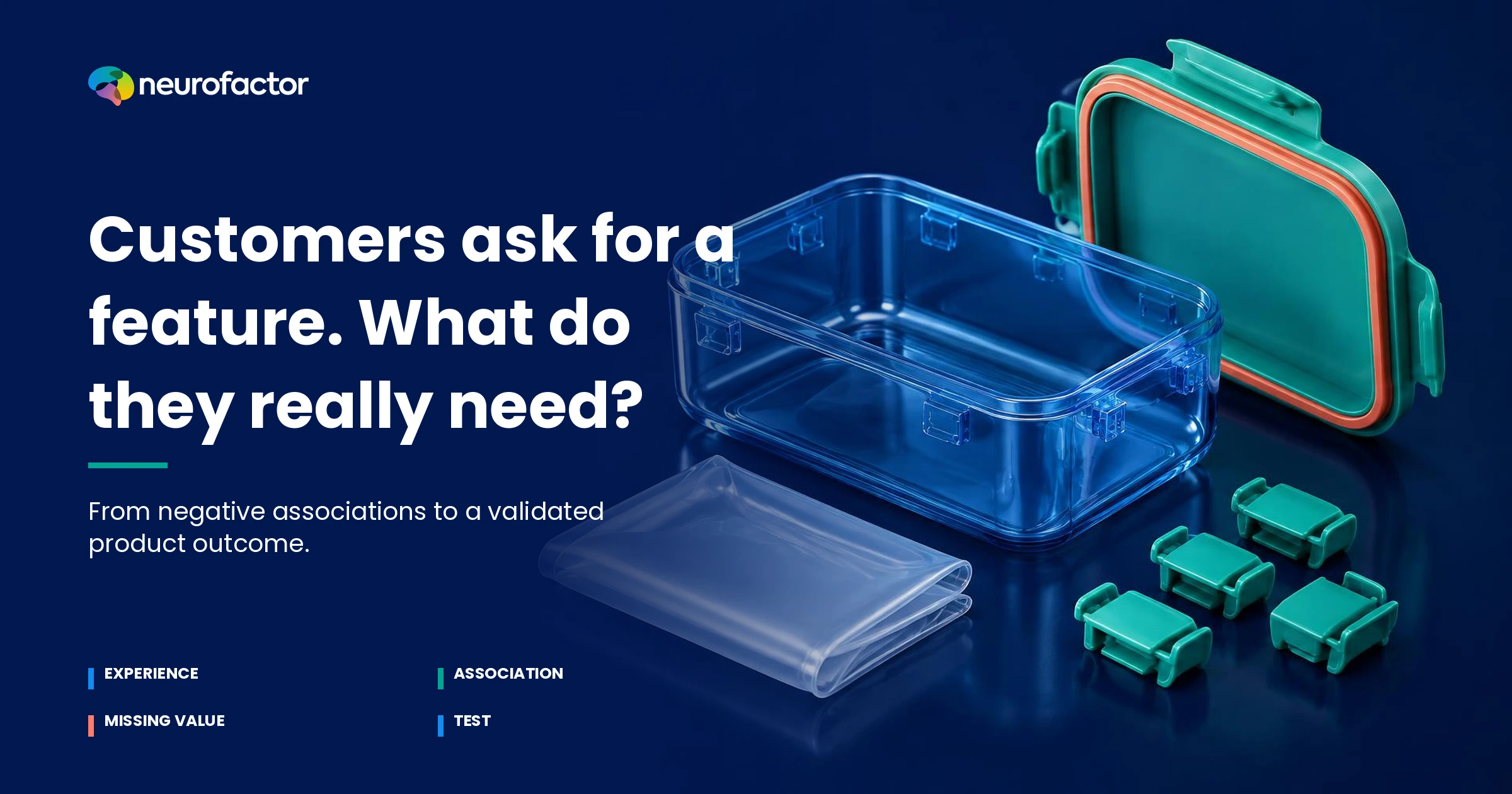
Your customer asks for another feature. What problem are they really trying to solve?
An unmet product need is not always announced as a request for a new feature. Sometimes the stronger signal is an association with the current alternative: 'hassle', 'unreliable', 'awkward' or 'too complicated'. Those words are not ready-made product specifications. They are clues about an outcome that is missing and the situation in which it matters. Start by investigating the task, the workaround, the emotional meaning and what people actually do. Translate the evidence into competing solution hypotheses, then test whether any prototype improves genuine use. Only after that should an organisation call the insight an unmet need worth building for. This article shows how to make that transition without confusing associations with product performance, attractive concepts with validated demand, or research hypotheses with measured Neurofactor results.
The most important product request rarely sounds like a requirement document
A product manager asks customers what they want and receives a practical list: a bigger size, more settings, a smarter lid. An engineering backlog almost writes itself. But what is the user actually attempting to achieve? Someone asking for greater capacity may not want to carry more food. They may want to avoid juggling two containers. Someone requesting a stronger lid may not be interested in materials engineering at all. They may want to stop worrying about an unexpected leak inside a bag.
That distinction is the central insight of this article. A customer's proposed feature and the value they are missing are not necessarily the same thing. In research on proactive market orientation, Narver, Slater and MacLachlan distinguish responding to expressed needs from recognising latent opportunities that customers have not yet formulated as product requirements [S01]. This does not mean customers cannot articulate their lives. It means their solution vocabulary is shaped by what is already on sale. The commercial implication is substantial: if a company develops every requested feature, it may improve the existing answer while leaving the underlying problem untouched. Explore the task, the workaround and the outcome before committing to the request.
A latent need is not a secret that a scientist extracts from the brain
A latent need is a potentially valuable outcome that existing options do not sufficiently deliver, or that users do not yet express in a conventional product brief. It may be visible in frustration, elaborate workarounds, task failure, or an unspoken requirement for reassurance. It need not be unconscious in a clinical sense. In unfamiliar categories, people may simply be unable to describe a product that does not yet exist. Eric von Hippel's work on lead users illustrates how people facing future market conditions earlier than others can sometimes offer unusual insight into emerging needs [S03]. Urban and von Hippel subsequently studied how that information could contribute to actual industrial product concepts [S04].
However, a lead user is not automatically representative. Someone who modifies their own equipment may have a much higher tolerance for complexity, price or maintenance than the average buyer. The methodological answer is to use such cases for discovery, then test the identified problem and proposed solution with the intended market. A latent need becomes more credible when the difficulty recurs, there is an identifiable cost, the desired outcome makes sense, and a prototype can make a measurable difference. An engaging interview alone cannot establish that demand exists at commercial scale.
What customers request and what they may actually need
These rows illustrate hypotheses to investigate, not universal psychological translations. The same phrase can point to different unmet outcomes depending on the task and the individual.
'I want more features'
- Possible missing outcome
- Fewer separate actions
- Competing explanation
- Novelty is attractive
- First evidence to collect
- Which tasks currently require workarounds?
'Make the packaging stronger'
- Possible missing outcome
- Trouble-free transport
- Competing explanation
- One supplier caused a bad experience
- First evidence to collect
- When and how did damage occur?
'It needs to be bigger'
- Possible missing outcome
- Carry everything together
- Competing explanation
- An unusually large occasion
- First evidence to collect
- What is being split or left behind?
'We need a smarter app'
- Possible missing outcome
- Fewer mistakes and decisions
- Competing explanation
- Technology language without a real problem
- First evidence to collect
- Which failure should disappear?
'Make it premium'
- Possible missing outcome
- Trust in long-term quality
- Competing explanation
- Prestige or category convention
- First evidence to collect
- What kind of proof is currently absent?
'It is such a hassle'
- Possible missing outcome
- Predictability and peace of mind
- Competing explanation
- One isolated frustrating moment
- First evidence to collect
- Which repeated step causes the effort?
Negative associations are diagnostic clues, not instant product concepts
Negative words associated with an existing solution can point towards a valuable opportunity. 'Leaks' may matter to users transporting food; 'unpredictable' to people using software; 'embarrassing' to someone operating a device in public. Yet the word alone does not tell designers what to build. A leakage concern might require a redesigned seal, clearer closure feedback, a better material, a user instruction, or simply quality assurance on the existing product. Each remedy has different cost and usability consequences.
Before drafting a feature, identify the associations that people spontaneously connect to the product category, the current alternatives and the desired outcome. Then look for the real occurrence behind each association. A newcomer might call a tool 'unreliable' because the feedback is unfamiliar. An experienced operator might report a genuine mechanical fault. Both expressions deserve attention; they do not justify the same product decision. Separate the researcher's inference from the user's words and from observed performance. The goal is neither to dismiss an emotional reaction nor to romanticise it as hidden truth. The goal is to turn the reaction into a falsifiable question about product value.
A workaround may tell you more than an answer to a survey
Watch what people do when the available option fails them. They put a lunch container inside a disposable bag, add sticky notes to a product interface, carry two devices instead of one, or use a spreadsheet to compensate for a missing capability. The effort itself is evidence that the existing arrangement has a cost. It can reveal an outcome the customer has become so accustomed to missing that they no longer mention it in an interview.
But workarounds need careful interpretation. An improvised method may be rare, and a user who modifies a product may not want to pay for a manufactured substitute. Record the frequency, context, effort and consequences. The important measure may be time, anxiety, the chance of making a mistake, the social cost of using the product, or simply cognitive load. Griffin and Hauser's research on the voice of the customer stresses identifying, organising and prioritising needs rather than collecting an unstructured catalogue of suggestions [S02]. A good product team documents what happened, not only the compelling anecdote that emerged. The remarkable innovation may be a surprisingly small improvement that makes a daily workaround unnecessary.
Four problems that can sound like the same product need
A customer's complaint can be produced by different types of friction. This framework prevents the team from assuming that better marketing or more functionality is always the answer.
Functional
- Possible association
- 'It does not work for me'
- What might actually be missing?
- Performance or compatibility
- Best first response
- Engineering diagnosis and task test
Cognitive
- Possible association
- 'There are too many choices'
- What might actually be missing?
- Clarity and predictable feedback
- Best first response
- Simplify steps or guidance
Emotional
- Possible association
- 'I do not trust this'
- What might actually be missing?
- Confidence grounded in evidence
- Best first response
- Examine risks and proof
Social
- Possible association
- 'Using it makes me stand out'
- What might actually be missing?
- Fit with the social situation
- Best first response
- Observe discreet or alternative use
Logistical
- Possible association
- 'It takes time every day'
- What might actually be missing?
- Integration with existing routines
- Best first response
- Redesign dimensions or process
Contextual
- Possible association
- 'It works everywhere except here'
- What might actually be missing?
- Suitability for one setting
- Best first response
- Test by context rather than demographic label
Start with the last occasion when the task went wrong
Instead of opening a customer interview with 'Which innovation would you buy?', ask the participant to reconstruct a specific recent occasion. Where were you? What were you trying to get done? What was in your hands? Which option did you use and what happened next? Ask about the last occasion that went surprisingly well, too. Differences between success and failure often reveal more than a general satisfaction rating. Avoid suggesting that the feature your company has already developed is the solution.
Keep three columns in your research notes. The first contains observable events; the second preserves the participant's own language; the third records the research team's interpretation. 'I checked the lid twice' is an event. 'I was worried about leakage' is the participant's account. 'People need stronger closure feedback' is a hypothesis. The three belong together but must not become interchangeable. Griffin and Hauser explain the importance of moving systematically from customer input towards prioritised needs [S02]. For a product team, this separation also improves accountability: when a manager later questions a design choice, the researchers can trace the reasoning rather than replying that customers 'just felt' a certain way.
The situation shapes the meaning of the same feature
'Compact' may be a positive attribute on a crowded train and a limitation when someone needs to feed several people. 'Powerful' may sound reassuring in a technical sales pitch and exhausting during everyday use. Consumer choice research shows that preferences can be constructed within a decision context rather than being retrieved as fixed, context-free values [S07]. That insight changes how associations should be studied. The same person may connect a characteristic to different benefits depending on the task, the time pressure and the alternatives available.
Document the moment rather than relying on broad demographic labels. Is the product being used for the first time or as a habit? Alone or in front of colleagues? Under time pressure or with room to experiment? Ask whether 'unsafe' describes a real incident, an anticipated consequence or a general reputation. The answer determines what should be tested. An apparent market segment may actually be a situational pattern, so do not label customers too quickly. The earlier article about different responses within the same audience explores that distinction. Product research should add the next question: what job changes across those situations, and is there a design that can help without introducing new disadvantages?
A fictional case: the lunch container that demands no extra attention
Imagine an entirely fictional company called Lento, which makes reusable lunch containers. This is not a Neurofactor client, and the following names, experiences and designs are invented. Its team assumes the next product needs more compartments and greater capacity. In a hypothetical discovery exercise, Nora complains that her backpack sometimes ends up wet. Miles dislikes checking the closure when hurrying for a train. Amina cannot fit a bulky container into a shared fridge. Joel wants a lid he can open without strong gripping force. Their stated preferences appear different.
A possible common need is taking lunch along without unnecessary effort or uncertainty. It is an attractive hypothesis, not a measured finding. A real study would establish whether those experiences occur, their frequency and importance, and how different users respond. The team could then test several ideas: more reliable sealing, clear closure feedback, a smaller footprint, a more accessible grip, or fewer loose parts. The case illustrates the fundamental design choice. The company could build a feature customers already know how to request, or investigate the missing outcome that makes daily use inconvenient. Neither choice should be made solely on the basis of an elegant cluster diagram.
The supposed need may be a mistaken explanation of a problem
Suppose the container leaks only when used with particular contents or when packed in a way that the current instructions do not explain. The cause is different from a general mechanical weakness. Similarly, 'difficult to clean' may refer to a complicated shape, a faulty design, poor guidance or a specific cleaning context. Associative research helps surface the experience, but a product-performance investigation must establish what happens physically and why.
Proactive market orientation encourages firms to look beyond expressed requests [S01]. It does not exempt them from examining competing causes. For each interpretation, write down at least one alternative hypothesis and the observation that would disprove the preferred explanation. If a simple demonstration eliminates a misunderstanding and no genuine design disadvantage remains, a complex new mechanism may not be warranted. If the existing seal fails a repeatable technical test, clearer branding will not repair it. The challenge is to connect the value people want with the intervention that actually provides it. That is the difference between developing a solution because it sounds innovative and developing one because it survives testing.
An association-to-need matrix for development teams
A matrix helps the team preserve the chain of reasoning. It does not diagnose a market automatically. Each possible value claim should eventually be linked to observations and a verification method.
'Hassle'
- Possible real trigger
- Too many actions or components
- Hypothesis about missing value
- Reduced cognitive effort
- Credible verification
- Task time and error count
'Unsafe'
- Possible real trigger
- Uncertain opening or transport
- Hypothesis about missing value
- Reliable control
- Credible verification
- Mechanical and user tests
'Too much'
- Possible real trigger
- Unused and confusing features
- Hypothesis about missing value
- Simplicity without loss of value
- Credible verification
- Choice and use comparison
'Fragile'
- Possible real trigger
- Breakage or category reputation
- Hypothesis about missing value
- Durability
- Credible verification
- Physical stress and wear tests
'Awkward'
- Possible real trigger
- Difficult in public settings
- Hypothesis about missing value
- Socially comfortable use
- Credible verification
- Natural-context observation
'Never fits'
- Possible real trigger
- Works only in ideal conditions
- Hypothesis about missing value
- Flexibility across situations
- Credible verification
- Cross-context task test
Look for clusters of meaning, not a single memorable word
A negative expression is informative only in relation to other associations. 'Complex' accompanied by 'confusing', 'slow' and 'too many controls' suggests something different from 'complex' alongside 'capable', 'professional' and 'flexible'. Explore how meanings cluster and whether they refer to the same underlying experience. The Neurofactor knowledge-base article on association clusters explains the broader concept. Brand-association research likewise distinguishes properties such as strength, favourability, uniqueness and the origin of associations [S05][S06].
Avoid giving every visually striking cluster the status of a new buyer type. Check whether the pattern appears across participants, repeats at different times and predicts a meaningful difference in needs or responses. Preserve positive associations as well as negative ones. Removing every trace of complexity may damage a product that expert users value for its powerful controls. Likewise, adding reassuring cues may weaken a distinctive simplicity. The product team needs a map of what is currently valuable, what is missing and which trade-offs people will accept. Without those distinctions, a beautifully designed association map can become an expensive way of justifying an existing product roadmap.
Implicit tests do not reveal a person's secret shopping list
Some evaluations occur quickly and are difficult to explain in ordinary language. Under an appropriate research design, indirect association measures can add information about the relative connections people make between concepts and attributes. The original Implicit Association Test paper introduced a reaction-time approach [S10]. Fazio and Olson's review discusses how implicit measures work and where their interpretation becomes difficult [S12]. Greenwald and colleagues' predictive-validity meta-analysis found relationships with outcomes that are informative but far from deterministic [S11].
None of that means an EEG recording or an association test can read an individual's true unmet need. Results depend on the particular task, stimuli, reliability, population and context. A relative association is not a direct measure of willingness to pay, long-term preference or engineering performance. Use any implicit findings alongside open interviews, contextual observation, actual product testing and properly designed choice tasks. Make the construct precise: does 'reliable' mean that the lid stays sealed, that the user can recognise a closed state, or that the company will replace a defective product? Those are different value propositions. The method is useful only when the research question is correspondingly specific.
The feature trap: treating an emotional insight as a feature request
Imagine the fictional research yields repeated concern about leakage. The design department decides to add three extra catches to the lid. It may look like a strong functional answer. Yet it could require more hand movements, become difficult to open and make cleaning unpleasant. Thompson, Hamilton and Rust described the risk of feature fatigue: people may initially favour more capabilities but later give greater weight to usability [S08]. A more elaborate solution is not automatically a more valuable one.
The commercial implication is straightforward. Validate the missing outcome before choosing the new function. Create several credible approaches to the same problem. One concept offers a clearer indicator. Another reduces the number of operations. Another improves the seal without changing the process. Ask the product team to predict which observable outcome each alternative should improve and which side effects may appear. This discipline prevents a research presentation from becoming a sophisticated justification for the technology engineering already prefers. It also makes it possible to abandon the proposed feature without dismissing the customer's underlying frustration.
Write product hypotheses that can actually fail
'Our innovative closure will delight customers' is not a research hypothesis. 'A visible closed-state indicator will reduce unnecessary checking among commuters without increasing closure time or errors' is much closer. It names a situation, intervention, expected outcome and possible side effect. Define before testing how much improvement would matter, how failure will be recognised and what alternative mechanism should be examined.
A practical hypothesis register includes the association, observed friction, desired outcome, candidate prototype, primary measure, possible adverse consequence and decision rule. The primary measure should normally reflect the promised task benefit. An association rating can help explain why an option is attractive, but cannot replace functional success. Research on innovation spans need discovery, consumer response, product development and market entry, with different tools suited to different questions [S13]. Do not let a polished concept test answer questions it was never designed to investigate. A disciplined team allows the possibility that the existing product is sufficient, or that a modest manufacturing fix will achieve more than an expensive new feature.
Four prototypes aimed at one possible missing outcome
The hypothetical alternatives below are deliberately different. They test competing ways to deliver the same broad benefit rather than competing expressions of the same marketing claim.
A: visible closed-state cue
- Barrier addressed
- Uncertainty after closing
- Expected association
- Control and reassurance
- Most important counter-test
- Is it understood when people are rushed?
B: simpler lid
- Barrier addressed
- Too many closing actions
- Expected association
- Ease and accessibility
- Most important counter-test
- Does the seal remain reliable?
C: more compact footprint
- Barrier addressed
- Insufficient bag space
- Expected association
- Fits normal routine
- Most important counter-test
- Is usable capacity still adequate?
D: removable internal module
- Barrier addressed
- Cleaning and food separation
- Expected association
- Adaptability
- Most important counter-test
- Does washing become more complicated?
Current container
- Barrier addressed
- Familiar existing experience
- Expected association
- Trust through familiarity
- Most important counter-test
- What problem disappears without redesign?
A price objection may conceal uncertainty, or simply be about price
A company might discover a valuable missing outcome and still fail to make the product commercially viable. A buyer saying 'too expensive' may mean the difference is unclear, the alternative already works or the risk of disappointment is too high. But the objection may also be literal: the product exceeds what the person can or wishes to spend. Association analysis must not psychologise away ordinary budget constraints.
Separate the importance of the unmet outcome from proof that a new design delivers it and from willingness and ability to pay. Someone may genuinely value a reliably sealed container while having no interest in a premium price. The answer could be lower-cost engineering, a different version, a changed service model or a decision not to develop. Product strategy is not about maximising perceived desirability in isolation. It is about finding a feasible relationship between the value users recognise, the evidence behind it, the purchase situation and the cost of delivery. The same discipline protects product teams from persuasive but financially misleading innovation stories.
One product benefit may represent four different personal outcomes
Return to the fictional container. Nora travels with electronics and interprets 'leak-proof' as avoiding damage. Miles prepares food before leaving home and hears it as freedom from repeatedly checking the lid. Amina needs something that fits in a small shared refrigerator and values compact storage. Joel needs an opening action that is manageable without high gripping force. These people are invented, but their situations demonstrate why a single product attribute may support different user outcomes.
Do not turn them into four personality categories. Actual research would observe situations, allow participants to disagree and check whether patterns repeat in new users. Some contexts may be addressed by one shared product promise: dependable carrying with fewer unnecessary actions. Other requirements may conflict, such as maximum resistance to opening versus ease of opening. That can justify different designs or a conscious product choice. The related article on how the same need can attract and repel consumers explores such tension. The innovation question is whether the company can serve more than one outcome without weakening the task the product exists to perform.
A nine-step protocol from vague friction to product decision
Step 1 - define the task. Identify what the customer is trying to accomplish, not just the category they buy. Step 2 - inventory alternatives. Include workarounds, postponed purchases and non-use. Step 3 - observe real occasions. Note the context, actions, effort and errors. Step 4 - elicit spontaneous associations. Avoid leading respondents towards a proposed design. Step 5 - separate meaning from cause. Fear of failure is distinct from observed mechanical failure.
Step 6 - structure the need hypotheses. Seek recurring patterns but retain outliers and counterexamples. Step 7 - develop competing concepts. Give each one a clear mechanism and a possible downside. Step 8 - test under realistic conditions. Compare against the current alternative on task success, experience and unintended consequences. Step 9 - make a decision. Improve, reject, narrow the market, or investigate further using predefined evidence thresholds. This is a practical editorial research protocol, not a proprietary nine-stage method claimed to have been validated through Neurofactor experiments. Keep a written record of failed hypotheses, too. They often prevent the next team from making the same expensive mistake.
Ask different questions before use, during use and after use
A prototype image tells people what they expect. Hands-on use reveals what happens. Repeated use shows whether the improvement holds once novelty disappears. These stages may produce different associations. Measure expectations and spontaneous meanings before first contact. Observe task performance, confidence, errors and workarounds during use. Then ask whether the anticipated benefit was delivered and what the person would choose next time. If possible, include a later follow-up rather than relying on a favourable first impression.
Van Osselaer and Janiszewski examine different processes through which people learn feature-benefit associations [S14]. Lemon and Verhoef place customer experiences within an evolving series of touchpoints rather than a single isolated rating [S15]. Neither study proves that a given container design will succeed. Their relevance is methodological: meaning can change as someone learns what an option actually does. The prototype that sounds impressive on a concept board might disappoint in a real bag. A strange-looking solution might earn trust after a week of reliable use. Innovation decisions should respect that sequence.
Choose the method that answers the question you have
No single measure can establish unmet need, psychological meaning, technical feasibility and market demand all at once. Use methods in a deliberate combination.
Open contextual interview
- Useful for
- Language and perceived meaning
- Does not establish
- Market-wide prevalence
- Valuable companion method
- Observation and later survey
Task observation
- Useful for
- Actions and actual friction
- Does not establish
- Willingness to buy
- Valuable companion method
- Interview and prototype task
Association network
- Useful for
- Patterns of connected meanings
- Does not establish
- Product reliability
- Valuable companion method
- Repeated measures and engineering tests
Implicit or reaction-time measure
- Useful for
- Relative associations in a task
- Does not establish
- Hidden individual desire
- Valuable companion method
- Explicit response and behaviour
Concept or choice experiment
- Useful for
- Preference among stated options
- Does not establish
- Long-term usability
- Valuable companion method
- Physical prototype and follow-up
Field or extended use trial
- Useful for
- Performance in a real context
- Does not establish
- Universal market demand
- Valuable companion method
- Representative research and cost analysis
A strong correlation between a word and satisfaction is not a cause
Suppose customers who love a product frequently say 'secure'. Maybe the product makes them feel secure. Or perhaps generally enthusiastic customers use positive language across every topic. Their experience, familiarity or the specific product version could explain both the association and the positive rating. An association cluster can help identify promising explanatory variables without showing which direction the influence runs.
When possible, randomise prototype order or exposure, keep competing factors constant and decide in advance what the primary outcome will be. If the question concerns a lid mechanism, hold packaging, pricing and instructional language stable across versions. Confirm basic functional safety before exposing participants to realistic use. Capture the associations before and after the task and inspect negative effects alongside improvements. An indicator that looks reassuring but causes more closure errors is not a success. The Neurofactor knowledge-base article on measuring associations discusses why an association claim needs more than a collection of evocative words. Causal language belongs only to designs that actually support causal inference, and any claim must match what was measured.
Turn the evidence into one decision, not forty sticky notes
Research workshops often end with walls of language: ease, freedom, reliability, elegance, peace of mind, value, simplicity. The product department still needs to decide what to build. A useful decision statement sounds like this: 'We will prioritise clearer closure feedback because unnecessary checking recurred in observed tasks and this prototype reduced those checks without introducing errors.' That statement requires real data. Before testing, it is a hypothesis and should be labelled as such.
A decision record can use five questions. Is the problem recurring and important? Does the prototype outperform the existing option on the actual task? Is its benefit understandable and credible? What disadvantages appear for other users or contexts? Is the result feasible, safe, affordable and socially responsible? Those final conditions are not side notes. A product that increases waste, prevents accessible use or creates a maintenance problem can have attractive associations while being a poor innovation. Association research should illuminate the whole trade-off, not decorate the favourite answer.
Small samples can produce persuasive stories and unreliable segments
Qualitative research often produces memorable language quickly. A team might name one group 'the anxious organiser' and another 'the effortless explorer'. Those labels may be helpful discussion prompts but are not proof of stable psychological types. Check whether similar patterns appear in additional samples, whether they change when questions or stimuli change, and whether they predict different observable product needs. A visually tidy clustering output is not a substitute for validation.
Sampling matters as much as the analysis. Current customers may have adapted to limitations that deter non-users. Lead users may tolerate technical complexity that most buyers would reject. People who abandon the category could reveal an unmet need that loyalty surveys entirely miss. Include contrasting cases and be transparent about uncertainty. Schwarz's research on self-reports shows how wording, format and context influence stated answers [S09]. Therefore, 'everyone wants reassurance' is rarely an appropriate conclusion. Report what was observed, in which circumstances, and what remains unknown. That discipline makes commercial recommendations more robust rather than less compelling.
What happens when a team solves the wrong problem
Imagine Lento develops a container with four additional compartments because customers requested 'more possibilities'. The launch visuals look impressive. In a hypothetical user session, participants leave compartments empty, dislike washing the extra pieces and continue checking the lid before putting it in a bag. These observations are fictional, included only to show how an apparently sensible product enhancement might miss the core difficulty.
A second hypothetical design offers clearer closure feedback and fewer removable parts. It might reduce checking and improve task ease, but it must still pass mechanical sealing, cleaning and durability tests. Only actual comparative evidence could establish that it performs better. The distinction has marketing consequences too. The first design leads with a list of extra components; the second could, if supported by testing, promise confidence with less effort. Our related article on credible brand positioning from associations explains why distinctive claims must connect to proof rather than appealing copy alone. Product innovation and positioning are linked, but they are not the same analytical step.
From unmet outcome to design proof and credible promise
Treat this table as a claim-control tool. It makes the route from hypothesis to design and evidence traceable, and it prevents speculative associations from becoming factual marketing statements.
People need closure reassurance
- Possible design choice
- Visible state indicator
- Required evidence
- Comprehension, errors and sealing tests
- Safe communication before validation
- 'We are exploring clearer closure feedback'
People want fewer operations
- Possible design choice
- Simplified lid
- Required evidence
- Task time and accessibility
- Safe communication before validation
- 'Prototype with fewer closure steps'
Bag space is limited
- Possible design choice
- Reduced footprint
- Required evidence
- Fit tests and adequate capacity
- Safe communication before validation
- 'Designed for compact bags' once confirmed
Cleaning is a repeated burden
- Possible design choice
- Fewer detachable parts
- Required evidence
- Cleaning time and hygiene testing
- Safe communication before validation
- 'Easier to clean' only with supporting evidence
Existing products feel unreliable
- Possible design choice
- Better engineering and guidance
- Required evidence
- Repeated mechanical and user tests
- Safe communication before validation
- 'Tested for...' only with verified scope
What an association-based Neurofactor approach can add
Neurofactor's contribution can be to clarify the meaning people connect to a product alternative, a friction point or a proposed benefit. Interview work, structured association research and, where methodologically appropriate, indirect measures may help identify relevant questions. Those findings can then inform prototype comparisons and the language used to explain them. The broader article on associations in marketing explains why meanings matter for decisions. But this is only one part of development. Context observation, design engineering, price research and product-safety tests must remain part of the process.
Neither EEG nor an implicit measure can directly tell a company which feature will sell, how long a seal will last, or whether a prototype meets regulations. Neurofactor-specific research outcomes must be assessed within their real sample, design and publication permissions. This article therefore makes no claims about actual client results and provides no invented effect sizes. The scientific literature supplies tested ideas and methodological cautions, not automatic forecasts for this fictional example. Stronger products are built when the experience researchers and engineers can challenge one another's assumptions with relevant evidence.
Three decision gates before the product enters the market
Build three decision gates into product development. Discovery gate: is there a recurring problem with a meaningful cost, or merely a persuasive anecdote? Concept gate: does the proposed solution change the right expectation and avoid unacceptable side effects? Use gate: does it improve the real task after hands-on or repeated use, at a sustainable cost and with acceptable safety and accessibility? At each gate, ask a colleague outside the project to offer the strongest alternative explanation.
Define stop rules as well as go rules. Stop developing when the problem is too rare, when the new solution makes everyday tasks harder, or when benefits can be achieved by repairing the existing option. Revise the positioning when the product works but people misunderstand it. Return to engineering when the association score improves but the functional performance worsens. Ajzen's theory of planned behaviour distinguishes intentions and behaviour and gives a role to perceived behavioural control [S16]. It is therefore wise not to treat high reported purchase intention as sufficient evidence of repeat use, adoption or commercial success. The decision should be anchored in the outcome the innovation promises to improve.
Research without turning customers into secret need profiles
Associations can become sensitive personal data when connected to identifiable individuals, health-related situations or other private information. Use a suitable lawful basis, clear participation information, data minimisation and appropriate retention periods. Report patterns at group level where possible. An attractive association cluster does not authorise hidden individual targeting or a claim that researchers understand a person's inner motivations better than the person does.
Explain when participants are interacting with prototypes, what is recorded and how the research will be used. Allow disagreement and negative feedback without attaching psychological labels. Where implicit or neurophysiological measures are proposed, scrutinise proportionality, validity and the difference between the measured construct and the story that marketing wishes to tell. Especially in product innovation, the ethical goal should remain simple: understand recurring friction and develop a useful solution without unnecessary intrusion. An evidence-based product development process can respect people while still uncovering problems they have never described as formal requirements.
An unmet need becomes credible when the workaround disappears
The most valuable innovation idea may not begin with somebody asking for something new. It may begin with a routine detour they would be relieved to stop taking: checking a lid twice, carrying a spare bag or memorising a complicated sequence. Negative associations can draw attention to the problem, while careful observation reveals its actual cost. Neither is enough by itself. The team must test alternative causes, compare different solutions and establish that the missing outcome can genuinely be delivered.
An unmet product need is not proven by an evocative cluster of words. It becomes credible when a relevant outcome is missing and a better way of achieving it survives real use. Companies that understand that distinction can stop adding features simply to look innovative and start designing products that remove the right friction.
Key terms
- Latent need
- A potentially valuable outcome that current alternatives underserve or that users do not articulate as a feature.
- Product association
- A meaning, expectation or feeling linked to a product, brand or use situation.
- Negative association
- An unfavourable meaning that may signal friction but does not establish its cause.
- Association cluster
- A pattern of connected associations whose stability and relevance require testing.
- Lead user
- A person or organisation experiencing a need relatively early or intensely, potentially contributing design ideas.
- Workaround
- An improvised method used to accomplish a task despite a product limitation.
- Voice of the customer
- A systematic approach to identifying, organising and prioritising user needs.
- Concept test
- A test of responses to proposed options that does not itself establish long-term use performance.
- Functional validation
- Evidence that an option improves a specific real task under suitable conditions.
Frequently asked questions
What is an unmet product need?
It is an outcome that matters to users but is not adequately delivered by current options. Recurring frustration, workarounds and unfulfilled expectations can be clues. Neither a compelling statement nor a concept preference proves the need until the problem and a meaningful improvement have been tested.
Which product associations might reveal latent needs?
Expressions such as hassle, fragile, confusing and unreliable can direct attention to missing value. They are not ready-made product requirements. Investigate whether each word refers to actual performance, unclear feedback, social meaning or an exceptional event.
How do you research needs without leading customers towards a feature?
Use open questions about recent tasks and observe existing workarounds. Keep events, participants words and researchers interpretations separate. Then test several solutions to the same hypothesised outcome and compare their performance with the current alternative.
Can EEG or implicit tests discover a hidden need?
Appropriate tests may provide complementary information about attention or relative associations, not mind reading or a guaranteed prediction of purchase. Their validity depends on the task and context. Combine indirect measures with observation, explicit research and real-use outcomes.
How is a product wish different from a customer need?
A wish proposes a means, such as an extra setting. A need describes the result, such as fewer errors or less effort. Different designs may deliver the same result with different costs and side effects. The best answer must be tested rather than assumed.
When is an innovation claim properly supported?
When the advertised benefit matches evidence from a relevant comparison. Favourable first impressions are not proof of durability, adoption or revenue growth. Test functional outcomes, document limitations and verify safety, accessibility and unintended consequences.
Sources
- 1.Responsive and Proactive Market Orientation and New-Product Success - Journal of Product Innovation Management 21(5), 334-347 (2004)
- 2.The Voice of the Customer - Marketing Science 12(1), 1-27 (1993)
- 3.Lead Users: A Source of Novel Product Concepts - Management Science 32(7), 791-805 (1986)
- 4.Lead User Analyses for the Development of New Industrial Products - Management Science 34(5), 569-582 (1988)
- 5.Conceptualizing, Measuring, and Managing Customer-Based Brand Equity - Journal of Marketing 57(1), 1-22 (1993)
- 6.Characteristics of Memory Associations: A Consumer-Based Brand Equity Perspective - International Journal of Research in Marketing 13(4), 389-405 (1996)
- 7.Constructive Consumer Choice Processes - Journal of Consumer Research 25(3), 187-217 (1998)
- 8.Feature Fatigue: When Product Capabilities Become Too Much of a Good Thing - Journal of Marketing Research 42(4), 431-442 (2005)
- 9.Self-Reports: How the Questions Shape the Answers - American Psychologist 54(2), 93-105 (1999)
- 10.Measuring Individual Differences in Implicit Cognition: The Implicit Association Test - Journal of Personality and Social Psychology 74(6), 1464-1480 (1998)
- 11.Understanding and Using the Implicit Association Test: III. Meta-Analysis of Predictive Validity - Journal of Personality and Social Psychology 97(1), 17-41 (2009)
- 12.Implicit Measures in Social Cognition Research: Their Meaning and Use - Annual Review of Psychology 54, 297-327 (2003)
- 13.Research on Innovation: A Review and Agenda for Marketing Science - Marketing Science 25(6), 687-717 (2006)
- 14.Two Ways of Learning Brand Associations - Journal of Consumer Research 28(2), 202-223 (2001)
- 15.Understanding Customer Experience Throughout the Customer Journey - Journal of Marketing 80(6), 69-96 (2016)
- 16.The Theory of Planned Behavior - Organizational Behavior and Human Decision Processes 50(2), 179-211 (1991)
Read next
Reviewed by: Martijn den Otter · Last reviewed: 11/5/2026
Martijn den Otter
Oprichter van Neurofactor. Expert in neuromarketing en consumentenpsychologie.
LinkedIn →