
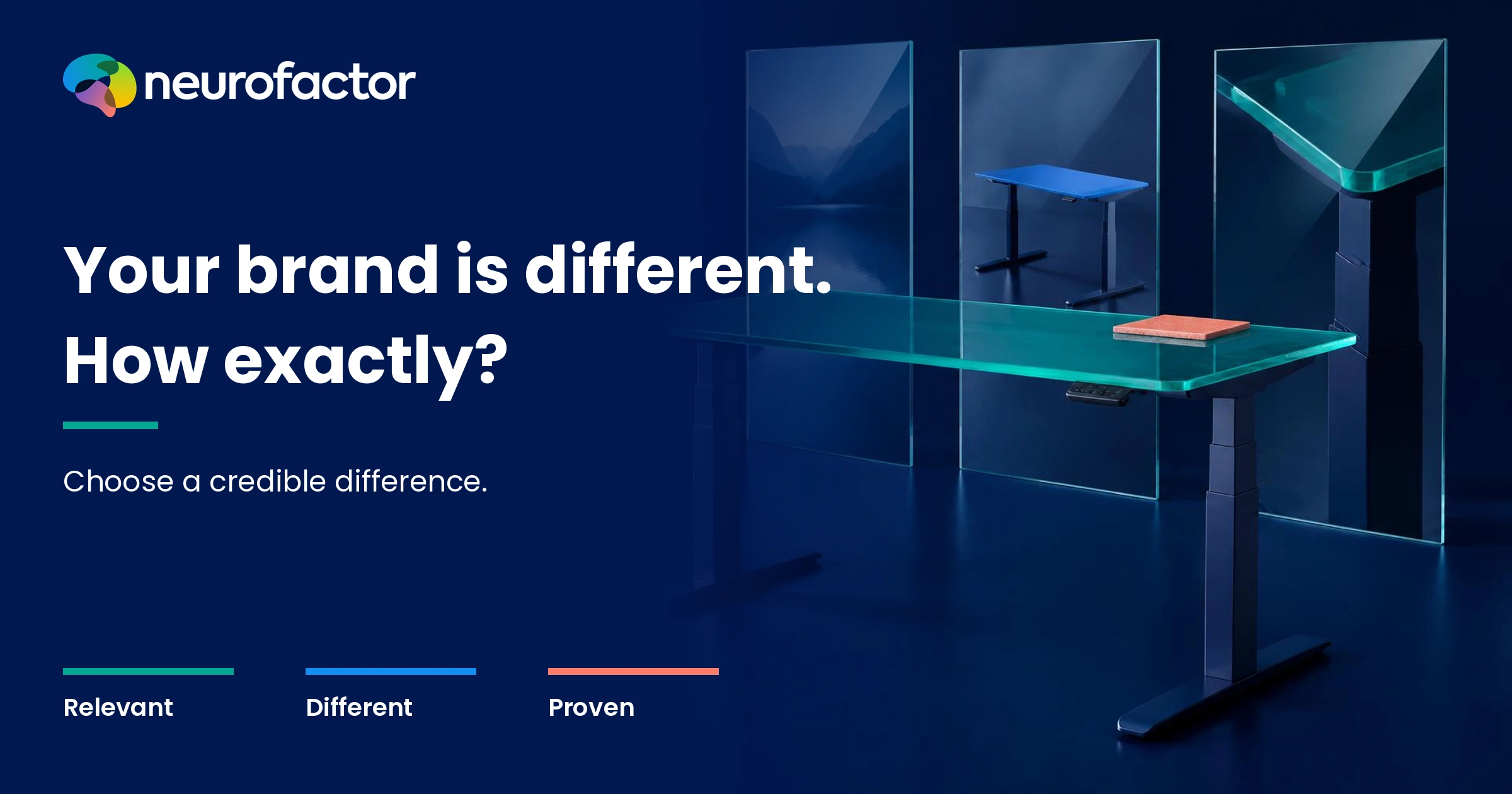
Your brand is different. Can customers tell how?
A credible brand position does not begin with an attractive adjective. It starts with an association that matters in a specific buying situation, is meaningfully linked to your brand rather than just every alternative, and is supported by something customers can verify. Those are three separate tests. Many teams answer only one question: what do we want to stand for? Better research asks what customers already associate with each competitor, when the meaning matters and what evidence could make a claim believable. The creative line comes last. Without this sequence, 'differentiation' often means nothing more than choosing a more polished way to make the same promise as everyone else. [S01] [S02] [S04]
You promise quality. So does everybody else.
Picture a marketing team presenting its new strategy after months of workshops. Three words dominate the slides: reliable, innovative and personal. The managing director recognises the business. Employees feel proud. The agency presents a beautiful new design. Nobody asks the awkward question: which serious competitor does not promise those things?
Buyers rarely compare internal brand documents. They recall a few suppliers, confront a decision and interpret signals against a practical need. One company feels competent but slow. Another feels modern but complicated. A third appears friendly, yet buyers doubt its capacity. Those impressions may be different even when the products look similar. Research on brand knowledge helps explain why associations form part of the way people interpret offers. [S01]
The commercial opportunity depends on what those impressions mean at the moment of choice. 'Innovative' may be an unhelpful primary claim for someone worried about implementation risk. 'Trustworthy' may be a necessary condition that every supplier can credibly state. Perhaps the useful territory is 'no surprises when the brief changes'. That is more concrete and easier to substantiate. Whether it is genuinely more associated with your brand remains a research question, not a management preference.
Four tests a position needs to survive
A powerful creative expression cannot compensate for a weak strategic premise. Examine relevance, relative difference, credibility and availability in memory separately. A desirable association may be shared by every brand; a unique association may not matter to buyers; a relevant promise may be impossible to deliver.
This is a managerial diagnostic framework, not a scientifically validated universal formula with fixed weights. It draws together several distinct research traditions rather than presenting an invented single measurement. [S01] [S02] [S03] [S04]
Relevance
- Key question
- Does the meaning matter in a real choice situation?
- Evidence to collect
- Needs, risks, category entry points and preferences
- Warning sign
- The word sounds attractive but changes nothing
- Decision
- Revisit the choice context
Relative difference
- Key question
- Is the association more strongly linked to us than to alternatives?
- Evidence to collect
- Consistent brand-by-brand comparisons
- Warning sign
- Every competitor owns the same claim
- Decision
- Make the difference more specific
Credibility
- Key question
- Can the claim be demonstrated in practice?
- Evidence to collect
- Product, service, process and experienced proof
- Warning sign
- The promise only exists in advertising
- Decision
- Improve delivery before communication
Mental availability
- Key question
- Does the brand come to mind when the need arises?
- Evidence to collect
- Contextual recall and recognition
- Warning sign
- People like us but never think of us
- Decision
- Build recognisable memory cues
Brand strategies do not live in slide decks
Kevin Lane Keller describes brand knowledge as brand awareness and a network of associations. His customer-based brand equity model considers how knowledge of the brand can change people's responses to marketing. Familiarity alongside favourable, strong and unique associations matters within that framework. It is a conceptual model, not a guaranteed equation linking any particular association score to sales growth. [S01]
People also need to retrieve a brand when it becomes relevant. Romaniuk and Sharp distinguish mere awareness from brand salience: the likelihood that a brand comes to mind in buying situations. That makes a difference. Someone may know your company and approve of it, yet fail to recall you when they actually need a solution. [S02]
Nedungadi's experiments investigated how the accessibility of a brand in memory can affect which options are considered, even without changing evaluations of the brands. This does not establish that every campaign will increase purchasing. It does establish why an image survey alone leaves a crucial question unanswered. You must ask in what situation does our brand come to mind, and alongside which alternatives? [S03]
Start where the buying situation starts
A brand can be helpful in one situation and irrelevant in another. A buyer hiring a supplier for an urgent one-off project may prioritise speed. The same buyer negotiating a five-year service agreement may care most about predictability and continuity. An identical offer can therefore evoke 'too careful' in the first context and 'reassuringly thorough' in the second.
Map at least three concrete category entry points before you write the research questions. Describe what triggered the need, who participates, what the buyer wants to avoid and which solutions are realistically available. Include the option to do nothing. Do not ask only for people's ideal supplier. Abstract questions tend to produce universally desirable words such as quality, service and transparency.
An effective brief states the decision to be made, the category boundary, the likely competing solutions and the hypothesised associations. Then it invites those hypotheses to be disproved. The Neurofactor knowledge base explains the basic concept of an association. A positioning study should remain open to discovering that the most important customer meaning is not among the values management initially selected.
An association is not the same as approval
Teams often combine attitudes, associations, recognition and proof under the vague heading of 'brand strength'. That makes recommendations almost impossible to interpret. These are different constructs that need different questions.
A high score for expertise can coexist with poor recall. Strong recall can coexist with low trust. A good image can coexist with unaffordable pricing or poor distribution. Separating these results prevents a brand problem from being diagnosed whenever the actual obstacle is operational. [S01] [S02] [S03]
Brand association
- Example
- 'They understand my business'
- Suitable measurement
- Open and structured associations
- What it cannot establish alone
- Whether that idea is distinctive
Brand evaluation
- Example
- 'I like this supplier'
- Suitable measurement
- Evaluation and consideration questions
- What it cannot establish alone
- Whether the brand will be recalled
Brand recognition
- Example
- 'I recognise its name and design'
- Suitable measurement
- Identification under defined conditions
- What it cannot establish alone
- Whether the brand is preferred
Brand evidence
- Example
- 'They provide a binding delivery schedule'
- Suitable measurement
- Review of product and service proof
- What it cannot establish alone
- Whether buyers actually notice it
Consideration
- Example
- 'This supplier is on my shortlist'
- Suitable measurement
- Contextual choice and shortlist tasks
- What it cannot establish alone
- Whether a transaction will follow
Step 1 - decide which business decision the research will inform
Before interviewing anybody, finish this sentence: 'We need this research so that we can decide whether to ...' Perhaps you are choosing a leading claim, building a proposition for a new segment, entering a new category or revising a position that has lost credibility. Without that decision, the research can produce a sophisticated association map that nobody feels able to act upon.
Define the product category carefully. A search for office lighting may create a different competitive set from a search for lower energy consumption. Define whether you are speaking to purchasing managers, users, influencers or a committee. Those groups may value different aspects of the same offer. Avoid treating their average as if it were one person.
List the real alternatives. These may include established competitors, a substitute category, an in-house solution and postponing the decision. Do not select only competitors that make your offer look good. If the buyer's shortlist is different from your brand team’s comparison set, any claim of competitive difference is incomplete from the outset.
Step 2 - listen before supplying your own adjectives
Start with spontaneous answers. Ask what first comes to mind about each supplier and when that company would realistically be considered. Follow up with examples, not just additional adjectives: 'What happened that made you say this?' 'What would need to change?' 'Whom would you compare them with?' The goal is not to collect the longest possible word cloud but to uncover how a specific meaning relates to a specific decision.
Ask about the direction of the association as well. 'Fast' could mean convenient or careless. 'Exclusive' could mean craftsmanship or exclusion. 'Flexible' could mean responsive or disorganised. Every apparently positive attribute can acquire a different meaning when the situation changes.
After an open phase, use balanced structured tasks to compare the same potential associations across brands and segments. Randomise presentation order where appropriate. The Neurofactor knowledge-base article on measuring associations explains why different questions and indirect tasks answer different kinds of research questions. Record the method before seeing the answer; don't keep changing it until the preferred outcome appears.
Pick the instrument for the question, not for its novelty
There is no single instrument that fully reveals a brand's position. Method selection should follow the uncertainty you need to reduce.
The original work introducing the Implicit Association Test and later methodological analysis support careful use of relative response measures. They do not support treating an individual's response-time difference as direct proof of a hidden purchase motive or inevitable future behaviour. [S06] [S07]
Spontaneous association
- Useful for
- Customer language and immediate meaning
- Main limitation
- Sensitive to memory and question wording
- Example research question
- What is volunteered without a prompt?
Structured competitor comparison
- Useful for
- Relative associations across brands
- Main limitation
- Selected statements may shape responses
- Example research question
- Who is connected with which benefit?
Contextual recall
- Useful for
- Mental availability in buying moments
- Main limitation
- Remembering is not purchasing
- Example research question
- Which supplier comes to mind here?
Indirect association task
- Useful for
- Relative response patterns in a defined task
- Main limitation
- Not a mind-reading or sales prediction tool
- Example research question
- How do selected concepts relate relatively?
Controlled choice experiment
- Useful for
- Trade-offs under stated conditions
- Main limitation
- Simulated choices differ from market behaviour
- Example research question
- Does adding evidence change consideration?
Observed behaviour
- Useful for
- Visits, enquiries, trials and purchases
- Main limitation
- Confounded by price, media and availability
- Example research question
- Does the change affect a real action?
A high score on your own dashboard proves very little
Imagine a brand reporting that 78 percent of respondents consider it competent. The communications team celebrates. But 86 percent may say the same about the main competitor. The attribute might be a category minimum rather than a deciding factor. Respondents might be long-standing customers rather than the people the company needs to attract.
Those percentages are fictional illustrations, not research results. The underlying principle is important: compare brands with the same instrument, in the same context, among appropriately selected respondents. Report uncertainty and sample composition. A gap between two percentages is not automatically statistically reliable, strategically important or attributable to the brand itself.
An essential safety attribute, for example, may deserve prominent proof without becoming the unique position. Companies do not need to abandon category expectations in the pursuit of uniqueness. They need to distinguish basic permission to compete from the reason a particular buyer might prefer or remember them.
Step 3 - separate desire from credibility
Almost everybody appreciates convenience. That does not mean every supplier can credibly occupy 'the easiest' position. Buyers may associate the company with bespoke complexity or intensive onboarding. Simply putting 'simple' on a homepage can widen the distance between promise and experience.
Erdem and Swait examined brand credibility, particularly trustworthiness and expertise, in brand consideration and choice. Their research across different product categories indicates why credibility deserves its own role in a positioning diagnosis, especially where buyers face uncertainty. It does not justify claiming that the same proof point works equally well in every category. [S04]
Ask people what evidence would let them believe the claim. A technical buyer might need a practical demonstration. A service buyer may require a service process and transparent terms. A premium buyer may look for materials and workmanship. The proof must fit the specific concern. If the organisation cannot support the claim, the responsible action is to adjust the offer or revise the promise, not to write more persuasive advertising.
Functional, symbolic and experiential routes
Different categories and buying situations allow different credible routes. Use them as a map of possible positioning territories, not as permanent personality labels for customers.
Park, Jaworski and MacInnis proposed a strategic framework distinguishing functional, symbolic and experiential brand concepts. That is a framework for managing meaning, not a randomised experiment showing which positioning will win in your market. The right route still has to be validated in the actual choice context. [S05]
Functional confidence
- Most relevant when
- Delivery risk and execution dominate
- Possible promise
- 'Predictable changes, no surprises'
- Proof requirement
- Processes, contractual clarity and consistent outcomes
- Risk
- Presenting a category basic as unique
Symbolic relevance
- Most relevant when
- Identity and personal meaning matter
- Possible promise
- 'Designed around your way of working'
- Proof requirement
- Genuine choice, personalisation and user examples
- Risk
- Elegant symbolism with no substance
Experiential ease
- Most relevant when
- Daily usage determines value
- Possible promise
- 'Works naturally when you're busy'
- Proof requirement
- Real tasks and service demonstrations
- Risk
- A simple claim with a complex journey
One fictional furniture producer, three possible stories
Consider an entirely fictional manufacturer of adjustable worktables sold to design studios and commercial workspace planners. Several suppliers offer comparable ergonomics, finishes and lead times. The manufacturer's team wants to position its products as 'outstanding quality' because the engineering is genuinely sophisticated. Nothing in the example is a real Neurofactor client finding.
For a project manager working against a fixed opening date, the meaningful concern might be: 'What happens if the design changes just before delivery?' A message about predictable changes, supported by a clear process, could matter. For an architect, the central question might instead be: 'Can I make the finished environment distinctive?' Customisation evidence would play a larger role. For a facilities manager working across multiple sites, maintenance and standardisation might dominate.
These are different buying situations, not three mutually exclusive types of people. The manufacturer still needs a coherent brand core. It can express that core through different context-specific proof, provided the promises do not contradict one another. The research would need to establish which association, alternative and evidence combination actually matters rather than assuming that the hypothetical examples are universal.
Do not turn three brand concepts into three kinds of human
A buyer can care about functionality, identity and experience at once. A procurement manager may need cost predictability while also wanting the project to reflect professional judgement and provide a pleasant daily experience. Treating customers as either rational or emotional reduces a complex buying situation to a misleading stereotype.
Aaker's research develops the brand personality construct and its measurement. That shows how language such as competence or sincerity can be studied as brand perceptions, not how to label consumers as fixed neurological categories. Fournier's qualitative research explores relationships people construct with brands. It does not imply that every person develops a strong relationship with every brand. [S09] [S10]
A stronger segmentation question is not 'Which sort of personality is this buyer?' but 'When does this meaning become important, to which decision and against which alternatives?' That lets marketers work with observed differences instead of comfortable but fragile personas.
Step 4 - write a promise a buyer could verify
Create a positioning statement in four parts. Define the choice context. State the value delivered in that context. Explain the relative difference that may make your brand preferable or more relevant. Finally, specify the evidence a buyer can actually observe.
Compare 'We are an innovative partner' with 'When your design changes, you can see the scheduling and cost implications before committing'. The second is more specific, but it is only an acceptable claim if the process genuinely provides the promised visibility. Otherwise it creates the wrong expectation.
Build a proof inventory before briefing creatives. Ask the sales team which questions people need answered. Ask operations what can be delivered consistently. Ask buyers which evidence reduces meaningful uncertainty. A third-party badge, a technical specification and a realistic demonstration are not interchangeable merely because all three fit on a landing page.
Turn the claim into evidence the buyer can use
A positioning statement needs to connect with proof at the precise point of doubt. This matrix illustrates how to build that connection.
The examples are hypothetical. A proof asset is not a decorative badge beside a claim. It is a practical way to show that the promised experience exists. That makes positioning a shared responsibility across brand management, product development, customer operations and sales.
Predictable delivery
- Buyer concern
- What if requirements change?
- Useful proof
- Change process and project example
- Appropriate touchpoint
- Proposal and sales call
- Outcome to test
- Understanding and confidence
Personal advice
- Buyer concern
- Will I meet a genuine expert?
- Useful proof
- Conversation with accountable specialist
- Appropriate touchpoint
- Initial consultation
- Outcome to test
- Relevance and next action
Long-term quality
- Buyer concern
- Who resolves failures?
- Useful proof
- Maintenance and repair conditions
- Appropriate touchpoint
- Product and agreement
- Outcome to test
- Perceived risk and questions
Ease of use
- Buyer concern
- What must the user actually do?
- Useful proof
- Realistic task demonstration
- Appropriate touchpoint
- Demo and onboarding
- Outcome to test
- Successful task completion
Design flexibility
- Buyer concern
- What can really be customised?
- Useful proof
- Configuration examples
- Appropriate touchpoint
- Product discovery
- Outcome to test
- Qualified enquiry
The strongest difference may be what people experience
Two competitors can use exactly the same claim and still create different associations. Both say their service is personal. One offers a generic contact form and an automated response. The other lets the prospective customer speak directly with the specialist who will later oversee the work. The advertised word is the same; the experience behind it is not.
Morhart and colleagues developed a multidimensional model and measure of perceived brand authenticity. Their work considers credibility, integrity, symbolism and continuity as parts of people's authenticity judgements. The study supports careful attention to the signals that make claims believable; it does not show that simply adding the word 'authentic' to advertising will increase conversion. [S08]
The interesting research question is which experience actually produces a distinctive, useful association. Sometimes the most powerful differentiator is not a novel abstract value but an unusual, verifiable way of doing something people already care about. If the operation cannot deliver that difference consistently, the positioning cannot credibly rest on it.
Association clusters describe a map, not an inevitable cause
Brand meaning rarely consists of isolated adjectives. 'Sustainable' might connect to responsible, expensive, durable and hard to maintain. Those connections can strengthen or contradict each other, depending on what the buyer is trying to achieve. Analysing patterns across associations can show why one seemingly positive term carries unexpected doubts.
The pattern itself does not reveal causation. If respondents associate a brand with both technical expertise and distance, it does not follow that expertise causes the feeling of distance. Perhaps a complex website, formal customer service or the broader category produces both impressions.
The Neurofactor article about association clusters sets out the basic principle. Use a cluster as a structured hypothesis for further investigation, not a map of direct mental mechanisms. If the business decision depends on a cause, design a test capable of distinguishing competing explanations.
Step 5 - adapt proof to each decision without inventing new brands
Consistency matters, but repetition of the exact same sentence at every touchpoint is not the same thing as consistency. A CMO might need to explain the strategic differentiation internally. An account manager needs to connect the same promise to a customer's specific objection. A product manager needs to ensure that the underlying feature or service genuinely delivers it.
Build a message matrix for each stage of the journey: what is happening, which association matters, which evidence can be offered and which next step is appropriate? Early in the journey, a clear problem description may be most useful. During comparison, a concrete alternative-by-alternative demonstration can reduce uncertainty. Just before purchase, contract terms and implementation proof might matter more than another brand manifesto.
Test the words with buyers. Ask what they believe the statement promises and what they expect to see next. If their interpretation differs from the intended one, adjust the language or the actual service. Do not use the design team to hide a gap between claimed and delivered value.
Being different is not the same as being recognisable
Brand debates often blur differentiation and distinctiveness. Differentiation concerns meaningful differences in what is offered or how people evaluate it. Distinctiveness concerns whether people can quickly identify the correct brand through assets such as a name, shape, tone or consistent visual system. The two can reinforce each other, but they are not interchangeable.
A recognisable colour can identify a product without making people consider it better. A unique, useful service can exist without buyers remembering which company provides it. Brand teams may therefore need two separate interventions and two separate measures: one for meaningful preference or relevance, and one for memory and identification. [S01] [S02]
Nor does every category demand that a brand be unique on every attribute. Some expectations are shared because a product cannot sensibly compete without them. The task is to decide which combination of ease of recognition, mental availability, relevant meaning and proof is worth investing in for the actual situation.
Repetition without a buying context may build little value
A campaign may repeat 'reliable and innovative' across hundreds of placements. People might recognise the advertisement yet fail to recall the brand when they need the category. Ad recognition, brand recall, consideration and buying are separate outcomes and should not be treated as substitutes.
Romaniuk and Sharp emphasise the memory structures that make brands available in buying situations. Collins and Loftus proposed a foundational theoretical model of spreading activation in semantic memory. Both help to frame a research question about associative retrieval, but neither predicts the financial return of your individual campaign without evidence. [S02] [S11]
Connect distinctive brand cues with the contexts where buyers have a real problem. If the brand claims speed, show what situation makes speed useful and what practical proof reduces concern. Repeat the relationship consistently, then assess whether the brand comes to mind unprompted in that situation. A high number of impressions is not an association outcome.
A decision matrix for the uncomfortable results
A good study should make it possible to reject a favourite internal idea. Use a simple classification to decide what to do when relevance, difference, credibility and recall do not line up.
This is a qualitative decision tool, not a substitute for properly designed research, confidence intervals or behavioural evidence. Make the rules explicit before seeing the result. Otherwise 'data-driven positioning' too easily becomes a story written to justify the strategy management already liked.
Relevant and credible but shared
- Likely interpretation
- Important category expectation
- First decision
- Retain it as baseline proof
- Remaining question
- Can the delivery itself be distinctive?
Relevant and different but not credible
- Likely interpretation
- Promising claim without foundation
- First decision
- Improve product or service
- Remaining question
- Which evidence is missing?
Unique and believable but irrelevant
- Likely interpretation
- An impressive internal story
- First decision
- Avoid making it the main position
- Remaining question
- Is it relevant in a narrower context?
Relevant, credible and relatively linked
- Likely interpretation
- Potential positioning territory
- First decision
- Test the proposition
- Remaining question
- Is the difference replicable?
Weak recall in a buying situation
- Likely interpretation
- Mental availability problem
- First decision
- Test brand cues and distribution
- Remaining question
- Is the brand visible at all?
High approval but low conversion
- Likely interpretation
- Possible non-brand friction
- First decision
- Investigate price, access and process
- Remaining question
- Where does the customer stop?
Do not test a positioning strategy by asking for the nicest slogan
A slogan preference test tells you which words participants prefer in a particular test. It does not by itself show that those words create a stronger position. If the business decision is about credibility, design variations around evidence. Hold the underlying product, price and context as constant as possible. Test what people understand, believe, remember and do when different proof is supplied.
Where feasible, set hypotheses and success measures in advance. Randomise alternatives and give adequate attention to sample size. Analyse predetermined segments, but do not search endlessly for a tiny subgroup that happens to agree. For a B2B decision, a qualified appointment or a meaningful next-stage action may be more informative than a likeability rating. For consumer retail, an enquiry or purchase may be appropriate, with price and availability taken into account.
Think in stages: association change, memory availability and actual behaviour may require separate measures and timelines. Treat a promising early result as support for further validation, not proof that your brand has permanently changed what every customer thinks.
What indirect association tests and EEG cannot tell you
Neurofactor can investigate brand associations through direct questions and, when the design calls for it, indirect response tasks. An IAT examines relative associative responses among selected target concepts and attributes under controlled conditions. It is not a direct reading of private motives or a guaranteed predictor of an individual purchase. Fazio and Olson specifically review the limits, context sensitivity and interpretation challenges of implicit measures. [S06] [S07]
EEG records aspects of brain activity during an appropriate research task. It does not automatically decode 'trust', 'quality' or 'purchase intent' from a single measurement. When the question is which associations people connect with which brands, choose the methods that actually address that construct, and use behavioural evidence to examine the commercial consequences.
A cross-sectional association difference does not establish that the association caused a purchase. Examine category knowledge, previous experience, sampling differences, stimulus effects and language. Present uncertainty openly. That discipline makes research commercially more useful, not less convincing.
Five mistakes that undermine differentiation
First, starting with the manifesto. If the questions repeat management's preferred language, the survey may mainly measure recognition of that language. Second, picking convenient competitors. Claiming uniqueness without testing real alternatives is not serious market research. Third, confusing approval with availability. People may have a positive attitude towards a brand they never recall at the right moment. [S03]
Fourth, finding the proof after launching the promise. Credibility must be built into delivery. Erdem and Swait make the case for studying trustworthiness and expertise; Oliver's work on expectations and disconfirmation adds a useful caution about what happens when the experience fails to support the anticipated outcome. These studies do not demonstrate that every proof badge increases conversion. [S04] [S12]
Fifth, treating an overall average as one homogeneous customer. Category needs and competitive sets may change across segments and buying occasions. Equally, a very small subgroup can make random differences look persuasive. Decide which segmentation is relevant before opening the dataset, then report the uncertainty rather than choosing the most flattering graph.
How an association study becomes a positioning choice
At Neurofactor, the useful sequence starts with the customer decision, not a preselected tagline. Identify the circumstances in which people need the category. Collect spontaneous and structured brand associations. Compare the real alternatives. Test whether promising meanings are useful, relatively linked with your brand and credible in terms of the actual experience. Where appropriate, add indirect association tasks and behavioural measurement.
Turn the evidence into a small set of competing hypotheses. For each one, specify the buying context, intended association, supporting proof and observable test outcome. The answer may be better copy. It may be a product demonstration, a different service process or a genuinely revised proposition. Research is doing its job when it identifies an operational weakness as well as a messaging opportunity.
No methodology guarantees growth in brand preference. The value lies in reducing ambiguity and making better strategic choices that can be tested, repeated or abandoned. A brand manager or CMO should walk away knowing not merely which adjectives seem attractive, but which specific meaning the business can actually earn.
A positioning is credible when it survives contact with reality
You do not have to be the only brand promising quality, convenience or reliability. You do need to be easy to recognise in the situations that matter, associated with something buyers value, and capable of proving the promise through actual delivery. Competitive differentiation is therefore not created by choosing a clever adjective. It is earned where buyer associations, relative alternatives and lived experience align. Research those elements separately, test the combination against behaviour and drop a claim if the business cannot substantiate it. That is how positioning becomes a defensible choice rather than another campaign line.
Key terms
- Brand association
- A mental connection between a brand and a meaning, experience, attribute or situation.
- Brand positioning
- The intended role and meaning of a brand relative to relevant alternatives in a specific market context.
- Competitive difference
- A relevant association or offer difference evaluated against the alternatives buyers actually consider.
- Brand salience
- The propensity for a brand to come to mind across buying situations.
- Brand credibility
- The extent to which people expect a brand to be able and willing to deliver a specified promise.
- Proof asset
- A tangible demonstration that helps people verify a brand claim.
- Distinctiveness
- Ease of identifying a brand through consistent, recognisable brand cues.
- Association cluster
- A pattern of connected brand meanings in research responses, not automatic proof of cause and effect.
Frequently asked questions
How do you choose credible brand positioning?
Identify associations that matter to buyers, compare your brand with real alternatives and collect proof of delivery. Test several hypotheses rather than choosing the most attractive adjective.
How is positioning different from brand associations?
Brand associations describe what people connect with a brand. Positioning is the strategic choice about which relevant and credible meaning a brand seeks to reinforce compared with alternatives.
How do I know whether a brand is differentiated?
Compare equivalent associations for your brand and realistic competitors, then evaluate their relevance, credibility and sampling uncertainty.
Does brand positioning require neuroscience?
No. Open questions, structured comparisons and behavioural research can already be useful. Indirect tasks should be added only when they suit a precise research question.
What is the difference between differentiation and distinctiveness?
Differentiation concerns meaningful differences in an offer or evaluation; distinctiveness concerns easy identification of the brand through consistent cues.
Should every customer segment have a different brand position?
Usually not. Maintain a coherent credible brand core and vary the context-specific proof or examples without creating contradictory promises.
Sources
- 1.Conceptualizing, Measuring, and Managing Customer-Based Brand Equity - Journal of Marketing (1993)
- 2.Conceptualising and measuring brand salience - Marketing Theory (2004)
- 3.Recall and Consumer Consideration Sets: Influencing Choice without Altering Brand Evaluations - Journal of Consumer Research (1990)
- 4.Brand Credibility, Brand Consideration, and Choice - Journal of Consumer Research (2004)
- 5.Strategic Brand Concept-Image Management - Journal of Marketing (1986)
- 6.Measuring Individual Differences in Implicit Cognition: The Implicit Association Test - Journal of Personality and Social Psychology (1998)
- 7.Implicit Measures in Social Cognition Research: Their Meaning and Use - Annual Review of Psychology (2003)
- 8.Brand Authenticity: An Integrative Framework and Measurement Scale - Journal of Consumer Psychology (2015)
- 9.Dimensions of Brand Personality - Journal of Marketing Research (1997)
- 10.Consumers and Their Brands: Developing Relationship Theory in Consumer Research - Journal of Consumer Research (1998)
- 11.A Spreading-Activation Theory of Semantic Processing - Psychological Review (1975)
- 12.A Cognitive Model of the Antecedents and Consequences of Satisfaction Decisions - Journal of Marketing Research (1980)
Read next
Reviewed by: Martijn den Otter · Last reviewed: 11/4/2026
Martijn den Otter
Oprichter van Neurofactor. Expert in neuromarketing en consumentenpsychologie.
LinkedIn →