
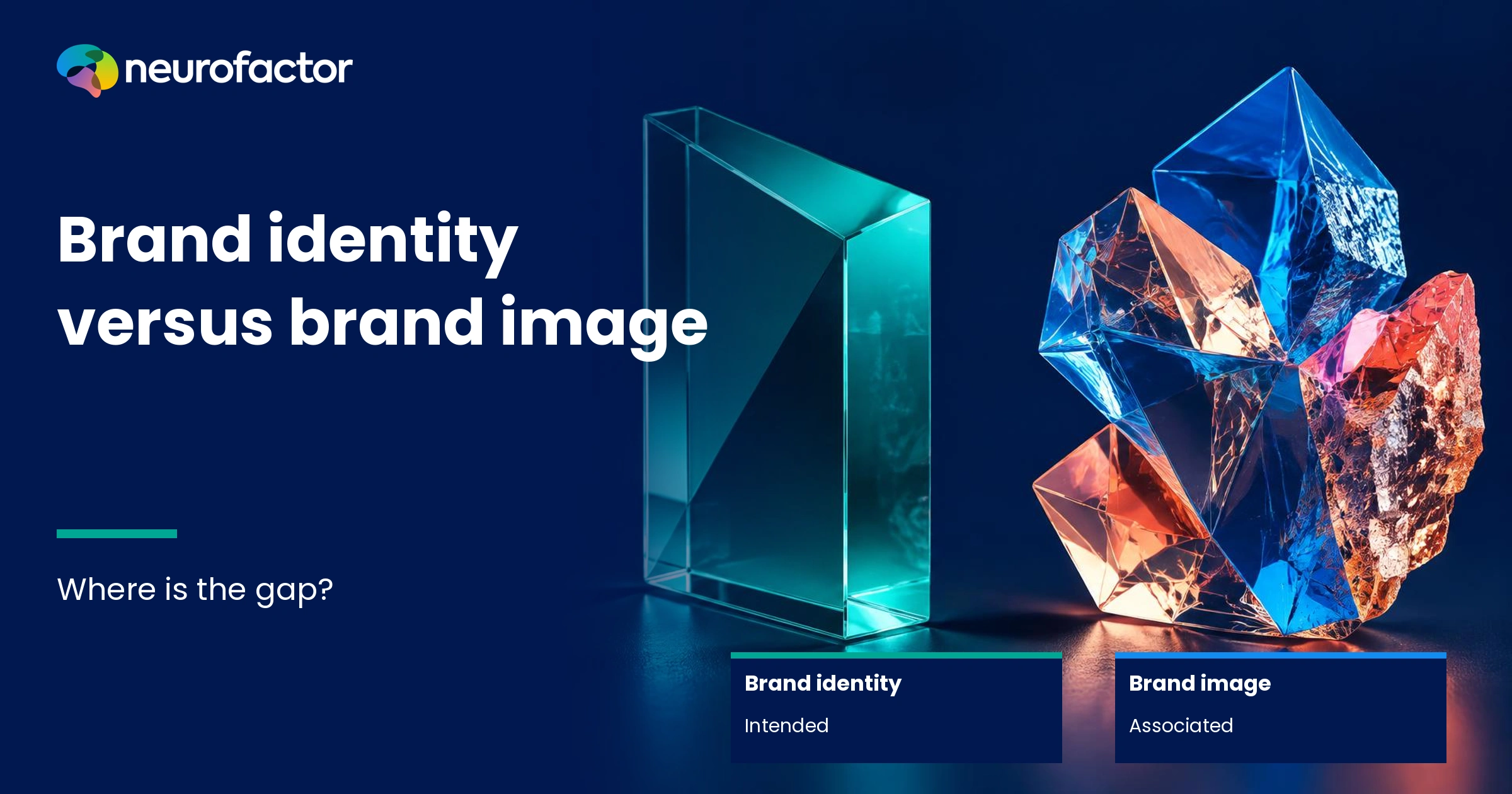
Brand identity versus brand image: which associations do not match?
A company can spend years telling the market it is innovative, personal and dependable. The leadership team recognises those words. So does marketing. But what happens when customers describe the brand without being shown its chosen values? They might say 'solid', 'distant' and 'complicated'. That difference cannot automatically be fixed with another campaign. It may reveal a gap between the meaning the organisation intends to create and the meaning people actually attach to the brand. Brand identity is intended meaning; brand image is the set of associations and evaluations held by a defined audience. Association research can examine the distance between them. Not by asking whether people like the visual identity, but by identifying what comes to mind, what those associations mean, how they are evaluated and whether they matter at a real choice point. [S01] [S02]
Your positioning lives in a document. Your image lives in people's minds.
Imagine a brand that promises simplicity. Its website says 'no hassle'. Its sales deck promises speed. Employees can repeat the values with confidence. Yet prospects describe the service as difficult to understand. Which side is right?
The question creates a false choice. The internal statement describes a strategic intention. People outside the company make sense of what they see, experience, hear and remember. Both accounts can be sincerely held and still disagree. A carefully articulated identity does not become a shared brand image merely because the company repeats it. [S02] [S03]
That is why brand research should not end with recognition. The more revealing question is what meaning becomes accessible when a decision is being made. An existing customer may remember support after a problem. A new prospect may rely on a peer's recommendation. A former customer may remember an unresolved issue. The same brand name can activate different associative routes depending on experience and context.
Brand identity, brand image and reputation are related, not identical.
Brand identity describes what an organisation wants to stand for and consistently deliver. It covers chosen values, positioning, personality, behaviour and evidence for its promises. Brand image concerns the associations and evaluations held by a particular audience. Reputation is related but often refers more broadly to judgments formed about an organisation over time. These perspectives overlap, but they should not be used as synonyms. [S01] [S02]
The problem begins when an intended identity is presented as an observed fact. 'We are known for personal service' is an empirical claim. It should be checked with people in a position to evaluate that service. A sentence in a brand book is not evidence of what customers think.
Brand identity
- Main question
- What do we intend to stand for?
- Typical evidence
- Strategy, leadership, employee behaviours, product promises
- Research task
- Define the intended meaning and the proof behind it
Brand image
- Main question
- What does this audience connect with the brand?
- Typical evidence
- Spontaneous and prompted associations, experience and evaluations
- Research task
- Identify accessible meanings, their valence and context
Reputation
- Main question
- How is the organisation judged over time?
- Typical evidence
- Stakeholder judgments and accumulated experience
- Research task
- Assess the broader evaluation and its resilience
Six different kinds of association gap.
A mismatch is not necessarily a negative opinion. Sometimes the desired meaning simply does not come to mind. Sometimes people use the right word but mean something else. Sometimes the claim is believed yet fails to distinguish the brand from competitors. If those situations are treated as one generic 'image problem', teams risk applying the wrong solution.
This is a practical diagnostic framework, not a separately validated scientific classification. The meaning of a response depends on the task, the respondent and the situation. Research should distinguish spontaneous answers, prompted judgments and interpretations introduced by the analyst. [S01] [S04]
Missing association
- Intended meaning
- Innovative
- Possible audience response
- Brand not recalled when innovation is discussed
- First diagnostic question
- Is the meaning sufficiently accessible?
Opposing association
- Intended meaning
- Simple
- Possible audience response
- Complicated
- First diagnostic question
- Is the actual offer or journey too complex?
Different interpretation
- Intended meaning
- Personal
- Possible audience response
- Intrusive
- First diagnostic question
- What does 'personal' mean to this audience?
Credibility gap
- Intended meaning
- Sustainable
- Possible audience response
- Nice words, little evidence
- First diagnostic question
- What proof is missing or contradicted?
Generic association
- Intended meaning
- Reliable
- Possible audience response
- Every established competitor is reliable
- First diagnostic question
- Is this expected hygiene or a genuine choice advantage?
Segment or context gap
- Intended meaning
- Freedom
- Possible audience response
- Autonomy for some, uncertainty for others
- First diagnostic question
- Who experiences which meaning and when?
An association network tells you more than a list of values.
Suppose two audiences both associate a brand with quality. A basic questionnaire suggests agreement. But the first group means durability and low maintenance, while the second means craftsmanship and exceptional design. The word matches; the underlying associations do not.
In his customer-based brand equity framework, Keller describes brand image in terms of associations in memory and distinguishes their strength, favourability and uniqueness. Krishnan empirically examined features including association set size, valence and uniqueness. John and colleagues introduced brand concept maps that elicit consumers' association networks and combine individual representations into a consensus map. Their research helps explain why understanding relationships among meanings can be more informative than reporting one overall approval score. [S01] [S04] [S05]
A network chart is not a brain scan. A line between concepts records a relationship defined by the research and coding procedure. Its width, colour and position only have quantitative meaning if the study actually defines and measures those features. An attractive network with no auditable method is a visual story, not independent evidence.
First, turn intended identity into measurable meaning.
Brand workshops often produce words such as accessible, human, innovative and premium. Those words are a starting point, not a measurement plan. Does accessible mean transparent pricing, easy onboarding, reaching a real person, or buying without an appointment? They are different expectations and may not appear together.
Ask the leadership team, brand team and relevant employees to identify three to five intended associations independently. For each one, record the specific experience, service behaviour or product attribute that should support it. Only then compare answers. If marketing promises personal attention while operations delivers highly standardised interactions, the organisation may have an internal alignment issue before customers enter the picture. [S02] [S03]
Prepare a short codebook with definitions, inclusion criteria and examples. Define what innovation should mean in this particular business: new capabilities, faster improvements or a genuinely different working method. Record what it does not mean. That reduces the risk of reading the intended claim back into ambiguous customer answers.
Measure external associations without supplying the answer.
Do not make the company's desired values the only response options. Start by asking what people spontaneously associate with the name. Invite concrete situations and keep their original wording before coding. 'Expensive' is not automatically negative: it might imply premium quality, or it might mean poor value. Ask what the respondent means rather than deciding for them.
Where appropriate, follow with prompted associations measured for the same brand and relevant alternatives. Separate unaided accessibility, prompted recognition, reported association strength and positive or negative evaluation. Keep records of item wording, display order and the category context in which the questions appeared. [S04] [S05]
Recruit participants who could plausibly face the actual choice. Current customers, new prospects, buyers who switched away and people using the category may have different information. A study restricted to loyal customers cannot automatically stand for the entire market. Sample composition, uncertainty and the intended decision must be made explicit.
Unaided, prompted and indirect tasks answer different questions.
There is no universal technique that reveals the one true image hidden inside everyone's mind. Each method captures a different response. Select methods based on the decision you need to make, rather than their technological appeal.
Indirect tasks may complement stated answers, but their scores depend on task construction and context. Fazio and Olson review these interpretive problems. EEG and eye tracking should not be used as if one signal automatically translates into one particular brand attribute. [S09]
Unaided associations
- Useful contribution
- What is accessible without suggested answers
- What it does not establish by itself
- That unmentioned associations are absent from memory
Prompted brand attributes
- Useful contribution
- Recognition, evaluation or reported strength of selected associations
- What it does not establish by itself
- Unaided salience or purchase behaviour
Association maps and follow-up interviews
- Useful contribution
- Connections between meanings and their interpretation
- What it does not establish by itself
- Literal neural connections
Reaction-time or indirect tasks
- Useful contribution
- Task-dependent and often relative association patterns
- What it does not establish by itself
- An individual's hidden buying intention
Behavioural or choice experiment
- Useful contribution
- Actions in a specified decision environment
- What it does not establish by itself
- The causal role of one association without a suitable design
Without competitors, you cannot identify meaningful distinctiveness.
Many brands want to be reliable, high quality and helpful. If buyers assign those same qualities to every competent supplier, the attributes might be expected category standards rather than reasons to choose your brand. Keller distinguishes strong, favourable and unique associations because they are different dimensions. [S01]
Use comparable wording and research conditions to examine relevant alternatives. Which brands are retrieved when people describe a need? Which associations are shared among competitors? Is an apparently unique association relevant and desirable in a real buying situation? Distinctive does not automatically mean beneficial.
Remember that the alternative may not be another brand. In B2B purchasing, a company may decide to do nothing. In consumer markets, the practical alternative may be an existing product that still works. Excluding that option can distort the interpretation of what makes the offer distinctive.
The same word can attract one person and repel another.
Exclusive sounds appealing in a positioning meeting. For one buyer it suggests craftsmanship and recognition. For another it suggests exclusion and an excessive price. Counting the word alone misses its meaning.
Ask which experiences and expectations respondents attach to an association. Separate whether a meaning is accessible from how it is evaluated. The first word that comes to mind is not necessarily the strongest influence on a decision. And a positive association may coexist with an important doubt. An associative profile is not simply a sum of favourable adjectives. [S05] [S07]
This also changes copy decisions. 'Personal service' may reassure someone seeking advice and annoy someone who wants to order independently without a conversation. Better messaging might require a choice of customer journeys, rather than replacing one headline with another.
Segments and choice moments produce different images.
One average figure makes a clean management slide, but it can conceal opposing patterns. Current customers know the delivery experience. Prospects often know the communication. Former customers may remember a specific event in which a promise was broken.
Compare segments only when their selection makes sense and uncertainty is reported. Small exploratory samples can generate dramatic differences that may not persist in a new sample. A group average is not a psychological diagnosis of each person in that group.
Context changes meaning too. During early exploration, innovative might mean attractive possibilities. Just before signing a contract, the same word can raise questions about stability, compatibility and support. Study identity-image gaps around actual decisions: considering, choosing, switching and staying. [S07] [S08]
Fictional example - an innovative brand meets a demand for certainty.
Fictional illustration, not a Neurofactor client study or measured result. Imagine a business software provider that describes itself as innovative, personal and simple. It really does offer new features and responsive people. Yet some prospects describe its offer as 'many possibilities, but complicated'. Existing users talk about flexibility and reachable support.
In this hypothetical case, innovative has not disappeared. Before purchase it also activates the idea of something not yet proven. Personal service is experienced by users, while prospects have not yet had evidence of it. Simple clashes with a difficult onboarding process. These are three distinct gaps, so applying one advertising fix to all three would be a mistake.
The first might require clear demonstrations and credible proof of reliability. The second needs tangible evidence of the support offered. The third may require a genuinely simpler onboarding process. Whether any measure works should be tested against a predefined outcome and, where possible, an appropriate comparison condition. There are deliberately no invented conversion rates or neurological scores in this example.
Five patterns, five different decisions.
A useful gap analysis does not stop at red marks next to missing brand values. It links the observed pattern to a falsifiable hypothesis and a decision that can be evaluated.
These are hypotheses, not proven causes. Low conversion may reflect distribution, price, timing or an unclear checkout. Do not use an association map as a substitute for studying the actual choice environment. [S07] [S08]
Intended meaning is rarely mentioned
- Possible explanation
- Few relevant memory cues
- Testable next step
- Improve distinctive contact moments and remeasure unaided recall
Meaning is mentioned but interpreted negatively
- Possible explanation
- Actual experience contradicts the claim
- Testable next step
- Investigate and improve the experience
Meaning is believed but generic
- Possible explanation
- Competitors credibly claim the same thing
- Testable next step
- Identify a relevant, provable additional distinction
Meaning differs between groups
- Possible explanation
- Different needs or previous experiences
- Testable next step
- Adapt proof to the context and test by segment
Positive association, no subsequent choice
- Possible explanation
- Brand not recalled at purchase or other barriers dominate
- Testable next step
- Examine availability, price, friction and observed choice
When should you change communication, and when the offer?
If a desired quality is genuinely delivered but barely recognised, communication may be the right starting point. Show the quality where the audience can understand and verify it. Instead of asserting reliability, demonstrate how a specific service commitment is honoured.
If negative associations reflect real product or service problems, improve those problems first. Repeating 'we make everything simple' while customers navigate unnecessary steps may widen the gap. Brand management is also about aligning staff behaviour, processes and culture with the promise. That is central to the work of de Chernatony and Harris. [S02] [S03]
There is a third possibility: the desired identity may be the wrong strategic choice. If the distinction is not relevant to the customer or is credibly owned by everyone in the category, investigate a position that offers meaningful and supportable value. Evidence should sometimes change the identity rather than merely be used to defend it.
A six-step identity-image association audit.
Step 1 - Specify the decision. For example, why is the brand regarded as competent but not accessible? Define the audience and choice moment.
Step 2 - Operationalise intended identity. Gather intended associations independently from internal stakeholders. Define what each term should mean in observable experience and proof.
Step 3 - Elicit external meaning without leading. Begin with spontaneous responses where feasible. Follow up with questions about meaning, comparable prompted tasks or a suitable indirect task only when warranted.
Step 4 - Make comparisons fair. Apply comparable questions across brands and audiences. Document samples, uncertainty, raw answers, coding rules and quality checks.
Step 5 - Test rival explanations. Examine actual service performance, category expectations, competitor positions, choice context and alternative barriers. A correlation or association is not by itself a causal diagnosis.
Step 6 - Evaluate the intervention. Predefine whether success means improved unaided associations, consideration, trial requests, purchase, repeat use or fewer support problems. Use an appropriate comparison design where feasible. Do not judge effectiveness only by whether the new campaign looks attractive.
What association research can and cannot establish.
Research can show which meanings are elicited, how they are evaluated and how their distribution varies across defined groups or conditions. It can identify where the intended internal pattern differs from an observed external pattern. John and colleagues demonstrate how consumer association networks can be systematically elicited and aggregated. [S04]
That does not establish that one unfavourable association caused a specific decline in sales. Nor does an indirect task read one person's secret purchase decision, a network diagram show neural wiring, or a higher association score guarantee market share. Claims of behavioural or commercial causality require suitable designs and evidence. [S09]
Disclose the sample, stimuli, operational definitions, coding decisions, exceptions and uncertainty. Label interpretations that remain hypotheses. The purpose is not to make uncertainty disappear but to make brand decisions better informed.
Four mistakes that can widen the gap.
Providing the desired answer. Show respondents the brand values and then declare that the values 'live'. You have measured prompted judgment, not necessarily spontaneous image.
Collapsing distinct meanings. Expensive, high quality and overpriced are related but do not mean the same thing. Use auditable coding rules and resolve ambiguous cases carefully.
Letting an average replace a decision. A positive overall evaluation can hide that one important audience encounters resistance at the moment of purchase. Examine context, segment and uncertainty.
Confusing persuasive copy with actual performance. A compelling story can coexist with poor delivery or frustrating service. Resolve the substantive issue before making a stronger promise. [S02] [S03] [S06]
Conclusion - stop asking whether the promise sounds good. Ask whether it is true for customers.
Brand identity gives direction. Brand image shows which meanings people attach to the brand. Association research becomes useful when it identifies precisely where the two diverge: missing associations, unexpected evaluations, unsupported promises, generic qualities and contextual differences.
The key question for a brand team is not 'Do people like our positioning?' It is 'What meaning comes to mind for the right audience at the relevant choice point, what evidence supports it and what must we actually change?'
That is the difference between a more polished story and a stronger brand. Sometimes the right move is to communicate real strengths more clearly. Sometimes the offer or experience needs improvement. And sometimes the organisation must admit that the identity it wants to claim is not yet the one customers experience.
For definitions and the broader series, see association research, associative networks and associations in marketing.
Key terms
- Brand identity
- The meaning a company intends its brand to convey and deliver, through positioning, behaviours and evidence.
- Brand image
- The associations and evaluations that a defined audience actually connects with a brand.
- Identity-image gap
- An evidenced difference between intended brand associations and those observed or measured among an audience.
- Unaided brand association
- A meaning that comes to mind without being supplied as a response option.
- Prompted brand association
- A brand-attribute link assessed after the attribute is explicitly presented.
- Associative differentiation
- A relevant, positive and relatively distinctive meaning linked to a brand in a defined choice situation.
Frequently asked questions
What is the difference between brand identity and brand image?
Brand identity is what an organisation aims to mean and deliver. Brand image concerns what a defined audience actually associates with it. An intended value cannot simply be assumed to exist in customers' minds. [S01] [S02]
How can you find an identity-image gap?
Define the intended associations first, then collect external spontaneous and prompted associations. Examine missing meanings, opposing evaluations, different interpretations, unsupported claims, non-distinctiveness and differences across audiences.
Is a satisfaction survey enough to measure brand image?
Not by itself. Satisfaction is an evaluation, while brand image also concerns accessible meanings, links among associations and the differences between competing brands. [S01] [S04]
What if people use the intended word but mean something different?
Ask for concrete experiences, investigate context and preserve original wording. "Personal" could describe helpful attention or unwelcome intrusion. Matching labels may conceal different meanings.
Does a gap always mean the brand needs more advertising?
No. If a real product or service experience contradicts the promise, improve the experience. Better communication is more plausible when the promised quality is genuinely delivered but poorly recognised. [S02] [S03]
Are implicit association tests automatically better than surveys?
No. Indirect tasks can add another perspective but have task-specific and context-sensitive limits. They do not independently reveal a person's hidden buying intentions. [S09]
Why compare a brand with competitors?
Because a positive association is not automatically unique or decision-relevant. It may be an expected feature of every credible provider in the category. [S01]
Does an association gap prove why people do not buy?
No. A gap can generate a testable hypothesis, but price, availability, switching costs and many other factors can explain the behaviour. Causal claims require appropriate additional evidence. [S08] [S09]
Sources
- 1.[S01] Keller, K. L. (1993). Conceptualizing, measuring, and managing customer-based brand equity - Journal of Marketing, 57(1), 1-22 (1993)
- 2.[S02] de Chernatony, L. (1999). Brand management through narrowing the gap between brand identity and brand reputation - Journal of Marketing Management, 15(1-3), 157-179 (1999)
- 3.[S03] Harris, F., & de Chernatony, L. (2001). Corporate branding and corporate brand performance - European Journal of Marketing, 35(3/4), 441-456 (2001)
- 4.[S04] John, D. R., Loken, B., Kim, K., & Monga, A. B. (2006). Brand concept maps: A methodology for identifying brand association networks - Journal of Marketing Research, 43(4), 549-563 (2006)
- 5.[S05] Krishnan, H. S. (1996). Characteristics of memory associations: A consumer-based brand equity perspective - International Journal of Research in Marketing, 13(4), 389-405 (1996)
- 6.[S06] Ross, J., & Harradine, R. (2011). Fashion value brands: The relationship between identity and image - Journal of Fashion Marketing and Management, 15(3), 306-325 (2011)
- 7.[S07] Romaniuk, J., & Sharp, B. (2004). Conceptualizing and measuring brand salience - Marketing Theory, 4(4), 327-342 (2004)
- 8.[S08] Nedungadi, P. (1990). Recall and consumer consideration sets: Influencing choice without altering brand evaluations - Journal of Consumer Research, 17(3), 263-276 (1990)
- 9.[S09] Fazio, R. H., & Olson, M. A. (2003). Implicit measures in social cognition research: Their meaning and use - Annual Review of Psychology, 54, 297-327 (2003)
Read next
Related topics
Reviewed by: Martijn den Otter · Last reviewed: 11/4/2026
Martijn den Otter
Oprichter van Neurofactor. Expert in neuromarketing en consumentenpsychologie.
LinkedIn →