
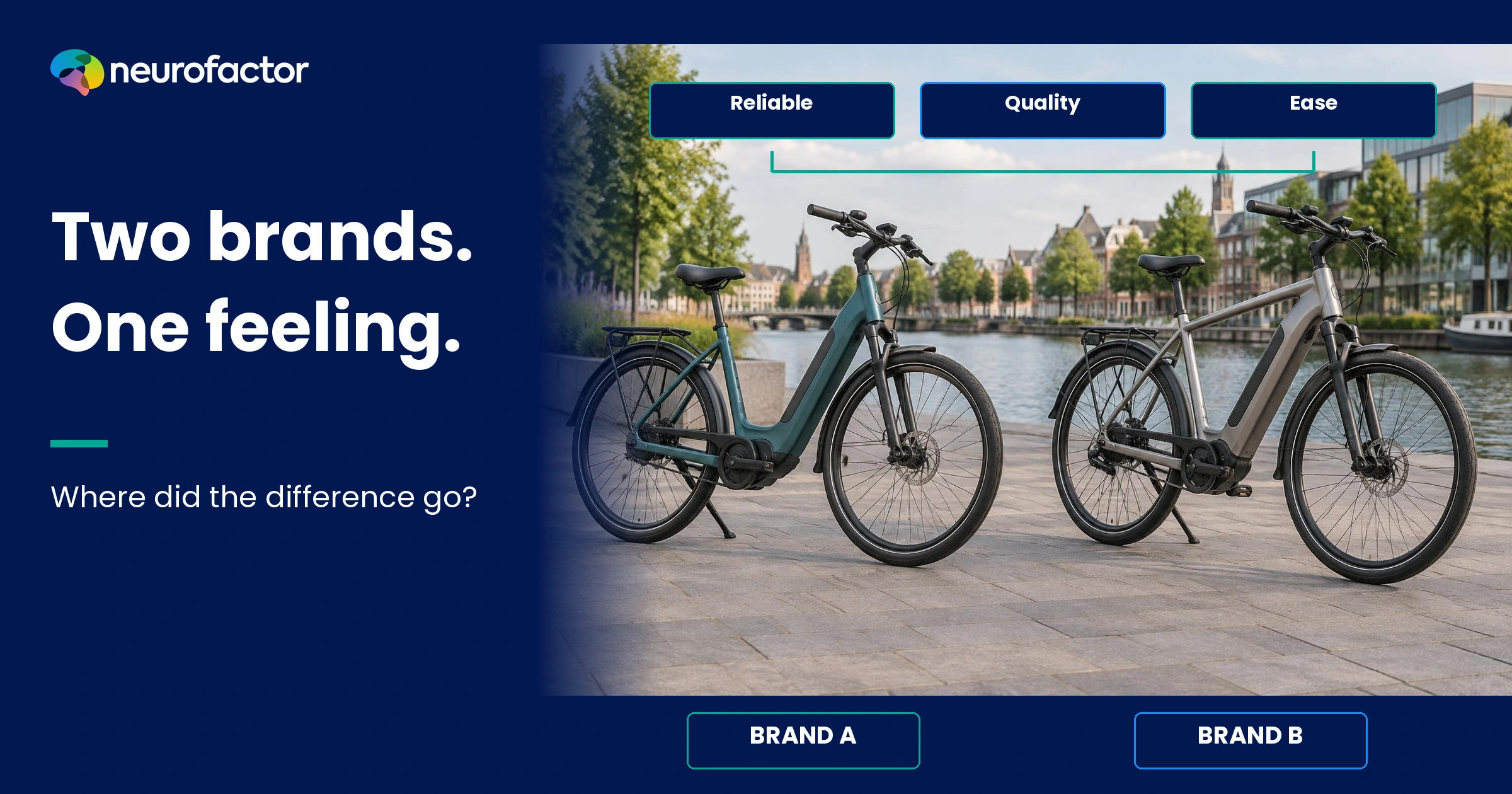
Why do two competing brands feel the same to customers?
You have a different product, a different story and a different visual identity. So does your competitor. Yet customers describe both brands in virtually the same language: reliable, innovative, high quality, customer-focused. If people attach the same meaning to both, is a new campaign really going to make the difference clear?
Two competing brands may feel the same to customers when they evoke largely overlapping associations and neither acquires a recognisable meaning of its own at the moment of choice. That does not mean the products are identical. It means that the differences people inside the business know so well are not sufficiently present in customer memory or in the context where the decision takes place. But shared associations are not automatically a problem. Sometimes they are the requirements for being considered a credible member of the category at all.
This article explains how to diagnose overlap, how to decide whether it warrants action and why a distinctive claim is not the same thing as a brand that gets recognised and chosen in real life.
Your brand may be different. The customer's memory may not be
Marketing teams know their brands from the inside. They know the engineering decisions, service standards, price structures and carefully defined values. Customers usually experience a brand from the outside, frequently for only a few seconds. This is where the mismatch begins: a difference that is decisive to the company may never become a distinctive mental connection for the buyer.
Imagine two fictional electric-bike brands. The first has invested in riding comfort over long distances. The second has engineered fast servicing and a practical battery system. Yet both advertise themselves with virtually identical imagery and language: freedom, sustainability, quality and worry-free riding. Ask a group of consumers for their first associations and they may supply the same list for both brands.
This does not establish that the bicycles are equivalent. It suggests that the communication might not make clear when and for whom the differences matter. One rider wants to finish a long weekend journey comfortably. Another wants a bicycle that is ready for the commute every single morning. A technical feature only becomes a commercially meaningful advantage when it answers a choice that a customer actually recognises.
Three reasons why competitors evoke similar associations
1. They legitimately share the category's basic requirements
A bank should be trustworthy. Software should appear usable. An electric bike should feel safe and well built. Such associations are not merely empty marketing language; they may be the conditions a brand has to meet before a buyer will consider it. If a brand fails on those basics, its supposed unique strengths might never get a hearing.
The first question, therefore, is not which association belongs to my brand alone? It is which associations does any credible brand in this category need to own? Establish those category expectations before identifying opportunities to build a useful difference.
2. The language changes, but the meaning does not
'Innovation that moves you forward' sounds different from 'intelligent solutions for tomorrow'. To a customer, both may simply mean modern, professional and vaguely promising. The sentences are different inside the marketing department, but their associative meaning is almost identical.
Visual branding can work the same way. Two businesses may have different logos yet rely on the same photography, editing, colour atmosphere, tone of voice and kinds of evidence. A logo might be recognisable in isolation without the message giving a buyer a different reason to choose that brand.
3. The advantage is not attributed to the right brand
A company may provide outstanding service, yet customers perceive excellent service as something the whole category should deliver. The advantage does not get credited to a specific brand. People may even remember the advertisement but forget whose advertisement it was. The link between meaning, brand identity and buying situation is missing.
The answer is not necessarily another brand promise. It may be more consistent brand attribution. Distinctive colours, packaging, sonic cues, names and a recognisable design system help only when people associate them with the correct brand. Being different is not the same thing as being identifiable.
Image
What can an association map reveal that a standard brand-image survey may miss?
Traditional questionnaires often ask respondents to rate brands against a predefined list of attributes. Those surveys can be useful. But if a researcher asks everyone about modernity, reliability and sustainability, those are also the words likely to dominate the answers. The instrument may narrow the very differences the project was intended to discover.
A richer diagnosis begins with the meaning consumers produce themselves. Which words, images, usage situations, emotions and expectations appear spontaneously? Which associations only emerge after prompting? How are associations linked to one another? Does the structure shift when people see the logo, hear the brand name or consider a real use case?
John and colleagues introduced brand concept maps, a method for eliciting consumer association networks and synthesising common structures across individual maps [2]. Imagine that 'reliable' links directly to 'long-lasting performance' for brand A, whereas the same word connects with 'fast after-sales support' for brand B. The vocabulary overlaps, but the network and the customer expectation behind the term do not have to be identical.
An explicit association map is not an implicit association measurement. A carefully designed response-time task may add evidence about relative automatic associations under the conditions of that task. It is not a direct scan of the brain, a universal brand-equity score or an automatic prediction of purchase behaviour. The method should follow the question, as explained on Neurofactor's research methods page.
Six questions to ask when comparing competitors
1. Which brands are genuine alternatives in the buying situation?
A company's competitor list is not necessarily the list customers retrieve from memory. Start with the situations that trigger a purchase or a search. Which brands come to mind without prompting? Which alternatives do buyers really compare? Study the customer's actual choice set instead of assuming that every player in a strategic presentation competes in the same way.
2. What is spontaneous and what appears only after a prompt?
Collect unprompted associations before presenting any descriptive words. Then, if the research question requires it, use a structured set of attributes to test more specific hypotheses. Keep these outcomes separate in the report. Mentioning an attribute spontaneously and agreeing with it after seeing a list are different signals.
3. How strong, favourable and accurately attributed is the connection?
Go beyond counting mentions. Is the association valued in this particular decision? Does it appear immediately or only after substantial prompting? Is the association shared across audience segments? Do respondents give the right brand credit for the benefit? Strength, valence, accessibility and exclusivity should not be collapsed into a single magic score.
4. Do customers, non-customers and audience segments have the same network?
Existing customers have usually had more direct experiences than people who barely know the brand. If you compare your own customer database with a general-market sample for your rival, you can manufacture a difference through sample composition alone. As far as possible, match audiences, familiarity levels and buying contexts. Treat small subgroups cautiously and make sample sizes transparent.
5. In what situation does the association matter?
Meaning changes with context. For a corporate buyer, 'convenience' might mean less administration. For a consumer, it might mean being able to use a product immediately. Look at recognisable stages of the journey: initial awareness, active comparison, trial, purchase and repeat choice. The relevant associations for a daily commute may differ from those for a weekend cycling trip.
6. Can the brand genuinely deliver what the association promises?
A word that customers find appealing is not necessarily a credible position. If buyers value personal contact but the company is almost impossible to reach, the promise can backfire. Tie every proposed association to demonstrable product capabilities, service behaviour or lived experience. Otherwise the campaign may widen the gap between expectation and reality.
Fictional example: two bicycle brands, nearly the same words
Suppose two fictional bicycle brands are compared during exploratory research. Both are described as durable, comfortable, liberating and dependable. A superficial interpretation would be that both positions have failed and each brand needs a new story immediately.
Look more closely. In a conversation about recreational long-distance rides, a respondent connects 'comfort' with knowing that several hours in the saddle will still feel pleasant. In a conversation about commuting, 'comfort' refers to a bike that is always ready and requires little maintenance. The word is the same. Its practical meaning, emotional consequence and supporting evidence are not.
That creates two hypotheses to test, not proven findings. Brand A could demonstrate the product decisions that make long rides comfortable. Brand B could show how its bicycle fits into a demanding working week. Neither brand necessarily needs to reinvent its identity. Each needs to connect a genuine capability to a customer meaning that can be recognised and checked.
The follow-up test might compare three types of stimulus: an unbranded product description, that description with the brand identified and a realistic usage scenario with the brand identified. Measure not just which claim sounds appealing, but whether the association is correctly attributed, which alternative enters consideration and whether an observed choice changes in a realistic setting. Choice experiments or behavioural data can strengthen the conclusion. The bicycles, proposed insights and testing plan are fictional illustrations. They are not Neurofactor customer results or measured research data.
Image
A meaningful difference is not the same as a distinctive brand cue
Two concepts are often confused in positioning discussions.
Meaningful differentiation refers to a perceived difference that might give a customer a reason to choose one brand over another in a particular context. An example would be demonstrably lower implementation risk for a buyer whose decision is dominated by that concern.
Distinctive brand assets are cues that make a brand identifiable: colours, shapes, name, sounds or recognisable visual language. These cues do not necessarily provide a rational or emotional purchasing advantage by themselves. Their job may be to help audiences recognise and correctly attribute the communication.
Both can play important roles. But research by Romaniuk and Gaillard found that unique brand associations did not automatically correspond to stronger preference or brand performance [4]. Claiming that every brand must possess one exclusive core association therefore overstates the evidence. The commercial objective is not to sound unique. It is to be recognised, considered and selected in the buying situations that matter.
Sometimes the right recommendation is to stop rewriting the proposition and make existing brand cues more consistent. In another case, recognition is strong but customers have no reason to value the offer more highly. That calls for attention to the offer and its proof, not simply a bolder logo.
Four decisions an association diagnosis may lead to
Decision 1 - Strengthen category fundamentals. If customers do not believe the brand can deliver the basics, a highly original message will not fix the issue. Establish credible evidence for service, safety, quality or basic reliability. Then measure whether the desired association becomes more accessible and believable.
Decision 2 - Make a relevant advantage concrete. If a genuine product benefit matters to buyers but does not come to mind, a rebrand may be premature. Translate the advantage into the buyer's situation and substantiate it with a demonstration, experience or credible data. Test whether the intended audience understands and values it.
Decision 3 - Improve recognition and attribution. If people remember an advertisement or a feeling but not the advertiser, work with recognisable brand cues more consistently. Check whether people can identify the brand even when the name is not explicitly shown.
Decision 4 - Build mental presence in buying situations. If the proposition is relevant but the brand is absent from consideration when a need arises, increase the link between the brand and those situations. That may involve communications, distribution and physical availability as well as brand assets. A strong association profile has limited value if buyers neither consider nor can obtain the product.
These are different paths from different diagnoses, not a compulsory four-stage programme. Sometimes the message needs work. Sometimes the product or the user experience needs fixing. In other cases, a new promise would create more noise than value.
How do you test whether the chosen approach works?
An association map is a diagnosis, not proof that an intervention succeeds. Define the intended result before producing the campaign or brand identity. Measure at least three levels.
For a creative experiment, randomly expose comparable respondents to carefully matched executions. Include an appropriate control condition where feasible, predefine the main outcome and keep the target population consistent. Do not test recognition exclusively among loyal users, and do not report purchase intention as though a transaction had occurred. If sales data are used, account for concurrent changes in price, promotion, seasonality and availability.
A favourable post-campaign attitude score by itself is not sufficient. A business decision should be based on how much useful recognition, relevant meaning and observed choice impact the investment actually produces.
Brand recognition
- What to measure
- Correct recognition and attribution of visual, sonic, packaging or message cues
- What it does and does not establish
- Shows whether the brand is identified, not whether it will be purchased.
Associative change
- What to measure
- Unprompted and, where suitable, implicit connections in a defined audience
- What it does and does not establish
- Shows whether intended meanings shift, not automatically why they shift.
Choice and behaviour
- What to measure
- Consideration in realistic scenarios, trials, conversion or actual sales
- What it does and does not establish
- Shows whether behaviour or choice changes; a causal claim needs a credible comparison.
What does this mean for a marketing team or CMO?
Avoid opening the brief with 'We need to differentiate more.' That chooses a creative solution before the underlying problem has been understood. Better questions are:
- Positioning: do buyers see us as similar because we meet the same category needs, or because we fail to communicate a meaningful advantage?
- Campaigns: do people remember our claim, and can they correctly attach it to our brand?
- Brand identity: are our identifying assets becoming easier to remember, or do we reinvent them so frequently that each campaign starts from zero?
- Segmentation: which groups have genuinely different buying questions, and which share enough common needs for a consistent offer?
- Conversion: are customers held back by weak brand associations, missing evidence, price, availability or friction in the purchase process?
- Research budgets: which concrete business decision would change if the association map revealed a particular pattern? If no one can answer that, the research brief is not yet specific enough.
Neurofactor's applications overview puts the behavioural question before the method. That order matters here: diagnose the buying problem, choose an appropriate measurement approach and only then design the response.
What association research can and cannot prove
Maps of brand associations do not reveal every unconscious mental process. Explicit responses can be shaped by language, memory, familiarity and the options supplied by the researcher. An implicit task measures specific responses under specific experimental conditions. A measured association difference does not, by itself, prove the cause of a purchase.
Large and familiar brands are often mentally available to more people across more situations. If you ignore differences in awareness, usage and category entry points, a higher number of association mentions may be mistaken for a better positioning strategy. Romaniuk and Sharp studied the relationship between brand perceptions and loyalty and found no simple rule under which a particular attribute or unique position guarantees loyalty [5].
For Neurofactor, the appropriate approach is to begin with an association diagnosis and combine it, when relevant, with qualitative work, stated preferences, behavioural data and controlled experiments. EEG and eye tracking can add value when attention or moment-by-moment response is part of the question; neither is a general-purpose purchase detector. No one method is a universal 'buy button' or a complete explanation of brand performance.
Conclusion: not every shared feeling is a problem
Competing brands can feel the same because customers connect them with similar meanings in a specific choice situation. Sometimes that creates unnecessary interchangeability. Sometimes it reflects the expectations that make a product category understandable and credible in the first place.
The opportunity is not to invent an exclusive brand association at any cost. Find out which meanings customers share, which differences they genuinely recognise and what makes them consider one brand rather than another at a specific moment. Only then can you decide whether the answer lies in better product proof, more consistent brand cues or stronger presence where choices are made.
Key terms
- Brand association
- a meaning, expectation, memory, image or feeling linked to a brand in a given context.
- Association network
- a structure of interconnected meanings attached to a brand; both the associations and their relationships can be informative.
- Category expectation
- an attribute or condition buyers generally need to believe a brand fulfils before considering it credible within a category.
- Meaningful differentiation
- a perceived difference that can give buyers a reason to prefer one option in a specific situation.
- Distinctive brand assets
- visual, auditory or verbal signals that help people identify a brand and attribute communication to it.
- Mental availability
- the likelihood of a brand coming to mind in relevant buying or usage situations.
Frequently asked questions
Why do competing brands often have similar associations?
They share category requirements and often communicate with similar claims, benefits and expectations. Genuine product differences may also fail to become linked to a specific brand. The cause has to be investigated for the audience and buying situation in question.
Is it bad if both brands are associated with quality?
Not necessarily. Quality may be a basic category expectation. Similarity becomes a commercial issue when buyers in a particular situation have little reason to consider one brand rather than another.
How can you measure whether brands are mentally interchangeable?
Compare spontaneous and prompted associations, brand attribution, recognition and the relevant choice context. Where possible, add behavioural evidence. Simply placing two lists of words side by side does not establish interchangeability.
What is the difference between brand differentiation and distinctive assets?
Differentiation is about a perceived, potentially valuable difference. Distinctive brand assets are identifiable cues such as colour, shape, name or sound. They serve different purposes and should be measured separately.
Can implicit association research predict purchases?
A suitably designed implicit task can provide evidence about relative automatic associations. It is not a direct purchase prediction. Claims about choice or sales require additional validation and behavioural measurement.
Does every brand need a completely unique association?
No. Research has found brands competing successfully despite limited perceived differentiation. Credible category performance, recognition, relevance and availability at buying moments still matter.
Sources
- 1.Conceptualizing, Measuring, and Managing Customer-Based Brand Equity - Journal of Marketing (1993)
- 2.Brand Concept Maps: A Methodology for Identifying Brand Association Networks - Journal of Marketing Research (2006)
- 3.Evidence concerning the importance of perceived brand differentiation - Australasian Marketing Journal (2007)
- 4.The relationship between unique brand associations, brand usage and brand performance: analysis across eight categories - Journal of Marketing Management (2007)
- 5.Measuring brand perceptions: Testing quantity and quality - Journal of Targeting, Measurement and Analysis for Marketing (2003)
Reviewed by: Martijn den Otter · Last reviewed: 10/30/2026
Martijn den Otter
Oprichter van Neurofactor. Expert in neuromarketing en consumentenpsychologie.
LinkedIn →