
From association clusters to a content strategy that answers real questions
Two people look for the same solution but need different answers. A keyword list captures only part of that difference. One person wants to know whether the investment is safe; another worries that daily use will become complicated. The content task is therefore not to publish another general product article, but to provide a credible answer to each meaningful concern. This article shows how to move from researched association clusters to questions, evidence, sequencing and a testable content strategy. All examples are hypotheses or illustrations, not claimed Neurofactor findings.
The visitor may be asking a different question
Two visitors type exactly the same words into a search engine. One needs reassurance; another wants to explore possibilities. In a search dashboard, they look like one audience with one intention. In conversation, their information needs prove quite different. The first asks what could go wrong and who would take responsibility. The second wants to imagine how the solution fits everyday life. If both are shown the same broad brand story, neither may get the answer they need. That tension drives this article. A useful content strategy begins with meanings attached to a decision, the evidence people need to judge those meanings and the moment when the answer becomes relevant - not merely with a calendar of topics.
One query can hide several mental starting points
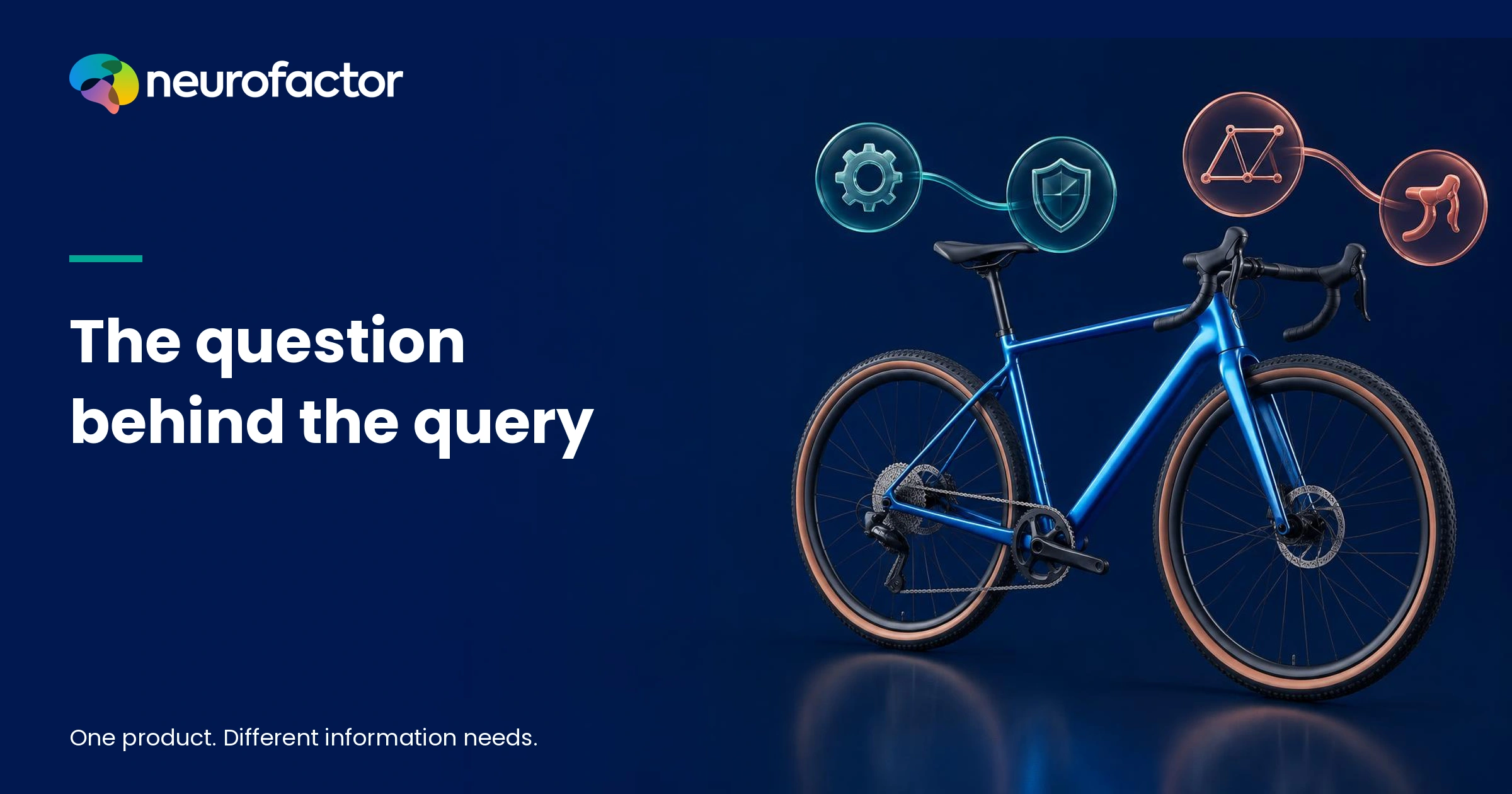
Imagine someone searching for 'sustainable bike'. To one person, sustainability means a frame that will remain reliable for years. To another, it means easy repairs so a fault does not require replacement. A third may care about material provenance, while a fourth refuses to sacrifice ride performance. These are plausible pathways, not empirically identified segments. A generic landing page can mention all four and still bury the crucial answer. The aim is not to put visitors into rigid personality boxes. It is to make their different questions visible and allow them to reach relevant evidence without unnecessary detours. That requires combining research into associations with observation of how people actually look for information.
What exactly is an association cluster?
An association cluster is a collection of meanings that appear to be related within a studied audience. For a product, 'reliable', 'long-lasting' and 'worry-free' might form one cluster. A cluster may also contain tension: 'sustainable' alongside 'expensive' or 'difficult to repair'. The connections should emerge from a stated research procedure, not from a marketing team's preference. John and colleagues developed Brand Concept Maps to elicit and aggregate networks of brand associations [S1]. Krishnan investigated characteristics including association set size, valence and uniqueness [S2]. A word cloud assembled during an internal workshop is therefore not a scientifically established association cluster. It can, however, provide hypotheses worth testing with the relevant audience.
Start with the decision, not with a content format
Finding an 'assurance' cluster does not automatically call for a white paper. First ask which decision is being postponed and why. Is the uncertainty about product failure, financial consequences, social approval or the visitor's own expertise? Those concerns require different proof. A demonstration can show how maintenance works. Clear warranty terms establish responsibility. An owner story can make a use case vivid, but cannot replace an independent performance test. The sequence should therefore be meaning, decision, question, evidence need and only then format. A comparison page, FAQ, demonstration, independent test, calculator or conversation becomes useful because it answers the right question, not because it fills a content calendar.
The same keyword can represent a different question
This matrix contains hypothetical interpretations, not research findings. It illustrates why one search phrase is insufficient evidence for deciding which message should come first.
sustainable bicycle
- Possible association
- reliability
- Question behind it
- How long will the frame last?
- Useful evidence
- Warranty terms and test method
sustainable bicycle
- Possible association
- avoiding hassle
- Question behind it
- Can parts be replaced easily?
- Useful evidence
- Service flow and parts overview
sustainable bicycle
- Possible association
- identity and style
- Question behind it
- Does it suit how I ride?
- Useful evidence
- Realistic use cases
sustainable bicycle
- Possible association
- responsibility
- Question behind it
- What supports the sustainability claim?
- Useful evidence
- Traceable material information
A cluster is not a personality type
A visitor who needs reassurance today may seek speed tomorrow. The same person may decide quickly on a minor purchase but investigate an expensive one carefully. Treat clusters as context-bound patterns to investigate, not as fixed personality labels. Do not call someone an 'anxious type' or an 'adventurer' because of one answer. Positive and negative meanings can also coexist: 'innovative' and 'complicated' may refer to the same brand. Koll and von Wallpach provide an important correction to simplistic brand management: matching intended and actual brand associations did not add explanatory power after accounting for the number and valence of associations [S3]. A management-approved association is not automatically the one that makes the visitor's decision easier.
Search intent and brand meaning live at different levels
Search intent concerns the immediate goal: finding information, comparing options, reaching a known website or taking action. Rose and Levinson studied the diverse goals found behind web queries [S5]. Associations concern what the subject means to a person. A search for 'gravel bike maintenance' may be driven by enthusiasm for mechanics or anxiety about surprise expenses. That distinction cannot be read reliably from the words alone. Historical search-log research reveals behavior patterns, not complete motivations [S6]. Use query data to observe what was asked and association research to investigate possible reasons, without treating either data source as a mind-reading device. Brucks also found in an experimental information-search task that product-category knowledge influenced search efficiency [S4]. That supports accounting for prior knowledge, not assigning people immutable content personas.
Write hypotheses that can be disproved
Replace 'our audience wants reassurance' with a testable statement. For example: 'Among people with little experience of this material, explicit maintenance terms will be recognized as more relevant proof than an atmospheric brand story'. Then decide in advance what observation would contradict it. If the brand story leads to better understanding and more appropriate next steps, revise the assumption. A usable content brief should specify the topic, search phrase, hypothesized meaning, audience context, evidence required and disconfirming outcome. Otherwise the association map risks becoming an impressive workshop artifact that changes nothing about the content you actually publish.
One brand promise may require several types of proof
A brand may choose 'reliability' as a central promise. Reliability becomes useful only when you know what it means in the visitor's situation. For someone worried about hidden costs, it means transparent terms. For an intensive user, it means demonstrated durability. For a professional recommending a supplier, it may mean repeatable service performance. The brand promise can remain consistent while the evidence varies with the decision. In an advertising experiment, Petty, Cacioppo and Schumann found that argument quality and peripheral cues had different effects depending on involvement [S8]. That is not a formula for website structure, but a reminder that one persuasive route is unlikely to serve every decision equally well.
Four clusters and four possible answer routes
This is a content design proposal linking tensions to an initial answer. None of the paths is validated until visitors demonstrate that the questions and proof are relevant.
Assurance
- Underlying tension
- What can go wrong?
- First answer
- Limits and warranties
- Follow-up content
- Long-term test
- Poor sequencing risk
- Inspiration before risk clarification
Convenience
- Underlying tension
- How much extra effort?
- First answer
- Practical steps
- Follow-up content
- Service demonstration
- Poor sequencing risk
- Technical report before basics
Value
- Underlying tension
- Is it worth the money?
- First answer
- Clear total cost
- Follow-up content
- Comparison and scenario
- Poor sequencing risk
- Price without decision context
Identity
- Underlying tension
- Will it suit me?
- First answer
- Relevant use situation
- Follow-up content
- Owner experience
- Poor sequencing risk
- Generic product claim
The first answer matters more than the amount of explanation
A page can be accurate and comprehensive yet take too long to address the visitor's real question. Someone questioning warranty coverage does not need three screens of corporate history before the conditions appear. You can explain the history of a promise, but after answering what matters. Research on information scent examines how people use cues in labels and links to estimate where useful information might be found [S7]. That makes headings and link copy part of the decision design. The promise of a link must match what lies behind it. 'How we ensure quality' is helpful only when the destination presents actual standards, limitations or a verifiable procedure.
Not every unanswered question is a content problem
Research sometimes reveals that the visitor is not missing information. The underlying objection may be real: delivery takes too long, the warranty excludes an important risk or the software lacks adequate privacy controls. Better copy cannot fix that. Content should describe such limitations honestly, not disguise them. Maintain an action list for product, service and policy alongside the editorial calendar. If the strongest association is 'unreachable', a headline test can only check whether a promise is understood. It does not make support more available. Good association research should influence what a company changes as well as what it says. Otherwise the content may become more persuasive while the experience stays disappointing.
Build a content matrix with four mandatory columns
For each cluster record the possible meaning, the decision affected, the exact audience question and the evidence required. A fifth column can specify format. Give every row a research identifier and its source: interview, open association, support conversation or search query. Keep observation separate from interpretation. This prevents a workshop phrase such as 'people want trust' from turning into an unsupported universal claim on a website. A content matrix also improves the handover to writers. They know not just which piece to produce, but why the answer matters, what source supports it and which tempting wording would promise more than the evidence allows.
Image
Evaluate whether proof is understood, not just whether copy reads well
After a short reading task, ask participants to explain what the company is actually promising. Which piece of evidence did they notice? Which objection remains unanswered? A page may feel pleasant while the central proof goes unnoticed. Conversely, a plain comparison can deliver the right answer more quickly than an impressive story. Do not limit evaluation to attractiveness or a general satisfaction score. Measure whether people understand conditions, recognize limitations and identify an appropriate next step. If you compare headings or content order, hold other factors reasonably constant. Define improvement criteria in advance and report whether one version makes a different subgroup worse off.
Turn the association map into a sensible answer sequence
Start at the first moment when a particular doubt influences the decision. A new product may require a basic explanation: what is it, who is it for and what is the most important limitation? Later come questions about performance, support, cost or switching from an existing solution. Order these questions by dependency, not only by search volume. A technical report is hard to judge before someone understands why its measured attribute matters. A price comparison is misleading if the offers do not solve the same problem. A content route becomes a sequence of checkable answers, each serving a specific purpose with clear ways to continue, return or seek advice.
Fictional case: same search, different content entry
The following case is entirely fictional. None of the scenarios are measurements or results from an actual study. The table shows testable hypotheses for a visitor study.
Sanne
- Visible query
- buy titanium gravel bike
- Underlying question - hypothesis
- Will it be a reassuring long-term choice?
- First content
- Warranty and maintenance
- Next step
- Compare specifications
Milan
- Visible query
- buy titanium gravel bike
- Underlying question - hypothesis
- Will it deliver the riding experience I want?
- First content
- Handling and fit
- Next step
- Test ride or advice
Both
- Visible query
- same search query
- Underlying question - hypothesis
- Two meanings, not fixed personality types
- First content
- Let the visitor select a concern
- Next step
- Provide relevant evidence
Editorial team
- Visible query
- hypothetical interpretations
- Underlying question - hypothesis
- Audience difference not measured
- First content
- Test both entrances
- Next step
- Measure understanding and fit
The entirely fictional Atelier Kade case
Imagine Atelier Kade, an entirely fictional bicycle maker offering a titanium gravel bike. The marketing team wants to talk about craftsmanship and sustainability because those are its preferred brand words. In a hypothetical exploratory interview, two different interpretations might appear. Sanne views titanium as a long-term investment and wants clarity about its lifetime. Milan links the same material to sporting performance but is unsure whether the bike fits his style of riding. Both search for a 'titanium gravel bike'. Atelier Kade does not necessarily need a different brand promise. It needs distinct routes from the visitor's real question to relevant evidence. The company, people, conversations and presumed findings are all invented for illustration. No respondents have been interviewed and no effects have been measured.
Sanne needs to understand the risk first
For Sanne, the best content path may begin with 'What happens if something goes wrong in six years?' Warranty terms, exclusions, maintenance steps and parts availability may then matter more than a cinematic film about freedom on gravel roads. This is a hypothesis, not a description of real consumers. How would we test it? Give participants with a similar decision context the page without directing them to the relevant answer. Afterwards, ask which risks they still perceive and what responsibility the manufacturer actually accepts. If participants remember the terms incorrectly, the content needs work even when they describe the brand as warm or premium. The explanation should become clearer, more visible or more honest.
Milan seeks the experience behind the specification
Milan may be using the same query to ask 'Will this be a bike I enjoy riding over long distances?' Fit, comfort, weight and handling across surfaces may matter more to him than a long warranty page as the opening screen. A carefully documented test ride, understandable geometry explanation and honest trade-off comparison could become the right entry point. This is not an established segment. Test whether participants understand which properties fit their use, and whether they select a relevant test ride or advice question. Simply ticking 'sporty' is not enough. The important outcome is whether the content supports an informed judgment and clearly identifies expectations that the product may not meet.
Image
Design two honest entrances, not two different websites
Atelier Kade does not need to become two contradictory brands. One product page can offer two clear entrances: 'First, understand how long it will last' or 'First, discover how it rides'. Both lead to different sections of the same factual foundation. Warranty claims remain identical, specifications do not change and important limitations are never concealed. Visitors can move between both paths. That prevents personalization from becoming manipulation. Evaluate not only which option attracts more clicks, but whether people find accurate information and can explain their decision. The route succeeds when it improves the decision, even if the informed decision is not to buy. That is a more credible definition of persuasive communication.
Turn a broad topic into a usable writing brief
Consider a proposed article on 'why titanium suits heavy use'. If a writer receives only a headline and three keywords, a generic list of material benefits is likely. An association-led brief adds the audience context, hypothesized concern, precise question, credible proof, likely counterargument, desired understanding and appropriate next action. A claim such as 'will last a lifetime' is only permitted when it can be justified under clearly defined conditions. Otherwise the content should state what is known, what maintenance is required and which uses fall outside the warranty. That may sound less dramatic, but it is more useful and trustworthy. The brief gives writers permission to qualify brand claims rather than amplifying them mechanically.
Why search volume is not proof of motivation
A high-volume search term helps distribution planning, but does not reveal which objection matters most. Even brand-related searches have multiple causes. Dotson and colleagues connected individual search behavior with brand attitudes and found associations that also reflected category engagement and prior familiarity [S9]. Their evidence was correlational. We cannot conclude that higher branded search volume necessarily means stronger trust, much less that one article caused that trust. Use search volume to understand discoverability and potential demand for a topic. Use interviews and targeted tests to investigate the meanings visitors may be seeking. Combine the evidence, but do not substitute search analytics for the psychological question.
The largest association is not automatically the top content priority
An association can be common yet tell little about the moment when a decision stalls. 'Beautiful' may appear frequently while 'unclear service terms' is mentioned by a smaller group. That group might nevertheless leave just before purchase. Conversely, a rare emotional word is not necessarily commercially decisive. Prioritize according to three questions: does this meaning affect a real decision, can the brand offer credible proof or a genuine solution, and can the consequences be evaluated responsibly? Consider the cost of misunderstanding as well. A transparent answer that discourages unsuitable buyers may be more valuable than copy that attracts clicks and disappoints people later. Present prioritization as a reasoned decision, not a supposedly objective brain score.
Write navigation labels that make questions recognizable
A menu label such as 'Our solutions' describes the company perspective. A link that says 'What happens if a part breaks?' describes the visitor's concern. Both can serve a purpose, but they are not interchangeable. Give pages titles that honestly predict their answers, group related questions on a hub and connect simple explanations with deeper evidence. In a usability task, ask people to predict what a link will open before they click. An unclear label can make an otherwise correct article effectively invisible. Information-scent research provides theoretical and empirical reasons to take link cues seriously [S7], but the usefulness of a particular label still needs testing with the intended audience.
What should be measured between question and decision?
The matrix prevents high click counts from being treated as proven comprehension or persuasion. The indicators are proposed measurement points, not observed outcomes.
Before publishing
- Measure
- Open associations and questions
- Invalid interpretation
- Search volume = motivation
- Responsible application
- Form cluster hypotheses
During use
- Measure
- Task comprehension and findability
- Invalid interpretation
- Click = conviction
- Responsible application
- Test comprehension with relevant users
After the answer
- Measure
- Evidence recognition and confidence
- Invalid interpretation
- Confidence = purchase intent
- Responsible application
- Use specific assessment questions
After choice
- Measure
- Relevant enquiries and decisions
- Invalid interpretation
- More conversions = proven causality
- Responsible application
- Test against comparable groups
Build an architecture that can accommodate several questions
An actionable strategy needs more than standalone articles. Use a hub for the broad decision, dedicated pieces for major association clusters and a strong proof element on the page where a decision is made. A knowledge base defines terms; a blog examines a meaningful tension; a case documents a verified application; a product page states current terms and limitations. These roles support one another without publishing the same text four times. Place follow-up questions where they naturally arise, not only in an unrelated-content sidebar. The architecture is not a rigid funnel. Visitors should always be able to return to the facts or choose another question without losing context.
Give every page one primary job
Define whether a page should explain a concept, answer an objection, support a comparison or enable an appropriate next step. Add an explicit 'done when' criterion to the brief. A warranty explanation is done when a test participant can accurately state its duration, exclusions and procedure. A comparison is done when users understand which attributes are genuinely comparable and which are not. Quality assurance then becomes substantive rather than purely editorial. It also prevents pages from being judged by keyword repetition. A clear, complete and honest answer to the primary question is a much more meaningful acceptance criterion.
Research hygiene matters more than impressive equipment
You do not need an EEG headset to learn that visitors misunderstand warranty terms. A careful interview, open-association task or usability study may be entirely sufficient. Implicit association tasks can under specified conditions explore relative associations in a particular measurement setup. Reaction times are not a direct reading of thoughts. EEG records electrical brain activity, not standalone words such as 'trust' or 'purchase intention'. Choose the simplest valid method for the question and document conditions, exclusions, order effects and analytical decisions. Pay attention to consent, data minimization and privacy whenever responses are linked at the individual level. Methodological restraint is part of credible neuroscience-informed marketing, not a concession.
A six-step protocol makes the method testable
The research protocol in this package follows six steps: define the decision and audience, elicit open associations, validate clusters and questions, develop comparable content variants, measure understanding apart from behavior, then analyze and refine. Decide what constitutes improvement before testing begins. It could mean fewer misconceptions about service, better recognition of relevant specifications or more appropriate requests for advice. Do not invent benchmarks or present mean reaction time as proof of purchase intent. If a result is found, specify the participants, content, context and observation period to which it applies. The practical value lies in making decisions testable, not in claiming a universal recipe for higher conversion.
What SEO and AI answer visibility can actually contribute
SEO helps people discover the relevant question and allows search systems to understand the page. For AI answer systems, the priority is that a claim can be summarized accurately with its source and context intact. Both benefit from the same editorial discipline: a direct answer near the top, jargon-free definitions, clear headings, genuinely comparative tables and an explicit distinction between published evidence and local hypotheses. Neither search ranking nor AI citations can be guaranteed. FAQPage markup is conditional on the FAQ being visible and does not promise a Google FAQ rich result. Canonical URLs, hreflang, publication date and final image addresses must be approved only when the actual localized pages exist in the CMS.
Turn an editorial plan into accountable ownership
Do not allow a content decision to vanish between marketing, sales, research and product management. Assign an owner to validate the research interpretation, another to verify factual product claims, a writer for the explanation and a named approver for publication. An unsupported durability claim must not enter the CMS just because the keyword opportunity looks attractive. Define review triggers, such as changed warranty conditions or a new product version. Monitor which questions continue to reach customer support: they may indicate that the content is difficult to find, difficult to understand or factually incomplete. The result is a learning system rather than a one-off publishing calendar. A responsible workflow also records corrections, uncertainty and the source of each important claim.
A better content path need not persuade everyone
Some visitors are genuinely not a good fit for a product. Useful content may help them discover that. This is not failure. A campaign that creates a misleading expectation can earn a click today and strengthen the association 'untrustworthy' later. Measure the quality of the decision, confidence grounded in correct facts and the questions that remain unanswered. Content can acknowledge differences between audiences while keeping the underlying facts consistent. If a product is unsuitable in a particular situation, that limitation must not vanish in the fast route. The strongest content does not turn every question into 'buy now'. It helps someone make an informed judgment about whether the offer is appropriate.
The right content is the answer that moves a decision forward
Moving from association clusters to content strategy is more than grouping keywords, assigning topics and adding a few FAQs. You investigate meanings that coexist, the decisions they influence and the questions they create. You then surface the relevant evidence, choose a coherent order and test whether visitors can actually use the answer. The method must remain disciplined: an association map is an interpretation of observed data, not a window into someone's mind. A query is a behavior, not a complete motive. A click is not conviction. When marketing respects those distinctions, content becomes less a stream of statements the company wants to deliver and more a useful set of answers that helps real people make better-informed choices.
Key terms
- proof asset
- Verifiable evidence, demonstration or experience that helps assess a specific concern.
- content path
- A structured sequence of answers from an initial question toward an appropriate decision.
- search intent
- The immediate objective a person wants to achieve through a search.
- information scent
- The perceived likelihood, inferred from labels and links, that the next page contains useful information.
- association cluster
- A research-derived group of related meanings surrounding a brand, topic or decision.
Frequently asked questions
What is an association cluster?
An association cluster is an analytically grouped set of meanings people connect with a brand, solution or decision. The grouping must be supported by research; a theme invented in a workshop is not automatically a measured audience cluster.
How does search intent differ from an association?
Search intent describes the immediate purpose of a search. An association is a meaning or expectation attached to a subject. The same query can reflect different associations, and the same association may appear in several queries.
How do you turn an association cluster into content?
Translate the hypothesized meaning into a precise audience question, identify credible evidence, select a format and locate it along the decision journey. Test understanding and real use rather than assuming the content will work.
Does every content strategy require EEG or implicit tests?
No. Choose methods for the question, not for their novelty. Interviews, open associations and usability tests may be sufficient. Implicit and physiological measures require their own validated protocols and careful interpretation.
Will this approach automatically improve conversions?
No. It makes choices testable. Assess comprehension, appropriate next actions, qualified leads and conversion separately, while accounting for differences in audience, channels and offers.
Sources
- 1.Brand Concept Maps: A Methodology for Identifying Brand Association Networks
- 2.Characteristics of memory associations: A consumer-based brand equity perspective
- 3.Intended brand associations: Do they really drive consumer response?
- 4.The Effects of Product Class Knowledge on Information Search Behavior
- 5.Understanding User Goals in Web Search
- 6.Real life, real users, and real needs: a study and analysis of user queries on the web
- 7.Using Information Scent to Model User Information Needs and Actions on the Web
- 8.Central and Peripheral Routes to Advertising Effectiveness: The Moderating Role of Involvement
- 9.Brand Attitudes and Search Engine Queries
Read next
Reviewed by: Martijn den Otter · Last reviewed: 11/6/2026
Martijn den Otter
Oprichter van Neurofactor. Expert in neuromarketing en consumentenpsychologie.
LinkedIn →