
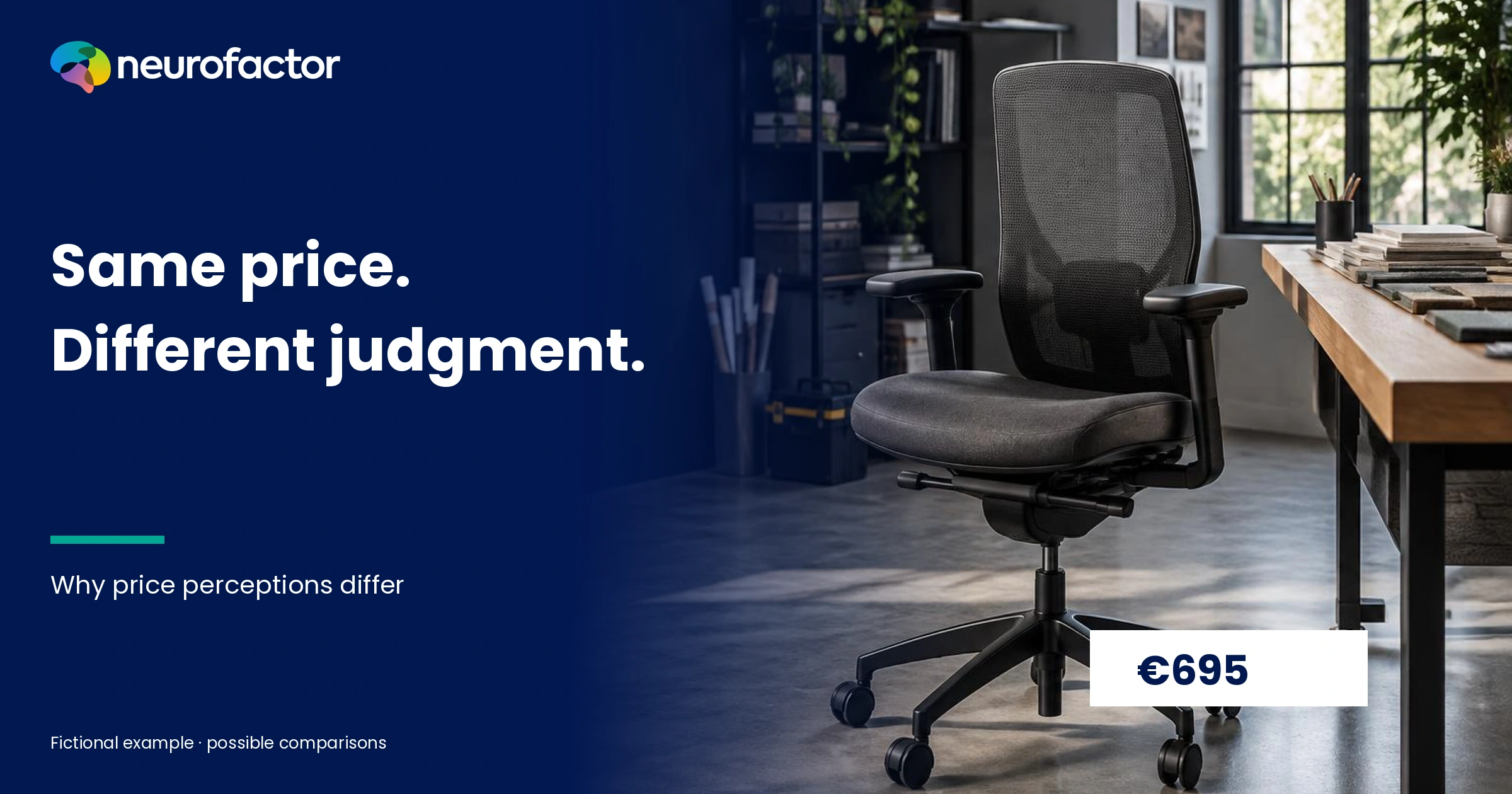
Why does the same price feel fair to one customer and too high to another?
A price tag displays one figure. Yet two people may see very different things when that figure appears. For one buyer, €695 for an office chair designed for professional use looks like a defensible investment in something intended to last. Another buyer compares it with a familiar mainstream alternative and considers it excessive. A third can afford the chair, accepts its quality, but wonders why someone else was offered a lower price last month. The conversation sounds as if it concerns money alone. In reality, several judgments are interacting: What am I getting? What am I comparing this with? What could go wrong? And is the way the seller arrived at this price reasonable? A price is a number. Its meaning is constructed in the customer's context. That is why effective pricing research cannot end with asking whether a figure is high or low.
The price is visible. The comparison in the buyer's mind is not
Imagine a marketing team presenting a new offer. The product page is well designed, the claims are accurate, and the price is clearly displayed. One visitor calls it 'expensive, but understandable'. Another responds, 'Far too expensive'. The post-campaign review concludes that the brand needs to explain its value more convincingly. Perhaps it does. But perhaps the second visitor needs the product only twice a year. Perhaps they are comparing it with a completely different category. Perhaps the budget genuinely is not available. Meanwhile, the first visitor might reconsider the fairness of the price when confronted with a countdown offer that does not seem credible.
What exactly is someone evaluating when they look at a price? First, the monetary sacrifice: how much money would leave their account? Second, the exchange: what would they receive in return? Third, the benchmark: what does a comparable product usually cost? Fourth, the procedure: is the price consistent, understandable and justifiable? Fifth, the personal or social meaning: what does this purchase say about the person or organisation making it?
These judgments are connected, but they are not interchangeable. A luxury product can be regarded as expensive and valuable. An essential service can be affordable but feel unfair. A low price can make buyers suspicious of product quality or business practices. And someone may consider a price entirely fair without having any reason to purchase the product.
That is the weakness of a single survey question. If you only ask 'Is €695 too expensive?', you do not know whether the response concerns affordability, a reference price, expected quality, use value, identity or trust in the seller. The marketing decision requires a more precise diagnosis: which judgment is blocking which stage of the decision? Otherwise, you may cut a price when the issue is unclear value, or rewrite the advertising when the offer genuinely exceeds the customer's means.
Differences can occur within the same target group. Two purchasing managers may use different reference prices because their existing supply contracts differ. One buyer may initially reject a price, then regard it as reasonable after a product trial, without the amount changing at all. Price perception is not a permanent personality trait or an inevitable property of a job title. It arises from an interaction between the product, information, context, expectations and timing.
Five price judgments that should not be mixed together
The matrix below is a set of possible interpretations to investigate, not measured customer segments or Neurofactor findings.
| Judgment | What the customer is evaluating | Possible statement | Research question | Potential response |
|---|---|---|---|---|
| Price level | How high the amount appears relative to a benchmark | 'That is expensive' | Which price or category is the comparison? | Clarify the relevant reference and category |
| Affordability | Whether the payment fits available funds and cash flow | 'I cannot afford that' | Is this a real financial limit even if value is acknowledged? | Different package, financing or no sale |
| Perceived value | The balance between benefits and total sacrifice | 'I do not see why it is worth that much' | Which relevant outcome is missing or unproven? | Provide evidence of meaningful use value |
| Fairness | Whether the amount and pricing process seem reasonable | 'Why did someone else pay less?' | Which comparison or process seems unfair? | Transparency and, if necessary, policy correction |
| Identity and fit | Whether the offer fits the person's self-image or organisation | 'That is not a product for someone like me' | What kind of buyer does the price seem to describe? | Honest repositioning or a different offer |
Notice the distinction between the first and fourth rows. A price can be high without being unfair. And a price within the budget can generate anger if buyers believe virtually identical customers are being treated differently for no defensible reason. Fair prices are not synonymous with low prices. Fairness also concerns the terms, comparison and process through which the amount was determined.
The matrix is useful for two decisions. First, which interpretations need to be tested? Second, what evidence or operational change could address them, assuming the product and pricing policy support it? A truly unaffordable purchase is not solved by a more emotional brand story. A misleading reference price is not fixed by friendlier wording. But misunderstanding how long an item lasts could be addressed with clearer, verifiable information.
What price research does and does not establish
Zeithaml developed a conceptual model linking price, perceived quality and perceived value [1]. This is a useful starting point: buyers do not judge only the amount; they also consider the meaning of what they receive and give up. The price can therefore be a cost and a quality cue at the same time. Being a quality cue is not proof that the higher-priced product actually performs better.
In their experimental setting, Dodds, Monroe and Grewal found a positive effect of price on perceived quality, but a negative effect on perceived value and willingness to buy [2]. Rao and Monroe's integrative review also identified a relationship between price and quality perceptions, while showing that research design matters [3]. Both findings challenge simple pricing rules. 'Raise prices to look premium' and 'reduce prices to increase demand' each describe only part of the possible response. Several judgments can move in different directions together.
For fairness, comparison is particularly important. Kahneman, Knetsch and Thaler studied judgments of business conduct in the light of reference transactions and perceived entitlements [4]. Their findings indicate that the fairness of a price change cannot be reduced to its absolute size. The reason for the change, the established expectations and the surrounding circumstances matter. It would be a mistake, however, to turn those findings into a rule that every buyer regards the same procedure as fair.
Bolton, Warlop and Alba investigated perceptions of unfair prices [5]. Their studies show how consumers use reference points such as previous prices, competitor prices and assumptions about sellers' costs. Consumers do not necessarily understand every component of a seller's cost structure. That does not mean a seller's cost explanation must be accepted. It means any price discussion should distinguish verified information from assumptions on both sides.
Xia, Monroe and Cox brought the field together in a conceptual framework of price fairness perceptions [6]. Their contribution highlights the importance not only of comparisons but also of perceived seller intentions, emotions and social context. When a customer says 'unfair', simply lowering the price might be the wrong response. You need to understand what is being judged and why.
These publications also have limits. Some are conceptual; others examine particular experimental conditions, often in consumer markets. An observed effect in one setting is not a reliable forecast for international business purchasing or for a specific subscription. A credible marketing decision must still be tested with the actual audience and purchase situation.
Five reference points that change what the same amount means
Buyers seldom compare a price with an entirely neutral baseline. What comparisons are accessible and credible helps shape the judgment. This second table presents hypotheses, not universal behavioural rules.
| Reference point | Possible thought about €695 | Potential association | What must be checked? |
|---|---|---|---|
| Previous purchase | 'My previous chair cost €240' | Price shock, doubts about added value | Was the previous product functionally comparable? |
| Direct alternative | 'Another model costs €590' | Competitiveness, caution | Are features, service and warranty truly alike? |
| Expected quality | 'At €695 I expect very little maintenance' | Dependability, disappointment risk | Is that expectation demonstrably justified? |
| Seller fairness | 'Why was the supposed original price higher?' | Suspicion, opportunism | Are historic prices and discount terms accurate? |
| Values and identity | 'We prefer products with repairable parts' | Responsibility, pride | Does the product genuinely deliver on that value? |
The mistake is to try to change the buyer's reference before checking the facts. If a customer is comparing a specialist product with a basic category and genuine differences exist, explaining them can help. If those differences do not exist, the comparison may be fair. If a buyer expects accessible repair services, the supplier must be able to substantiate that promise through parts, terms and operating capacity. A reference point cannot be erased with persuasive language when the underlying evidence contradicts the message.
Another question concerns what buyers learn about the prices paid by others. Haws and Bearden studied fairness perceptions under dynamic pricing [7]. Their results underline the risks associated with differences by customer, time or selling condition. A business may be able to explain different amounts economically, but an explanation does not automatically make those differences acceptable. With personalised offers and discounts, the process becomes part of the brand experience.
Price can even intersect with self-image. In field experiments examining 'pay what you want', Gneezy and colleagues found circumstances in which people opted out rather than choose a price that felt uncomfortable in relation to their identity [8]. This does not mean every premium purchase is really about identity. It does show that monetary decisions can involve more than seeking the greatest benefit for the smallest payment.
Fictional case: one repairable office chair, three possible price stories
This is an entirely fictional illustration. No Neurofactor client study or measurement is being reported. Imagine a manufacturer offering a professional office chair for €695. In the hypothetical offer, the chair has a repairable design, replaceable components and an extended service arrangement. Whether such features would be substantiated in a real market is not established here. The product, price and factual information are identical for everyone in this thought experiment.
A self-employed designer who sits at a desk every day may view the chair through their work routine. They might associate the purchase with a dependable workspace, product longevity and reduced disruption. For this buyer, €695 could be a substantial expense but a reasonable investment, provided comfort and service can actually be demonstrated. 'Premium' alone does not answer the relevant questions. What benefit can the person expect, and what happens if the chair does not meet their needs?
A facilities buyer purchasing fifty chairs sees the same unit price. Their reference might be an existing supply contract with different maintenance conditions. The first response could be 'considerable budget impact'. They must also consider standardisation, delivery dates, spare parts, replacement and total cost of ownership. A chair that seems sensible as a single purchase may not fit a multi-site procurement plan. It would be wrong to use a luxury narrative to dismiss a business case that does not add up.
An employee offered a fixed allowance for home-office equipment may use a third frame. €695 might be beyond the allowance. Even if the employee regards the product as fairly priced, they may not wish to pay the difference personally. Alternatively, the visual identity and price might signal a management-oriented product that does not seem intended for them. These are possible hypotheses, not psychological profiles inferred from an individual's job, age or income.
Now change only one piece of communication. An advertisement says the chair 'normally costs €995' and is 'now only €695'. If €995 was never a legitimate reference price, the problem is not a weakly written offer. The comparison itself is misleading. If the historic amount is accurate, customers may still evaluate whether the discount process and conditions are fair. The pricing procedure matters in addition to the final number.
Which approach would work best? The fictional individuals cannot tell us. The case identifies what should be investigated: expected use value, affordability, price benchmarks, procedural fairness and fit with the buyer's situation. Real research might support clearer evidence, a different package, another target group, an adjusted price or a decision not to sell in this segment. It need not produce a discount.
From price associations to a testable research design in nine steps
Step 1 - Define the actual pricing decision. Is the business setting an introductory price, considering an increase, revising a subscription or investigating fairness after a complaint? Specify the choices that research could realistically change. Measuring interesting associations without an actionable decision often adds complexity without value.
Step 2 - Identify meaningful buying situations. Do not segment solely by age, sector or job title. Include frequency of use, buying experience, budget responsibility, available alternatives and decision timing. Test whether groups truly face different questions and ensure enough participants to draw credible conclusions.
Step 3 - Collect real price references before presenting yours. Ask which alternatives come to mind, what people paid previously and what they consider comparable. Collect spontaneous answers before showing an investigator-selected market price; otherwise, the study itself may create the anchor it later claims to have discovered.
Step 4 - Measure the five judgments separately. Ask about perceived price level, affordability, value, fairness and purchase intention as distinct outcomes. A response to 'too expensive' cannot replace all five. Include questions about trust in the terms and the perceived reasons behind the amount.
Step 5 - Explore the association layer. Ask what comes to mind when people encounter the product, brand and price. Where useful, test potential links with 'quality', 'dependable', 'wasteful', 'exclusive', 'risky', 'transparent', 'too good to be true' or 'profiteering'. Carefully designed indirect tasks may add information about specific associations, but they do not reveal a complete, objective motive for every purchase.
Step 6 - Keep product information controlled when testing presentations. Randomise presentation of truthful explanation variants while holding product attributes constant. Do not silently change the warranty, imagery or service at the same time as the price. Test alternative price levels separately, within a commercially defensible range, and account for order effects.
Step 7 - Observe choice, not just stated enthusiasm. Give respondents realistic options that resemble the relevant market. Where feasible, include a consequential decision or follow-up behaviour. A stated intention is not a payment. Observe postponement, preference for an alternative and rejection after reading the terms.
Step 8 - Evaluate unit economics and fairness. Check which prices the business can sustain after delivery, service and operating costs. Investigate whether groups are treated consistently and whether legitimate differences can be explained. A low price that destroys margin is not a successful strategy. Neither is a short-term conversion gain obtained through obscure price discrimination.
Step 9 - Replicate, implement cautiously and keep measuring. Specify the main outcome before the analysis, report uncertainty and test results where possible in a separate sample or time period. After implementation, track margin, returns, complaints, trust and customer expectations alongside conversion. Small differences and small samples can be misleading.
The useful output is not a mystical 'perfect price'. It is a decision map showing the benchmarks customers use, the associations that support or hinder value, which doubts can be addressed with evidence, what pricing rules are fair and which commercially sustainable options deserve testing. That is where association research becomes useful to pricing strategy.
What NeuroPricing can contribute - and what a brain signal cannot prove
A NeuroPricing study can separate the stages of encountering a price. A participant first sees the product, then the price, then gives an assessment such as cheap or expensive, followed in a distinct step by a yes or no purchase response. Such sequencing can help differentiate the stimulus moment, immediate evaluation and stated choice rather than blending everything into a single question.
This is a useful approach, not a universal experiment guaranteed to deliver the same result in every category. The sequence can itself create expectations and anchors. Repeating a cheap/expensive question may direct much more attention to the amount than a natural shopping situation would. Order, price range, repetitions, alternative products and learning effects must therefore be considered in the design.
Do not infer fairness or actual willingness to pay from a single neural signal. EEG can measure time-related electrical brain activity under appropriate conditions. It cannot directly certify that a person regards €695 as fair, is willing to pay it or will purchase later. Similarly, an implicit association measure is not a lie detector and cannot independently demonstrate causal effects on behaviour. Its contribution depends on integration with explicit judgments, relevant decisions and observed outcomes.
Fairness requires an additional question: why does the price seem reasonable or unreasonable? Cheap/expensive and yes/no are not complete fairness measures. Study the perceived procedure, the buyer's reference comparison and trust in the explanation. A product might look high quality but still invite resistance when the advertised discount or customer-specific prices seem inconsistent.
The sensible starting point is not 'How much can we increase the price?' but 'Which psychological and behavioural response do we need to understand to make this decision?' Sometimes association research provides an adequate diagnosis. Sometimes controlled choice experiments, eye tracking, commercial behaviour or appropriately designed physiological measures add value. The question determines the method, not the reverse. Neurofactor describes this approach in its research methods overview.
Ten marketing decisions that may follow a pricing diagnosis
1. Change the comparison, not the facts. If customers compare unlike categories, explain relevant, verifiable differences. Do not create artificially inflated reference prices to make the offer look better.
2. Make use value demonstrable. Translate 'premium quality' into features, lifespan, repairs, service and outcomes the buyer actually needs. Remove benefits that the product cannot substantiate.
3. Reduce genuine purchase risk. A clear return policy, repair arrangement or trial may help more than a discount. The business must have the capacity to honour the promise.
4. Show total costs. Where relevant, make purchase, maintenance, consumables, contract duration and replacement transparent. A deceptively low entry amount can later damage trust.
5. Check whether the package fits. Some buyers need an all-inclusive service; others need the core product. Explain options and avoid revealing essential charges only at checkout.
6. Do not confuse premium positioning with status stereotypes. A high price does not inherently establish quality, prestige or sustainability. Test which evidence the target group recognises.
7. Audit discount logic. Explain terms clearly. If permanent promotions are required to make the offer acceptable, examine the underlying pricing policy rather than the banner design alone.
8. Correct unfair procedures. When the evidence shows actual unfairness, unclear differential treatment or misleading claims, change the policy before polishing the copy.
9. Accept a smaller but appropriate audience when necessary. Not every offer needs to suit every buyer. A clear, honest proposition can outperform broad messaging that creates expectations the business cannot fulfil.
10. Optimise for sustained results. Assess contribution margin, repeat purchases, complaints and retention alongside immediate sales. A brief conversion spike after a promotion is not proof of a stronger market position.
These are options, not a checklist to implement all at once. A good diagnosis reduces unnecessary interventions. Sometimes the price need not fall; a misunderstanding about repairs is the issue. Sometimes the published price seems defensible but the discount procedure weakens trust. Sometimes a genuinely cheaper or simpler package is required. Different problems should lead to different decisions.
When is a fair price still too expensive?
One of the most important findings marketing teams can face is also an uncomfortable one: customers may regard your price as entirely fair and still be unable or unwilling to buy. Fairness is not purchase intention. A person may understand production costs, recognise quality and appreciate transparent conditions. If the expense does not fit their budget, priorities or likely use, however, they should be free to decline.
That is not necessarily a psychological objection to overcome. A buyer with limited funds does not have a defective association network. Someone using the product twice a year may rationally conclude that owning it makes little sense. A procurement manager may value repairability while operating under a fixed tender framework. Responsible pricing respects such constraints instead of trying to talk people out of them.
Affordability does not mean every business must reduce every price. Sellers must cover costs, deliver support and remain viable. Pricing research should therefore seek a balance between understandable value for the relevant customer and a sustainable offering for the business. It is not a technique for extracting the maximum possible payment from whoever can be persuaded.
Beware of averages. An average 'acceptable' amount can hide dramatically different situations. Context-based segmentation may help, provided people are treated fairly and the organisation does not assume vulnerability or willingness to pay merely from personal attributes. A label such as 'price sensitive' becomes useful only when the evidence demonstrates what it means for this particular purchase.
Transparency, identity and trust are not decoration
Price communication influences the relationship beyond the first transaction. Why did the seller raise its rate? Why does a price differ across channels, periods or buyers? What conditions apply? Who qualifies for a discount? When these questions are not answered clearly, price dissatisfaction can become a lasting association with a brand that cannot be trusted.
This risk grows as prices become personalised. Haws and Bearden [7] illustrate how dynamic differences can influence fairness judgments. That does not establish that all differentiated pricing is illegal or inherently unfair. It does show that economic optimisation and perceived procedural fairness are distinct criteria. Have the applicable consumer, commercial and data-protection requirements checked in the markets where the offer is sold. A successful marketing experiment is not legal authorisation.
Buyers' self-image may also matter. Some people dislike feeling that they are overpaying because they failed to compare. Others dislike benefiting from a price they regard as exploitative. Gneezy and colleagues [8] examined particular pay-what-you-want situations, not ordinary premium pricing. The research indicates a possible mechanism but cannot justify treating every high-value purchase as an identity exercise.
A trustworthy brand can explain uncomfortable price decisions without pretending they are always pleasant. It can acknowledge that a product is expensive, show what is actually delivered and say for whom the offer may not be appropriate. That is more useful than shrinking the apparent amount by omitting terms or inventing comparisons. Trust does not come from hiding the price; it comes from making the trade-off comprehensible and honest.
What should you measure after changing price or communication?
First, measure whether buyers attach a different meaning to the amount. Do they understand the comparison? Can they identify the real product difference? Is the procedure clearer? Has perceived value improved, has fairness improved, or does the amount merely look lower? Use the same carefully selected measures before and after the intervention.
Second, observe what people actually choose. Does the path from viewing and comparing to requesting a quote or paying change? Are buyers selecting a more suitable product, or being steered toward a package they do not need? Which objections keep appearing? A rise in sales alongside more returns or misleading expectations can be an important warning.
Third, measure the commercial and relational outcome. Account for margin after service, recurring revenue, satisfaction and trust. If differential prices raise short-term revenue but damage the brand relationship, the result may not be sustainable. Sufficient observation time, relevant segments and uncertainty estimates matter; without them it is easy to tell a confident story about random variation.
Finally, check whether the problem was really the price. If clearer communication changes nothing but a product improvement does, product development may be the right response. If the offer is valued but still unaffordable, the solution may concern packaging, financing or target-market choice. If customers regard the process as unfair, the answer belongs in pricing governance. All three problems may begin with the same sentence: 'Too expensive.'
Conclusion: the right meaning and a fair offer, not necessarily the lowest price
Why does the same price feel fair to one person and excessive to another? There is no single neurological switch or questionnaire item that explains it. People compare what they see with alternatives, previous purchases, quality signals, their available budget and their expectations of a reasonable exchange. These comparisons elicit associations ranging from dependable and worthwhile to unnecessary, risky or unfair.
To improve pricing decisions, first identify which judgment the customer is actually making. Is the amount simply high? Financially out of reach? Poorly supported by value? Perceived as unfair? Or a mismatch with the way the product will be used? Then study the associations, test credible options and examine behaviour after making a change.
A good pricing strategy does not search for the phrase that makes everyone buy. It helps the right customer understand what is being offered, why it is priced that way and which decision is sensible. Not every 'too expensive' calls for a discount. Every 'too expensive' deserves a better diagnosis.
Key terms
- Reference price
- An amount or price range, such as a previous purchase or alternative, against which a buyer compares the offer.
- Perceived value
- The buyer's evaluation of what the offer provides in relation to money, time, effort and risk given up.
- Price fairness
- The extent to which someone considers the amount, differences and price-setting process reasonable and defensible.
- Price-quality association
- A mental link between price and expected quality; this expectation is not evidence of objective product superiority.
- Affordability
- Whether a purchase fits actual financial resources and priorities, regardless of whether the price is fair.
- NeuroPricing
- A research approach that presents product, price and choice stimuli in a controlled way and interprets responses alongside associations, explicit judgments and behaviour; not an automatic willingness-to-pay detector.
Frequently asked questions
Why does the same price seem fair to one buyer and excessive to another?
Because buyers may use different benchmarks, budgets, quality expectations, perceived risks and beliefs about the seller. A single amount can therefore signal value in one buying situation and a poor fit in another. Investigate the actual purchase context rather than relying on job titles or stereotypes.
What is the difference between an expensive price and an unfair one?
'Expensive' usually means the amount is high relative to a reference. 'Unfair' concerns the reasonableness of the amount or the process by which it was set. A product can be expensive but fairly priced, or inexpensive yet still feel unfairly offered.
How can a company research price fairness?
Measure perceived fairness separately from perceived price level, use value and buying intention. Ask which comparison the buyer uses, what they believe explains the amount and whether they trust the conditions. Add associations and realistic choice or purchase evidence.
Can a higher price improve perceptions of quality?
In some circumstances, a higher price acts as a quality cue. It does not establish superior objective quality or guarantee a higher purchase rate. The same change may improve quality expectations while reducing perceived value. Test the effect in the relevant category.
Can EEG or implicit association testing identify the optimal price?
Not on its own. EEG and carefully designed indirect tasks can provide additional information about responses or particular associations, but they cannot directly establish a fair price, real willingness to pay or sustainable profit. Choice studies, behavioural evidence and financial data remain essential.
When should you lower the price instead of explaining value more clearly?
Consider lowering or restructuring the price when genuine affordability is a barrier or the promised value cannot be delivered. Explain value more clearly when relevant, demonstrable benefits exist but are misunderstood. Fix unfair pricing procedures first instead of trying to talk around them.
Sources
- 1.Consumer Perceptions of Price, Quality, and Value: A Means-End Model and Synthesis of Evidence - Journal of Marketing, 52(3), 2-22 (1988)
- 2.Effects of Price, Brand, and Store Information on Buyers' Product Evaluations - Journal of Marketing Research, 28(3), 307-319 (1991)
- 3.The Effect of Price, Brand Name, and Store Name on Buyers' Perceptions of Product Quality: An Integrative Review - Journal of Marketing Research, 26(3), 351-357 (1989)
- 4.Fairness as a Constraint on Profit Seeking: Entitlements in the Market - American Economic Review, 76(4), 728-741 (1986)
- 5.Consumer Perceptions of Price (Un)Fairness - Journal of Consumer Research, 29(4), 474-491 (2003)
- 6.The Price Is Unfair! A Conceptual Framework of Price Fairness Perceptions - Journal of Marketing, 68(4), 1-15 (2004)
- 7.Dynamic Pricing and Consumer Fairness Perceptions - Journal of Consumer Research, 33(3), 304-311 (2006)
- 8.Pay-what-you-want, identity, and self-signaling in markets - Proceedings of the National Academy of Sciences, 109(19), 7236-7240 (2012)
Read next
Reviewed by: Martijn den Otter · Last reviewed: 11/2/2026
Martijn den Otter
Oprichter van Neurofactor. Expert in neuromarketing en consumentenpsychologie.
LinkedIn →