
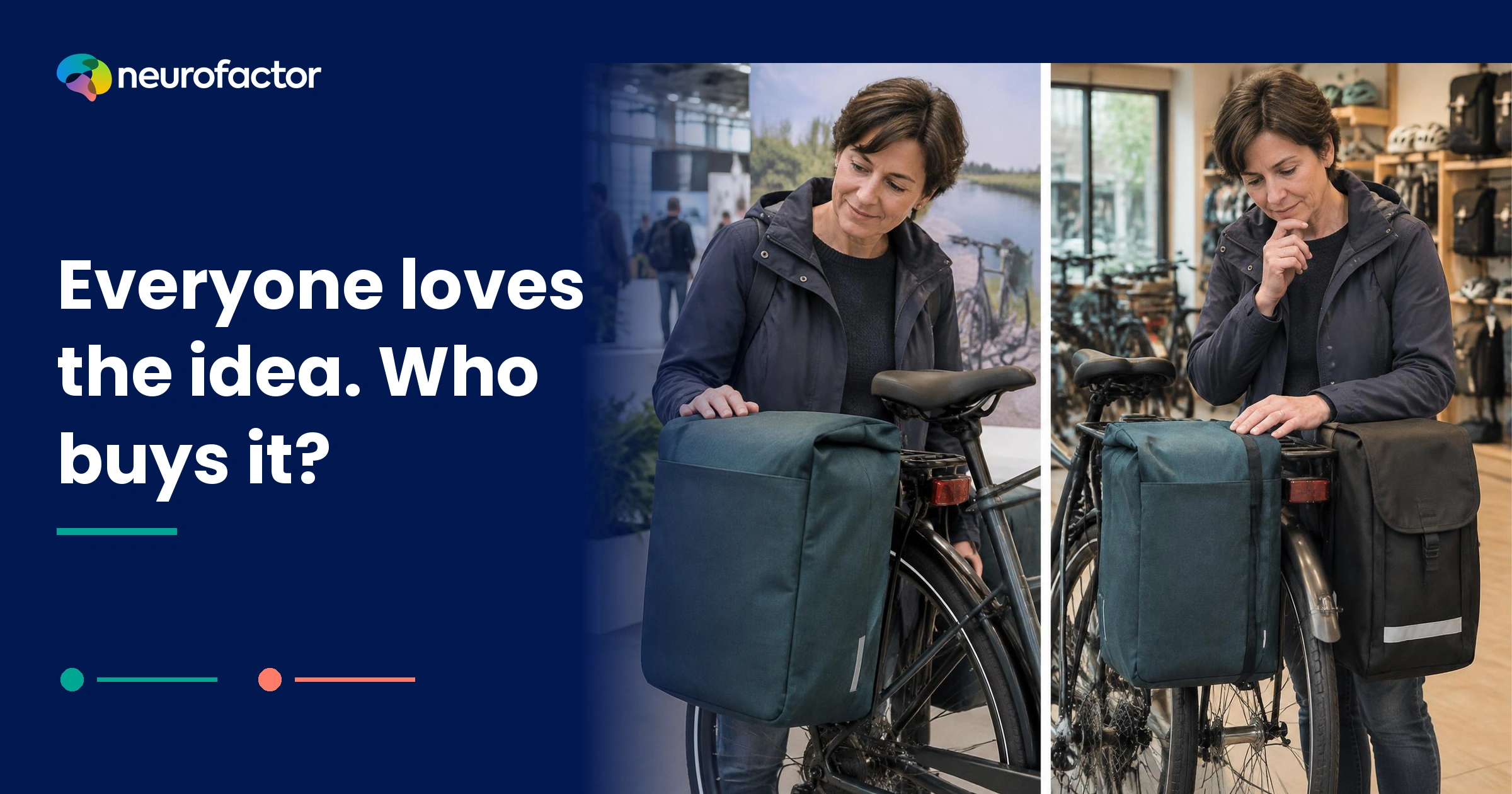
Why does everyone find an innovation interesting, yet nobody buys it?
A new product receives excellent feedback. People are curious during the presentation, early trial users respond positively and almost everyone in the concept survey says the idea is interesting. Yet orders remain disappointing. This does not automatically mean the campaign needs more reach. Finding an innovation attractive is different from accepting the risk and effort of actually switching. The newer a solution feels, the more people need to work out what they would give up, how they would use it and whether the promised benefit justifies moving away from a familiar option. Understanding that gap requires research into positive and resistant associations, as well as real choices.
For marketing teams, that changes the first question. Instead of asking how to make the idea sound even more revolutionary, ask: what does the innovation come to mean when the customer imagines paying for it and using it? Sometimes better communication is enough. Sometimes the proof must become more specific. And sometimes the product or buying process has to change because the concern is justified.
The audience applauds the innovation and buys the familiar alternative
There is a striking difference between a conversation at an innovation event and the moment someone must enter their payment details. At an event, people evaluate an idea. Saying that something seems clever, sustainable or revolutionary costs them nothing. They are largely reacting to potential: what might this product make possible one day?
A purchase changes the question. A buyer must consider consequences today, not just a possible benefit in the future. Will it fit what I already own? Can I trust it? What happens if it fails? How long will it take to become comfortable using it? Can I return it? And why replace my existing solution when it is still doing the job?
These are not minor objections. They are the choice context. Alexander, Lynch and Wang investigated intentions to buy really new products versus incrementally new products. Across four field studies, favourable intentions for really new products were followed through less often; the gap grew with time. The authors relate the difference partly to how concretely consumers imagine buying and first using the product [1]. That does not mean every innovation is destined to fail. It means enthusiasm for a concept is not the same measure as successful adoption.
This is where a costly management reflex appears. A team sees enthusiastic feedback and disappointing sales, then concludes that the story needs to be told more forcefully. More media budget, bolder claims, another launch film about the revolutionary breakthrough. But if the customer is thinking, 'Will this actually fit my bike?', a larger campaign will not solve the problem. Bigger promises may even increase the distance between what the brand says and what customers dare to believe.
We therefore need to understand two sides simultaneously: the associations that create attention and desire, and the associations that appear once the decision has consequences. This is the starting point of a useful innovation strategy. It asks not only whether people approve of the future, but also why they may prefer the present.
Interest, preference and purchase are three different outcomes
Concept research often compresses several stages into one score. People see a visual and are asked whether they like it, whether they would consider it or how attractive the concept appears. These measures have value. They simply do not mean the same thing as making a purchase in the real world.
The design of a study defines what its result means. With genuinely new products, respondents may not yet have stable preferences. Hoeffler found that consumers experience greater uncertainty about the usefulness of really new products than of incremental innovations. Techniques involving mental simulation and analogies could change the predictive accuracy of preference measures, but not every technique was beneficial [2].
Imagine showing a prospective buyer only a product picture. The picture leaves out the action that will ultimately determine the purchase: attaching a component, replacing familiar equipment, learning a new workflow or relying on an unknown system. Those actions may reverse an initially positive opinion. A useful study therefore asks how people evaluate the journey to the promised benefit, not only whether they like the destination.
We separate awareness, interest, comprehension, trust, preference, payment, actual use and repeated choice. Not every project can measure all stages. But when sales are the commercial objective, the report must make clear which were actually measured. High concept appeal is not a revenue forecast. Equally, low willingness to buy can reflect poor timing, weak distribution or a target segment with no genuine need.
The distinction becomes especially important when comparing innovations with familiar products. A new concept may win a no-cost preference question yet lose a realistic decision once the existing option, its known performance and the full cost of switching are included. That is not necessarily a research contradiction. It may be the most commercially relevant finding of the study.
Do you find the idea interesting?
- What it actually measures
- Curiosity or positive evaluation of a concept
- What it does not prove
- That someone will spend money now
Which solution appeals to you?
- What it actually measures
- Preference among the options presented
- What it does not prove
- That the option is available and practical
Would you consider buying it?
- What it actually measures
- Stated intention in a hypothetical situation
- What it does not prove
- That the buyer will act without hesitation
Which would you choose at this price?
- What it actually measures
- A choice under stated alternatives and prices
- What it does not prove
- That the choice will generalise to every context
Do you actually buy or use it?
- What it actually measures
- Observable behaviour in a specific setting
- What it does not prove
- That the effect applies automatically to every market
Why something new can mean progress and loss at the same time
An innovation does not carry one fixed meaning. The manufacturer often associates it with improvement. A customer may associate the same product with convenience, modernity and freedom, while also thinking of fragility, unfamiliarity and dependence on proprietary parts. Positive and negative associations can coexist without the person being inconsistent.
Ram and Sheth distinguished functional barriers to innovation, including usage, value and risk, from psychological barriers, such as tradition and image [3]. This remains a useful distinction. Someone who questions the reliability of a fastening mechanism has a different concern from someone who feels the product would look inappropriate on their bicycle. The former may need technical validation or product improvement. The latter may be thinking about identity, familiarity or belonging to a particular category.
Kleijnen, Lee and Wetzels also differentiated resistance expressed as rejection, postponement and opposition [4]. Marketers should not merge all three into a single 'non-buyer' group. Postponement may mean waiting for evidence, the right replacement occasion or lower uncertainty. Rejection may signal insufficient value. Opposition can reflect a more fundamental objection linked to values or identity. Each route suggests a different question for further research.
You can often hear the associative layer in customer language. 'Innovative' might suggest competitive advantage and independence to one audience, yet unfinished development to another. 'Automatic' can mean effortless operation, or a lack of control. 'Sustainable' can mean responsible consumption, or a higher price and uncertainty about whether the claim is true. These are hypotheses to investigate, not attributes to assign to people based on demographics or intuition.
This distinction matters because some concerns are entirely legitimate. A first version of a product may genuinely be hard to install or have limited compatibility. In that situation, customer resistance may protect people from an unsuitable purchase. Research into associations should never be used merely to talk people out of justified objections. Its purpose is to distinguish misunderstanding, uncertainty and genuine product limitations.
A team that can make those distinctions is less likely to confuse positive brand sentiment with a strong commercial proposition. The proposition needs to remain desirable when the customer thinks about the downsides, not only when the idea is presented under favourable conditions.
The hardest competitor is often the routine that already works
Most innovations do not compete solely against another brand. They compete against existing use. People already own accessories, have developed habits, understand known inconveniences and trust the familiar system. Familiarity has value in itself. The current solution does not have to be objectively superior to remain the preferred option.
Rogers identified five perceived characteristics relevant to the diffusion of innovation: relative advantage, compatibility, complexity, trialability and observability [5]. The word perceived is important. A measurable technical improvement may still be irrelevant if people do not recognise it, cannot use it in their setting or do not consider it sufficient to justify replacing the familiar alternative.
Consider relative advantage. A product may save twenty seconds per action, but if the action occurs only once a month, that saving may not create a compelling reason to buy. The manufacturer calls it efficiency. The customer may hear 'a solution to a problem I barely have'. The technology is not inherently weak; its benefit may simply lack relevance in that context.
Compatibility has at least two practical dimensions. The product must work with existing systems, accessories and routines. It also needs to fit the customer's expectations, experience and values. Someone who cares about sustainability may appreciate a recyclable innovation but reject it when the components cannot be repaired. Someone seeking independence may view an app-controlled system as yet another dependency.
Complexity also has multiple meanings. An explanatory film can clarify how a device works without reducing the actual installation time. A demo can reveal an immediate benefit without demonstrating reliability in prolonged use. That is why it helps to ask at every stage whether the problem concerns perceived meaning, credible evidence or the actual product experience.
The ordering of decisions changes as a result. A marketing team may optimise for message comprehension and celebrate improved understanding. Yet comprehension without sufficiently relevant benefits and credible performance does not necessarily make the innovation the next logical purchase. Which reason to keep the existing product is currently stronger than the reason to replace it? That question often reveals more than asking how excited people are about the launch.
Trust is built through the right proof, not a bigger promise
Innovation communication naturally emphasises possibility. The brand wants potential users to see what will improve. But the more unfamiliar the solution, the less personal experience a buyer has for evaluating its claims. They must imagine future reliability and usefulness. Hoeffler's work shows why this uncertainty creates challenges when measuring preferences for really new products [2].
For marketing, this is a proof challenge, not automatically a reason to add emotion. A promise such as 'attach it in one movement' demonstrates convenience. The customer may simultaneously wonder whether the fastening will stay secure on a bumpy road. Without a credible response, the very simplicity that attracts attention can create suspicion.
Relevant proof is audience-dependent. An experienced user may want a demonstration under load. A risk-sensitive buyer may want a transparent warranty and return process. A retailer may need confidence that staff can explain the mechanism and that the product will not generate costly complaints. A product designer may ask which existing standards it supports. Different associations lead to different evidence needs.
Appropriate proof might include demonstrations, independent testing, clear limitations, comparison with the familiar alternative, an accessible trial or a service promise the business can actually honour. Proof is not necessarily more content. It is the information that resolves a specific unanswered question at the point of choice.
In empirical research on innovation resistance, Ram found that changing the innovation and using communication strategies addressed different forms of resistance across the product categories studied [6]. The practical implication is to avoid replacing diagnosis with a standard campaign. An actual technical defect should not be treated purely as a storytelling problem. Equally, adding more specifications may not resolve a negative identity association.
The most credible innovation marketing is sometimes willing to say where a new product is not better. Clear limitations can prevent the buyer from assuming that the entire promise is exaggerated. Whether such transparency improves adoption in a particular case still needs testing, but it makes the decision more informed and reduces the risk of promising what the product cannot deliver.
Fictional case: a clever bicycle bag that nobody trusts enough to attach
This case is entirely fictional. No participants were tested, and the responses described here illustrate a possible research process, not Neurofactor results.
Imagine a manufacturer introducing a bicycle bag with a new magnetic attachment system. A single movement attaches or releases the bag. The launch campaign focuses on speed, convenience and clean design. In a concept test, potential customers call the product interesting. They like the idea of no longer struggling with traditional hooks and straps.
Yet when visitors handle the product in a shop, many put it back. The marketing team's first explanation might be that the benefit has not been communicated strongly enough. They propose a headline: 'Never struggle with your bicycle bag again.' This could improve appeal. But it may completely miss the reason people hesitate.
Suppose exploratory interviews, association tasks and observation in a realistic demonstration reveal a more complicated picture. Looking at the product, participants use words such as 'easy', 'light' and 'fast'. When asked to imagine riding over cobblestones with a laptop inside, some begin thinking of 'coming loose', 'losing my things' and 'not certain'. A second group likes the idea but discovers that it requires a particular carrier. A third group sees no urgent reason to replace a bag they already own.
These are three different problems. The first group may need a credible demonstration of the fastening mechanism or an actual product improvement. The second group may need real compatibility or transparent explanations about limitations. For the third group, the replacement moment may matter more than a new slogan. Someone who does not buy now is not necessarily a lost customer. They may simply be waiting until the current bag wears out.
The research question therefore changes from 'Do people like our innovation?' to 'Which risk or lack of relevance outweighs convenience when the purchase becomes real?' That is where association research can contribute commercial value. It helps turn unexplained hesitation into a product, evidence or communication decision that can be tested.
Notice that this example does not invent conversion rates, psychological scores or customer quotations from a real project. In a real study, the team would need to document who was tested, under what conditions, with which stimuli and what evidence supports each interpretation. Without that, an attractive narrative is not an empirical finding.
Four explanations for the same low conversion rate
One weak sales figure can have several different causes. A simple diagnostic distinction prevents every problem being described as 'innovation resistance'.
This is an editorial decision aid, not a scientifically validated typology. Its purpose is to help teams form competing hypotheses instead of immediately buying more media. Several explanations may coexist. A buyer may understand the concept, distrust its long-term reliability and consider its price too high.
An association map should therefore include both attraction and resistance. For the positive side, identify not only descriptive words but also the moments when the benefit matters. For the negative side, find out whether the concern relates to the product, user, brand, purchase process or social context. Compare relevant segments. A daily commuter may value speed more than a touring cyclist who prioritises security under load.
Use behavioural funnel evidence too. A low click-through rate can suggest a problem with audience fit, message relevance or creative visibility rather than with the fastening system. Many product views followed by little add-to-cart activity may reflect price, trust or missing information. Checkout abandonment can signal a different obstacle again. Without these distinctions, the associative explanation may be asked to account for too much.
Attention but limited understanding
- Possible associative diagnosis
- New yet confusing or complicated
- Other explanation to check
- Poor information or demonstration
- First testable action
- Show use in a recognisable situation
Enthusiasm without trust
- Possible associative diagnosis
- Clever but fragile or risky
- Other explanation to check
- Missing product tests, quality or warranty
- First testable action
- Improve evidence or the product itself
Trust without urgency
- Possible associative diagnosis
- Good idea but not needed now
- Other explanation to check
- Current solution still works or price is too high
- First testable action
- Investigate timing and relevant segments
Real need but no purchase
- Possible associative diagnosis
- Attractive but too much effort to switch
- Other explanation to check
- Installation, compatibility, stock or checkout
- First testable action
- Reduce actual switching friction
Seven marketing decisions that change when you understand innovation resistance
1. Define the behaviour that counts. 'Finding the idea interesting' differs from trying it, paying for it, choosing it at a higher price or continuing to use it after a month. State the relevant business outcome and observation period before designing the study.
2. Test the innovation against the real default. Include the product people currently use, with its price, familiar performance, risks and switching costs. A concept without an alternative can win attention too easily. A question without price or consequences is not a real purchase.
3. Research enthusiasm and doubt. Measure spontaneous associations with the product, brand and actual usage scenario. Distinguish deliberate reports, spontaneous meanings and indirect task performance where appropriate. An implicit task is not automatically a better predictor of sales.
4. Make the benefit tangible in everyday situations. Show when and for whom a concrete action improves. Move beyond the abstract promise of 'more convenience'. Test whether the improvement is large enough to justify replacing the present option.
5. Match proof to the specific risk. Provide relevant test evidence for a safety question, clear compatibility information for a fit question and meaningful support conditions for a repair question. Never promise what the product or warranty cannot support.
6. Lower actual switching costs. A trial, compatible accessories, easier installation or transparent returns can be more valuable than the next advertising campaign. The best solution may need collaboration between marketing, product development and operations.
7. Observe the next step and learn from non-buyers. Where possible, measure trials, paid orders, adoption, returns and repeat use. Speak to people who expressed interest but did not purchase. Record what was observed, what is a plausible interpretation and what remains untested.
These are not universal funnel stages. A new medical technology, business platform and bicycle bag have different standards for risk, price and evidence. The common requirement is to study the decision as it occurs in reality, not only the reaction to an attractive presentation.
How to investigate associations that block adoption
Start by defining the decision that marketing or product management needs to make. Should the company provide better risk evidence, change the proposition, modify a component or address a different audience? Only then choose the measurement methods.
Step 1 - Map the market context. Examine reach, availability, pricing, competition, search behaviour, inventory and conversion drop-off. Check that the audience has a realistic opportunity to buy. Ask what people currently use and why they keep using it. If distribution is broken, psychological explanations have limited value.
Step 2 - Collect real language and situations. In open interviews, ask what the innovation appears to solve, who it seems suitable for and what usage occasion comes to mind. Explore what people do not understand, what they fear giving up and what evidence they would want before switching. Link answers to a concrete situation, not just a list of product attributes.
Step 3 - Examine the association structure. Use spontaneous associations, structured word or image tasks and, if appropriate, an indirect task such as a carefully designed IAT variation. Compare the novel fastening system with convenience and reliability relative to the familiar mechanism. Predefine what relation is being tested, how stimuli are selected and how measurement quality will be assessed. IAT research supports predictive relationships in some contexts; it does not provide automatic individual purchase predictions [7].
Step 4 - Put a real decision in front of participants. Present an existing alternative with realistic price, delivery, compatibility and service conditions. Where possible, move beyond hypothetical choice towards consequential trials, reservations, paid pilots or observed orders. Choice experiments can be informative, but their artificial constraints should be reported transparently.
Step 5 - Compare segments and moments. A daily commuter, an e-bike owner and someone who has just damaged a bag may evaluate the innovation differently. Do not invent tiny segments after seeing the data. Plan relevant comparisons and check that the samples support the conclusions.
Step 6 - Test one improvement against an appropriate comparator. That improvement could be the product mechanism, stronger evidence or a simpler trial offer. Measure actual conversion and use where feasible. Keep pricing, stock, audience and exposure comparable, or document meaningful differences. Check whether a higher initial conversion is accompanied by satisfactory use and reasonable return rates.
This research model connects associative and commercial evidence. It is not an automatic randomised-trial protocol and does not require a particular neuroscience device. Neurofactor's research methods investigate different layers of response, while its marketing applications link those findings to decisions about propositions, product experience and conversion.
More research does not automatically create more certainty
Another survey can make the situation less clear if the questions are poorly constructed. Ask a hundred people whether the new bicycle bag is interesting and you may obtain a precise estimate of an ambiguous judgement. Present an unrealistic price or a competitor they have never heard of and the resulting chart can look persuasive while describing a choice nobody would face.
A better pilot defines the decision and outcomes before exposure. Do prospective buyers understand the fastening system? Does riding over bumps evoke concerns about security? Is a demonstration of relevant test evidence more useful than a generic convenience claim? Does that change lead to more paid purchases among people who can actually use the product?
You can measure whether associations change after a demonstration. That may help explain what the intervention affects. But improved associations without additional purchases do not prove a commercial effect. Conversely, sales can increase even without measured associative change because price, stock or distribution improved. Those alternatives must remain visible in the analysis.
Hoeffler and Ariely studied how experience, choice and effort can help preferences become more stable [8]. For an unfamiliar product, a single questionnaire need not be the final assessment. An actual trial can reduce uncertainty, but it can also reveal that the product is less valuable in daily use than the concept promised.
A meaningful product test should therefore document not only a before-and-after attitude but also what participants actually experienced. Otherwise, the team may be measuring whether the promise felt appealing, not whether the product stands up to reality.
When more marketing is the wrong solution
Sometimes the innovation simply is not a good purchase for the customer right now. It may cost too much for the available benefit, require awkward modifications or fail to deliver the advertised performance. Research should not be used to persuade people past such justified concerns. It should help the business correct the product, offer or expectations.
Targeting can be wrong as well. An innovation may be exceptionally valuable to a small group with a pressing need and irrelevant to the mass audience. High average interest can hide the contrast between these groups. Identify who receives meaningful value and under what circumstances before optimising for maximum awareness.
Be careful with causality. Associations can relate to preference and behaviour, but measuring an association does not establish that it causes a purchase decision. An IAT score is not a hidden buy button, and EEG does not convert interest into a proven purchase intention. Reliability, validity, sample design, order effects and behavioural criteria still matter. Respondents also have legitimate reasons to refuse testing or reject an innovation.
The scientific sources cited here support mechanisms within their original research contexts. The bicycle bag case is fictional and includes no customer results, brain scores or Neurofactor effect estimates. Product-specific predictions require research in the actual market, especially where safety, privacy, health or substantial financial consequences are at stake.
Conclusion: interest opens the conversation, but does not close the sale
An innovation can deliver what it promises on paper and still fail to become the logical purchase. Not because people are incapable of appreciating new technology, but because new benefits must compete with familiar habits, uncertainty and the concrete costs of change.
The wrong response is often to explain even more loudly how revolutionary the solution is. A better response begins with a sharper question: what actually improves for this customer, what must they give up and what evidence makes the change a sensible decision?
You do not sell an innovation simply by making the promise bigger. You make adoption more likely when the expected improvement becomes more important and credible than the uncertainty of switching - and when that difference is visible in real choices.
Key terms
- Innovation adoption
- The process by which a person or organisation becomes aware of a new solution, evaluates it, chooses it, starts using it and potentially continues to use it.
- Innovation resistance
- Rejection, postponement or opposition to a new solution associated with perceived usage risk, limited value, habit or psychological meaning.
- Perceived relative advantage
- The extent to which someone considers an innovation a better option for their needs than an existing alternative.
- Compatibility
- The degree to which a new solution fits existing equipment, routines, experiences, values and practical needs.
- Associative barrier
- A negative or uncertain meaning linked to an innovation, brand or purchasing action that may be relevant to a choice.
- Intention-behaviour gap
- The difference between a stated positive intention and the behaviour someone actually demonstrates under real conditions.
Frequently asked questions
Why do people like an innovation but not buy it?
Interest often concerns a potential benefit. Purchase decisions also involve price, reliability, learning effort, compatibility, availability and the value of what people already own. Investigate those factors separately before blaming communication.
How can you uncover hidden resistance to a new product?
Combine open interviews, association research and observation of realistic choices. Compare the innovation with the customer's current solution and ask about specific situations in which they would switch. Indirect measures can add evidence but do not replace behaviour.
What role do positive and negative associations play in adoption?
The same innovation can evoke excitement and concern. The important question is which associations arise at the actual point of use or purchase and how they relate to preference, postponement or rejection.
Is strong survey purchase intention enough to justify a launch?
No. Stated intention is useful, but it does not guarantee a purchase. Where feasible, test real prices, alternatives, trial opportunities, paid orders and actual use.
Should innovation resistance be addressed through communication or product changes?
It depends on the barrier. Misunderstanding may need explanation; genuine functional risk needs product improvement; credibility concerns need evidence; a difficult switch may require easier processes or better compatibility.
Can Neurofactor predict sales of an innovation using association research?
Association research can improve hypotheses about attraction, resistance and audience differences. Credible prediction requires validation for the specific choice and should include market conditions and, wherever feasible, observed buying behaviour.
Sources
- 1.As Time Goes By: Do Cold Feet Follow Warm Intentions for Really New versus Incrementally New Products? - Journal of Marketing Research (2008)
- 2.Measuring Preferences for Really New Products - Journal of Marketing Research (2003)
- 3.Consumer Resistance to Innovations: The Marketing Problem and Its Solutions - Journal of Consumer Marketing (1989)
- 4.An Exploration of Consumer Resistance to Innovation and Its Antecedents - Journal of Economic Psychology (2009)
- 5.Diffusion of Innovations, 5th Edition - Free Press (2003)
- 6.Successful Innovation Using Strategies to Reduce Consumer Resistance: An Empirical Test - Journal of Product Innovation Management (1989)
- 7.Understanding and Using the Implicit Association Test: III. Meta-Analysis of Predictive Validity - Journal of Personality and Social Psychology (2009)
- 8.Constructing Stable Preferences: A Look Into Dimensions of Experience and Their Impact on Preference Stability - Journal of Consumer Psychology (1999)
Reviewed by: Martijn den Otter · Last reviewed: 10/30/2026