
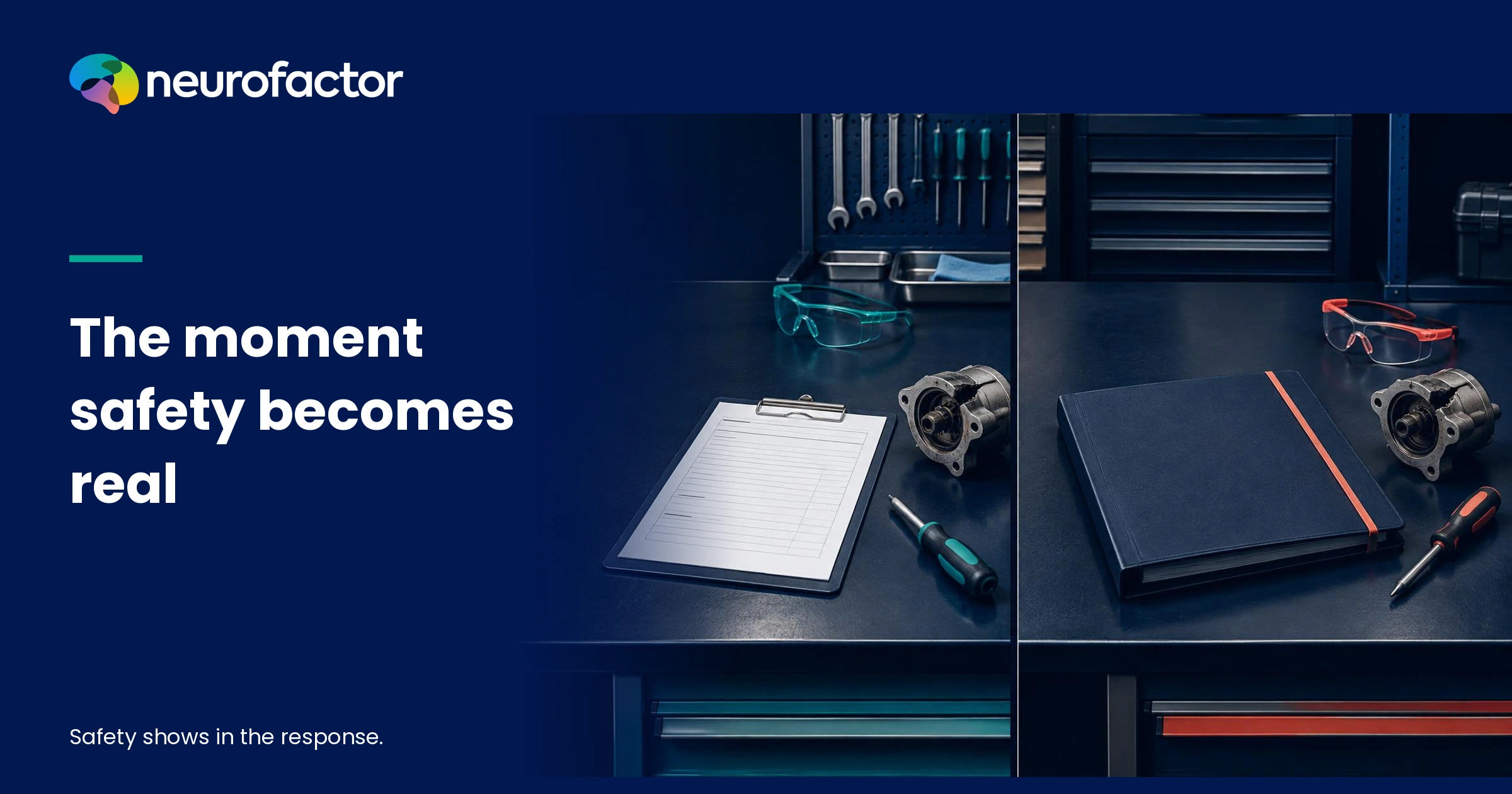
How does psychological safety develop through everyday work experiences?
Psychological safety develops when employees repeatedly experience that they can report an error, ask a difficult question or challenge an assumption without humiliation or unfair social consequences. It is not the same as friendliness or freedom from accountability. In a study of 51 teams, shared psychological safety was associated with learning behaviour [S1]. Yet the same reporting policy can evoke cooperation in one team and personal blame in another. The relevant question for employer branding and organisational improvement is not whether openness is printed on a careers page. It is what actually happens when somebody takes a social risk. Examine the expected reaction, the observable work process and the outcome of concerns separately.
People test safety precisely when speaking carries a risk
At onboarding, an employer says that mistakes are welcome learning opportunities. A technician later discovers an error in a maintenance record and hesitates to report it. The crucial question is no longer what the values statement says. It is how the team and supervisor will respond. Will they help resolve the underlying issue, or will the mistake become an informal warning attached to the employee's name? Psychological safety develops when team members share a belief that interpersonal risks, including acknowledging an error or challenging an assumption, can be taken without humiliation. It is a quality of working together, not a personality label. Edmondson's field study of 51 teams linked that shared belief with team learning behaviours [S1].
What psychological safety is - and what it is not
Psychological safety is a shared belief that members of a team can take interpersonal risks. They can ask an apparently simple question, mention a concern, or challenge a decision without anticipating an automatic social penalty. It is not identical to being liked, job security, general happiness, conflict avoidance or a promise that professional standards no longer apply. A psychologically safe team can disagree intensely about evidence while still treating people with respect. Serious safety incidents or misconduct may require prompt formal action. Kahn's qualitative work explored psychological safety as a condition for personal engagement; Edmondson subsequently defined and studied shared team psychological safety [S12][S1]. Keeping the concepts distinct prevents the phrase from becoming an empty synonym for a pleasant atmosphere.
The same invitation can carry opposite meanings
'Raise problems as soon as you notice them' can mean that management wants to help. The same sentence can mean 'do not become the person associated with trouble'. The words are unchanged, but previous reactions, hierarchy, professional status and informal group rules shape their meaning. An open-door policy does not tell us whether employees expect fair treatment behind that door. A manager may sincerely believe criticism is welcome while an employee associates disagreement with embarrassment or an unfavourable performance review. Interview evidence on employee silence found fear of being viewed negatively to be a prominent reason for withholding concerns [S5]. That is why employer branding needs to begin with lived experience rather than a campaign promising openness.
Four association clusters behind everyday reactions
The word 'mistake' can evoke learning, shame, accountability or repair. 'Question' can mean curiosity, collaboration, incompetence or interruption. 'Challenging a decision' can mean professionalism or disloyalty. And 'reporting' can suggest responsibility or betrayal. These clusters are research hypotheses, not universal segments and certainly not measured Neurofactor results. To identify the relevant associations, ask about a specific role, team and situation. The same employee may confidently raise an issue with a trusted colleague and remain silent in front of a senior executive. The context of speaking matters as much as the abstract belief. Investigate spontaneous language, remembered episodes and anticipated social consequences before designing any intervention.
An invitation is not the same as receiving the message
A supervisor can request feedback at every meeting and still make speaking up costly through a single public dismissal. That is a plausible hypothesis, not a mathematical rule about human behaviour. In a two-phase study of thousands of employees and managers, perceptions of managerial openness were consistently associated with improvement-oriented employee voice; psychological safety helped explain the relationship [S3]. The next step is to examine what leaders actually do when the comment is inconvenient. Do they listen, ask neutral questions, assign ownership and explain the outcome? Does the employee see a response even when the proposal is rejected? A slogan promising an open culture can raise expectations; dismissive handling of real concerns may widen the gap between employer promise and everyday reality.
Table 1 - four work moments and their possible meanings
These situations illustrate why one general question about 'feeling safe' cannot explain every decision to speak or stay silent. Each situation contains a different interpersonal risk, possible association and form of observable evidence. The table is a diagnostic design aid, not a report of measured employee profiles. Test which interpretations actually occur in a particular workplace and never assign an assumed association to someone simply because of their job title.
Reporting a mistake
- Possible safe meaning
- Repairing and learning together
- Possible threatening meaning
- Blame and reputational damage
- Observable evidence
- Initial response and follow-up
Asking for help
- Possible safe meaning
- Collegial support
- Possible threatening meaning
- Appearing incompetent
- Observable evidence
- Responses to basic questions
Challenging a decision
- Possible safe meaning
- Professional responsibility
- Possible threatening meaning
- Questioned loyalty
- Observable evidence
- Treatment of alternative arguments
Reporting a near miss
- Possible safe meaning
- Preventing harm
- Possible threatening meaning
- Becoming a troublemaker
- Observable evidence
- Handling and safeguarding
Suggesting a change
- Possible safe meaning
- Improving together
- Possible threatening meaning
- Extra work or lost face
- Observable evidence
- Reasons behind the decision
Safety is not a promise of consequences-free behaviour
Psychological safety should not be marketed as permission to ignore professional obligations. Patient protection, financial controls and workplace safety may demand investigation and accountability. The important distinction is whether someone who reports a concern or admits an honest error can expect due process without humiliation, arbitrary blame or retaliation. A difficult conversation can be safe if the facts are discussed fairly. A friendly-looking team can be unsafe if dissent is punished through jokes, isolation or lost opportunities. Research on organisational error-management cultures examined the role of identifying, discussing and correcting mistakes and found associations with organisational performance [S7]. That does not establish a universal causal effect of any single workshop or mean that errors should be treated as harmless.
Professional status changes the risk of speaking
An experienced colleague may experience disagreement as professional responsibility. A temporary worker, new joiner or junior employee may anticipate that contradicting a senior colleague threatens their future in the team. These are possible differences, not fixed personality traits attached to contract status. A study across 23 neonatal intensive care units examined how inclusive leadership and professional status related to psychological safety and improvement efforts [S2]. Ask not merely whether people can speak, but who can challenge whom and what they believe will happen afterwards. Informal hierarchy also matters: a respected senior teammate can establish norms that outweigh an official policy. A defensible diagnosis therefore compares situations and power relationships without reducing participants to simplistic demographic categories.
Suggesting an improvement differs from reporting harm
A proposal for a faster meeting agenda may attract approval. Reporting an unsafe practice may imply that a respected colleague's routine is wrong. Both involve voice, but the expected social cost is not identical. Liang and colleagues used a two-wave design to examine psychological antecedents of promotive and prohibitive employee voice. Psychological safety was particularly relevant to prohibitive voice - raising potential problems [S4]. An organisation that only counts cheerful innovation suggestions risks missing precisely the silence that matters most. Separate constructive new ideas from warning signals in both interviews and process measurements. If people willingly suggest software features but never mention harmful shortcuts, the first activity does not establish safety in the second.
Silence can feel like a rational choice
An employee may know that a defect should be reported while also knowing that the last person who spoke up was labelled difficult. The organisation benefits from the information; the employee may shoulder the interpersonal risk. Milliken and colleagues interviewed forty employees about issues they withheld from supervisors and found worries about negative labels and valued relationships [S5]. Their qualitative sample does not establish the proportion of silent workers in every company. It does suggest that silence should not automatically be interpreted as apathy. A committed employee may hold back precisely because they value a working relationship. To understand behaviour, investigate the consequences they anticipate and the experiences from which those expectations developed.
Ask about the last real episode, not just intentions
'Are you comfortable speaking up?' invites a response that may reflect an ideal self-image or an official company norm. A more diagnostic invitation is: 'Describe the last time somebody raised an uncomfortable problem. What happened next?' Explore who reacted, what was said, which actions followed and whether anyone heard the outcome. Also ask for positive experiences so that the interview does not lead participants toward a negative story. Separate observed events from interpretations. Protect confidentiality: even without a name, an unusual incident might identify an employee. Interview data help generate hypotheses and understand meanings. They do not automatically measure the prevalence of fear or define the average safety level of an entire organisation.
Being heard requires visible follow-through
Speaking and being heard are distinct parts of the same process. Someone may report a concern, receive a polite thank-you and never learn what happened. Burris, Detert and Romney studied disagreements between managers' and employees' perceptions of employee voice and their connections with work outcomes [S11]. This supports examining both perspectives instead of accepting the manager's account as the whole story. A practical process should acknowledge the concern, assign responsibility and close the feedback loop. Not every proposal must be adopted. A reasoned, respectful rejection provides more information than unexplained silence. The relevant experience is whether the employee's contribution is taken seriously and whether the process remains fair when the decision goes against them.
Table 2 - expected response versus intended leadership signal
This is an illustrative diagnostic matrix, not a ranking of existing employers. It contrasts what a manager may intend to communicate with what an employee could interpret from the same behaviour. Such differences become questions to investigate through interviews and observation. Do not let individual examples from a sensitive research project become evidence in an employee's performance review.
My door is open
- Intended message
- You can approach me
- Possible employee interpretation
- My concern will still be judged
- Question to investigate
- What happened after the last critical question?
Report mistakes quickly
- Intended message
- We want early repair
- Possible employee interpretation
- The messenger receives the blame
- Question to investigate
- How did the leader handle the last report?
Every voice matters
- Intended message
- Everyone will be heard
- Possible employee interpretation
- Senior voices carry all the weight
- Question to investigate
- Who has challenged the leader?
We have a suggestion box
- Intended message
- You have another channel
- Possible employee interpretation
- I can speak only anonymously
- Question to investigate
- How is direct dissent received?
Thank you for the feedback
- Intended message
- Your contribution matters
- Possible employee interpretation
- Nothing will follow
- Question to investigate
- What response did the employee receive?
A challenging idea may be judged as disloyalty
Supervisors may publicly invite ideas yet react negatively when the idea challenges their own judgment. Burris examined managerial reactions to supportive and challenging voice in a field study and two experiments. More challenging voice was evaluated less favourably, with perceived threat and loyalty contributing to the pattern [S6]. This does not describe every supervisor or imply that all criticism is correct. It does show why genuine safety cannot be inferred from how warmly agreeable proposals are received. Observe who gets interrupted, who must defend a concern more extensively and whether critical suggestions face a different evidential standard. The social meaning of 'speaking up' is shaped by the reaction to disagreement, not simply by the invitation to contribute.
Turn the first response into a repeatable routine
One possible response routine is to acknowledge the signal, separate facts from assumptions, identify who will investigate and communicate what happened. This is a design proposal, not a universally validated four-step intervention. Immediate risks must still trigger the proper safety or integrity protocol. Avoid publicly blaming the messenger before the incident is understood. Ask what was observed, what impact is possible and what information is needed to respond appropriately. Peer behaviour matters as much as supervisor language: ridicule after a meeting can create consequences that no formal policy records. Train leaders to give substantive answers even when they cannot adopt a suggestion. Consistency makes the response more predictable for the next person facing a difficult choice.
Fictional case - two teams at LumaServ Techniek
LumaServ Techniek is an entirely invented technical service company with maintenance staff and planners. During an imaginary shift, an employee discovers that a required part is unavailable although the system shows a normal delivery time. Reporting the mismatch early could allow the customer to receive accurate information. In Team North, the fictional supervisor Mira responds: 'Thank you for noticing. What do we need to fix?' In Team South, another supervisor says in front of colleagues: 'You should have thought of that sooner.' The point is not to claim Team North has been scientifically measured as safer. The two responses demonstrate how the same reporting procedure can acquire radically different associations in employees' minds. No real client data or research results are used.
Leila and Bram interpret the same policy differently
In the invented example, Leila is a relatively new technician who wants to flag a mistake during handover. Bram is an experienced planner who noticed a similar problem earlier. For Leila, 'report it immediately' might evoke being judged before she has established credibility. For Bram, it may mean protecting customer trust while there is still time to act. Both have read the same policy. Their anticipated social consequences nevertheless differ. This is a reason to examine status, previous reactions, the relevant manager and actual escalation routes rather than instructing staff to be braver. The people, quotes and situations are fictional and there are no fabricated interviews, EEG measurements, survey percentages or customer outcomes.
Image
A quiet meeting can conceal the most serious issues
Imagine a meeting in which nobody asks a question. The chair assumes everyone agrees. Yet one person might be silent because the agenda is rushed, another because the issue is unclear and a third because previous questions were mocked. The observable outcome is identical, but its causes are not. Attendance, smiles and agreement are weak substitutes for evidence of psychological safety. Offer different ways to ask questions if needed, while also testing whether questions receive a fair response. An anonymous suggestion box can provide a temporary route for sensitive information, but it cannot prove that the ordinary team conversation is safe. Choosing a channel is an observable behaviour; its emotional meaning still requires investigation.
An association is a hypothesis, not a brain scan
Association research can help reveal meanings linked to errors, reporting, challenging decisions and particular team practices. Spontaneous terms, narratives, sorting tasks and carefully designed indirect measures may illuminate different parts of that picture. But fast responses are not automatic proof of unconscious beliefs, and a single task cannot diagnose psychological safety. The primary field studies in this area rely on team measures, interviews, observed or reported behaviour and organisational research, not a universal neurological test [S1][S2][S3]. Do not imply that findings from those studies validate a newly invented EEG or implicit-association procedure. Triangulate stated expectations, documented experiences and work processes. Treat contradictions as information rather than choosing whichever method produces the most dramatic story.
Translate employer promises into specific moments
An employer value proposition may promise that 'you can be yourself here'. Test the claim against moments that matter: the first error, the first difficult question, the first disagreement and the first unresolved concern. Identify the behaviour leaders show at each moment, the evidence employees can observe and possible counter-associations. The result should inform work practices before recruitment advertising. Never use group findings to rank supposedly difficult or 'unsafe' individuals. A credible EVP can acknowledge work in progress rather than hiding inconsistencies behind perfect claims. Where colleagues fear retaliation, copywriting cannot compensate for the actual experience. Ask newly hired employees and long-serving staff whether the same message matches what happens during ordinary working weeks.
Table 3 - from association hypothesis to observable evidence
The third table translates four plausible barriers into field observations, research questions and intervention hypotheses. It is not a presentation of actual scores or a catalogue of interventions proven to work everywhere. Its role is to distinguish a language problem from a structural problem. If colleagues are punished for raising concerns, better communications cannot solve the underlying risk. If nobody knows the correct reporting route, practical process guidance may be a sensible first experiment.
Mistake means blame
- Potential cause
- Public shaming
- Evidence to collect
- Interviews and response records
- Change to test
- Non-accusatory response routine
Question means incompetence
- Potential cause
- Mocking reactions
- Evidence to collect
- Questions during handover
- Change to test
- Supportive answers and follow-up
Dissent means disloyalty
- Potential cause
- Hierarchy and dependence
- Evidence to collect
- Who challenges whom?
- Change to test
- Invite junior perspectives explicitly
Reporting is pointless
- Potential cause
- No feedback loop
- Evidence to collect
- Response times and decisions
- Change to test
- Visible follow-through
Disagreement threatens career
- Potential cause
- Unclear evaluation incentives
- Evidence to collect
- Interviews and HR process review
- Change to test
- Separate reporting and appraisal where appropriate
Image
Spontaneous language provides clues, not the whole answer
If 'feedback' is associated with assessment, first ask why. Perhaps the term was historically used mainly in formal performance reviews; perhaps an employee experienced blame; perhaps the respondent simply thinks of the most common context. A single word association cannot distinguish these explanations. Ask about concrete episodes, use more than one prompt and check whether meanings remain stable. Avoid introducing preferred labels that could prime the answer. Compare individual narratives with appropriately aggregated team findings. An indirect measure needs documented reliability and validity for its specific use. Calling a task 'neuroscience' is not validation, and a reaction-time result is not an ethical basis for classifying an identifiable employee as afraid or disloyal.
Do not diagnose individual employees from a team construct
Psychological safety is not a personal score indicating whether somebody is brave, honest or trustworthy. Quiet employees are not necessarily anxious; vocal employees are not necessarily safe. Recent events, workloads and question wording can all affect responses. An anonymous survey is not truly anonymous when the organisation can easily infer which of three people described a distinctive incident. Agree appropriate aggregation thresholds in advance with privacy specialists and employee representatives. Do not turn sensitive team feedback into selection criteria, individual performance targets or a disguised loyalty test. Formal safeguarding, harassment and whistleblowing systems must remain available separately when required. A study of team climate cannot replace the legal and organisational responsibility to protect an employee who makes a serious report.
What should recruitment and HR communicate differently?
Do not advertise a vaguely 'supportive culture' without examples. Describe what happens when a new colleague makes a mistake, how questions are handled in a shift handover and how managers respond to dissent. Use real examples with appropriate permission rather than invented employee testimonials. Ensure that leaders actually practise the behaviour before promising it to candidates. Compare the expectations formed during recruitment with the experiences of new joiners and established teams. Early uncertainty may reflect unfamiliarity with procedures rather than an unsafe culture; investigate it instead of attaching a label. A well-designed employer brand is evidence of specific organisational behaviour. The strongest candidate journey allows people to ask uncomfortable questions and receive candid, verifiable answers.
Supervisors also operate within incentives and constraints
A line manager who is judged exclusively on flawless monthly targets may be tempted to suppress bad news, even while believing that openness matters. Examine work pressure, authority, incentives and capacity to follow through, not only the manager's interpersonal style. Leaders cannot reliably resolve problems if no one gives them time or permission to act. Nembhard and Edmondson's study shows why inclusive behaviour and status relationships need to be considered together [S2]. A practical response might involve protected improvement time, a transparent escalation route and support for explaining decisions that cannot be changed. Boundaries can help when they are predictable and justified. Treating all failure reports as personal disloyalty usually creates a different kind of information problem.
Three small routines worth testing, not assuming
A short check-in that invites one uncertainty, a blameless discussion of near misses and a visible log of issues with responses are possible experiments. None is a guaranteed universal recipe. Select one that fits the work and define what you want to observe. More meeting talk is not necessarily safer reporting. Monitor whether important concerns actually surface, whether managers respond respectfully and whether issues are handled. Distinguish cheerful suggestions from reports of potential harm; the latter may carry higher social cost [S4]. If your team readily shares easy ideas but stays silent about unsafe shortcuts, a rising suggestion count tells you very little about the central problem. Look for credible behaviour, not just enthusiastic workshop feedback.
Psychological safety alone cannot guarantee performance
Teams also require technical competence, clear standards, useful tools, realistic workloads and accountability. Edmondson's study linked safety to learning behaviour but did not establish that a short workshop causes a measurable improvement in every organisation [S1]. Studies of error-management cultures found associations with organisational performance; they do not excuse poor controls or justify treating errors casually [S7]. Keep team experience and operational outcomes as distinct measurement domains. A pleasant workplace might still miss serious problems, while a demanding environment can be psychologically safe when disagreement is handled fairly. Research should therefore track whether concerns are raised, acknowledged and resolved as well as how people experience those moments. It should not collapse all outcomes into a single happiness score.
Research ethics come before the first question
An employee study about fear and retaliation can itself create risks. Before recruitment, specify who has access to individual responses, what is voluntary and how findings will be handled. Develop an appropriate data-protection assessment, minimise identifiers and offer safe contact routes. Under employment-related power imbalances, consent may not be the appropriate sole GDPR basis; obtain qualified legal and privacy review. Do not claim that a research provider makes information safe merely by being external. Separate group-level diagnosis from individual reports that may require a safeguarding response. Never infer hidden loyalty, fear or future misconduct from reaction times. Provide a process for serious concerns outside the ordinary research dataset and explain that process transparently to participants.
Research protocol step 1 - define the risky moment
Choose the specific working decisions to investigate: admitting an error, asking for help, disagreeing with a manager or escalating a concern. Document team roles, task conditions, likely power differences and the actual reporting routes. Formulate a falsifiable hypothesis, such as an association between 'reporting' and personal blame during overnight shifts. Record alternative explanations in advance, including procedural confusion or workload. Define what could be observed and what needs confidential conversation. Do not design individual risk profiles. Predefining the question prevents an attractive association map from being mistaken for causal evidence after the fact. Clarify what a non-supportive result would mean before gathering data.
Research protocol step 2 - collect language and episodes
Conduct voluntary, confidential interviews across relevant functions, seniority levels and working patterns. Ask participants to describe a recent incident, the first response and what happened afterwards. Record spontaneous language around 'mistake', 'help', 'feedback', 'reporting' and 'supervisor' without suggesting preferred answers. Seek positive and negative counterexamples. Distinguish actual events from remembered interpretations and avoid quoting combinations of facts that could identify an individual. Review interview interpretation with participants when appropriate. The output is a set of hypotheses and contextual insights, not an estimate of how many employees are afraid. Protect the right not to answer and explain how serious concerns will be handled outside ordinary analysis.
Research protocol step 3 - measure team experience and process
Choose a defensible psychometric measure of team psychological safety and document the translation, reliability and limits relevant to the workforce. Combine responses with appropriately anonymised process indicators, such as acknowledgement and resolution of reported issues. More reports may indicate greater confidence to speak, a genuine rise in incidents or both. Do not treat volume alone as a safety score. Avoid individual rankings and report small teams only where confidentiality is credible. Record the timing of major organisational changes and operational pressure. Analyse team experience separately from incident quality, reporting frequency and operational risk. If historical records are inconsistent, document those limitations rather than manufacture precision.
Research protocol step 4 - test associations carefully
Use an additional association or comparison task only if it answers a defined question that interviews or surveys cannot address alone. A task might contrast 'reporting - repairing together' with 'reporting - personal blame', after the terms have been pretested with employees. Check wording, order effects, task comprehension and response consistency before interpretation. An implicit task is not a lie detector or an individual diagnosis. Do not report neurological explanations without a validated method and ethically collected supporting evidence. Compare patterns with real situations and invite alternative interpretations. If methods disagree, investigate why; do not discard inconvenient responses simply to produce one neat headline for management.
Research protocol step 5 - pilot an observable response change
Select one small, reversible intervention based on the diagnosed problem. For example, leaders may practise acknowledging concerns and providing follow-up within an agreed process. Define the intended observable behaviour, the implementation requirements and potential harms such as superficial reporting or additional administration. Where feasible, compare with a suitable team or phase in the change, accounting for different workloads and incidents. Ensure that serious reports continue through formal safeguarding and safety channels. A pilot tests a specific hypothesis; without adequate comparison and implementation evidence it cannot establish a universal causal effect. Make sure the people who receive reports have the authority and resources to act on them.
Research protocol step 6 - evaluate and close the loop
Repeat the relevant measures at pre-agreed points and compare perceptions with response quality, issue handling and qualitative explanations. Ask whether employees feel heard when managers disagree with their proposal, not only whether they can speak. Report group-level results with appropriate confidentiality safeguards. Invite teams to check whether the interpretation reflects their working context. If little changes, examine implementation fidelity, timing, task differences and the possibility that the wrong barrier was targeted. State uncertainty and alternative explanations. Tell employees what the organisation is changing, what it is not changing and why. Closing the feedback loop is itself a consequential experience that can shape the next decision to speak.
Table 4 - from research question to defensible evidence
This decision matrix separates the question, the evidence to collect and what cannot be inferred from an indicator. The examples are proposed measures, not fixed norms or evidence that a particular organisation improved. Every measurement should be reviewed for confidentiality and for ambiguous interpretations. Higher reporting rates, for example, could be a sign that the reporting route is trusted or a sign that more incidents occurred.
Can teams report mistakes?
- Suitable indicator
- Team survey and case narratives
- Invalid inference
- Quiet individuals are afraid
- Safeguard
- Repeat measures and protect privacy
Do reports receive action?
- Suitable indicator
- Acknowledgement and closure
- Invalid inference
- More reports always mean more incidents
- Safeguard
- Check severity and follow-through
What does dissent mean?
- Suitable indicator
- Spontaneous language and interviews
- Invalid inference
- One association proves hidden fear
- Safeguard
- Explore alternatives
Do roles and shifts differ?
- Suitable indicator
- Appropriate group comparisons
- Invalid inference
- All new employees think alike
- Safeguard
- Avoid exposing small groups
Did the pilot help?
- Suitable indicator
- Before-after with context
- Invalid inference
- One time difference proves causation
- Safeguard
- Check fidelity and confounders
Why a single safety score can hide the decision
A dashboard showing one average safety figure may conceal major differences by shift, team, role or type of concern. More reported incidents can mean people are finally speaking up, or that the incident rate is genuinely higher. Fewer reports can mean improved processes or complete withdrawal. Interpret figures alongside evidence about what happened to real reports. Protect small groups from identification and make statistical uncertainty explicit. An attractive management dashboard should never replace a conversation about whether difficult signals reach decision-makers and receive action. The intended outcome is not a higher survey number at any cost. It is a workplace where important mistakes and concerns are surfaced and addressed more reliably, with employees able to challenge assumptions without fear of unfair consequences.
Psychological safety is an accumulated workplace meaning
Psychological safety develops through repeated interactions in which employees take real interpersonal risks. Reporting errors, requesting help and challenging decisions can become associated with learning and cooperation, or with embarrassment, damaged status and silence. Leadership behaviour, hierarchy, peer norms and visible follow-through shape those expectations, although the pattern varies across teams and situations. It is not created by a poster, a training course or one employee-satisfaction metric. The strongest evidence comes from understanding specific experiences and comparing them with team processes and appropriate research [S1][S2][S3]. A credible employer promise therefore starts with the moment that would normally make someone hesitate. Change that moment, and a claim about speaking up can begin to acquire real meaning.
The next sensible decision is a workplace decision
Before launching an internal culture campaign, identify one recurring moment when someone needs to report an error, ask a difficult question or voice disagreement. Investigate what people expect to happen, make the response process visible and evaluate the results. If there is actual retaliation, intimidation or a failure of safeguarding, a communication campaign is not an adequate remedy: protection, governance and accountability come first. If the route is simply unclear, better guidance may help. If leaders listen but never act, improve the decision and feedback process. Association research is valuable when it changes the conditions under which employees work, not when it merely supplies more attractive language for a problem that remains.
Key terms
- Psychological safety
- A shared team belief that interpersonal risks such as admitting errors or challenging assumptions can be taken without unfair social consequences.
- Employee voice
- Speaking up with ideas, concerns, questions or objections to colleagues or organisational decision-makers.
- Employee silence
- Withholding work-relevant concerns or information despite having a possible opportunity to share them.
- Prohibitive voice
- Speaking up to warn about potentially harmful practices, errors or risks.
- Error-management culture
- Shared practices for identifying, discussing, correcting and learning from mistakes.
- Association hypothesis
- A testable proposition about the meaning a workplace moment evokes, not a diagnosis of a person.
Frequently asked questions
What does psychological safety at work mean?
It is the shared team belief that people can discuss mistakes, questions and concerns without unfair interpersonal consequences. Professional standards and accountability still apply.
Can an association test measure psychological safety?
An association task may inform a hypothesis about workplace meaning. It cannot diagnose psychological safety on its own. Use defensible team measures, interviews and real work-process evidence together.
Why do employees stay silent about mistakes?
Potential reasons include anticipated negative judgment, unclear reporting routes, status differences, dismissive past responses or little confidence in follow-through. The relevant explanation must be examined locally.
Does a higher reporting rate mean a workplace is less safe?
Not by itself. More reports might reflect more incidents, greater trust in the reporting route or both. Consider severity, context, handling and other evidence.
How can an employer improve psychological safety?
Examine one recurring interpersonal risk, improve how leaders receive and handle concerns, and evaluate both employee expectations and actual process behaviour. Address retaliation or safeguarding failures directly.
Sources
- 1.Psychological Safety and Learning Behavior in Work Teams
- 2.Making it safe: the effects of leader inclusiveness and professional status on psychological safety and improvement efforts in health care teams
- 3.Leadership Behavior and Employee Voice: Is the Door Really Open?
- 4.Psychological Antecedents of Promotive and Prohibitive Voice: A Two-Wave Examination
- 5.An Exploratory Study of Employee Silence: Issues that Employees Do Not Communicate Upward and Why
- 6.The Risks and Rewards of Speaking Up: Managerial Responses to Employee Voice
- 7.Organizational Error Management Culture and Its Impact on Performance: A Two-Study Replication
- 8.Learning Behaviours in the Workplace: The Role of High-Quality Interpersonal Relationships and Psychological Safety
- 9.Leader Personality Traits and Employee Voice Behavior: Mediating Roles of Ethical Leadership and Work Group Psychological Safety
- 10.Why Hospitals Do Not Learn from Failures: Organizational and Psychological Dynamics That Inhibit System Change
- 11.Speaking Up vs. Being Heard: The Disagreement Around and Outcomes of Employee Voice
- 12.Psychological Conditions of Personal Engagement and Disengagement at Work
- 13.Speaking Up to Higher-Ups: How Supervisors and Skip-Level Leaders Influence Employee Voice
Read next
Reviewed by: Martijn den Otter · Last reviewed: 11/6/2026
Martijn den Otter
Oprichter van Neurofactor. Expert in neuromarketing en consumentenpsychologie.
LinkedIn →