
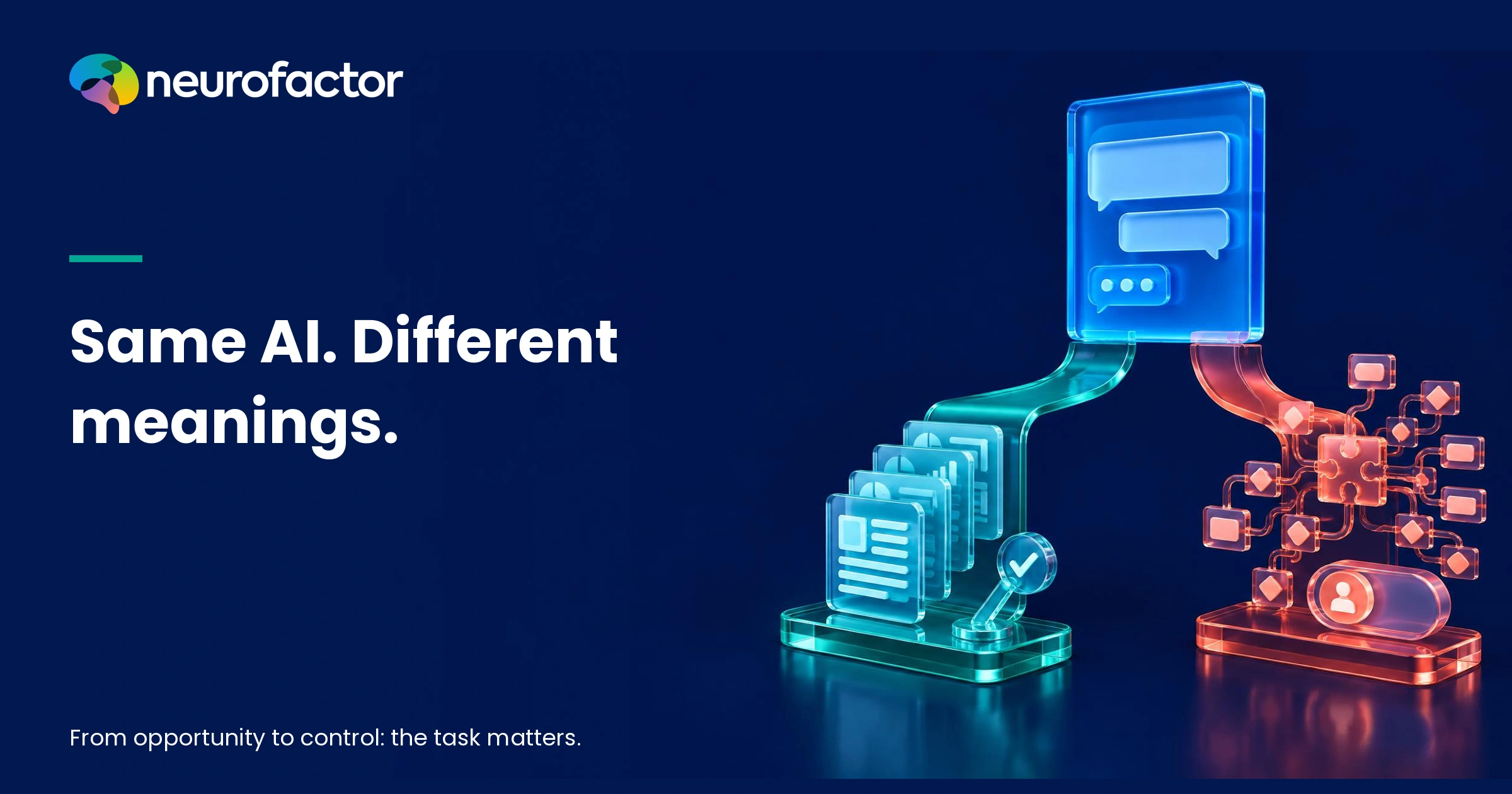
Why do new AI tools trigger both excitement and fear?
When an organization announces a new AI tool, two very different reactions can emerge at once. One employee thinks about saved time. Another hears a question about the future value of their work. The product and promise are identical, yet the associations differ. This article explores why that happens, what primary research can and cannot tell us, and how to turn the difference into a testable rollout decision. The objective is not to make everyone enthusiastic. It is to understand what the tool means in each task, for each group, and what the organization needs to change honestly.
The AI tool that saves time and creates unease
A team is introduced to a new AI assistant. The presentation sounds exciting: less repetitive work, quicker answers and more room for situations that need real attention. In the same room, someone wonders whether their job will still exist in a year. These responses are not inconsistent. People assess not only what a technology can do but what its introduction may mean for their own role. For one employee, AI signifies support; for another, surveillance, loss of expertise or replaceability. An impressive demonstration can activate both meanings. The useful question is not whether employees are 'for' or 'against' AI. It is which specific association influences whether they will use a tool appropriately, confidently and within its limits.
One announcement, two first thoughts
Imagine an organization announcing, 'Next month AI will help us answer customer questions.' Someone who currently gathers information from five systems may hear relief. A colleague whose value comes from years of solving exceptional cases personally may hear another message: 'My knowledge will be captured in a system and I may become less necessary.' The statement is identical; the personal reference point is not. Even before anyone tests the tool, an initial expectation is being formed. This is an illustrative hypothesis, not a measured finding about actual employees. It explains why a company-wide presentation can conceal crucial differences between functions, levels of experience and responsibilities.
Excitement and fear are not two fixed audiences
Change teams often divide employees into enthusiasts and skeptics. The labels are convenient, but may be misleading. A specialist might welcome automation of routine work and remain uncomfortable about the use of confidential data. A manager may appreciate speed while fearing liability for mistakes nobody can explain. Not every concern signals resistance, and a positive survey response does not prove readiness for appropriate use. Measure opportunity associations and threat associations separately instead of compressing them into one 'AI acceptance' score. Then examine whether the same individual scores highly on both and which concrete workflow brings the tension to the surface.
What people associate with AI extends beyond its features
A tool has functions: summarize documents, locate information, draft proposals. Users attach meanings to those functions: getting home sooner, making fewer errors, losing autonomy, being monitored or finally having time for complicated work. Those meanings are associations. They may be expressed directly, but not always in the first answer to a satisfaction question. Someone who calls AI 'useful' may respond very differently when asked who will evaluate their work. Association research therefore records the stimulus, decision setting and attributed meaning together. A generic question such as 'What do you think about AI?' hides that essential link.
The task changes which associations come to mind
A person may happily use AI to rewrite a routine email and reject it as the final judge of a colleague's performance. That need not reflect ignorance. The stakes depend on the task. Castelo and colleagues (2019) found less willingness to rely on algorithms when tasks appeared subjective. Lee (2018) also observed differences in perceived fairness and trust between mechanical and human-centered managerial decisions. Those studies examined specific settings, not every possible generative AI product. They do, however, show why a useful assessment starts with the concrete task and its responsibilities instead of a blanket label for AI.
Four applications, eight possible meanings
The label 'AI' can acquire different positive and negative meanings in different workflows. These are testable hypotheses, not Neurofactor study results. The final column focuses each conversation on a real decision rather than a generic preference.
Summarizing text
- Possible opportunity association
- Saved time
- Possible risk association
- Loss of nuance
- Research question
- Who checks the summary?
Customer contact
- Possible opportunity association
- Faster help
- Possible risk association
- Impersonal service
- Research question
- When does a person step in?
Work scheduling
- Possible opportunity association
- Consistency and fairness
- Possible risk association
- Monitoring and control
- Research question
- Who can correct decisions?
Creative work
- Possible opportunity association
- More ideas
- Possible risk association
- Skills becoming replaceable
- Research question
- Who makes the final choice?
Image
Productivity gains can be real - within defined tasks
The evidence is not simply a story of anxiety. Noy and Zhang (2023) randomly gave some of 453 professionals access to ChatGPT for professional writing tasks. In that setting, work was completed faster on average and assessed as higher quality. Brynjolfsson, Li and Raymond (2025) studied a staggered introduction of AI support among more than five thousand customer-support agents and found average productivity gains with substantial differences between employees. These are meaningful findings, not a promise that any tool makes everyone faster. Claiming universal improvement overstates the research and creates precisely the disappointment that can undermine confidence after rollout.
An organizational benefit can send a different personal signal
Saving thirty minutes on a task may mean breathing room to one employee. To another it may raise the question of whether their department will remain the same size. Business value and personal interpretation therefore form distinct layers. Enlarging a productivity chart will not resolve that conflict. Leaders need to explain what happens to released capacity, which decisions remain with humans and how employees can develop their expertise. Where answers do not exist yet, uncertainty should be stated rather than disguised as a guarantee. Then test whether that honest explanation changes the associations attached to the tool.
Trust has a cognitive as well as an emotional side
In an organizational field study by Vuori, Burkhard and Pitkäranta (first online in 2025, journal issue in 2026), cognitive and emotional trust did not always align. Someone may believe a system performs well and still feel uncomfortable using it. Another may like the experience without adequately understanding its limits. The researchers described different configurations of trust and behavior in one company. The typology does not establish global percentages and is not a brain-based fear test. For practical communication, the distinction matters: a convincing technical demonstration answers a capability question, not necessarily a question about safety, professional recognition or autonomy.
Why researchers have found both appreciation and aversion
The familiar claim that 'people distrust algorithms' is too broad. In forecasting studies, Dietvorst and colleagues (2015) saw reluctance after participants observed algorithmic errors. In different judgment experiments, Logg and colleagues (2019) found settings in which participants weighted algorithmic advice more heavily than human advice. The findings should not be averaged into a universal effect. Tasks, comparison points and expertise differ. Organizations need to observe whether people follow, challenge or avoid AI suggestions in defined workflows. It is entirely plausible for the same team to behave differently when checking factual summaries and when making subjective personnel decisions.
Different employees, different first questions
These profiles describe testable hypotheses about concerns; they are not diagnoses or personality types. They help reveal distinct evidence needs, which a single generic launch presentation may fail to address.
New team member
- First question
- Will this help me learn?
- Possible dominant association
- Support or evaluation
- Relevant evidence
- Safe practice and feedback
Experienced specialist
- First question
- Does my expertise still matter?
- Possible dominant association
- Augmentation or replacement
- Relevant evidence
- Expert review and quality cases
Manager
- First question
- Who remains responsible?
- Possible dominant association
- Scale or liability
- Relevant evidence
- Escalation and decision rights
Privacy lead
- First question
- Where does the information go?
- Possible dominant association
- Control or data leakage
- Relevant evidence
- Data map and permissions
Fear of replacement is not always a misunderstanding
An employee who asks whether AI will take over their job may be asking a legitimate strategic question. Leaders cannot always know how roles will change. 'Do not worry' is therefore neither sufficient nor necessarily true. Explain which tasks are currently supported, who decides about future roles, which skills remain important and when further clarity is expected. Separate known facts, testable assumptions and unresolved policy choices. Communication may help people understand the change, but it cannot make genuine employment or privacy risks disappear. Association research is useful precisely because it identifies where explanation will help and where the underlying design or policy must change.
When AI evaluates people, fairness becomes a different question
AI as an assistant and AI as an evaluator are more than different labels. A model that drafts an email presents different stakes from software that influences performance ratings, promotion advice or schedules. In an online experiment, Lee (2018) found that algorithmic decisions involving hiring and work evaluation received lower fairness and trust ratings than comparable human decisions. That is not a universal verdict on all AI, but it shows why 'AI tools' is often too broad a unit of research. Specify who sees the advice, who makes the decision, what errors are possible and how a person can appeal. Without that context, a survey may combine fundamentally different experiences.
Fictional practical case: the rollout at Asteria Servicehuis
Asteria Servicehuis is a wholly fictional organization considering a generative AI assistant to prepare answers to customer inquiries. Every name, incident and decision in this case is invented. Noor has recently joined customer service and hopes the tool will make information easier to find. Sam has years of experience handling exceptions and worries that an automated suggestion could become the default even when incorrect. Their manager wants to reduce the backlog. The first presentation emphasizes 'faster', 'smarter' and 'automatic', but does not explain who approves final replies or which customer data may be entered. No study has been conducted. The differing reactions are hypotheses for a test design, not invented questionnaire findings.
Why Noor may see a learning aid
Noor may still be learning the organization's procedures. She needs a safe way to locate reliable answers. An AI assistant that provides sources on request and allows correction could therefore match her goal: learn faster without giving customers poor advice. Yet the same tool might feel threatening if every question becomes an employee performance signal. The distinction is not her age or job title. It concerns the task, clarity about data use and the ability to ask for help without penalty. A careful experiment would vary those conditions separately rather than assuming that junior employees are automatically more enthusiastic.
Why Sam thinks first about accountability
Sam handles the exceptional cases that do not fit neatly into standard processes. If an assistant offers a confident but wrong answer, someone must be able to recognize the risk and reject the suggestion. Sam needs less of a promise that 'the tool thinks for you' and more of a demonstration using difficult real cases, named accountability and a visible correction route. Dietvorst and colleagues (2018) found that some control over an algorithm's forecast could increase use in specific experiments. For Asteria this remains a design hypothesis, not a proven deployment effect. The practical test is whether Sam really has the authority, time and incentive to challenge the system.
Image
Start with a recognizable task, not an AI sales pitch
Invite employees to describe a familiar workflow: where does time disappear, where do errors arise and when is human judgment essential? Only then demonstrate a bounded AI function on that same problem, including an incorrect or uncertain response. Ask not only whether the demo was useful, but which three words people associate with this particular use, what risk they would first rule out and which step they want to retain. This turns persuasion into a testable conversation about meaning. Use synthetic or otherwise permitted example data. A polished demonstration is not evidence of security, accuracy or legal compliance.
What an attractive AI promise does and does not prove
AI launch messages routinely go beyond the available evidence. This comparison converts an appealing claim into an outcome that can be checked independently. The measures are methodological options, not a validated universal KPI set.
AI saves time
- Evidence you can actually show
- Time per well-defined task
- Conclusion you cannot claim
- Everyone becomes more productive
- Measure
- Task time and corrections
AI improves decisions
- Evidence you can actually show
- Quality on predefined criteria
- Conclusion you cannot claim
- AI is always better than people
- Measure
- Blind output assessment
AI increases autonomy
- Evidence you can actually show
- Real ability to override
- Conclusion you cannot claim
- An override button equals agency
- Measure
- Actual correction and escalation
AI builds trust
- Evidence you can actually show
- Appropriate observed use
- Conclusion you cannot claim
- Positive attitudes predict use
- Measure
- Trust plus actual behavior
Make human oversight a functioning process
An 'approve' button means little if staff lack time, access or authority to reject a suggestion. Specify who reviews consequential outputs, which errors trigger escalation, how corrections are logged and what happens when a user disagrees. Do not present uncertain output as settled fact. The idea that some influence may encourage uptake is supported in particular forecasting experiments by Dietvorst and colleagues (2018), but its transfer to generative AI needs separate testing. Human review does not mean a person is always correct. It means responsibility is visible, feasible and auditable instead of merely being promised on a launch slide.
Transparency is more than announcing that AI is used
An organization may openly disclose AI use and still leave data processing, model limitations and employee evaluation unclear. Useful transparency explains consequences. What information is retained? Who can access it? When is an output merely a draft? Which rules apply to customers, applicants or confidential documents? These are questions of system design and governance, not only communication. Privacy, employment law and applicable AI regulations require case-specific review by qualified specialists; this article is not legal advice. If an employer cannot explain boundaries, the first task is to improve the arrangement, not to polish the presentation.
State clearly what the tool must not do
An effective rollout guide should begin with boundaries as well as possibilities. Explain which data must never be entered, when a human review is mandatory, how mistakes are reported and who is accountable for the final decision. Let employees practice with an example in which the AI confidently produces something wrong. Fallibility can then be discussed without declaring the technology useless. The objective is calibrated reliance: recognizing where the tool helps, where review is required and where not using it is the best decision. A high enthusiasm score at a launch event is a much weaker target.
Why an exciting launch tells little about routine use
The first minutes with a tool differ from using it under pressure. In a demonstration, the presenter selects a favorable question, there is no customer queue and the audience does not bear responsibility for a wrong answer. Real work involves deadlines, access rules and social expectations. That is why laboratory results should not be treated as an organizational forecast. Pilot a defined, permitted workflow with real operational constraints. Record whether people check suggestions, how much rework is required and whether appropriate use continues after novelty fades. Excitement is a worthwhile signal to explore, but it is not the final performance measure.
Teach employees when to reject the suggestion too
A session that only shows fast answers teaches button locations, not judgment. Add a second exercise using correct, uncertain and incorrect AI proposals without announcing which is which. Ask participants what they would verify, which source they would consult and when they would escalate. Reward sound decisions rather than the largest number of prompts. This is a proposed instructional design, not a Neurofactor-tested intervention. Its usefulness can be evaluated objectively: do participants become better at distinguishing helpful suggestions from those that should be checked or rejected? That question matters more than whether everyone completed the tutorial.
Four interventions that can genuinely be tested
This matrix links a possible barrier with a focused design change and an observable outcome. The relationships are hypotheses, not guaranteed effects. Interpret changes in associations alongside behavior and quality.
Real task demonstration
- Association hypothesis
- From vague to useful
- Observed outcome
- Quality and time
- Limit / safeguard
- No sensitive customer data
Human final review
- Association hypothesis
- From replacement to collaboration
- Observed outcome
- Correct interventions
- Limit / safeguard
- Named accountability
Clear data rules
- Association hypothesis
- From surveillance to bounded use
- Observed outcome
- Understanding data flows
- Limit / safeguard
- Still needs legal review
Randomized message test
- Association hypothesis
- From threat to appropriate role
- Observed outcome
- Association and choice difference
- Limit / safeguard
- Not evidence of long-term impact
An association map matters only if it changes a decision
After qualitative exploration, possible associations can be grouped into themes such as assistance, speed, autonomy, transparency, status and replaceability. An association map is not a biological fact or a fixed personality category. It is a working model of meanings found within a specified sample and context. The next question is which association obstructs which use case. If the main barrier is privacy, another speed demonstration is unlikely to address the right issue. If the problem is uncertainty about answer quality, a policy lecture alone is insufficient. Match a design change to the hypothesized barrier and define success before testing.
Measure associations through more than one window on the choice
Start with open association questions: ask people for words connected to a specific AI use case without offering examples. Then explore importance, certainty and what prompted the interpretation. Only later introduce structured comparisons, such as which version people would trust for a defined task and why. With suitable samples and design, a choice task or reaction-time measure may add information, but interpretation must be planned in advance. Implicit tasks are not a direct recording of the unconscious. Track exposure, language, task and order effects. Compare what people report with the actions they are permitted and able to take in the same workflow.
EEG does not read AI acceptance or fear from the brain
Neurofactor may combine EEG, eye tracking or implicit measures with interviews and behavior when the research question justifies doing so. Those methods are not mind-reading machines. EEG records electrical activity at the scalp; a single pattern cannot directly tell you whether someone fears AI or expects to lose their job. Eye tracking shows where a participant looked, not why they trust a message. Reaction-time differences may indicate associations under controlled conditions but require cautious interpretation. For this particular question, open associations, scenario-based choices, output quality and repeat measurements may be more informative than an impressive-looking neural score. Promise only what each method actually measures.
Step 1 - Define the decision and the permitted use case
Describe exactly what the AI may do in each workflow, who receives its output and which management decision the research is meant to inform. Predefine a desired association, such as 'strengthens my expertise', and an unwanted one, such as 'decides without me'. Treat both as hypotheses, not moral judgments. Identify non-negotiable quality, privacy and safety constraints. Select a primary behavioral outcome, for example appropriate acceptance or rejection of a recommendation in a bounded task. This protects the study from turning a well-received demonstration into an unsupported claim of organization-wide adoption.
Step 2 - Sample by task, responsibility and experience
Do not generalize from the first volunteers who sign up. Build a sampling plan across different tasks and accountabilities: newer employees, experienced specialists, managers and people responsible for privacy or quality. Document who was not reached and why. Avoid classifying employees by assumed personality or an unvalidated BIS/BAS score. Start with actual exposure, job experience, task type and the consequences of an error. Offer space for confidential feedback, but do not promise complete anonymity where observation or logs can identify an individual. Decide on permissions, access and retention before the study begins.
Step 3 - Establish a baseline without suggesting responses
Before intervention, ask participants for spontaneous words about two specific situations, such as 'AI helps prepare an answer' and 'AI determines a performance assessment'. Explore perceived benefits, risks and conditions for appropriate use. Record prior experience, confidence in task output and availability of a human alternative. Where safe and permitted, collect a baseline quality or error-detection measure using a standardized exercise. Document the exact question order and language. Otherwise, the survey itself may prime words such as 'fear' or 'job loss' and contaminate the differences you later attribute to communication.
Step 4 - Compare messages and the actual tool experience
Create at least two editorially approved introductions that describe the same factual capabilities. Version A might emphasize efficiency; version B shows the same task with explicit human review and boundaries. Randomize exposure where practical and hold duration, information amount and response process constant. Never conceal real risks or use unsafe data to make the experiment dramatic. A safe sandbox can help compare real interactions as well as descriptions. Pre-register what is changed, what counts as an exclusion and which outcome takes priority. This makes it easier to separate the effect of wording from the effect of interacting with the tool.
Step 5 - Measure associations, decisions, errors and change over time
Immediately after introduction, repeat open association questions and concrete concerns. Include willingness to use the tool for a bounded task, but do not confuse that intention with actual use. During a safe pilot, record permitted usage, correct checks, errors and necessary rework without repurposing these data as individual performance ratings. Repeat relevant measures after several weeks. Make data purposes clear and use only authorized logs. Ask whether people have become better at accepting useful advice and rejecting wrong advice, not merely whether their confidence score has risen. An initial spike in enthusiasm is not sufficient evidence of change.
Step 6 - Turn the finding into a testable intervention
For each relevant group, identify the association most likely to obstruct the defined behavior and the evidence or design change that could address it. Quality uncertainty may call for a better review workflow; privacy concerns may require a different data architecture. Report differences, uncertainty and competing explanations. A correlation between trust and use does not prove that trust caused use. Restrict any A/B finding to the message, population and time window tested. Finish with a decision log: what changes, who owns it, which guardrail remains and when will it be measured again? Association research then guides a concrete decision instead of producing an attractive word cloud.
Where adoption research meets employment policy
It is tempting to treat every objection as a communication issue. But if staff fear that their inputs will be used for hidden evaluation, the response must involve actual rules and data processing safeguards. A researcher can diagnose an association; research cannot replace employment law or remove a real organizational risk through wording. Identify accountable owners for data handling, HR, workflow quality and employee representation where appropriate. Provide a safe route for reporting errors and concerns. A successful outcome may sometimes be less unsafe use rather than more use overall. That belongs in the research conclusion and the business case alike.
Three questions for your next AI launch
Before the launch, ask more than 'How much faster is it?' Ask, 'Which decision will the tool explicitly not make?', 'What happens when it confidently makes an error?' and 'What does this change mean for a person's expertise and authority?' Have product, HR, privacy and the affected employees examine those answers independently. If they tell incompatible stories, communication is not ready. Show not just the potential gain, but the workflow, boundaries and relevant proof. This provides a credible opportunity for AI to mean appropriate assistance rather than vague threat. Whether the association actually changes must still be measured.
Not everyone needs to feel excited. Everyone needs to know where they stand.
New AI tools can generate curiosity, enthusiasm, skepticism and fear at the same time. That is not necessarily a communication failure. It may reveal that the same technology carries several meanings depending on task and responsibility. The difference becomes visible when you ask what people expect, what they are accountable for and which first association comes to mind. Do not confuse a positive launch reaction with safe adoption. Research which meaning facilitates or blocks appropriate behavior, address real risks and show evidence in the workflow where decisions happen. The strongest launch does not sell the idea that AI can do anything. It clarifies what the system does, what people still decide and how the organization will test its promises.
Key terms
- AI association
- Meaning spontaneously or promptedly connected to AI, such as support, speed, lost control or replaceability.
- Algorithm aversion
- Reluctance to follow algorithmic advice under certain conditions, especially after observed errors.
- Algorithm appreciation
- Giving algorithmic advice more weight than human advice in certain judgment settings.
- Calibrated reliance
- Using AI when appropriate, checking uncertainty and refraining from unsafe or out-of-scope use.
Frequently asked questions
Why can employees be excited about AI and afraid of it at the same time?
They may anticipate faster, easier work while worrying about control, errors, privacy or the future value of their expertise. Which interpretation dominates depends on the person, the task and the setting; it requires evidence.
Is fear of AI simply resistance to change?
No. Someone can be eager to experiment yet demand safeguards. Refusing a tool with unclear accountability or unsafe data handling can be a rational decision.
Does AI training automatically overcome resistance?
Training may build competence, but it cannot replace clear purpose, data protection, accountable decisions and genuine choices about use. Test behavior and perceptions after training.
Can EEG or an implicit test prove that someone is afraid of AI?
No. EEG measures scalp electrical activity; it does not read fear, acceptance or intentions. Implicit tasks may examine associative patterns under controlled conditions, not directly predict future tool use.
How should successful AI adoption be measured?
Predefine task outcomes, error rates, permitted actual use, autonomy and trust. Use multiple time points and compare roles and exposure rather than relying solely on a satisfaction survey.
Sources
- 1.Experimental evidence on the productivity effects of generative artificial intelligence
- 2.Generative AI at Work
- 3.Understanding perception of algorithmic decisions: Fairness, trust, and emotion in response to algorithmic management
- 4.Algorithm aversion: People erroneously avoid algorithms after seeing them err
- 5.Overcoming algorithm aversion: People will use imperfect algorithms if they can (even slightly) modify them
- 6.Algorithm appreciation: People prefer algorithmic to human judgment
- 7.Task-Dependent Algorithm Aversion
- 8.Resistance to Medical Artificial Intelligence
- 9.It's Amazing - But Terrifying!: Unveiling the Combined Effect of Emotional and Cognitive Trust on Organizational Members’ Behaviours, AI Performance, and Adoption
Read next
Reviewed by: Martijn den Otter · Last reviewed: 11/6/2026
Martijn den Otter
Oprichter van Neurofactor. Expert in neuromarketing en consumentenpsychologie.
LinkedIn →