
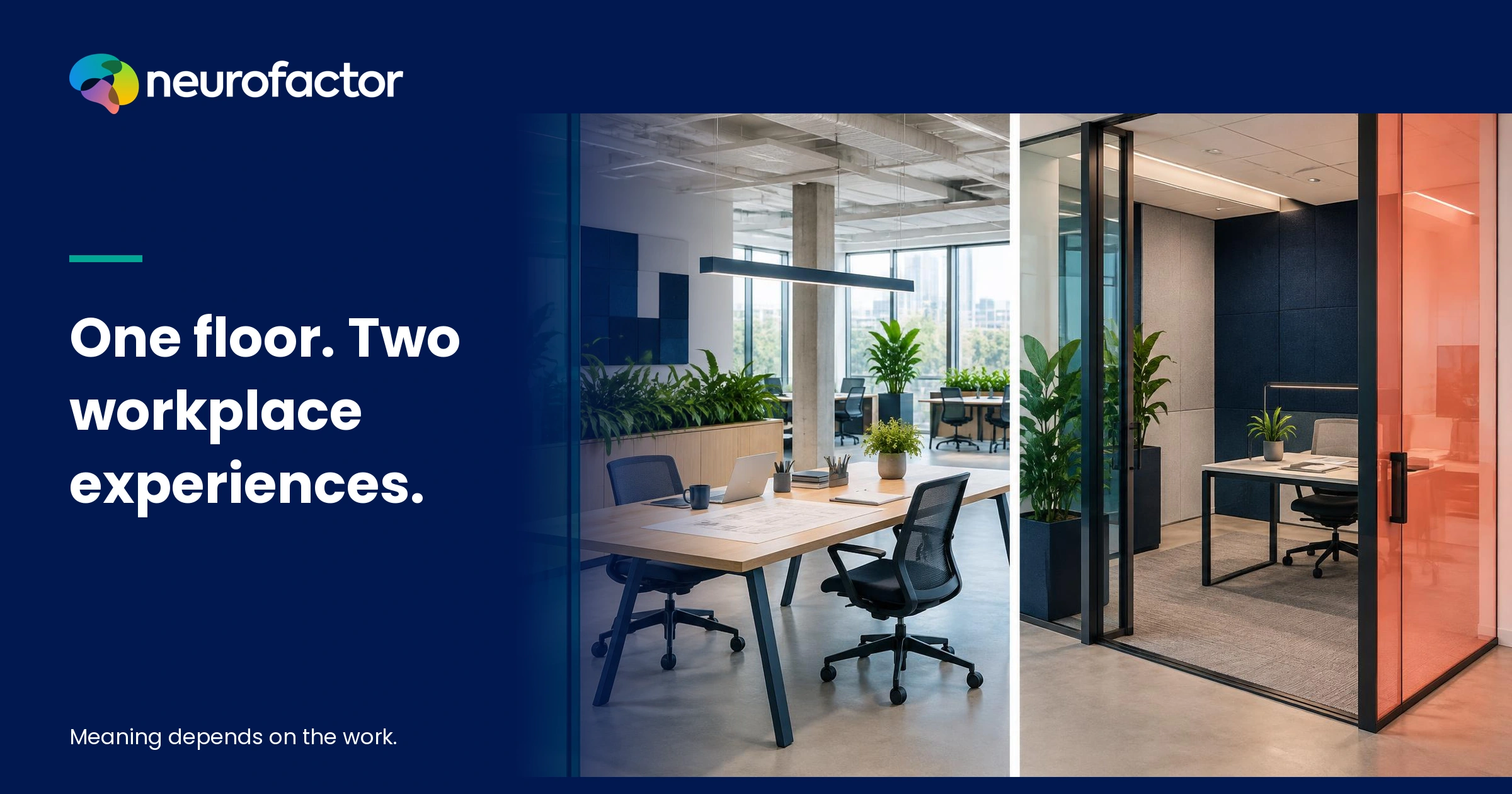
Why does an open-plan office feel liberating to some and unsafe to others?
An open-plan office may mean freedom, easy contact and collaboration to one employee, but interruption, exposure and lost privacy to another. The difference is not determined by layout alone. Task demands, timing and actual freedom to choose matter. Research identifies noise and privacy loss as major drivers of dissatisfaction in some open offices [S1], while a different field experiment found favourable outcomes in an open configuration with perceived privacy and autonomy [S8]. The practical question is which associations this particular office evokes during real tasks and which changes reduce friction without undermining valuable cooperation.
The same floor can feel liberating and exposing
Imagine a bright, open workplace with shared tables, generous daylight and an informal meeting area. Noor, a project coordinator, experiences it as welcoming and flexible. Yusuf, a data analyst, describes the same floor as distracting and exposed. Neither statement proves that the office is objectively dangerous. They are describing what the setting means for their work. To Noor, nearby colleagues mean quick decisions. To Yusuf, nearby colleagues can mean interrupted concentration and conversations that are difficult to keep private. The question is not whether open offices are inherently good or bad. It is which associations a particular workplace evokes for particular tasks, and what people can do when their needs change. Research on workspace satisfaction identifies acoustic and visual privacy as consequential aspects of that experience [S1].
Freedom and safety need clear definitions
Freedom might mean choosing where to sit, asking a colleague a quick question or starting a discussion without a formal appointment. Feeling unsafe might refer to being overheard, having one's screen visible, lacking an escape from interruption or feeling unable to protect confidential information. Those experiences are not equivalent to proven physical danger or a clinical condition. Spatial privacy is also different from psychological safety within a team. A person may work behind a closed door and still fear disagreeing with a manager. Another may enjoy an emotionally supportive team while the acoustics of its shared office make sensitive conversations difficult. Separate these concepts in the research design. Otherwise an aggregate 'safety' score can conceal completely different problems that demand different responses.
A space carries a promise before work begins
Glass partitions can suggest transparency and equality to one worker but unwanted visibility to another. A long communal desk can promise collaborative energy while also signalling an expectation of permanent availability. These meanings are not permanent properties of glass, furniture or lighting. They grow from prior experiences, unwritten team rules and the task a worker expects to carry out. Somebody who completed a collaborative sprint yesterday may assess the same room differently from somebody who struggled to find privacy for a client call. That is why the first question after an association should be: 'Which situation made you think of that?' Without concrete episodes, terms such as modern, open and dynamic remain the designer's intended message rather than evidence of the employee's actual experience.
Four association clusters worth investigating
A useful initial framework contains four hypotheses, not four personality types. Connection concerns approachability, chance encounters and solving problems together. Visibility concerns being observed, overheard or judged on how busy one appears. Focus concerns uninterrupted attention, predictable acoustic conditions and task continuity. Control concerns being able to choose, withdraw, set limits and reach an appropriate workspace. These clusters are editorial and research hypotheses, not validated Neurofactor scores or universal profiles. Their relevance changes across activities. The same employee may appreciate connection during brainstorming but prioritise control when checking a complex document. An association map becomes useful only when it records those contextual changes and is tested against real workplace events, rather than assigning permanent labels to people.
Job titles are a poor substitute for task requirements
Two employees with identical job titles can have very different working days. One needs frequent, informal coordination; another requires extended periods of analytical attention; a third handles information that should not be audible to the whole team. A study involving 1,241 employees found that concentration requirements modified relationships between office type, distraction and cognitive stress [S13]. That finding does not mean every analyst deserves a private room or every project manager prefers a communal table. It means workplace planning should begin with the tasks, not stereotypes about roles or introversion. Map which activities genuinely require face-to-face access, confidential speech and uninterrupted periods. Then examine whether the space provides those conditions when needed, especially at peak occupancy rather than only in an architectural rendering.
Table 1 - one setting, contrasting possible associations
This comparison sets several workplace moments alongside plausible positive and negative interpretations. The entries are prompts for investigation, not measured employee outcomes. Avoid assuming that someone who appreciates connection today will welcome every interruption tomorrow. Ask when the interpretation changes, what events precede it and which practical alternatives were available. The relevant unit of analysis may be a task episode rather than a person. By placing the observable circumstances next to potential meanings, the table helps interviewers ask better questions without turning a working hypothesis into a supposed psychological fact.
Quick project check-in
- Possible positive meaning
- Easy access
- Possible negative meaning
- Constant interruption
- Context to examine
- Task urgency and interruptions
Complex data analysis
- Possible positive meaning
- Questions solved together
- Possible negative meaning
- Fragmented concentration
- Context to examine
- Availability of focus rooms
Confidential call
- Possible positive meaning
- Fast coordination
- Possible negative meaning
- Conversation can be overheard
- Context to examine
- Actual booth access and usage
Shared break
- Possible positive meaning
- Sense of belonging
- Possible negative meaning
- No personal boundary
- Context to examine
- Freedom to opt out
Open workbench
- Possible positive meaning
- Equality
- Possible negative meaning
- Continuous visibility
- Context to examine
- Desk positioning and norms
Image
Do not pathologise a person because the office is a poor fit
When someone finds an open-plan workplace difficult, managers may be tempted to say that the person is unusually sensitive or should simply wear headphones. That response turns a possible design mismatch into an individual weakness. Yet concentration, confidentiality and distance can be legitimate work requirements. Another employee's desire for spontaneous interaction is equally legitimate. The proper question is whether the workplace supports both activities at the moments they occur. Take reports of discomfort seriously without making unsupported claims about anxiety disorders, neurodivergence or clinical stress. Those would require different, professionally appropriate assessments. Good workspace research identifies a mismatch between tasks and available resources before it starts assigning characteristics to employees.
Speech can disrupt work without being especially loud
A relatively quiet, intelligible conversation may interrupt writing or calculation more than a steady background sound of greater intensity. Noise disturbance is not only a matter of decibels. Speech intelligibility, unpredictability, acoustic distance and the meaning of the interruption also matter. In a longitudinal relocation study, employees reported more distraction, weaker privacy and greater concentration difficulties after moving from individual rooms to an open-plan office, even though average sound levels across the working day did not rise [S3]. This does not establish that every open office produces the same effect. It does show why a single sound-level reading is insufficient. The right response could involve phone-call zones, acoustic changes or different task scheduling, depending on what the evidence reveals.
Contrasting findings are part of the scientific picture
Kim and de Dear's analysis of workspace survey data found that advantages in ease of interaction did not outweigh noise and privacy drawbacks in the open layouts studied [S1]. Bernstein and Turban observed a decline in recorded face-to-face communication following two transitions to more open offices, alongside greater electronic communication [S2]. Yet a field experiment involving 96 people found lower physiological stress and better group-task performance in the most open of three configurations, with perceived privacy, ambience and autonomy among the proposed contributing factors [S8]. These studies involved different workplaces, interventions and outcome measures. It would be careless to proclaim either universal superiority or universal harm. Openness is a spatial description; its human consequences depend on how the space functions and what people can control.
Choice can change the meaning of the same interruption
A spontaneous discussion next to your desk may feel welcome if you can later move to a quiet room. It can feel intrusive when there is nowhere else to go or when supervisors expect everyone to remain visibly available. Control is more than a theoretical right to switch desks. Appropriate spaces must actually be free, rules must permit their use and choosing privacy must not carry a social penalty. A longitudinal study of activity-based flexible offices found more favourable developments in satisfaction among employees reporting better alignment between their needs and the available workplace resources [S14]. That is evidence about one studied relocation, not a universal promise for flexible offices. Check whether employees can exercise choice on busy days and whether quiet spaces work for the tasks they are meant to support.
Replace generic satisfaction questions with recent episodes
Asking 'Do you like our office?' usually generates a verdict on the setting as a whole. You cannot tell whether the answer reflects daylight, social culture, one difficult Monday or a consistently unavailable call room. Instead ask about the last occasion when someone needed deep concentration, informal coordination and a confidential conversation. Where were they sitting? Which interruptions occurred? What could they change? What did the experience make the workspace mean to them? Look for positive counterexamples as well as complaints, so that interviews do not steer everyone towards dissatisfaction. Let employees' spontaneous vocabulary inform any later association task. Avoid placing words such as threat, freedom or surveillance in participants' mouths before they have described their own experiences.
Physical sound measurements and lived meaning are different evidence
Acoustic surveys can quantify background levels, speech transmission, occupancy and availability of quiet workspaces. Interviews and surveys can examine perceived privacy, choice, distraction and accessibility. Those datasets describe different things. A sound-pressure reading cannot reveal whether a conversation felt like support or intrusion. Equally, a self-report alone cannot identify the physical cause of a complaint. A 2025 study combined acoustic measurements and responses from 349 occupants across 28 open offices and demonstrated the complexity of predicting dissatisfaction from physical parameters [S6]. Link each instrument to the same defined task and moment. Do not turn one technical number into an unsupported explanation of emotion, performance or psychological safety. Triangulation should expose uncertainties rather than conceal them.
Table 2 - design promise versus experience in use
Open office proposals often promise transparency, connection, energy and flexibility. Those are desired associations, not confirmed employee outcomes. In practice the same element can help one task and obstruct another. This table compares each promise with a potential benefit, a possible unintended interpretation and a specific question for evaluation. It is not a catalogue of established defects. The point is to examine how design features operate during actual work, including busy periods, confidential discussions and times when quiet rooms are occupied. A concept is credible when the stated benefit can be demonstrated in daily use without disregarding its costs.
Transparency
- Intended benefit
- Accessible colleagues
- Possible alternative experience
- Feeling observed
- Testable question
- When is visibility welcome?
Flexibility
- Intended benefit
- Choose a suitable desk
- Possible alternative experience
- Quiet places permanently taken
- Testable question
- How often is a good setting available?
Collaboration
- Intended benefit
- Faster coordination
- Possible alternative experience
- More uninvited interruptions
- Testable question
- Which interactions help the task?
Energy
- Intended benefit
- Lively environment
- Possible alternative experience
- Distracting speech
- Testable question
- Which activities require calm?
Space efficiency
- Intended benefit
- Shared floor area
- Possible alternative experience
- Confidential tasks exposed
- Testable question
- Which tasks cannot happen here?
Entirely fictional case study - Veldlicht Projectadvies
Veldlicht Projectadvies and all its characters are fictional. The company has introduced an open floor with shared desks, phone booths and a communal meeting space. Noor coordinates projects and frequently exchanges information with designers and client managers. Yusuf analyses data and must regularly check detailed reports where small mistakes matter. They use the same facilities. On Friday, both are asked whether the office feels free. Noor appreciates easy access to colleagues. Yusuf is uncertain because quiet rooms are often booked. These are not measured findings or disguised information about an actual Neurofactor client. The scenario simply makes two plausible interpretations concrete enough to guide further research, without claiming to represent every person in either job.
Image
Noor experiences visibility as access
Noor notices that coworkers ask quick questions more easily when they can see her. She crosses the floor to solve project issues and appreciates not having to book a meeting for every exchange. For her, the space evokes access, momentum and joint problem-solving. But during a weekly confidential client meeting, the same openness becomes a limitation: if the phone booth is occupied, her usual desk is unsuitable. That moment matters. Noor is not a permanent supporter of all shared spaces. Her assessment changes with the task. An analysis that labels her 'extroverted' and therefore fully satisfied would miss the real design requirement. Ask which specific work moments reverse her positive evaluation and what a feasible alternative would look like.
Yusuf experiences proximity as a loss of control
Yusuf has protected two hours to validate a complicated dataset. Colleagues walk past his screen, someone joins an online call nearby and the only concentration room is occupied. He describes the environment as unsafe. In this entirely fictional example, he is not claiming that his colleagues are dangerous. He worries that uncontrolled interruptions will undermine the accuracy of his work and that confidential material could become visible. His associations are exposure, interruption and limited control. A headset might reduce some disturbances but cannot fix inadequate room availability or privacy. The investigation must determine which disruptions actually occur, how often they matter and whether the proposed solutions are practical. Assigning Yusuf a fixed personality category would be neither necessary nor helpful.
Preferences can change several times in a day
The difference between Noor and Yusuf must not become two rigid personas. Yusuf may enjoy an open floor during a design workshop, and Noor may prefer an enclosed room for contract negotiations. The experience of a quiet Tuesday can differ dramatically from a crowded Thursday. Familiarity may change some expectations, but it does not magically create missing space or eliminate confidential tasks. Sample different activities, occupancy conditions and weeks rather than relying on one tour or a single afternoon questionnaire. Segmentation by workplace moment may be more informative than segmentation by employee. A floor can achieve a respectable overall satisfaction score while failing repeatedly during the few high-stakes tasks that require privacy or sustained attention.
Spatial privacy is not the same as social safety
When somebody says an office feels unsafe, clarify what they mean. A worker might dislike coworkers viewing a screen without fearing professional disagreement. Another might have a perfectly quiet room but feel unable to challenge a supervisor. These experiences may interact, but they are not interchangeable. This article concerns the associations and practical experience of physical workspaces. If interviews reveal bullying, harassment or discrimination, safeguarding and appropriate reporting procedures take priority over interior experiments. An office redesign cannot substitute for correcting harmful social conduct. Conversely, someone seeking acoustic privacy should not be told that the team is friendly and therefore the workspace is safe. Start by defining the issue rather than collapsing every concern into a single emotionally powerful word.
The phone area exposes hidden assumptions
In fictional Veldlicht, the rule allows short calls at shared desks. For a coordinator, that can signal speed and availability. For a person handling sensitive contracts, the same rule might mean that important details can be overheard. A floor can contain an adequate number of phone booths on paper and still fail if those booths are distant, hard to reserve or informally considered excessive for a short call. Ask not just what facilities exist but how people actually use them, for which tasks and why they sometimes stay in the shared area. Observe whether the formal usage policy matches the social norm. The meaning of a workplace emerges from the building, its operating rules and everyday behaviour together.
Design for activities rather than the average employee
A useful workspace map starts with activities: focused analysis, collaboration, confidential calls, quick coordination and recovery from intensive work. For each, specify appropriate sound conditions, privacy, proximity and availability. Make moving between spaces simple and socially acceptable. A 'quiet area' is not a credible answer if people regularly take calls there or if teams treat those who seek quiet as uncooperative. Pair architectural choices with clear and workable behavioural agreements. Include managers because their expectations influence whether employees feel entitled to leave the main floor to concentrate. The design is therefore more than furniture placement. It is an arrangement of spaces, access and practical norms that supports different tasks without creating unnecessary friction.
Table 3 - from potential association to testable change
The matrix links possible interpretations of a space to a research question and a proportionate change that could be piloted. These are hypotheses, not proven prescriptions. Acoustic panels may reduce reverberation without providing confidentiality. A booth offers privacy only if it is available at the right time. A partition may protect focus while reducing informal accessibility. Consider the cost and unintended consequences of each change. Test the feature against the task it aims to support, while also checking what happens to collaboration and overall access. The purpose of evidence is to improve decisions, not to justify a favourite design solution after the fact.
I cannot focus anywhere
- Potential friction
- Quiet rooms fully booked
- Pilot intervention
- Protected focus zone
- Possible trade-off
- Less spontaneous access
Calls are audible
- Potential friction
- Phone traffic near workstations
- Pilot intervention
- Dedicated call area
- Possible trade-off
- Longer travel to meeting points
I have to stay visible
- Potential friction
- Unspoken attendance rules
- Pilot intervention
- Explicit choice rules
- Possible trade-off
- Greater coordination needed
Collaboration will disappear
- Potential friction
- Too many isolated areas
- Pilot intervention
- Easy-access meeting points
- Possible trade-off
- Shorter focus periods
Every desk suits everyone
- Potential friction
- Activities mismatch spaces
- Pilot intervention
- Activity-based zoning
- Possible trade-off
- Added booking complexity
Let employees participate in the design process
An organisation can spend heavily on furniture without identifying which situation is causing the greatest problem. Start with a facilitated review in which staff describe helpful and unhelpful work episodes. Ask teams to test a short coordination task, a demanding analysis task and a confidential conversation in the proposed layout. Identify which benefits must be preserved as well as which difficulties must be addressed. A field refurbishment study involving 135 employees reported improvements in environmental satisfaction and job satisfaction after changes including acoustics, ergonomics and privacy [S15]. Without a randomly assigned comparison group, that does not guarantee the same outcome elsewhere. It supports a more sensible proposition: target a defined problem, involve the people affected and evaluate the result rather than assuming a redesign will succeed.
Being able to see people does not guarantee more collaboration
One argument for open-plan offices is that colleagues will naturally approach each other. Yet Bernstein and Turban's two intervention-based field studies recorded less face-to-face interaction after office spaces became more open, while digital communication increased [S2]. Those results do not prove that openness always reduces collaboration. They demonstrate that visible proximity alone is an inadequate proxy for useful interaction. Examine the quality and purpose of exchanges, not merely how many encounters occur. A well-designed workplace may support planned teamwork and still protect individual concentration. If an organisation optimises only for spontaneous conversations, it may damage the independent work on which successful teamwork depends. The correct evidence needs to cover both sides of that trade-off.
EEG and physiological measures cannot diagnose workplace comfort
In a properly designed study, physiological measurements may add information about responses during particular work tasks. But no single EEG feature, heart-rate variable or reaction-time association task can establish that an individual feels unsafe in an office. A field experiment with 96 participants examined stress-related physiology and task performance across open configurations [S8]. It did not validate a universal neural marker of employee workplace preference. Task demands, movement, sleep, health and measurement conditions can all influence signals. Any proposed neuroscience component therefore needs a clear hypothesis, ethical review, appropriate legal basis and qualified analysis. Avoid employee surveillance or individual workplace scoring. If surveys and observed task performance already answer the design question, a sensor may add cost and risk without sufficient benefit.
Pilot a change before rebuilding the floor
Start with a reversible intervention: designate a genuinely quiet area, move a noisy call zone or simplify access to concentration booths. Specify the problem and the expected improvement before changing anything. A workplace experiment within a technology company compared open-plan, zoned, activity-based and team configurations, finding more favourable outcomes for zoned open and team offices than for unzoned open arrangements in that setting [S7]. This does not establish a universal ranking for all organisations. Use it as a reason to test more than one feasible configuration and to examine task demands. Make sure employees actually have access to the pilot space; otherwise you will be evaluating scarcity rather than design. Consider collaboration and availability as well as focus-related outcomes.
Acoustic changes cannot replace workable social rules
Sound-absorbing panels may help reduce reverberation, but they cannot fix a management expectation that everyone must remain constantly reachable. A private booth can protect conversations but fails if colleagues treat its use as antisocial. Conversely, a polite phone-use rule will disappoint when the layout offers nowhere else to call. Physical and social changes therefore belong together. Research on two office relocations identified distraction as an important factor in environmental problems and described benefits associated with quiet workspaces [S5]. That does not justify equating every sound with stress. A workspace functions well when its physical conditions suit the task, the necessary alternatives are genuinely available and employees may use them without unnecessary obstacles. Evaluate all three elements.
Three small experiments worth testing carefully
First, introduce a clear rule for conversations at desks and identify a realistic alternative call location. Second, create accessible focus space without a booking process that makes brief use impractical. Third, agree that choosing a quiet room for complex work is a normal professional decision, not a rejection of colleagues. These are testable design ideas, not guaranteed solutions. Record actual interruptions, use of alternate areas and any unintended reduction in team accessibility. Decide in advance what to do when a facility is repeatedly full. Do not launch a glossy campaign about the wonderful new office before employees report and demonstrate that the critical work situations have improved. Otherwise communication may amplify the gap between the promise and the lived experience.
Investigate context instead of diagnosing a worker type
One employee may evaluate a workspace differently depending on deadlines, video calls, confidential tasks and the surrounding team. Remote-work options, time of day, occupancy, management practices and even which employees avoid the office can shape the results. If dissatisfied workers stay home, a survey conducted only among those present can overstate satisfaction. Cross-sectional studies such as Kim and de Dear's identify associations but do not assign individual causes [S1]. Track who could participate and where important work actually takes place. Document plausible alternative explanations before attributing an improvement to the office concept. A useful workplace profile is a description of task demands, available settings and experienced friction, not a label that follows an employee through their career.
Research protocol step 1 - specify moments and hypotheses
Before collecting data, list the activities that the workplace must support: focused writing, short collaboration, confidential calls, online meetings and breaks. Identify which spatial features and practical rules matter for each. Formulate a falsifiable hypothesis, such as open-plan work being associated with perceived loss of control during concentrated tasks when quiet rooms are unavailable. Write down an alternative explanation, for instance inconsistent phone etiquette. Define what observable evidence would weaken the initial hypothesis and how any later intervention will be judged. Decide at the outset which task and role comparisons are justified. This protects the research from a convenient after-the-fact story in which every observation supposedly supports a preselected design.
Research protocol step 2 - collect spontaneous meanings and episodes
Use voluntary confidential interviews, brief task diaries and guided walkthroughs. Ask about recent occasions when a space helped or obstructed work, which interruptions occurred and what people could change. Collect the words employees use spontaneously for freedom, privacy, cooperation and loss of focus. Include positive and negative episodes, along with examples that contradict the emerging hypothesis. Avoid asking whether the 'noisy open office makes you anxious' because that supplies both a description and an emotion. Protect participants from identification through job title or a rare incident. Separate observed events from interpretations and record the context in which each arose. Treat the narratives as starting points for testing, not as validated personality classifications.
Research protocol step 3 - combine surveys with spatial evidence
Use an appropriate workplace questionnaire to assess privacy, choice, distraction, collaboration and accessibility, preferably with established measures where available. Collect practical spatial indicators such as occupancy, availability of phone rooms, relevant sound conditions and use of quiet zones. Sample busy and quiet periods instead of extrapolating from a nearly empty office. Align measures with defined activities so that a change in sound or availability can be interpreted sensibly. Keep questionnaire data distinct from observation and acoustic instruments in the analysis. A louder workplace does not automatically imply psychological danger, and a favourable survey score does not prove absence of confidentiality issues. Minimise personal location data and establish a lawful, proportionate data-processing plan.
Research protocol step 4 - test associations without overinterpretation
If a specific question remains unanswered, consider a supplementary association or reaction-time task using familiar workplace terms such as open floor, privacy, collaboration and quiet. Pretest comprehension, order effects and repeatability. Ask workers whether those words capture their experience before assigning them theoretical meaning. Compare groups only where numbers and privacy safeguards are adequate. A fast response to the word control is not evidence that a manager is monitoring someone, and an indirect task is not a clinical or neural truth detector. Triangulate its patterns with interviews, tasks and spatial evidence. Predefine what would count as a contradictory result and report it. The aim is to improve understanding, not to classify individual employees.
Research protocol step 5 - test one reversible intervention
Choose a small change based on the diagnosis: better access to phone booths, a quiet zone, a new call policy or altered workstation allocation. Record precisely what changes, who has access and which tasks are affected. Compare similar activities before and after the intervention and, where feasible, use a matched area or staggered introduction. Monitor adverse effects such as longer journeys to meetings or reduced informal support. A pilot can guide a practical decision but cannot automatically establish causality. Consider novelty effects, adaptation, seasonal variation and changing attendance. Avoid promising productivity gains that were never measured. Make the evaluation criteria explicit before employees experience the new arrangement.
Research protocol step 6 - evaluate and translate findings into decisions
Combine follow-up questionnaires, qualitative episodes, occupancy and task-relevant measures. Look beyond the average score to see whether high-need tasks are now better supported. Examine participation and the possibility that people dissatisfied with the office are avoiding it. Report uncertainty, alternative explanations and any harms arising from the new configuration. Avoid publishing data about small groups whose members might be identifiable. Decide whether to expand, revise or stop the pilot and explain that decision to employees. Closing the feedback loop also shapes the meaning of workplace research: a serious response can support trust, while another glossy concept announcement without practical follow-through may deepen scepticism. Reassessment should remain possible as tasks change.
Table 4 - matching research questions to defensible evidence
A workplace study works only if each instrument answers a defined question. Surveys capture reported experience, observation describes events, acoustic instruments describe physical sound conditions and task measures address particular aspects of work. None is a standalone detector of inner safety or a universal productivity score. This matrix pairs questions with suitable evidence and identifies conclusions that cannot be supported by a single measurement. Use it to prevent overclaiming, particularly if physiological or indirect association methods are proposed. A transparent research design should clarify uncertainty instead of hiding it behind a dashboard that appears scientifically comprehensive.
When does distraction occur?
- Suitable evidence
- Observation, tasks, acoustics
- Unsupported inference
- Louder means psychologically unsafe
- Safeguard
- Sample busy and quiet periods
Can employees choose?
- Suitable evidence
- Room availability and interviews
- Unsupported inference
- A floor plan proves autonomy
- Safeguard
- Check access at peak times
Did experience change?
- Suitable evidence
- Surveys plus task episodes
- Unsupported inference
- One score proves causality
- Safeguard
- Before-and-after with context
Which meanings are salient?
- Suitable evidence
- Spontaneous language and optional task
- Unsupported inference
- Reaction times expose hidden fear
- Safeguard
- Validity and privacy checks
Did zoning help?
- Suitable evidence
- Task outcomes and space use
- Unsupported inference
- Every worker must benefit
- Safeguard
- Track unintended trade-offs
Inspect the distribution behind any average
Suppose most employees enjoy the shared floor but a small group cannot complete important confidential or analytical tasks there. The average satisfaction score could still look encouraging. Yet two complaints would not be enough to declare the entire design unsuccessful. Examine task frequency, severity, occupancy and real access to alternatives. A cross-sectional survey of 1,078 people in shared and open offices associated irrelevant speech with greater reported disturbance and poorer perceived work outcomes in open settings [S10]. That does not predict how any particular employee will react. It does show why specific sources of disturbance, their timing and coping strategies deserve separate analysis. Protect anonymity when reporting small groups and avoid turning one summary number into a verdict on the entire building.
An open office has no single psychological meaning
The same proximity can facilitate collaboration and fracture concentration. The same visibility can feel approachable or invasive. The research literature includes both disadvantages and context-dependent benefits [S1][S8][S14]. It follows that neither 'ban every open office' nor 'everyone should adapt' is an evidence-based answer. Ask which activities the space supports, what associations workers attach to particular episodes and how much control they can exercise when demands change. When design, access and working agreements align with those moments, a promise of freedom becomes more credible. Without that alignment, openness is mainly a characteristic of the floor plan and not necessarily of the employee's experience.
The next design decision begins with a better question
At the next office review, replace 'Do we want open or enclosed space?' with 'Which tasks should become easier, quieter or more private, for whom and at what times?' That framing helps facilities, HR, managers and employees assess the same working reality. Begin with spontaneous meanings, verify practical and physical conditions, then pilot a proportionate change. Explain openly what the pilot did and did not establish. The goal is not a flawless room in which everybody is happy at all times. It is to reduce demonstrable friction between the work people need to perform and the spaces the organisation provides, while preserving the benefits that staff actually value.
Key terms
- Open-plan office
- A shared workplace where multiple employees work without full-height enclosed rooms separating every desk.
- Spatial privacy
- The perceived ability to regulate visual access, sound, personal exposure and confidential information.
- Acoustic distraction
- Interruption caused by speech or other unpredictable sound, not simply the overall noise level.
- Workspace autonomy
- Practical freedom to choose suitable settings, limit interruptions and manage access while completing work.
- Need-supply fit
- How closely the features available in a workplace match the requirements of employees and tasks.
- Association hypothesis
- A testable explanation of the meaning a workplace situation evokes, not an individual diagnosis.
Frequently asked questions
Why can an open-plan office feel unsafe?
Employees may be concerned about being observed, audible conversations, confidential information, repeated interruptions or insufficient control. Clarify the meaning; discomfort is not automatically a medical diagnosis.
Are employees more productive in an open-plan office?
Not necessarily. Effects vary with task demands, privacy, acoustics, operating norms and access to suitable alternatives. Research reports disadvantages as well as context-dependent benefits.
How can workplace associations be investigated?
Start with spontaneous language and specific episodes, examine patterns through interviews and suitable surveys, then combine them with occupancy observations and appropriate physical measurements.
Do quiet zones solve open-office problems?
They may help when they are genuinely quiet, accessible and available. Identify the task problem and pilot the change before assuming success.
Can EEG reveal whether an employee feels safe at work?
No. Physiological measures may complement a well-designed study, but EEG signals or reaction times alone cannot diagnose an individual sense of safety or office preference.
Sources
- 1.Workspace satisfaction: The privacy-communication trade-off in open-plan offices
- 2.The impact of the open workspace on human collaboration
- 3.Effects of acoustic environment on work in private office rooms and open-plan offices - longitudinal study during relocation
- 4.Stress and open-office noise
- 5.Benefits of quiet workspaces in open-plan offices - Evidence from two office relocations
- 6.Noise disturbance and lack of privacy: Modeling acoustic dissatisfaction in open-plan offices
- 7.The work environment pilot: An experiment to determine the optimal office design for a technology company
- 8.Office Openess Affects Stress Regulation and Teamwork: A Neurophysiological Field Study
- 9.Office Type in Relation to Health, Well-Being, and Job Satisfaction Among Employees
- 10.A Cross-Sectional Survey on the Impact of Irrelevant Speech Noise on Annoyance, Mental Health and Well-being, Performance and Occupants Behavior in Shared and Open-Plan Offices
- 11.Perception of Work Environment and Well-being in Activity-based Office - Three-wave Longitudinal Study
- 12.The relation between office type and workplace conflict: A gender and noise perspective
- 13.Concentration requirements modify the effect of office type on indicators of health and performance
- 14.Need-Supply Fit in an Activity-Based Flexible Office: A Longitudinal Study During Relocation
- 15.Refurbishment of an open-plan office - Environmental and job satisfaction
Read next
Reviewed by: Martijn den Otter · Last reviewed: 11/6/2026
Martijn den Otter
Oprichter van Neurofactor. Expert in neuromarketing en consumentenpsychologie.
LinkedIn →