
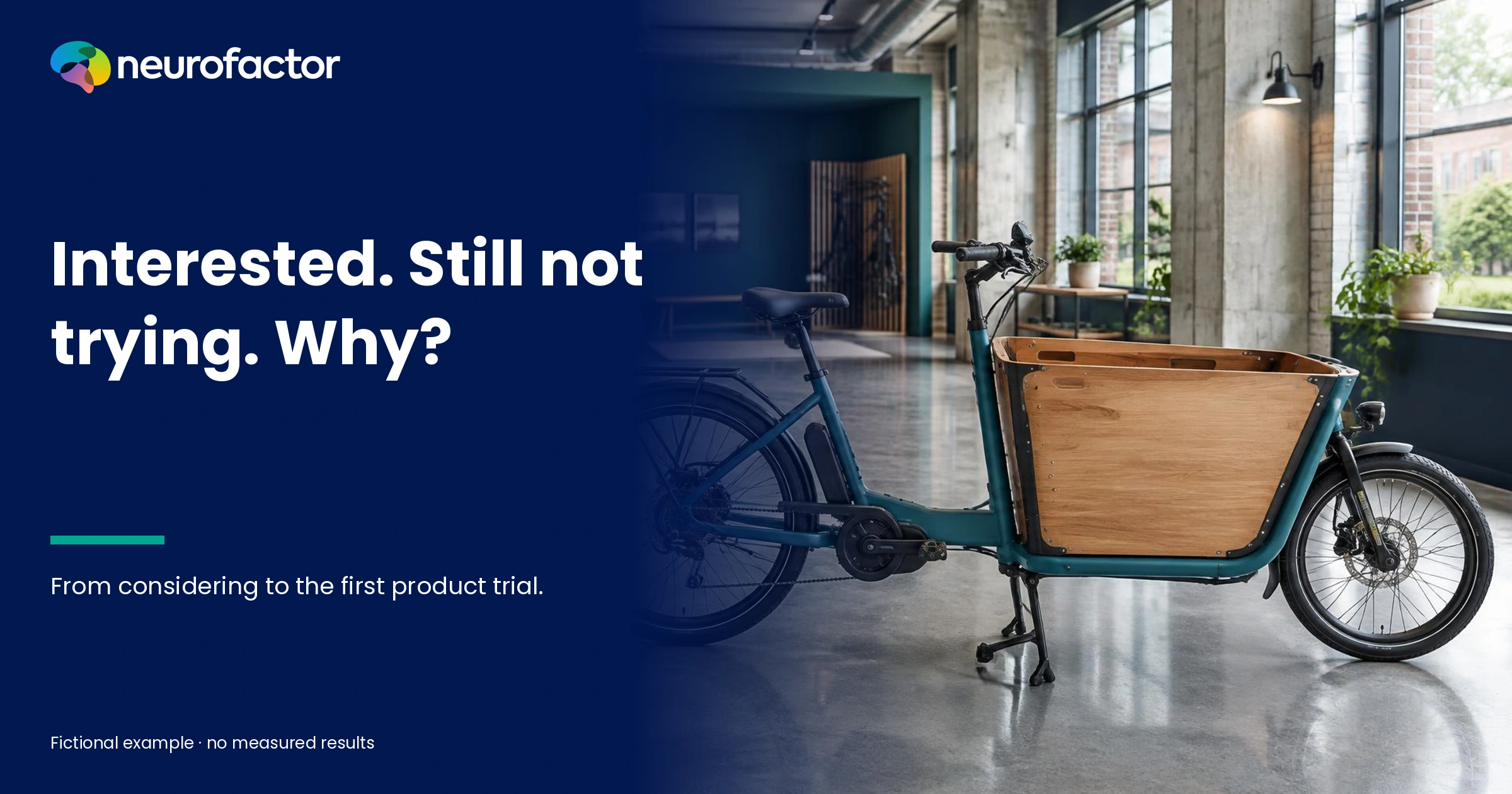
They want to try it. Until the moment they actually have to begin.
A customer stands beside a product, asks specific questions and says it looks interesting. The salesperson offers a trial. The customer smiles, asks for more information and says, 'I'll think about it.' Perhaps the interest is sincere. Perhaps the person can see exactly why the product could be useful. Yet there is no test ride, no demonstration and no first use. That is not automatically a sales failure. **Between 'this could be useful' and 'I am going to try it now' there may be an entire world of unspoken associations.** Trying something might mean freedom. It can also mean wasted time, lack of skill, embarrassment, risk, being observed or having to enter a sales conversation. If you fail to distinguish those meanings, an enthusiastic invitation can reinforce the very hesitation you are trying to understand.
AI summary: Interested customers do not necessarily try a product because intention and action are different things. A trial can carry associations with risk, time, competence, status, sales pressure, privacy, relevance or abandoning an established routine. Some barriers are psychological hypotheses; others are practical facts such as unavailable demo units, confusing terms, inaccessible locations or broken sign-up flows. First investigate expectations, then identify the precise action that fails to happen and the competing explanations. Design an honest, appropriate trial experience and measure real behaviour without treating clicks, appointments and completed trials as the same outcome. Association research, eye tracking or EEG may add information in carefully designed studies, but they cannot read a person's motives or reliably predict an individual's purchase.
Interest is not the first action
Imagine considering an electric cargo bike. Its range looks suitable, the carrying space fits everyday trips and the appearance appeals to you. A member of staff says, 'Go ahead, you can take it outside and ride it right now.' To someone who regularly rides heavy bicycles, that sounds like an attractive opportunity. To a newcomer, it may signal something else. How much does it weigh? Can I steer it? Will the salesperson watch? What if I feel unstable at the first corner? And does taking a ride imply that I have to purchase something afterwards?
The product has not changed. Neither has its price. But the question facing the customer has changed. Initially the person was evaluating possibilities from a distance. Now they must imagine themselves using the product, making an unfamiliar movement in public and perhaps accepting a consequence. The meaning of the offer shifts from possible benefit to concrete action under uncertainty.
This distinction is fundamental to behavioural research. Sheeran and Webb describe the intention-behaviour gap: people do not always carry out the actions they intend to perform. [1] A meta-analysis by Webb and Sheeran shows that experimentally increasing intentions does not produce an equally large increase in actual behaviour. [2] These studies address many kinds of behaviour. They do not show that changing one test-ride website or a particular sales invitation guarantees more trials. They do, however, support investigating interest, intention and execution as separate constructs.
Ajzen's theory of planned behaviour also distinguishes attitudes, subjective norms and perceived behavioural control. [3] Someone may like the bike, expect others to approve and yet feel unable to complete the first ride confidently. Combining those dimensions into one vague 'purchase readiness' score obscures relevant differences. The relationship between the particular beliefs and the next action must be examined in the specific situation.
It is also entirely possible that the visitor never intended to try. People may enjoy gathering information, comparing future alternatives or exploring a category without wanting an immediate experience. That is a legitimate choice, not a hidden deficiency that every business must repair. The relevant question is therefore: which interested people would, in principle, value a suitable trial, yet do not begin one - and why?
Eight possible associative barriers to trying a product
An invitation to try seems simple. In practice it asks someone to enter a new situation. The meaning depends on the product, the person, the setting and previous experience. The eight categories below are hypotheses to investigate, not fixed personality types. Genuine curiosity can coexist with fear of an awkward introduction.
| Possible association | What the customer may imagine | What to investigate honestly | Possible business response |
|---|---|---|---|
| Risk - 'I could damage something' | Falling, damage, liability, loss of data | Perceived versus real risk, terms and actual safety | Clear guidance, factual conditions, a suitable safe setting |
| Time - 'This will take an hour' | Registration, travel, waiting, lengthy sales pitch | Actual duration and perceived time cost separately | Short option with a credible estimate of total time |
| Status - 'I will look foolish' | Appearing inexperienced in front of others | Associations with visibility and social judgement | Discreet first use, optional private guidance |
| Competence - 'I cannot do it' | Operating errors, confusing instructions | Confidence in carrying out the task | Practice mode and clear instructions |
| Sales pressure - 'Then I have to say yes' | Follow-up calls, feeling indebted, awkward refusal | Expectations about obligation and follow-up | Explicit freedom to decline and opt in to contact |
| Privacy - 'They want my data' | Account creation, telephone number, tracking, payment details | What information is genuinely necessary and why | Data minimisation and transparent handling |
| Relevance - 'What exactly am I testing?' | Unclear use case or success criterion | Recognition of the real task in the demonstration | Task-based trial with honest product limitations |
| Status quo - 'My current option works' | Changing routines, switching costs, losing familiarity | What people expect to give up | Fair comparison without artificial urgency |
These meanings may interact. A person who expects a long demonstration might also fear being trapped in conversation with a salesperson. Someone uncertain about controls may welcome expert assistance, but not in front of an audience. The answer is not necessarily 'more explanation'. It may involve changing the social context, the time commitment or the actual shape of the experience.
Samuelson and Zeckhauser's work on status quo bias demonstrates that an existing alternative often has a special position in decision-making. [4] Thaler discussed wider departures from strictly rational consumer-choice models. [10] This does not establish that everyone who postpones a test is loss-averse. The current product may genuinely work better, the new one may be too expensive, or the visitor may simply not have a relevant need. Competing explanations must be considered rather than dismissed.
The same unbooked demo can have very different causes
A marketing dashboard shows that a thousand visitors saw the trial button, a hundred opened the form and only a few attended. The obvious response may be to enlarge the call to action or introduce a discount. But the numbers do not yet explain which step failed. Opening a form may reflect curiosity, confusion or purchase intent. Missing an appointment may be due to an inconvenient slot, poor confirmation or a deliberate change of plans.
| Observation | Possible explanation | Appropriate test | What this does not prove |
|---|---|---|---|
| Many interested visitors, few trial requests | No real intention, perceived risk, insufficient value or hidden route | Interviews, traffic-source analysis and task observation | That a stronger CTA is the solution |
| Form opened but not completed | Privacy concern, complexity or software failure | Field-level audit, error logs and privacy questions | That there is unconscious resistance to the product |
| Booked but did not attend | Low priority, forgotten appointment, travel or inconvenient timing | Neutral cancellation question, scheduling and no-show analysis | That the visitor is frightened of trying |
| Attended but never started | Safety, competence, social pressure or poor suitability | Observation with freedom to decline | That the instructor lacks enthusiasm |
| Completed the demo but did not purchase | Wrong fit, price, timing or a well-informed comparison | Evaluate expectations and suitability | That the demonstration failed or should apply more pressure |
| Trial bookings rise after a campaign | Different visitors, expectations or offer | Comparable groups and completed-trial rates | That associations were proven to change |
A strong diagnosis traces the decision. What did the person expect before the invitation? What changed when trying became concrete? Which information did they look for? Which action did they avoid? What outcome was appropriate for that customer? Behavioural data provides the starting point for these questions, not a ready-made psychological explanation.
A broken booking form or a shortage of test equipment should simply be fixed. It does not require brain measurement. Nor should a visitor who does not want to try be classified as 'resistant' merely because marketing wants more demonstrations.
From interest to use: five different transitions
A trial journey contains several gates. At the first gate, a person recognises possible value: 'This might be relevant.' At the second, they assess personal fit: 'Will it work for me, and can I use it safely?' At the third, they decide whether it is feasible: 'Can I find a suitable moment without excessive effort?' The fourth gate is the actual first action: moving the bicycle, completing a meaningful software task or handling a new material. The fifth is evaluating the experience and making an appropriate next decision.
These gates are a practical diagnostic framework, not a scientifically validated five-stage scale. Their value is that they force a business to define what is being measured. An appointment is not an experience. Watching a demo video is not the same as personally completing the task. Finishing a test ride does not prove that a purchase would be right for the customer.
For a digital service, free registration may remove one barrier but make another more visible. After creating an account, the user might have to import data, configure a workspace or invite colleagues. In those circumstances the low sign-up cost looks attractive, while the real workload appears only after registration. For a physical product, touching the item may happen effortlessly in a shop, whereas a separate appointment across town requires planning.
Davis studied perceived usefulness and ease of use in technology acceptance. [6] Moore and Benbasat developed measures for perceptions associated with adopting information technology, covering concepts such as relative advantage, compatibility and opportunities to try an innovation. [5] Venkatesh and colleagues integrated several technology acceptance frameworks. [7] These are useful theoretical resources for technology. They do not establish that the same factors have identical effects on bicycle rides, cosmetic sampling or B2B pilots.
The research question must therefore define what 'trying' actually means in context. Does it involve touching, operating, solving a task, gaining experience or accepting a risk that might be hard to reverse? Only once that is clear can a measurement instrument be chosen responsibly.
Fictional case: the cargo bike everyone finds interesting
This entire case is fictional. The company, showroom, visitors, reactions, proposed variants and barriers have not been observed in Neurofactor client research. No measured effect or proven conversion increase is claimed.
A fictional mobility retailer, called Stadslijn in this example, displays a new electric cargo bike for everyday use. The showroom has a demonstration unit, a test area and employees who can explain the controls. Its website includes photographs, dimensions, relevant safety information and a trial booking option. During informal conversations, visitors use words such as 'smart', 'convenient' and 'interesting'. Yet many continue looking and asking questions without getting on the bike.
Initially the team suspects that the value proposition is too weak. It wants larger posters about carrying groceries and school bags. Those benefits may indeed matter. Before changing the communication, however, the team maps three hypothetical moments when interest might fail to turn into action.
Scenario A - The parent who does not want to look unsteady. A parent is interested in replacing some car journeys. Yet the immediate thought about the trial is not 'savings' but 'what if I wobble when starting?' The first few metres are outside the shop window, visible to other people. This could reflect competence and status concerns. Those concerns cannot be inferred from age or family status; a real study would have to establish them.
Scenario B - The interested professional with limited time. A customer rides a normal bicycle every day and expects little trouble with the controls. The invitation to 'come by on Saturday for a comprehensive test ride' nevertheless sounds like arranging half a day. The obstacle may concern the time and the process rather than fear of riding. A shorter bookable slot could then be a more relevant hypothesis than another brochure.
Scenario C - The visitor who does not want a sales conversation. Someone is curious about the riding experience but anticipates a discussion about purchase, insurance or finance after the ride. A small-print statement saying 'no obligation' may not change that expectation. Allowing the visitor to choose freely whether any follow-up takes place could be a testable service and communication change.
The team considers three untested concept variants. Variant A offers a calm introduction in a suitable part of the premises with clear safety instructions. Variant B provides a short appointment with a clearly stated start and finish. Variant C explicitly makes a follow-up sales conversation optional and collects only genuinely necessary booking information. None of these ideas is a known winner.
An appropriate study permits people to decline the ride. First, participants receive a safe and suitable choice. Researchers then record booking, attendance, actual first movement, completed rides and relevant safety or service incidents. They ask whether the experience helped people evaluate the bike honestly. Tracking bookings alone would be inadequate: a longer or poorly matched experience might produce more no-shows, confusion or disappointment.
If real conversations reveal that the bike is unsuitable for a steep daily route or a particular physical need, the correct answer could be better product information or another model. Persuading someone to ride anyway is not a responsible objective. Behaviour change is not the business of erasing every reservation. It starts with understanding which reservations matter and why.
A nine-step research protocol
Step 1 - Define the target action. Document what counts as genuinely trying the product. Is opening a trial account enough, or must the person perform a relevant task? Is a five-minute test ride meaningful? Specify the primary and supporting outcomes, including task completion, voluntary participation and understanding of limitations. Do not call a campaign successful solely because registrations increased without any real product experience.
Step 2 - Check the actual offer and operational reality. Confirm that a suitable demonstration unit is available, customers can select realistic times, the location is accessible, total time is accurately described, costs are clear and no unmentioned obligations apply. For software, check setup requirements, permissions and support. It is not defensible to label low capacity or technical defects as implicit resistance.
Step 3 - Identify the context and eligible audience. Not every interested person should be expected to participate. Some are browsing, some cannot use the product safely and others require approval from a colleague or family member. Distinguish focused search from curiosity, experienced users from newcomers, and contexts where safety or privacy needs special attention. These are relevant task contexts, not fixed psychological buyer profiles.
Step 4 - Capture expectations before the invitation. Ask what the product means to participants, what benefits they anticipate, what disadvantages they imagine and what they think 'trying' will involve. Capture spontaneous wording rather than feeding reassuring examples into the question. Record what the company actually offers separately, so perceived pressure, risk and time can be compared with facts.
Step 5 - Investigate associations and alternatives in parallel. Use careful explicit questions, free associations and, if appropriate, a validated relative association task. Define the target: is the response about the product, the demo, the salesperson, the showroom or the participant's own ability? Combine this with operational evidence. Positive associations with the product and negative ones with the trial may coexist. Reliability and validity have to be reported, not assumed.
Step 6 - Observe the path to the first action. Test information retrieval, booking and comprehension. Use eye tracking if the visual accessibility of conditions is an important research question. In physical demonstrations observe the introduction and the actual start. Participants must be able to decline without penalty. Looking at a warning does not prove fear, and opening a sign-up field does not establish trust.
Step 7 - Form a bounded intervention hypothesis. For example: 'Stating duration and the optional nature of a trial clearly beside the booking button may reduce incorrect expectations about sales pressure.' Or: 'A private introduction may make first use easier for people who report uncertainty about handling.' Identify the group, proposed mechanism, verified evidence, intended effect and potential unwanted outcome. Safety and legal claims must reflect reality.
Step 8 - Test behaviour with an appropriate comparison. Where practical use random assignment between ethically acceptable alternatives. Define sample, duration, exclusions, primary outcome and analysis in advance. With few observations, a well-observed pilot may be more useful than a claim of statistical significance. Report seasonality, campaigns, staff availability and selection bias. Avoid searching numerous post-hoc segments until chance produces an exciting percentage.
Step 9 - Follow the quality of the trial experience. Record actual starts, relevant completion, usefulness, appropriate next steps and any harm or dissatisfaction. Ask whether participants now have a more accurate understanding of the product. A new design that attracts more people but creates unsafe situations, confused expectations or involuntary commitments is not a successful optimisation.
From association to intervention: prove it before designing it
Association research becomes useful when perceived meaning is connected to an actual product property or service condition. Writing 'no obligation' is not the same as operating without obligation. Claiming 'ten minutes' is legitimate only when the organisation can reliably deliver that experience. Promising a 'safe trial' requires suitable conditions and real safety instructions, not merely a calming icon.
| Hypothesis | Verifiable evidence | Change to test | Important boundary | Behavioural outcome |
|---|---|---|---|---|
| The ride feels risky | Real instructions, route and conditions | Calm introduction with appropriate guidance | Never minimise actual safety requirements | Safe first starts and completed rides |
| The demonstration feels too long | Observed duration and steps | Clear slot and shorter suitable option | Do not promise an impossible time | Bookings, attendance and completion |
| Trying feels socially awkward | Interviews on visibility and assistance | Choice of a discreet introduction | Avoid assuming everyone has the same need | Voluntary starts across conditions |
| The trial feels like a sales obligation | Actual contact and follow-up policy | Explicitly optional sales discussion | No undisclosed outreach | Correct expectations, complaints, optional next step |
| Registration feels invasive | Necessary fields and lawful basis | Data minimisation and plain explanation | No covert tracking | Relevant completed bookings and feedback |
| 'My current solution is good enough' | A fair real-task comparison | Compare against the familiar alternative | No fake urgency or unverified savings | Appropriate use and realistic evaluation |
An effective intervention should change more than the words. Ideally, it reduces a real barrier and communicates the new reality truthfully. If a visitor is right to distrust an inadequately maintained demo unit, maintenance comes first. A warmer invitation without maintenance merely makes the original problem less visible.
Here behaviour design intersects with product development, customer service and business models. Trial processes can themselves be poorly designed: too long, too aggressive or dependent on sharing information that has no legitimate purpose. Sometimes the better solution is for the company to ask less of the customer, rather than ask the customer to be braver.
Why the same invitation does not work for everyone
Two people say, 'That looks interesting.' One views experimentation as learning and is comfortable with small errors. The other experiences the very same situation as a test of personal competence. You cannot infer this difference reliably from age, education or occupation. It becomes actionable only when you investigate what meanings arise in a particular setting and how they relate to an actual task.
Bandura's work on self-efficacy provides a theoretical basis for separating knowledge of what a product can do from confidence in one's ability to use it. [9] It does not show that cheerleading automatically increases perceived control. A practice area, intelligible instructions and a safe opportunity to stop may be more helpful than an even more enthusiastic invitation.
Experienced users may not want a long explanation at all. For them, mandatory assistance can signal wasted time or a lack of trust in their abilities. The very change that supports a newcomer may slow someone with more experience. Investigate the relationship between the task, prior knowledge, support needs and actual actions. When possible, offer a choice of appropriate support instead of forcing everybody into one standard ceremony.
In business pilots, constraints can be structural. Testing a new software tool may require data preparation, security review or coordination with colleagues. The user sees the potential benefit but lacks permission to start. That is not necessarily timidity. Perceived control and organisational conditions need separate attention. [3][7]
Ten design decisions that may support first use
1. Explain exactly what the first step requires. 'Try now' may conceal an account, payment card, appointment or lengthy conversation. State time, location, equipment, conditions and any real charges. The experience begins with the expectation of what is going to happen.
2. Offer a meaningful first task. Demonstrating every function may be impressive but unhelpful if the customer cannot recognise their own problem. Choose a realistic task the participant can evaluate. Be clear about what that task does not prove.
3. Reduce social pressure without labelling people. Where feasible provide a calm space, individual assistance or a choice of support. Present them as normal options, not as a special arrangement for 'nervous' customers. Make it easy to stop without defending that choice.
4. Show real safety and usage requirements. Do not hide risks behind a welcoming atmosphere. Explain guidance, instructions, prerequisites and limits. If a trial is unsuitable in a given situation, say so before the person begins.
5. Make a trial genuinely optional when you promise it is. Let people decide if they want an offer, conversation or further contact. Do not make a free trial secretly dependent on recurring charges or obscure cancellation. The belief that a trial creates an obligation cannot be repaired simply by making 'free' bigger.
6. Request only necessary data. Separate booking data from consent for subsequent marketing. Say what is retained and why. Privacy is not a decorative trust badge; internal practice must justify the promise.
7. Provide a realistic time estimate. Include preparation, instruction and possible waiting, not just the ride itself. If you promise ten minutes but routinely take thirty, the experience may create a new negative association with credibility.
8. Provide pathways for different levels of experience. Beginners may prefer a demonstration first; experienced users may wish to explore independently. Match the support to the task without assuming everybody needs identical instruction.
9. Use a concrete opportunity rather than fabricated urgency. Available appointment slots, a clearly defined trial period or a planned occasion can make action easier. Fake scarcity and countdowns create pressure rather than an honest choice. Gollwitzer and Sheeran review evidence on when-then action plans, but that evidence is not a commercial trial-conversion guarantee. [8]
10. Measure trial quality, not just registrations. A trial that helps someone discover the product is unsuitable may prevent returns and false expectations. Define what an appropriate outcome looks like and ensure the organisation learns from refusals as well as purchases.
These ten proposals are not an automatic conversion formula. Better safety guidance may take longer. A less intrusive experience might produce fewer immediate sales leads but a healthier customer relationship. The right trade-off depends on the product, risk, capacity and business purpose, and should be specified before testing.
Trial behaviour with physical goods, software and services
A physical product trial has qualities that a digital demonstration cannot fully reproduce. People feel the weight, hear the sound, move their body and may be observed by others. First contact can resolve uncertainty but may create new questions. Make sure the demonstration is representative. A carefully prepared unit that performs differently from the delivered product creates false expectations.
For software, the barrier can be less visible. An account may take seconds to create, while the user still needs to find the right data, complete configuration or coordinate with colleagues. Calling every account a 'product trial' overstates adoption. A more honest activation event is the independent completion of a relevant first task, with appropriate help where necessary.
With services such as advice, education or subscriptions, a trial can feel like the beginning of a relationship. Customers are not only considering the content. They may wonder how much contact will follow and how difficult leaving will be. The difference between a demonstration and a continuing commitment is especially important here.
Davis, Moore and Benbasat, and Venkatesh provide constructs for investigating perceived utility, effort and technology adoption. [5][6][7] But physical retail tests and personal services require different operational definitions. Applying a questionnaire designed for workplace technology to every product without validation is not sound research.
What association research, eye tracking and EEG can contribute
Interviews can reveal meanings people recognise and are willing to describe. Free association tasks may surface terms the researcher has not supplied. When justified, a carefully designed implicit association task can add evidence about relative connections among concepts such as 'test ride', 'freedom', 'pressure', 'safety' and 'uncertainty'. Such tasks require appropriate stimuli, a clear scoring approach, validity evidence and reliability checks. They cannot determine why one individual will or will not ride tomorrow.
Eye tracking is useful when important conditions are on a website but people fail to find them. Researchers can examine where participants look while searching for duration, terms or the booking option. Eye movements do not directly reveal whether a warning is reassuring, intimidating or irrelevant. Comprehension tasks, questions and observed choices are needed to interpret the gaze data.
EEG can record time-related neurophysiological responses under controlled conditions. It is not a universal, validated meter of 'purchase intention', 'embarrassment' or the chance that someone will book a demo. A response to a test-ride video does not establish that an actual ride feels safe. Interpretation depends on the protocol, task, noise, data quality and independent evidence. For many trial problems, technical audits, observation and well-designed behaviour tests are the most direct starting methods.
Neurofactor can combine methods when the question warrants that combination. The key is to state what each method can and cannot support. A positive implicit association with a product does not prove that somebody has enough time. Eye tracking cannot convert visual attention into resistance. An EEG response cannot confirm an individual purchase decision. The research sequence runs from business question to behavioural evidence, associative hypothesis, intervention and evaluation of action, not the other way round.
Designing an honest trial experiment
A useful experiment begins with a meaningful comparison. One test might compare a short ride with a transparent duration against the existing invitation. Another might compare a first software task with examples against an unstructured start. Both alternatives must be ethically defensible. Participants should never be misled about actual risks, obligations or information collection.
The primary outcome might be the share of eligible visitors who begin a trial, the proportion completing an appropriate task or the proportion making a well-informed next decision. Define the main question and its numerator and denominator. Reporting increased bookings without knowing the source audience and no-show rate proves little. Compare conditions carefully: weather, campaigns, location, opening times, staffing and available demonstration units.
Avoid slicing data into dozens of groups after the experiment until a striking result appears. Experience level can be a relevant segmentation variable but needs a rationale and adequate data. With a small pilot, qualitative observation may be more useful than a dramatic percentage. Report what was observed, what remains uncertain and what further measurement is needed.
Set a stop rule as well. A variant that creates pressure, omits necessary safety instruction or bundles sales consent into a mandatory demonstration is not a suitable intervention. The behavioural objective must remain compatible with a fair relationship between customer and business.
The wrong KPI can reward a poor trial experience
A company measuring trial requests may simplify registration and leave the rest of the process unchanged. The dashboard looks better while staff face more empty appointment slots. A company measuring test rides may extend the ride beyond what customers find useful, without improving their understanding. A business measuring only immediate purchase after the demo may encourage employees to talk away doubts rather than address real questions.
Use a connected measurement ladder instead: qualified interest, stated trial intention, booking or access, attendance, first action, meaningful task completion, accurate expectations and appropriate next steps. Later is not automatically better. Someone who declines a purchase after a safe, representative trial may have made a valuable decision.
Where appropriate, monitor later outcomes such as proper use, returns, support requests, complaints and continued adoption. For an expensive product, same-day sales are not necessarily the right primary measure of trial quality. For software, a small number of active, suitable users may be more valuable than thousands of unused accounts. Choose metrics from the purpose of the experience rather than because a dashboard makes one metric easy to display.
A decrease in unsuitable trials may even be beneficial. Clearer conditions can help people recognise beforehand that the product does not fit. Total bookings may decline while completed, relevant sessions become more useful. That need not be a failure. The evaluation design should define which combination of outcomes matters.
When declining a trial is the sensible choice
Not every delay is irrational. A visitor may lack the budget, space, physical suitability or necessary permission. Their existing solution might genuinely work better. Neuromarketing should not undermine that judgement through attractive imagery or concealed pressure.
A trial can also demand unreasonable information. A company may rightly be reluctant to demonstrate software using sensitive business data. That is not automatically a 'privacy association' to be solved with more persuasive copy. A sandbox environment, appropriate agreements or realistic synthetic data may be needed. Taking such concerns seriously is part of responsible behaviour design.
The same applies to status concerns. Someone who does not want to struggle publicly with unfamiliar equipment does not need to be challenged to prove confidence in front of others. Offering a calm first step may be preferable. Autonomy and safety matter as business values too.
A valuable outcome of research may therefore be a change to the product, trial process or target audience. Less pressure and a more useful experience may be the stronger outcome. If customers use a representative trial to discover the product is wrong for them, the trial has done an important job.
Conclusion: make the first step appropriate, not just attractive
Why do interested customers fail to try a product? Because interest evaluates possibilities, while trying requires an action in real time, social surroundings, skill, risk and practical commitments. The mental meaning of the trial may differ sharply from the meaning of the product. Sometimes the barrier is associative, sometimes operational and sometimes entirely justified.
The most useful approach begins by separating those explanations. Investigate what the customer values, what they expect trying to involve, which first action is missing and what the business can actually provide. Design a trial experience that is safe, voluntary, understandable and relevant. Choose research methods that can answer the question, then evaluate behaviour and suitability together.
You do not need to push customers across a line to prove your product is good. You need to make the first step clear enough that they can responsibly find out whether it is right for them. That is the beginning of behaviour change that leads not only to more activity, but to better decisions.
Interpretation boundary: these publications concern intention-behaviour differences, action planning, innovation adoption, self-efficacy and choice. They do not establish that the fictional test-ride variants described here have been tested or that a commercial trial intervention guarantees increased participation.
Key terms
- Trial behaviour
- A concrete, observable first use in which a person tests relevant properties of a product or service directly.
- Intention-behaviour gap
- The difference between intending an action and actually carrying it out; not evidence of one particular unconscious cause.
- Associative barrier
- A potentially relevant connection between trying and risk, effort, status or obligation, which must be investigated rather than assumed.
- Perceived behavioural control
- The degree to which someone believes they can perform the action in the given circumstances.
- Trialability
- The opportunity and perceived ability to experiment with an innovation on a limited basis before making a further decision, defined according to context.
- Status quo bias
- A tendency for existing options to receive a special preference, which does not explain every instance of delay.
- Appropriate trial experience
- A voluntary, representative and sufficiently safe experience supporting informed choice without undue pressure or deception.
Frequently asked questions
Why do interested customers not try a product immediately?
Because interest is not the same as intention or an actionable opportunity. A trial may require time, skill, public performance or accepting uncertainty. Practical causes such as availability, travel, broken booking flows and unclear terms must also be investigated before changing communication.
Which associations can prevent a test ride or product demonstration?
Possible associations include damage, time loss, appearing incompetent, insufficient skills, sales pressure, loss of privacy, uncertain relevance and giving up a familiar routine. Their relevance varies by task and audience and cannot be presumed without investigation.
Can implicit association research predict who will book a demo?
Not as a general individual prediction. A well-designed relative task may provide clues about meanings connected to the product or trial experience. Interpretation depends on validity, reliability, stimulus choice and context. Combine findings with interviews, operational checks and observed action.
Does a free trial always encourage people to start?
No. A free price can lower financial concerns, but a trial may still require time, account creation, personal data or an unclear cancellation process. Measure meaningful first use rather than merely registration and communicate the real conditions transparently.
Are eye tracking or EEG essential to investigate trial hesitation?
No. Begin with actual behaviour, practical access and participants' concrete questions. Eye tracking can help detect information-finding problems. EEG records responses under defined conditions but does not explain or predict individual trial behaviour by itself. Add methods only when they address an appropriate research question.
What is the most useful KPI for a trial campaign?
It depends on the business goal. Often the main outcome is the proportion of suitable people who actually perform a meaningful trial action. Monitor safety, comprehension, completion, honest expectations and appropriate next steps too. More bookings without real use do not establish a better trial experience.
Sources
- 1.Sheeran, P., & Webb, T. L. (2016). The intention-behavior gap. Social and Personality Psychology Compass, 10(9), 503-518. - Social and Personality Psychology Compass (2016)
- 2.Webb, T. L., & Sheeran, P. (2006). Does changing behavioral intentions engender behavior change? A meta-analysis of the experimental evidence. Psychological Bulletin, 132(2), 249-268. - Psychological Bulletin (2006)
- 3.Ajzen, I. (1991). The theory of planned behavior. Organizational Behavior and Human Decision Processes, 50(2), 179-211. - Organizational Behavior and Human Decision Processes (1991)
- 4.Samuelson, W., & Zeckhauser, R. (1988). Status quo bias in decision making. Journal of Risk and Uncertainty, 1, 7-59. - Journal of Risk and Uncertainty (1988)
- 5.Moore, G. C., & Benbasat, I. (1991). Development of an instrument to measure the perceptions of adopting an information technology innovation. Information Systems Research, 2(3), 192-222. - Information Systems Research (1991)
- 6.Davis, F. D. (1989). Perceived usefulness, perceived ease of use, and user acceptance of information technology. MIS Quarterly, 13(3), 319-340. - MIS Quarterly (1989)
- 7.Venkatesh, V., Morris, M. G., Davis, G. B., & Davis, F. D. (2003). User acceptance of information technology: Toward a unified view. MIS Quarterly, 27(3), 425-478. - MIS Quarterly (2003)
- 8.Gollwitzer, P. M., & Sheeran, P. (2006). Implementation intentions and goal achievement: A meta-analysis of effects and processes. Advances in Experimental Social Psychology, 38, 69-119. - Advances in Experimental Social Psychology (2006)
- 9.Bandura, A. (1977). Self-efficacy: Toward a unifying theory of behavioral change. Psychological Review, 84(2), 191-215. - Psychological Review (1977)
- 10.Thaler, R. (1980). Toward a positive theory of consumer choice. Journal of Economic Behavior & Organization, 1(1), 39-60. - Journal of Economic Behavior & Organization (1980)
Read next
Reviewed by: Martijn den Otter · Last reviewed: 11/2/2026