
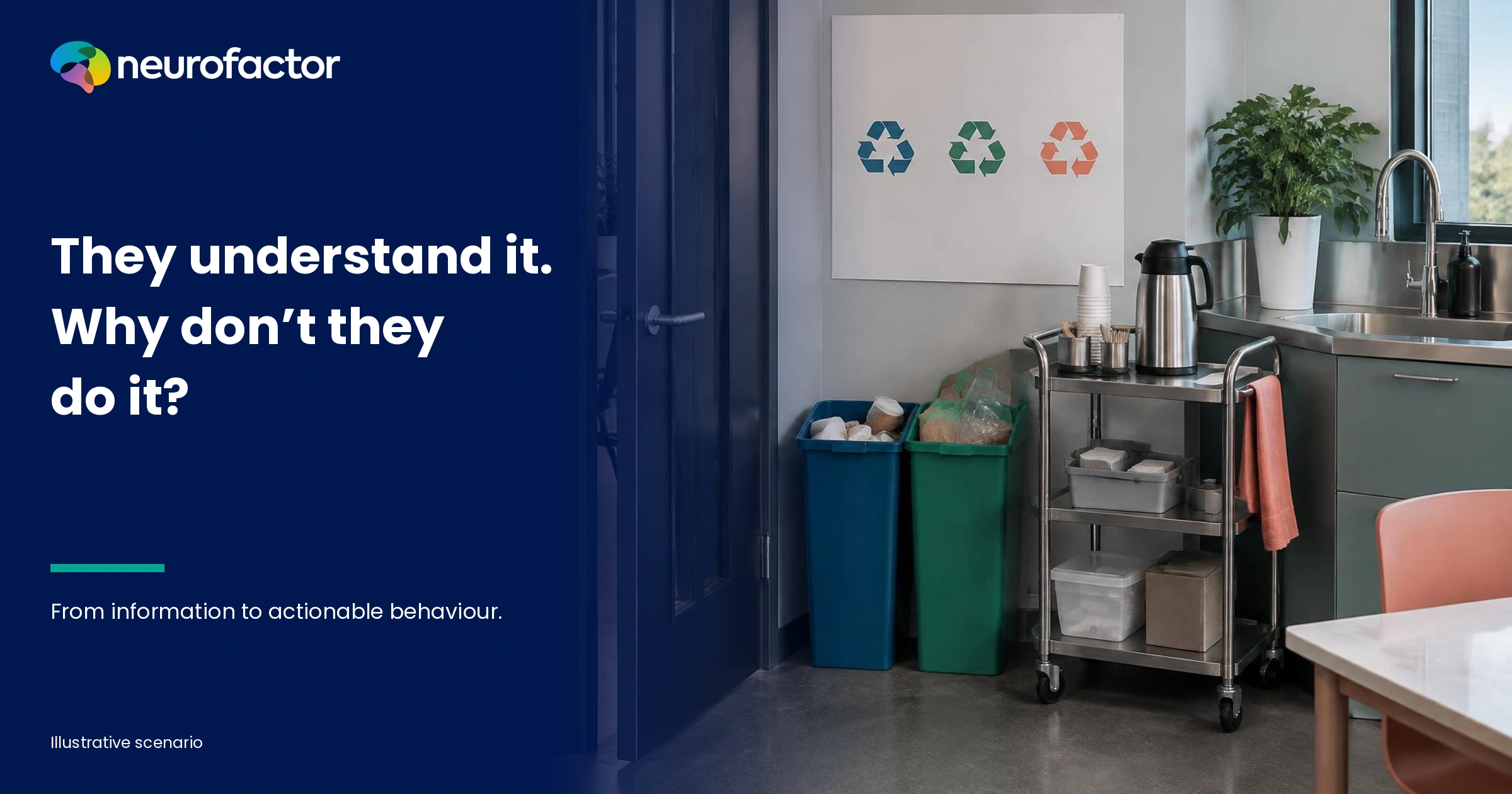
Why does explaining a change rarely change behaviour? The missing step comes afterwards
An organisation launches a new working procedure. It produces an explanation, an attractive presentation, a training video and a reminder. Afterwards, employees can describe exactly what is expected. Yet in daily practice they keep doing what they did before. The familiar response is to explain the procedure again. That is useful when knowledge is actually missing. But when people already understand the requirement, additional information does not automatically remove the barriers to action. Behaviour also depends on skills, opportunity, routines and the meaning a decision acquires in a particular moment. If the communication changes while the conditions do not, the underlying problem may remain untouched. This article explains how to investigate that gap and translate the findings into a testable intervention rather than another campaign built on assumptions.
The instructions were clear. The behaviour did not follow
The management team asks why its internal campaign has not worked. Most employees opened the intranet announcement. The meeting was well attended. People found the training video understandable. A short survey shows that staff support the new policy. Still, everyday execution barely changes. The proposed answer is another video, a stronger slogan or more reminders. Communication is visible and straightforward to organise, so improving it feels like progress. But visibility is not evidence that communication was the missing mechanism.
Imagine an employee who has received clear guidance on sorting waste. They can correctly name the categories. After lunch, however, they encounter full bins, inconsistent labels and colleagues putting everything in general waste. Their knowledge has not disappeared. The decision is simply made in an environment where speed, availability and the observed group norm may matter more than a message read last week. A poster cannot empty a bin or move a collection point closer to the actual decision. Nor does it give someone additional time during a crowded lunch break.
The more revealing question is therefore not only 'Did people understand the message?' It is 'What happens between understanding a requirement and having to perform it?' That interval contains context cues, competing priorities, familiar movements, assumptions and practical constraints. Calling every gap 'resistance' hides those differences. A person may be willing and competent while lacking the practical means to act. Another person may have plenty of opportunity but lack a clear understanding of an exception to the rule.
A meta-analysis of experiments on intention and behaviour helps explain why this distinction matters. Increasing people's intentions produced a smaller average change in actual behaviour. The finding does not mean information campaigns never work. It means increased willingness should not be treated as proof of execution. [2] First specify an observable behaviour. Instead of 'increase awareness of recycling', ask 'does the waste reach the correct container when employees finish lunch?' With that definition, communication outcomes and behaviour outcomes can be reported separately instead of being bundled into one optimistic campaign score.
Image
Six different causes can produce the same adoption problem
A dashboard may show one result: adoption is below target. The underlying causes, however, can be unrelated. A sensible diagnosis starts by distinguishing what people know, what they can do, what their setting permits and what the proposed action means to them.
This table is a diagnostic map, not a personality assessment. Two people displaying identical behaviour may face different obstacles. One cannot locate the appropriate container; another distrusts the process because a previous collection programme was abandoned. One overall satisfaction score would conceal both. An intervention can include multiple parts, but every component should correspond to a plausible and examined mechanism.
COM-B describes behaviour through the interaction of capability, opportunity and motivation. Capability includes knowledge and skill. Opportunity includes physical circumstances and the social environment. Motivation includes conscious goals as well as automatic processes. The Behaviour Change Wheel provides a structured way to move from diagnosis towards intervention functions. [1] The framework is useful for organising questions; it does not guarantee that a chosen intervention will work in an unfamiliar organisation.
Another distinction matters: symptoms are not causes. A delayed task may reflect uncertainty, but it may equally arise from conflicting priorities, unavailable equipment, an unclear trigger or a software setting that defaults to the old procedure. Someone can understand a policy while being assigned a schedule that makes compliance unrealistic. The organisation must determine whether the obstacle belongs to the individual, the design of the work or the conditions created by management.
People repeatedly make the same substantive error
- Plausible explanation
- Knowledge or understanding is missing
- What to investigate
- Can they identify and perform the correct action in context?
- What is unlikely to be sufficient
- Only an emotional awareness campaign
People know the rule but cannot execute it
- Plausible explanation
- Skill or necessary support is missing
- What to investigate
- Can they demonstrate the task in realistic conditions?
- What is unlikely to be sufficient
- Another poster about responsibility
People want to comply but the procedure obstructs them
- Plausible explanation
- Physical opportunity is inadequate
- What to investigate
- Time, location, access, capacity and interface design
- What is unlikely to be sufficient
- Asking for greater commitment
People avoid behaviour that differs from colleagues
- Plausible explanation
- Social opportunity or perceived norms constrain action
- What to investigate
- What is performed, rewarded and criticised in the group?
- What is unlikely to be sufficient
- Restating the formal rule alone
People revert under pressure
- Plausible explanation
- Context cues trigger an old habit
- What to investigate
- Which situations and immediate consequences support the routine?
- What is unlikely to be sufficient
- Motivation messages without context change
People understand but consider the change undesirable
- Plausible explanation
- Reflective or associative resistance
- What to investigate
- What does it suggest about control, loss, fairness, workload or identity?
- What is unlikely to be sufficient
- Repeating benefits without addressing objections
Image
Why information often targets the wrong part of the mechanism
Explanations can make expectations explicit. They can correct misconceptions, teach a new rule or reveal why a process matters. Those are legitimate outcomes. What explanations cannot do automatically is create physical opportunity. A compelling message does not fix an inaccessible interface, a full bin, an understaffed shift or a queue that prevents someone from stopping to choose. It does not instantly replace a rehearsed movement that has been repeated for months.
Wood and Rünger describe habits as learned responses that become linked to recurring contexts. A familiar situation can trigger a familiar action even when people have adopted a different conscious goal. [4] The employee accustomed to dropping a cup in the nearest bin does not necessarily make a fresh, deliberate evaluation on every occasion. An explanation delivered on Friday may not come to mind at the relevant point on Monday. That is why timing and the environment can be as important as message quality.
Social meaning introduces another layer. In one team, taking the extra step may signify care and professionalism. In another, the same action could be interpreted as delaying colleagues or blindly following management. These associations may be supported by remarks, previous experiences and what managers reward in practice. But researchers must not invent them. Treat 'people find this bureaucratic' as a hypothesis until interviews, association tasks or contextual evidence offer support. A negative reaction can also be a reasonable judgement about a genuinely burdensome procedure.
It helps to examine three different moments: when people see the communication, when the decision must be made and when the behaviour has to be repeated. A positive survey immediately after a workshop concerns a different situation from an action at the end of a busy shift. Assessing the effectiveness of the message without examining that situation creates a blind spot. It also risks blaming people for factors they cannot control.
Implementation intentions offer one approach for connecting a goal to a specific moment. A person specifies in advance what they will do when a particular situation appears. A major meta-analysis found positive average effects on goal achievement, although effectiveness depends on the task and setting. [3] Yet the plan 'When I finish lunch, I will use the correct collection point' cannot succeed if there is no usable collection point. A cognitive intervention cannot compensate for every practical defect.
From awareness campaign to matched behavioural intervention
Organisations often compare solutions by their impact on attention: a video is thought to be stronger than a written notice, a moving story stronger than a procedure, a large launch stronger than a quiet improvement. The hierarchy is misleading if nobody has established what prevents the target behaviour. The right intervention is the one that addresses the missing condition and can be evaluated appropriately.
The matrix is not an unstructured list of 'nudges'. Michie and colleagues developed a behaviour change technique taxonomy to define intervention components more precisely and support clear reporting. [7] You can distinguish information, feedback, prompts, goal setting, practice, social support and environmental restructuring. But using a named technique does not mean your local programme has demonstrated effectiveness. That requires appropriate evidence from the actual setting.
It is equally important to identify who owns the barrier. If an action requires a five-minute detour, facilities management may need to modify the site. If a software system selects the wrong option by default, product or process owners must act. If managers consistently reward speed over a new safety step, leadership behaviour may be central. Better communication cannot simply transfer organisational responsibility to employees who have been given an unworkable system.
Incomplete knowledge
- First intervention to consider
- Clear, task-specific guidance at the relevant moment
- Evidence worth collecting
- Can participants explain and perform the action?
- Why the intervention might fail
- Knowledge was already sufficient
Missing skill
- First intervention to consider
- Practice, demonstration, feedback and support
- Evidence worth collecting
- Can the task be performed under realistic pressure?
- Why the intervention might fail
- Essential equipment remains unavailable
Limited physical opportunity
- First intervention to consider
- Modify the process, location, time, materials or interface
- Evidence worth collecting
- Is the target behaviour now genuinely possible?
- Why the intervention might fail
- Only the messaging changes
Contradictory social norms
- First intervention to consider
- Credible role models and consistent management decisions
- Evidence worth collecting
- What happens without supervision?
- Why the intervention might fail
- Leaders still reward the old behaviour
Automatic old routine
- First intervention to consider
- Change the cue, establish a trigger and practise a new response
- Evidence worth collecting
- Does it persist under load and after launch?
- Why the intervention might fail
- The new action is too demanding to repeat
Negative meaning or low trust
- First intervention to consider
- Investigate objections, change the procedure if needed, explain honestly
- Evidence worth collecting
- Do meaning and actual behaviour change separately?
- Why the intervention might fail
- The underlying disadvantage remains real
Fictional case: everyone understood the recycling rule, but execution was inconsistent
This is an entirely fictional case. The situation, observations and possible interventions illustrate the method; no client results, proprietary Neurofactor measurements or performance percentages are being reported.
A medium-sized civic office wants to improve waste separation in its shared lunch areas. It produces a short animation about material reuse, a poster using pictograms and a leadership announcement. Employees can explain the basic distinction between paper, packaging and residual waste. The communication receives positive ratings. Yet the bins are still used inconsistently, and the organisation considers launching a more emotional campaign.
When a researcher observes real lunch periods, a different picture emerges. Containers are arranged differently on each floor. Two compartments are frequently full. A symbol cannot be seen from the direction people approach. Visitors do not know the building's local rules. Staff are moving through a narrow space at peak times. The instruction is no longer the only relevant influence. Where someone stands, which bin they see first and how long the queue is all become part of the choice.
Interviews provide additional hypotheses. Some staff associate separation with stewardship and care for shared resources. Others describe another management initiative that may disappear within months. Several question whether sorted material is collected separately later. That last issue is not merely a message-framing problem. If the collection process does mix waste streams, a more reassuring campaign could create false expectations. First verify what happens operationally.
The hypothetical research team proposes a testable combination: consistent positioning of collection points, more legible icons, a workable emptying routine, a short instruction located at the decision point and transparent information about downstream processing. Communication supports these changes rather than being treated as the primary intervention. Observations would examine correct sorting, availability, crowding and differences between lunch areas. They would not be used to shame or individually rank employees.
No outcome is assumed. The arrangement might improve sorting. It might reveal that the categories do not match the waste generated on site. It might create new confusion among occasional visitors. The point is not that a particular combination must work. It is that the problem you try to solve looks different when you investigate behaviour rather than measuring only awareness. The appropriate answer may involve communication, physical design and management decisions at the same time.
Image
Diagnose the barrier first: a nine-step research protocol
Step 1 - Define an action, not an aspiration. 'Our people should behave more sustainably' cannot be observed reliably. 'After finishing lunch, employees place each item in the appropriate container' is much clearer. Define who acts, where, after which cue and how frequently. Decide in advance what is not the primary outcome. A person expressing support for sustainability is not the same as someone completing the intended action.
Step 2 - Test what people actually understand. Do not ask only whether a presentation was clear. Have participants explain the required action in their own words, or let them demonstrate it in a realistic situation. Distinguish exposure, comprehension and execution. If genuine knowledge gaps emerge, information may be the right first intervention. Otherwise, the next investigation should not simply recreate the same explanation.
Step 3 - Observe the real decision point. Follow the route through the setting. Is the equipment available? How much time does the person have? Which sign is visible first? What happens when a queue forms? Which old action requires less effort? Record sequences, exceptions and environmental constraints. Avoid converting an observation such as 'walked past the container' into an unsupported judgement such as 'does not care'.
Step 4 - Examine capability, opportunity and motivation separately. Use COM-B to organise interviews and observation. Can people perform the task? Does the physical setting permit it? What social behaviour is visible and rewarded? Which conscious goals and automatic routines may be relevant? [1] Competing priorities matter. An employee can value a new procedure while working under deadlines that make the new sequence impractical.
Step 5 - Investigate the associations without suggesting the desired answer. Start with open prompts: 'What comes to mind when you hear about this procedure?' and 'Which part feels difficult or worthwhile?' Depending on the question, consider free associations, word or image associations and appropriately validated implicit tasks. Do not prime participants exclusively with management's preferred words. Connect the findings to observed action rather than assuming that an interesting association is itself the behavioural cause.
Step 6 - Build a barrier map and choose corresponding components. Record each hypothesis, supporting evidence, competing explanations and practical intervention. Poor labels may require just-in-time guidance. Missing materials require an operational adjustment. A deeply familiar routine may need a new cue, easier repetition and a concrete if-then plan. The behaviour change technique taxonomy provides a useful language for specifying components. [7]
Step 7 - Compare alternatives as fairly as circumstances allow. Use comparable locations, tasks or time periods where feasible. Record staffing, workload, season and equipment availability. A simple before-and-after comparison may reflect changes unrelated to the intervention. Where random assignment is practical and ethical, consider it. Where not, report the uncertainty rather than presenting a local improvement as proven causality.
Step 8 - Measure performance, friction and unintended effects. Examine whether the target behaviour happened, whether the intervention slowed other tasks and whether some users were disadvantaged. An improvement in one room should not simply displace the problem into another. Collect the minimum data needed. For a sorting intervention, anonymous observation of waste streams may answer the question more proportionately than individual employee surveillance.
Step 9 - Check maintenance after the launch effect fades. Repeat measurement under normal workload, after staff changes and when intensive reminders have stopped. Who will maintain the equipment or update the labels? Behaviour maintenance may rely on different combinations of motivation, resources, self-regulation and habit than initial uptake. A systematic review of behaviour maintenance theories emphasises this complexity. [5] Make follow-up responsibility part of the intervention itself.
This protocol changes the brief from 'How do we make everyone hear the message again?' to 'Which mechanism needs to change, and how will we recognise that it did?' It fits the question-first approach on Neurofactor's methods page and the broader applications overview. Neither a single questionnaire nor a single brain measure can replace the underlying behavioural diagnosis.
Associations can support change or make it harder
The word 'new' is not necessarily a positive promise. In one organisation it suggests progress, autonomy or a fresh opportunity. In another it evokes additional administration, a failed earlier project or temporary rules. The same applies to terms such as 'responsible', 'efficient', 'safe' and 'sustainable'. That is why association research is relevant: identical information can enter very different mental contexts.
Do not investigate only the message the organisation intended to communicate. Ask what recipients connect to it. Leaders might describe a system as 'more individual responsibility'; employees may hear 'less support'. Management might say 'efficiency'; a team dealing with chronic understaffing may hear 'even less time'. These are plausible contrasting interpretations, not fixed profiles based on someone's job title. They must be examined in the particular organisation.
Interviews can explain experiences underlying those interpretations. An association task may add information about how stimuli relate to concepts, provided its design and interpretation are valid. Neither method demonstrates on its own that an association caused the observed behaviour. Someone who dislikes the word 'monitoring' can still follow the procedure correctly. Someone who likes sustainability cannot make unavailable collection equipment appear. Meaning must therefore be examined alongside practical ability and opportunity.
History can be decisive. If staff have seen previous initiatives quietly abandoned, 'this will also disappear' may be an understandable interpretation. More enthusiastic language is not necessarily the answer. Leadership might need to demonstrate follow-through, reduce workload and acknowledge what is uncertain. Occasionally a programme needs redesign because objections are justified. Behavioural science should not be used to persuade employees to tolerate an unreasonable policy without modification.
Context matters as much as wording. The phrase people remember during a discussion may not be the cue they see at the point of action. Explore the physical environment, the social situation and the timing of prompts. An association is one part of the explanation, not the entire causal chain. What matters is whether a proposed change fits both the meanings attached to an action and the conditions that make the action possible.
Ten interventions that go beyond repeating the message
1. Put guidance where the action happens. A short instruction at the decision point may serve people better than a lengthy presentation delivered weeks earlier. The longer presentation may still be useful for context and motivation. Test whether the right information is available when it becomes necessary.
2. Remove unnecessary steps. If a new action demands several additional screens, a long detour or a complicated approval, investigate whether those requirements are essential. Reduce avoidable friction without eliminating safeguards, quality checks or legal obligations. Process design may matter more than persuasion.
3. Make the target action easy to locate. Visible collection points, understandable signage and a consistent interface make it more practical to choose correctly. Design for visitors and occasional users as well as insiders. Check accessibility, physical reach, language and the clarity of symbols.
4. Practise the real task, including exceptions. Instruction and training are different interventions. People may know the rule but struggle with an unusual case. Demonstrate the task, provide feedback and ensure that errors can be corrected without embarrassment. Confirm competence under normal operating conditions.
5. Attach the action to a specific cue. An if-then plan may help connect intention to execution: 'When I finish lunch, I will look for the correct symbol before disposing of the packaging.' Research on implementation intentions finds average benefits but does not make plans a substitute for equipment, time or access. [3]
6. Alter the cue that supports the old habit. If general waste is always the nearest option, a familiar movement may dominate under pressure. Modify placement or sequence and make the new response repeatable. Research on habit formation shows that automaticity develops through repetition, with substantial variation across individuals and behaviours. [6] There is no single compulsory number of days. Gardner and colleagues also discuss the importance of repeating a behaviour in a consistent context when applying habit formation in practice. [8]
7. Use credible social examples. Colleagues and managers should demonstrate the required behaviour in the same situation. Do not invent descriptive claims such as 'everyone already does it'. A visible norm only helps if it is true and supported by the way leaders organise and reward everyday work.
8. Invite difficult objections. Ask where the procedure creates extra burden, inequality or confusion. Treat specific criticism as data rather than dismissing it as resistance. If the organisation cannot resolve a disadvantage, explain the trade-off honestly and remain open to adjusting the policy.
9. Give feedback on the process, not just campaign engagement. Share credible observations about the actual task. Avoid turning the measurement into a contest that pressures teams to conceal exceptions, manipulate data or exclude harder situations. Interpret process quality alongside the headline number.
10. Plan maintenance before launch. Assign responsibility for supplies, interface updates, induction and recurring evaluation. A launch can create a temporary wave of attention, but lasting change requires workable everyday conditions. Review behaviour after the novelty wears off. [5]
The best intervention is not the programme containing the largest number of techniques. It is the smallest defensible combination that addresses the verified obstacles and can be evaluated without imposing disproportionate costs or monitoring. A genuine knowledge gap needs good explanation. A missing resource needs operational repair. An old habit needs appropriate cues and repeated opportunity. Match the solution to the mechanism before optimising the creative execution.
What association studies, eye tracking and EEG can actually reveal
Behavioural change is sometimes presented as a hidden 'brain problem'. That language is attractive, but a measurement is only useful when its interpretation matches the question. A free-association exercise can show which words people spontaneously connect with a proposed change: worthwhile, complicated, controlling, fair, unreliable or useful. Those responses describe meaning. They do not by themselves predict whether a particular person will perform the required action tomorrow.
A properly designed implicit association study can provide information about relative links between stimuli and concepts. Interpretation depends on reliability, scoring, task structure, setting and population. It is not a lie detector or a general measure of willpower. A negative association may coexist with a positive intention and accurate performance. The next step is always to compare possible meanings with the behaviour observed at the decision point.
Eye tracking can help establish whether people look at a sign, instruction or interface element. It does not automatically tell you whether they understood it. EEG records time-varying electrical brain activity under suitable conditions. It cannot directly identify a specific employee's resistance to a new waste procedure. Neither a gaze fixation nor an EEG waveform, in isolation, proves a particular mental cause. Complex technology cannot rescue an unclear research question.
Sometimes a task observation and a basic usability test provide everything the organisation needs. In other circumstances a broader research stack, combining association research, interviews, observation and possibly visual-attention measures, may be justified. Make the choice on validity, proportionality and the practical decision it informs, not on how advanced the instrument appears. Avoid collecting personal data that are unnecessary for the diagnosis.
A final limitation is causality. An association with 'extra work' may be linked to low adoption because the procedure really creates extra work. The negative association could be a consequence rather than the initiating cause. Or workload may explain both. Unless alternatives are considered and the design permits causal inference, present findings as associations and hypotheses, not demonstrated mechanisms. This distinction protects both scientific quality and the people whose behaviour is being studied.
When better explanation really is the correct intervention
The headline is not an argument against communication. Clear information is essential when a task is unfamiliar, a safety rule is misunderstood or someone lacks the knowledge needed to act. Information-based interventions can change understanding, intention and sometimes behaviour. Webb and Sheeran's experimental meta-analysis found that changes in intention were accompanied by smaller average changes in behaviour, rather than no change at all. [2] The conclusion is that information and intention are not sufficient in every situation, not that they are irrelevant.
Precision matters. If a form is filled out incorrectly because a label is ambiguous, a clearer label may solve the problem. If the form cannot be accessed on the device people use, better wording cannot remove the access barrier. If a supposedly efficient process genuinely increases workload, an inspiring story will not erase the additional minutes. Researchers and managers should decide which mechanism is operating before investing further.
The word 'resistance' should also be used carefully. People with limited digital access, a disability, language barriers or an unworkable schedule may appear to reject an innovation while actually confronting an accessibility problem. Criticism may also identify genuine risks. The organisation's response to these concerns shapes whether future explanations deserve trust. Respectful participation and a willingness to redesign can be part of effective behaviour change.
Proportionality is an ethical requirement. Highly intrusive monitoring, psychophysiological tracking or hidden persuasion should not become the default response to an ordinary process problem that can be solved with accessible equipment and straightforward dialogue. Explain the purpose of research, minimise data and avoid attaching speculative psychological labels to individuals. Even a promising average intervention effect does not justify every data-collection method.
Finally, distinguish initial adoption from maintenance. A high-profile launch may temporarily increase attention and effort, while later routines require different support. Reviews of maintenance theories highlight multiple influences, including motivation, resources and self-regulation. [5] Do not call a programme successful merely because behaviour improved during the first week when extra staff and reminders were available.
Evaluate action, not only how many people heard the message
Communication teams measure reach, clicks, completion rates and satisfaction. Those figures can tell you whether people encountered and appreciated the explanation. They cannot, by themselves, show whether a recurring task is now performed correctly. It is possible to have an excellent awareness result and no meaningful change in execution. Report those two findings separately rather than turning them into a single campaign verdict.
Define the primary behavioural measure beforehand. In the fictional civic office, an appropriate outcome might concern the share of waste correctly sorted, together with the availability of usable collection points. Record traffic, queueing, time of day and differences across locations. The quality of the action matters: a bin being used frequently may still be contaminated with the wrong material. A container that remains empty may indicate good prevention or simply poor visibility.
Track plausible mediators, but do not confuse them with the outcome. Do people understand the signs? Is the task physically possible? Are collection points maintained? What meaning does the policy have to employees and visitors? An anonymous questionnaire can help answer some questions. Direct observation or operational records may answer others. Combining sources is especially useful when social desirability and memory affect self-reports.
Watch for displacement and unintended consequences. A redesigned collection area might improve one room while moving the problem to another. A process may become easier for permanent staff but harder for visitors. Higher apparent compliance may reflect reduced usage rather than better performance. If feasible, compare conditions fairly and report remaining uncertainty. The purpose is to understand whether the intervention improved the situation, not to manufacture a favourable graph.
The findings must reach those who can act on them. If the barrier is a maintenance schedule, facilities management needs to be involved. If it is a skill deficit, training has a role. If managers reward behaviour that contradicts the policy, the leadership system needs adjustment. Research becomes valuable when it identifies a change the organisation can and will make, rather than offering a more precise account of why employees continue struggling.
Conclusion: change the conditions, not only the explanation
If people do not understand, explain better. If they lack the means, make the action possible. If a familiar habit takes over, adjust the cue and support repetition. If social expectations contradict the formal rules, address leadership and the behaviour people actually observe. If the change evokes negative associations, find out whether those meanings are misunderstandings, genuine experiences or legitimate objections. Start with what the evidence says about the barrier.
That is the distinction between a campaign and a behavioural strategy. A campaign delivers a message; a behavioural strategy examines what must happen before the message can become a repeatable action. COM-B helps structure the diagnosis, habit research explains why intentions do not always control routine decisions, and implementation-intention research shows one way to connect a goal to a concrete moment. [1] [3] [4] None of these frameworks removes the need to measure actual behaviour.
The decisive question is not 'How can we explain it one more time?' but 'What has to change when someone reaches the moment of action?' Sometimes the answer is the wording. Often it involves a combination of information, materials, social meaning and the conditions of the task. And sometimes the right conclusion is not that employees must change, but that the plan itself needs to change.
Key terms
- Intention-behaviour gap
- The difference between an action someone intends to perform and the action they actually perform in a specific setting.
- COM-B
- A behavioural framework organising the role of capability, opportunity and motivation in explaining behaviour.
- Associative barrier
- A possible link between a proposed action and meanings such as control, loss, uncertainty or added workload that may influence a decision and requires investigation.
- Implementation intention
- A concrete if-then plan connecting a recognisable situation with a specified action to support goal pursuit.
- Context cue
- A situation, location, event or signal associated with a learned behavioural response.
- Behavioural outcome
- A predefined, observable action or quality of performance used to assess the intended change, distinct from awareness and approval.
Frequently asked questions
Why does additional information not automatically change behaviour?
Because knowledge is only one possible condition. People may also need skills, time, accessible equipment, social support or new habits. Investigate the specific barrier first; if knowledge really is missing, clear instruction can be highly relevant.
Is resistance to change always an emotional problem?
No. What appears to be resistance can reflect inadequate resources, inaccessible procedures, unfair workload or valid safety concerns. Negative associations may also arise from real experiences. Examine both the practical and meaning-related dimensions.
How can you tell whether employees truly understand the required behaviour?
Ask them to explain or perform the task in a realistic situation, including exceptions. A positive rating for the presentation does not demonstrate an ability to carry out the task under normal conditions.
How do COM-B and association research differ?
COM-B helps categorise capability, opportunity and motivation as conditions for behaviour. Association research explores the meanings attached to the change. They can complement one another alongside observation and actual behavioural measures.
Can EEG or implicit association tests explain why someone fails to change?
Not independently. Appropriate implicit tasks can investigate relative conceptual associations, while EEG measures electrical brain activity. Neither proves the cause of someone's behaviour in isolation. Their use requires a valid question and proportionate research design.
How can you establish whether an intervention lasts?
Measure the specified action repeatedly, including after launch support has stopped. Track contextual changes, maintenance, side effects and differences between groups. Report design limitations when a controlled causal test is not possible.
Sources
- 1.The behaviour change wheel: A new method for characterising and designing behaviour change interventions - Implementation Science, 6, 42 (2011)
- 2.Does changing behavioral intentions engender behavior change? A meta-analysis of the experimental evidence - Psychological Bulletin, 132(2), 249-268 (2006)
- 3.Implementation intentions and goal achievement: A meta-analysis of effects and processes - Advances in Experimental Social Psychology, 38, 69-119 (2006)
- 4.Psychology of habit - Annual Review of Psychology, 67, 289-314 (2016)
- 5.Theoretical explanations for maintenance of behaviour change: A systematic review of behaviour theories - Health Psychology Review, 10(3), 277-296 (2016)
- 6.How are habits formed: Modelling habit formation in the real world - European Journal of Social Psychology, 40, 998-1009 (2010)
- 7.The behavior change technique taxonomy (v1) of 93 hierarchically clustered techniques: Building an international consensus for the reporting of behavior change interventions - Annals of Behavioral Medicine, 46, 81-95 (2013)
- 8.Making health habitual: The psychology of habit-formation and general practice - British Journal of General Practice, 62(605), 664-666 (2012)
Read next
Reviewed by: Martijn den Otter · Last reviewed: 11/2/2026