
Why does the same product demo convince one buyer and leave another unmoved?
The product demonstration runs perfectly. The software identifies an anomaly, the dashboard responds instantly, and the sales team notices growing interest around the table. Yet the quality manager asks for an error analysis, the production manager wants to see what happens on a busy Monday, and finance is mainly concerned with what value remains after implementation costs. One demonstration, four different conclusions. The answer is not necessarily to generate more excitement. A buyer evaluates not just what the demonstration shows, but what it proves for the decision they have to make. Answer the wrong evidence question and you can deliver a technically impressive presentation without moving the buying process forward. The solution is not a different version of the truth for every stakeholder. It is a demonstrably honest account that makes the relevant expectations, risks and decisions easier to examine.
The demonstration is identical. The question in the buyer's mind is not
You can spend twenty minutes showing a dashboard functioning flawlessly. But what if the audience is silently asking a different question from the one your presentation answers? You demonstrate speed. The customer is looking for predictability. You demonstrate automation. The operator worries that professional judgement will be replaced. You showcase a clean interface full of capabilities. The information-security specialist sees another system requesting access to sensitive data.
That does not make the customer irrational. It means no demonstration reaches a person with a completely empty set of expectations. People remember previous suppliers, failed integrations, unexpected charges, false alarms and promised savings that never materialised. Those experiences create mental associations. A camera detecting a faulty component can consequently represent 'less waste', 'better oversight', 'a dangerous black box', 'changing responsibilities' or 'another system to maintain'. Which interpretation matters most in a particular project is something to investigate, not assume.
A demonstration differs from an ordinary promotional claim because it adds an observable event: the customer sees or tries something. A claim can become more concrete, gain support or be contradicted. Research on product trials indicates that the information acquired from actual experience is processed in relation to earlier communication and to how diagnostic the trial really is. [3] Much of that evidence comes from consumer settings. It supplies a useful mechanism, not a universal estimate of what happens in every industrial procurement demonstration.
A classic B2B mistake is measuring the success of a demonstration by visible enthusiasm. Someone smiles, asks several questions and praises an attractive feature. Those are signs of engagement, not approval of a purchasing decision. Another participant says little but writes down the exact integration condition that the project must meet. That person may be doing more to remove the critical uncertainty than the most enthusiastic guest.
The commercially useful question is not whether the presentation impressed the room. It is which uncertainty became smaller, for whom and on the basis of what evidence. That question turns a show into something that can inform an association profile and improve sales.
Seven evidence questions that may sit behind the same demo
A buying committee is not a collection of fixed personality types. One person can represent several interests, and the decisive question changes with the company, project and purchasing stage. Still, distinguishing possible evidence requirements is a useful starting point. Webster and Wind described organisational purchasing as a process influenced by several dimensions rather than the private preference of one anonymous 'business customer'. [2]
| Viewing perspective | Possible question during the demonstration | Possible association | Useful evidence | What a beautiful animation cannot prove |
|---|---|---|---|---|
| Daily user | Can I operate this under real time pressure? | Control or additional steps | Complete a recognisable task independently | That actual work will be easy |
| Quality lead | What failures does the system miss or create? | Reliability or black box | Test cases, error categories and known limits | That a selected success represents all cases |
| Operations manager | Can our process keep running? | Continuity or disruption | Exception handling, fallback and time impact | That deployment will be painless |
| IT or security lead | Which systems and data will be exposed? | Manageability or new vulnerability | Architecture, permissions, logging and review | That the product poses no risk |
| Financial decision-maker | Where does net value come from? | Investment or overhead | Transparent assumptions, total cost and scenarios | That a supplier's ROI estimate is guaranteed |
| Executive sponsor | Does the solution fit our strategic direction? | Governance, reputation or dependence | Dependencies, ownership and measurable outcomes | That technology can replace a strategy |
| Procurement or legal | Are the commercial terms defensible? | Transparency or lock-in | Service terms, exit conditions and data ownership | That a good interface implies a good contract |
These are hypotheses, not facts about people who hold these jobs. Ask the stakeholders what matters to them. A CFO may be deeply interested in the day-to-day user journey; an operator may raise the most important privacy concern. Job titles help identify whom to include, but cannot replace discovery.
Sequence also matters. If the quality lead does not trust the defect-detection evidence, a financial calculation based on an unvalidated detection rate will not settle the issue. First establish what the performance evidence supports. Then work through its economic implications. Otherwise, you build an appealing business case on an assumption that the customer has good reason to question.
Why seeing, trying and believing are not the same process
Several research streams help explain the distinction. First, Kempf and Smith modelled how people process product trials and how their earlier exposure to advertising affects those experiences. [3] A trial can convey diagnostic information, but a carefully staged success does not automatically answer how the solution performs under difficult conditions. The evidence must actually distinguish a reliable product from an unreliable one.
Second, Hamilton and Thompson found differences between direct experience with a product and indirect information about it. Greater experiential contact could direct attention towards concrete aspects of use, including usability. [5] Someone admiring a broad dashboard from a distance may discover only through a hands-on task how many clicks, exceptions and instructions are involved. That need not be a negative outcome for the demo. It may mean the buyer is finally learning something relevant.
Third, Hoch and Ha studied how prior advertising influences what people learn from an experience when the evidence is ambiguous. When quality information was clear, advertising had much less influence on perceived quality; ambiguity gave expectations more room to shape interpretation. [4] A demo that does not disclose which elements are selected, simulated or representative can therefore encourage either unwarranted confidence or unnecessary suspicion.
A fourth issue is feature fatigue. Thompson, Hamilton and Rust studied the tension between a product's capabilities and usability. Before using a product, people may weigh the number of features more heavily than they will when they actually have to work with the product. [6] A long tour of advanced functions may create excitement about capabilities that subsequently make the job harder rather than easier.
The elaboration likelihood model developed by Petty and Cacioppo also helps explain why people may examine substantive arguments more or less thoroughly depending on circumstances and available cues. [7] It does not justify dividing buyers into fixed rational and emotional types or interpreting one person's visible reaction as a purchasing diagnosis.
None of these findings amounts to a formula for an ideal B2B demonstration. Research settings vary, many studies involve consumers, and industrial procurement has additional requirements: approvals, security reviews, contractual obligations and operational dependencies. These studies provide hypotheses to test in your own market, not guaranteed conversion improvements.
It also helps to distinguish three activities. A demonstration shows selected functionality under defined conditions. A trial lets the buyer attempt tasks. A validation assesses whether predefined performance requirements are met under agreed circumstances. They can form part of one evaluation, but one cannot automatically stand in for the others. Five flawless minutes on a supplier's laptop do not establish that a production line will function reliably across two shifts every day.
Five differences between a great show and decision-grade evidence
A supplier can truthfully say its event received the warmest response at a trade fair. That says something about presentation quality. It does not necessarily say whether the product deserves a place on the customer's shortlist. Anderson, Narus and Van Rossum warned that many B2B value propositions list benefits without supplying convincing documentation of their relevance or value. [1]
| What may impress | What the buyer actually needs to test | Better demo design | What becomes clear |
|---|---|---|---|
| A perfect example | Does this handle unusual input? | Use a pre-agreed edge case | Where the capability ends |
| A long feature list | Which task becomes easier? | Let the user complete a real task | Practical usability |
| An attractive savings chart | Which assumptions fit our operation? | Reveal calculations and sources | Business-case credibility |
| A clean supplier-side integration | What is needed in our IT environment? | Review dependencies, APIs and permissions | Technical feasibility |
| A persuasive testimonial | How comparable is that customer's situation? | Discuss differences and selection criteria | Limits of generalisation |
A powerful demonstration can certainly be visually engaging. The problem begins when wow takes the place of proof that this will work in our circumstances. A highly technical customer may value a difficult exception over a theatrical moment. Another customer may benefit from a short, visually clear opening before the deeper evidence. The appropriate level of detail follows the decision being made, not the presenter's preference.
Different kinds of evidence are not interchangeable. Ten positive testimonials cannot replace a required safety approval. A successful proof of concept does not replace a contract. A detailed API document does not establish that the customer's input data will be usable. A clear evidence sequence reduces the risk that a meeting ends with everyone returning to the same unanswered question.
A practical test for a demo designer is to ask what a sceptical and well-informed buyer could reasonably conclude from each scene. If the camera detects one scratch in a staged clip, the answer may be 'it detected that scratch under those conditions'. It is not 'it always identifies defects', 'it will reduce quality costs by a fixed percentage' or 'it can safely replace all manual inspection'. Those larger conclusions need additional work.
Fictional case: the camera finds a defect, four buyers see different risks
This case is entirely fictional and illustrates an evaluation method. It contains no actual Neurofactor findings, client results or measured detection rates.
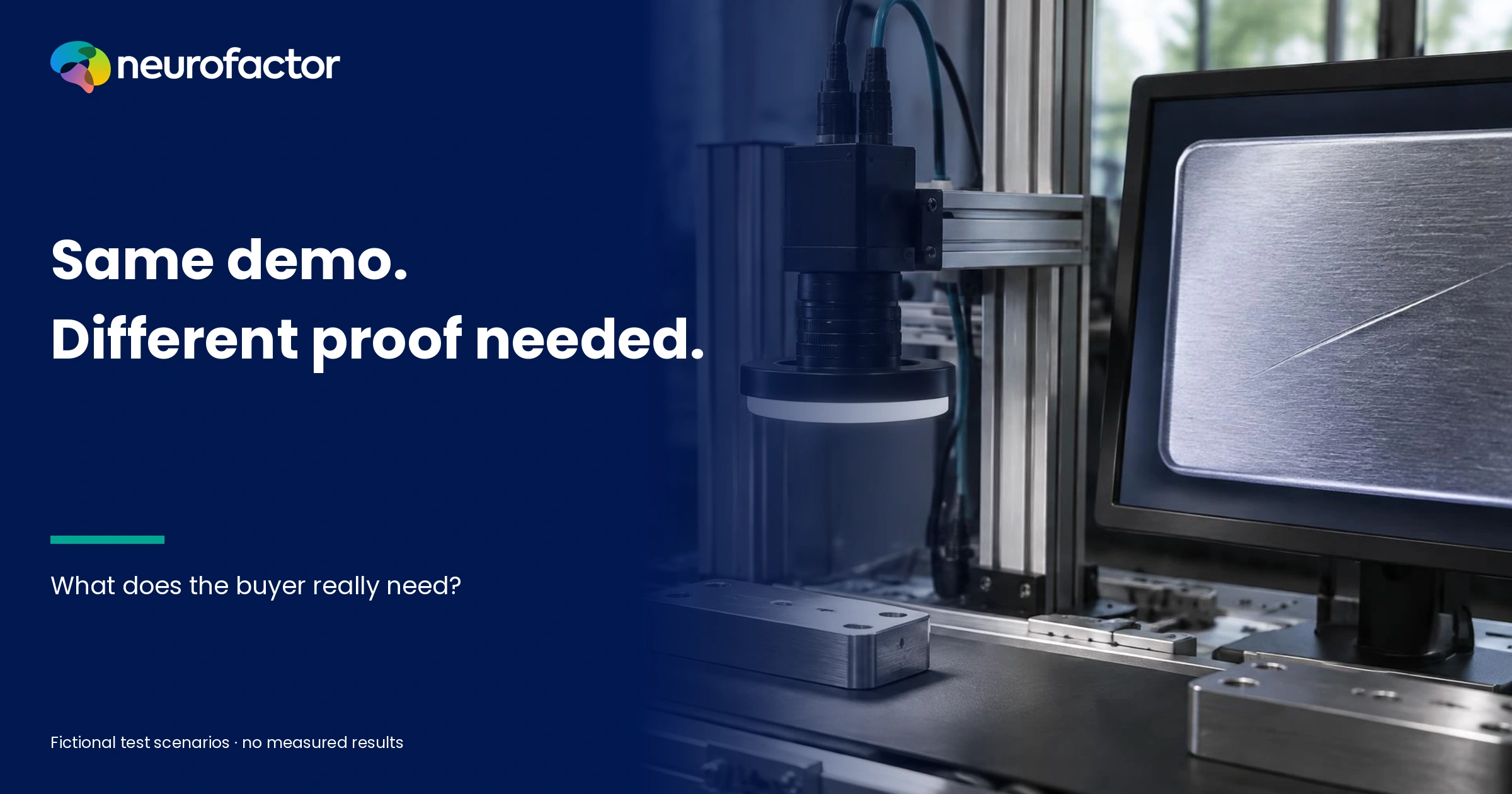
A manufacturer of metal components is considering a vision-based inspection system that flags visible anomalies. During a supplier demonstration, a component passes under a camera and a scratch is highlighted on the screen. A second test component receives the same warning. The interface is fast, the image clear and the salesperson describes how automated assistance might make quality control more consistent.
The production manager immediately thinks about line speed. 'What happens when the system produces an alert we cannot afford to investigate while the line is running?' The quality manager asks about missed defects: 'Which scratches or surfaces does this model fail to classify?' The IT lead wants to know where images are stored, who can access them and what happens if the network fails. The financial lead asks about costs beyond the camera: training, recalibration, downtime and staff time.
Four different associations could now dominate. Automation might mean extra capacity to operations, repeatability to quality, additional technical dependency to IT and uncertain savings to finance. These are possible explanations for similar roles, not established psychological facts about people with those titles. An actual project has to validate them.
The salesperson could tell a different optimistic story to each stakeholder. That would undermine the quality of the decision. A better approach is a shared factual foundation: what the product does, under which test conditions, which error categories have been examined, what remains unknown, how people supervise the system and what costs have not yet been validated. Each participant can then investigate that same foundation from their own perspective.
For a second session, the participants agree on three test scenarios in advance: an ordinary part, a borderline defect and a case with an imperfect camera image. The supplier shows the outcomes, logs, error handling and situations that still require human review. Finance receives a transparent scenario model, not a guaranteed return. IT receives an architecture discussion with documented open questions, not a claim that every security review is already complete.
The second meeting may feel less spectacular. It is also more useful. One stakeholder may become more confident because a previously vague risk is now quantified. Another may realise that the product is unsuitable for this process. Neither reaction invalidates the evaluation. A clear no can save both parties from an expensive failed implementation.
The decision point should therefore be explicit: proceed, run another test, defer or reject, with reasons that the committee can examine. Making the next decision possible is a much stronger outcome than collecting compliments for the presentation.
From association hypothesis to demo research in nine steps
The strongest demos do not begin with a list of screens that the sales team wants to show. They begin with a specific uncertainty that a buyer should be able to assess afterwards. In B2B, that uncertainty may be distributed across several people, approval rules and hidden dependencies. A sensible research process therefore combines interviews, association measurement, task observation and business outcomes.
Step 1 - Define the decision stage. Is the customer exploring the market, building a shortlist, seeking technical sign-off or approving a final investment? State what kind of decision the demo can realistically support. An introductory meeting is rarely enough to prove full implementation readiness.
Step 2 - Map actual decision responsibilities. Ask who will use the solution, bear the operational risk, manage budget, approve security and negotiate terms. Let each person describe what they must be able to explain to colleagues. Recruit participants by their responsibilities, not by an assumed emotional profile attached to their job title.
Step 3 - Record expectations before exposure. Ask open questions such as 'what do you expect this product to improve?' and 'what would make it unacceptable?'. Investigate the spontaneous meanings of terms such as 'autonomous', 'control', 'reliable' or 'integrated'. Only then introduce prompted associations so the research does not create the very mental links it later claims to discover.
Step 4 - Select one representative task and one difficult exception. Use a task that resembles the client's work. Choose an edge case that tests a known limitation. Agree what success means, including errors, manual interventions, elapsed time and the information available to the user.
Step 5 - Keep the factual conditions comparable. If comparing two presentation formats, vary the sequence, explanation or scenario relevance rather than changing product performance, test data and presenter quality all at once. Randomise order where feasible, document technical issues and distinguish simulations from actual performance.
Step 6 - Measure attention separately from understanding. Observe which elements people inspect, which tasks they finish and where they get stuck. Ask afterwards, in their own words, what they believe the demo proved. Eye tracking can help describe visual attention, but cannot by itself reveal comprehension of the business value.
Step 7 - Test claim credibility and residual objections. Ask which statements were substantiated, which evidence is missing and what new risks appeared. Invite a classification such as 'sufficient evidence', 'additional evidence required', 'poor fit' or 'undecided'. A single satisfaction rating obscures these different outcomes.
Step 8 - Ask for a meaningful next action. That may be agreement to test with the customer's own data, a security review, a documented business-case assessment or an informed decision to end discussions. A polite 'interesting' without an actionable next step is not evidence of buying progress.
Step 9 - Check later outcomes. Track technical approvals, pilot results, repeated objections, time-to-decision and, where possible, actual adoption after deployment. Look beyond the number of presentations or proposals. Small samples should be treated with appropriate caution, and changes in conversion should not be attributed to the demo if other factors changed at the same time.
A useful deliverable is a demo evidence map: each decision, the associated expectations and risks, the minimum credible proof required, who needs it and the measurable next step. Such a map connects the psychological meaning of an offer with operational and commercial evaluation without pretending that all organisations share one generic buying persona.
One factual foundation, different routes into the evidence
Personalised selling is sometimes described as showing each person what they want to see. That becomes dangerous when personalisation gives different people incompatible beliefs about the same product. The operations team sees only speed, finance sees only potential savings, and nobody checks whether the combined claims can all be true under the same conditions.
Start with an unchanging evidence record: product version, demonstrated functions, test conditions, operating limits, integrations, known risks and material assumptions. This information should be the same for everyone. Then provide paths into the questions that matter to different participants. A quality manager might examine false positives and missed defects. An operator can test exceptional workflows. Finance can examine assumptions behind net value. IT can review access control and system dependencies. The underlying facts and caveats must not change with the audience.
Anderson and colleagues advocated focusing a value proposition on the differences that are meaningful and demonstrable for a specific customer. [1] Ulaga and Eggert examined how businesses create differentiation in supplier relationships, beyond the product and its price alone. [8] A good demo connects what it shows to the customer's actual use and relationship requirements. It need not cram every detail into one meeting.
For the fictional vision system, that means the operator completes a task, quality reviews error types and validation boundaries, IT assesses integration requirements, and finance uses only supported performance assumptions. Different stakeholder meetings can take place in different sequences. But the evidence pack should remain consistent.
Two questions are especially useful. First: 'If we could prove just one thing in this session, what would help your decision most?' Second: 'What would count as evidence that our claim does not hold?' The second question turns a marketing promise into a falsifiable test. It also helps reveal whether a buyer is seeking reassurance, compliance evidence or an outcome that can actually be measured.
Language matters as well. 'Automated' may suggest efficiency to one person and loss of control to another. 'Real time' could signal timely intervention or a flood of notifications. Those interpretations should be explored in context. They are not universal translations of technical features and should not be written into a sales script as if they were facts about every department.
Ten practical improvements that make demos more useful for decisions
1. Open with the customer's task, not your navigation menu. Identify the work, decision or error that the buyer wants to improve. Then show the relevant capability. This makes the demo easier to judge against a meaningful outcome.
2. Name the evidence level. Explicitly distinguish a simulation, a staged demonstration, a customer-run trial, a limited pilot and validated production performance. Do not use language that suggests stronger evidence than you possess.
3. Include a difficult exception. A borderline or failure case can be more informative than another ideal example, particularly when quality or safety matters.
4. Let the user try. Give a real user the controls and allow them to complete the task with minimal coaching. Observe the effort and errors without turning the trial into a scripted tour.
5. Show what remains manual. Explain where people must intervene, what the system cannot classify and what happens when automation fails.
6. Reveal the financial assumptions. Show the basis for volume, time, errors, licensing, support and implementation. A dramatic savings number is not an adequate substitute for a transparent model.
7. Surface dependencies early. Discuss data quality, training, permissions, contracts, vendor concentration and the customer's operating environment rather than treating them as minor post-sale details.
8. Invite credible objections. Ask which claim was least convincing. Make it safe for participants to raise doubts; otherwise, an apparently positive meeting may conceal the real decision barrier.
9. Agree on a proportionate next step. An early demo may justify a technical workshop rather than a contract. Match the ask to the quality of evidence already collected.
10. Optimise for sound decisions. A smaller number of better-qualified pilots may create more value than many enthusiastic meetings. Examine the reasons for rejection as carefully as the reasons for purchase.
These improvements are not a fixed checklist for every product. An everyday, low-risk service seldom needs the same validation as a safety-critical inspection system. Appropriate depth is part of good communication. Overloading a simple solution with every imaginable caveat can be unhelpful; concealing meaningful limitations in a critical decision is unacceptable.
A demo designed around evidence may reveal more objections earlier. That does not mean it is failing. It means the supplier and buyer are learning what must be addressed before either invests more time. Sales performance is not improved merely by postponing a difficult fact until after a contract is signed.
What a demo cannot prove, even with EEG or eye tracking
'Persuasion' is a tempting label because it seems to describe an internal state that can be measured directly. But several very different signals can accompany a demo. A person can look at the screen for a long time, show a physiological response or praise the interface, yet remain unconvinced about the supplier's reliability or product fit.
Eye tracking provides information about visual attention, not the business conclusion someone draws. EEG can, under suitable conditions, measure time-related brain responses, but it is not a direct reading of purchase decisions, trust or operational suitability. An implicit association task may provide clues about relatively automatic connections to concepts such as 'safe', 'complex', 'freedom' or 'dependence'. These tasks require careful design and validation, and they never replace an engineering test or financial due diligence.
Interviews have their own limitations. People may offer a coherent retrospective explanation of a decision shaped partly by context, habit or organisational rules. That is a reason to combine methods, not a reason to dismiss explicit answers as fundamentally worthless. Task performance, observational data, interviews, associations and later choices can complement one another.
Sometimes a demonstration does not convince because the product genuinely fails to meet the customer's needs. Sometimes the solution is suitable but the customer lacks budget. Sometimes a key approver has not attended. Sometimes meaningful testing is impossible until the product is connected to a customer's data. All these explanations should remain possible. Psychological friction is not a label to apply to every unsuccessful deal.
Turn explanations into tests. 'The quality manager has doubts because the demo only showed successful cases' is a hypothesis. You can test it through an independent, representative evaluation and a targeted conversation. You cannot establish it by observing that the person rarely smiled.
Neurofactor describes the combination of association research, observation and other approaches within its research methods and business applications. The method should follow the question, not the other way around.
After the demo, ask more than whether everyone liked it
One common closing question is: 'Was the demonstration clear?' People can all answer yes and still walk away with incompatible interpretations. One means that the interface was understandable. Another believes that the savings claim was substantiated. A third simply wants to avoid being impolite. You need questions that reveal what the demonstration actually changed.
Ask: 'What can you now say with more confidence than before this session?' Let participants answer without being offered the supplier's language. Follow up with: 'What can you still not evaluate?' A presentation can be easy to follow without being diagnostic. Conversely, a demanding technical session may provide exactly the evidence a specialist needs to make a responsible judgement.
Ask participants to name the three largest remaining decision risks. Then ask what they think other stakeholders may object to, and compare those assumptions with what colleagues actually say. This can reveal misunderstandings within the committee. A salesperson may believe IT is opposed to the project when the IT team simply needs a standard security document before giving its view.
Explore the associations attached to the offer and supplier as well. A demonstration of automation might evoke 'efficient', 'impersonal', 'dependence', 'innovation' or 'pressure'. Ask which meanings arise spontaneously and what they refer to in this workplace. A separate implicit measure can help if the research question justifies it, but a word association is not proof of why the purchase has stalled.
Check what next action each person can actually take. Can they arrange a test with their own data, involve a technical colleague, define acceptance criteria or recommend an informed rejection? These outcomes are more actionable than the single word 'positive'.
If testing two demo versions, preserve interpretability. A new version that simultaneously uses a shorter script, a stronger presenter and different product data cannot tell you which change mattered. Use randomisation where feasible, predefined primary outcomes and comparable participants. Interpret small numbers as directional evidence rather than a proven universal conversion uplift.
From applause to the next responsible buying decision
A demo creates commercial value when it helps someone make a better-informed decision. That decision may be to purchase, to commission another trial, to renegotiate a requirement or to stop the evaluation. Sometimes 'not yet' is exactly right. An early rejection can prevent a costly implementation with poor fit.
Distinguish presentation outcomes from decision outcomes. Presentation outcomes include attention, clarity, satisfaction and recall of the central message. Decision outcomes include how well a claim was tested, how much uncertainty remains, whether the next validation step has an owner, and whether the product eventually works in practice. They may be related, but they are not substitutes for each other.
A useful sales dashboard should show more than 'demo completed' and 'proposal sent'. Add the dominant evidence question, which objection was resolved, what new limitation surfaced, which evidence is still missing and what meaningful action follows. Examine lost opportunities with the same discipline as closed deals. That helps distinguish unsuitable leads from poor demonstrations and genuinely weak value propositions.
This approach is also ethically stronger. It does not attempt to overwhelm the buyer with an impressive sequence of positive scenes. Instead, it makes performance, limitations and fit easier to evaluate. That may bring objections to the surface sooner. But objections that can be tested are useful information, especially when an implementation would otherwise expose both parties to larger costs and reputational risk.
The Neurofactor perspective is not that brain measurements should take over selling. It is that you can investigate how associations, attention, explanations and choices connect to commercial outcomes, using the methods appropriate to the decision. Many cases start with a carefully designed interview and practical observation. More advanced measurement is helpful only when it answers a relevant question that simpler methods cannot resolve adequately.
Conclusion: do not show everything; let the buyer test the right thing
One buyer is excited because the demo appears to solve a daily operational problem. Another remains unconvinced because important risks have not yet been tested. Neither is necessarily mistaken. They can see the same interface while needing to make very different decisions.
A better demonstration begins with three questions: What does this offer mean to the buyer? Which uncertainty is decisive? What evidence could honestly reduce that uncertainty? Only then should you choose the screens, test scenarios, message and sequence. Let the customer try what matters, reveal the limitations and define a next step that can be evaluated.
A supplier who wants to impress shows the best-looking side of the product. A supplier who wants to help a buyer make a sound choice demonstrates whether the product creates value in that buyer's actual situation. That is not a minor improvement to presentation technique. It is a different way to approach selling.
Key terms
- Product demonstration
- A controlled presentation of how an offering works in specified circumstances; not necessarily a representative test of daily performance.
- Evidence need
- The information a participant requires to evaluate a relevant claim, risk or decision.
- Diagnostic information
- Evidence that helps distinguish between competing explanations or options rather than merely creating a favourable impression.
- Association profile
- A research-based account of the meanings, expectations and potential resistance people connect with an offer.
- Proof of concept
- A bounded test of whether a solution meets predefined conditions in a specific context; it does not guarantee full operational performance.
- Buying committee
- The people who influence an organisational purchasing decision, each potentially responsible for different aspects of the evaluation.
Frequently asked questions
Why does the same demo affect B2B buyers differently?
Because buyers bring different tasks, previous experiences, decision risks and expectations. The same screen may show one person convenience and suggest a new dependency to another. Investigate which claim each person needs to validate.
Do we need a separate demo for every type of decision-maker?
Not necessarily. Keep one shared factual foundation while offering different ways to inspect relevant tasks and evidence. Never change performance claims, limits or conditions depending on the audience.
How can we tell whether a demo actually persuaded someone?
Look beyond enthusiasm to understanding, credibility of specific claims, completed tasks, remaining risks and agreed next actions. A real pilot or later customer outcome can provide stronger evidence.
What is the difference between a demo and a proof of concept?
A demo shows selected capabilities under chosen conditions. A proof of concept tests predefined criteria within a bounded setting. Production readiness may require additional integration, safety and operational validation.
Can EEG or implicit association tests identify the best demo?
They may add information about brain responses or associations under suitable research conditions. On their own they do not prove trust, product fit, purchase intention or future sales. Combine them, where useful, with behaviour and actual decision data.
What if a customer stays unconvinced after an excellent demo?
Identify the decisive missing evidence or constraint and check whether the solution actually fits. Sometimes more validation is appropriate; sometimes the budget, timing or product is wrong. A well-informed rejection is also a valuable evaluation outcome.
Sources
- 1.Customer Value Propositions in Business Markets - Harvard Business Review, 84(3), 90-99, 149 (2006)
- 2.A General Model for Understanding Organizational Buying Behavior - Journal of Marketing, 36(2), 12-19 (1972)
- 3.Consumer Processing of Product Trial and the Influence of Prior Advertising: A Structural Modeling Approach - Journal of Marketing Research, 35(3), 325-338 (1998)
- 4.Consumer Learning: Advertising and the Ambiguity of Product Experience - Journal of Consumer Research, 13(2), 221-233 (1986)
- 5.Is There a Substitute for Direct Experience? Comparing Consumers' Preferences after Direct and Indirect Product Experiences - Journal of Consumer Research, 34(4), 546-555 (2007)
- 6.Feature Fatigue: When Product Capabilities Become Too Much of a Good Thing - Journal of Marketing Research, 42(4), 431-442 (2005)
- 7.The Elaboration Likelihood Model of Persuasion - Advances in Experimental Social Psychology, 19, 123-205 (1986)
- 8.Value-Based Differentiation in Business Relationships: Gaining and Sustaining Key Supplier Status - Journal of Marketing, 70(1), 119-136 (2006)
Read next
Reviewed by: Martijn den Otter · Last reviewed: 11/2/2026
Martijn den Otter
Oprichter van Neurofactor. Expert in neuromarketing en consumentenpsychologie.
LinkedIn →