
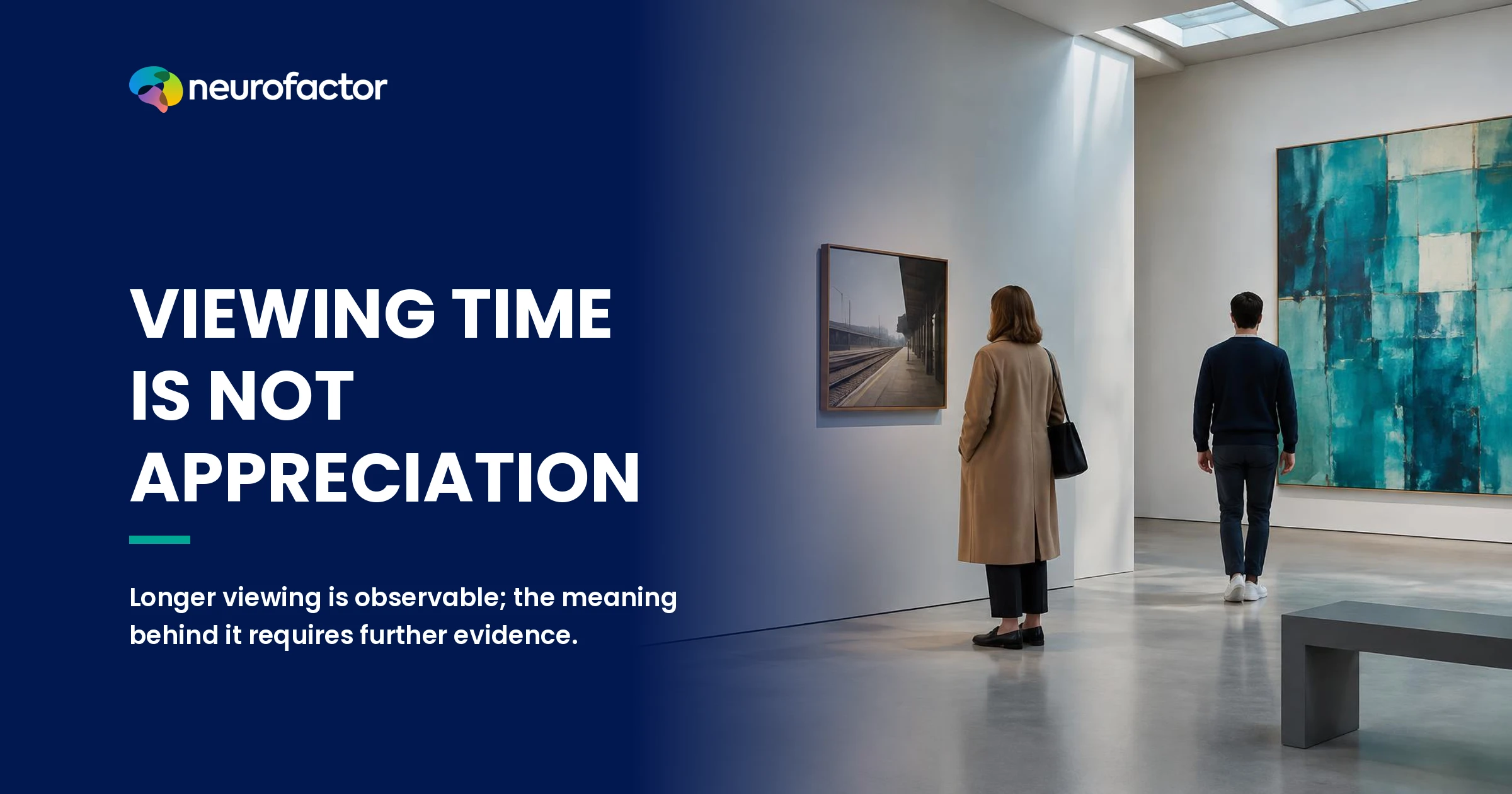
Museum experience: why do visitors spend longer with some artworks?
A visitor walks straight past a large, colourful painting. A few metres away, the same person stands still for several minutes in front of a modest image of an empty railway station. Their companion does the reverse. Which artwork made the stronger impression? And what does spending more time looking actually tell us?
Viewing time is an attractive metric for museums. It can be observed, timed or recorded more precisely with mobile eye tracking. Yet a number of seconds does not explain why somebody stopped. Recognition, curiosity, delight, confusion, discomfort or a detail that demands another look may all play a part. Or perhaps the visitor is waiting for someone, cannot read the label or has nowhere else to stand. A museum that treats dwell time as a direct score for appreciation turns behaviour into an interpretation before collecting evidence.
The more useful question is how attention, associative meaning, exhibition context and practical circumstances combine to make a visitor stop, explore, return or move on. Answering it gives curators, museum researchers and experience designers a stronger basis for decisions than a ranking of the artworks that receive the most seconds.
Forty seconds of looking is not forty seconds of the same experience
Imagine two visitors who each spend forty seconds in front of a painting. The first follows a narrative in the image, recognises a childhood experience and wants to know who made the work. The second searches for an explanation, struggles with the wording of the label and tries to find the next room. They receive the same dwell-time value. They do not have the same experience.
The reverse error matters too. A person may recognise a subject instantly, feel a powerful connection and move on because the response is personal. Another may look for much longer precisely because the work feels troubling or difficult. Longer viewing indicates some form of visual engagement or information gathering; it does not automatically imply positive evaluation.
Brieber, Nadal, Leder and Rosenberg recorded looking behaviour with mobile eye tracking in a 2014 study comparing an exhibition viewed in a museum with one viewed in a laboratory. Participants also rated liking, interest, understanding and ambiguity. The relation between the experience of art and viewing time depended partly on the setting. In other words, even a useful statistical relationship should not be treated as a fixed translation from seconds to feelings. Brieber et al., 2014.
This does not make dwell time useless. It makes the research question decisive. A museum may have credible evidence that more people pause at one artwork than at another. Establishing why they pause requires a different kind of evidence.
The visitor journey contains more than a single moment of attention
An art encounter begins before someone enters the gallery. A visitor may recognise the artist, have encountered a reproduction on social media, be accompanying a friend or expect an enjoyable family afternoon. These expectations influence what seems relevant. Then attention is allocated: which works enter the visual field, where does the person stand and what earns another look? Interpretation follows, although interpretation can also direct subsequent looking.
For research it helps to separate five questions: what did the visitor expect, notice, interpret, do and remember? They are analytic distinctions rather than five discrete brain mechanisms. A visitor may repeatedly move between looking and interpreting. A conversation in the next room can change what an earlier object means. A later memory can give a short encounter more significance than a long one.
Leder and colleagues' model of aesthetic processing brings perception, classification, attempts at understanding and evaluation into a coherent research framework. It does not prescribe one identical path for every visitor. Leder et al., 2004. Pelowski and colleagues review alternative approaches and show why an art experience may include changes in understanding rather than a simple pleasure response. Pelowski et al., 2016.
A study that measures only stops and durations therefore captures part of the journey. Add questions about meaning at the appropriate moment and, when relevant, ask what visitors remember later. The artwork that receives the longest look need not be the artwork they recall most vividly.
Personal associations make particular artworks relevant
An empty station can suggest freedom to one visitor and loss to another. This does not mean the painting contains one objectively correct message. It means elements in the painting may become connected with existing experiences, memories, beliefs and expectations. A sculpture made from cables may evoke craftsmanship for an engineer, play for a child and an inaccessible art world for someone else.
An association is not simply an opinion given in response to a direct question. Some links can emerge quickly and are difficult to describe. That does not license a researcher to label every unexplained reaction 'subconscious'. The person may have been asked the wrong question, may be uncertain or may be attending to something the researcher overlooked. The responsible approach is to measure associations in a defined task and compare them with what people do and say.
An artwork's appearance is only one source of meaning. Its title, its neighbours on the wall, the exhibition theme, the information supplied by a curator and the actions of other visitors may all prompt additional connections. An installation that seems obscure on its own can become meaningful when placed in an exhibition about migration. Yet the same explanation may narrow a visitor's interpretation when the institution supplies only one possible reading.
The practical question becomes specific: what meanings arise before explanation, which emerge after viewing or reading and which remain later? That is how a museum distinguishes attracting attention from enabling an encounter to develop meaning.
The room is part of the experience, not invisible background
A large painting at eye level near a gallery entrance has a different chance of being seen than a small work hidden beside a crowded doorway. A school group standing around an object can attract interest while simultaneously preventing others from approaching it. A bench encourages time and conversation. A narrow passage may make stopping uncomfortable or cause people to linger while others move past.
These factors are not all inconvenient noise. The room is part of what visitors encounter. But they do change the interpretation of a finding. Are we studying the attractiveness of one artwork, the effectiveness of its display or the overall quality of the visitor journey? A single dwell-time figure cannot answer all three questions.
In the 2014 study, participants viewing works in a museum spent longer with them on average than participants viewing them in a laboratory. Related research from 2015 found differences in valuation and memory across settings. Those findings support the importance of context, but do not isolate a single cause, such as authenticity, architectural setting, expectation or spatial memory cues. Brieber et al., 2015.
For practical museum research, record display height, sight lines, crowding, label position, distance and sequence alongside time. Otherwise a team may move an artwork when the original problem was the placement of a text panel. Experience design starts with a precise diagnosis of what visitors were actually able to see and do.
Six explanations for a long look
An observed pause can support several competing explanations. This matrix helps a museum avoid deciding in advance what longer viewing 'must' mean. The examples are hypotheses rather than diagnoses of individual visitors.
| Possible explanation | What you might observe | What to investigate next | Risk of overinterpretation |
|---|---|---|---|
| Recognition or relevance | Immediate stop and return visit | Personal associations, stories and later recall | Everyone must find this work attractive |
| Curiosity or ambiguity | Extended exploration of unusual details | What felt puzzling, challenging or interesting? | Difficulty means dislike |
| Aesthetic enjoyment | Voluntary continued exploration | Separate liking, pleasure and interest ratings | Time equals beauty |
| Discomfort or resistance | Long pause combined with visible hesitation | Open interpretation, negative associations and context | Resistance means disengagement |
| Practical friction | Repeated label reading or waiting | Legibility, route layout, queues and accessibility | Every additional second is engagement |
| Social coordination | Waiting for a friend or following a group | Companions, conversation and visitor role | Individual preference has been measured |
Graf and Landwehr describe how aesthetic pleasure and interest can arise from different modes of processing. A challenging stimulus may attract sustained attention because a person wants to understand it, without immediately feeling pleasure. Graf & Landwehr, 2015.
The value of the table lies in keeping multiple possibilities alive. A researcher should only narrow them after collecting the information needed to distinguish them.
The artwork and the viewer both influence where the eyes go
High contrast, a human face or a strong visual composition may attract an initial glance. At the same time, visitors look for information relevant to their current interest or task. A conservator may scrutinise technique, a parent may watch a child's reaction, and a historically minded visitor may search for cues about the period represented.
Massaro and colleagues used eye tracking to examine the effects of visual features and viewing tasks on eye movements when looking at representational paintings. Their work shows that both the content of a painting and the task assigned to the observer can affect viewing patterns. Massaro et al., 2012. Locher and colleagues investigated how an early overall impression can be followed by more detailed visual exploration. Locher et al., 2007.
That creates a real design choice. Does the curator want visitors to discover a small detail, reconstruct a story or remain free to form their own associations? A label that points out a detail may redirect attention. That does not prove the entire experience has improved. It may even cause other details to receive less attention.
Treat attention to a particular feature and meaningful engagement with the work as separate outcomes. A changed gaze pattern is evidence of changed looking. Stronger understanding, more nuanced interpretation or a richer memory requires additional evaluation.
Expertise changes looking, but not in one simple direction
Experience with art can change which characteristics a visitor notices and how quickly references, techniques and styles are recognised. This does not mean experts always look better or newcomers have inferior experiences. They may take different routes towards understanding. An expert may need only a brief look to recognise an established technique. A newcomer may spend longer because the same work raises unfamiliar questions.
Vogt and Magnussen compared eye-movement patterns and visual memory in artists and non-artists. Their findings support the relevance of expertise to visual exploration, but should not be turned into a universal hierarchy of visitors. Vogt & Magnussen, 2007.
For museum research, associative differences may be more informative than a crude split by age or formal art education. Some people seek recognition, some challenge, some emotional connection and some an opportunity for conversation. These motivations can coexist or change from one gallery to the next. Thinking in terms of an association network helps describe connections between meanings without turning them into fixed human types.
Begin with what a particular artwork means to a visitor. Then ask whether similar patterns emerge across people under comparable conditions. This protects both the analysis and the visitor's freedom to have an unexpected response.
Titles and labels can open or close a line of interpretation
A title is not merely an inventory label. It can tell a visitor where to look, suggest a story or make an unusual symbol easier to interpret. A short text may offer a useful starting point. A longer explanation may support deeper investigation. But a panel can also impose one reading, disrupt a visitor's pace or attract more attention than the artwork itself.
Leder, Carbon and Ripsas examined how different kinds of titles affect the understanding and appreciation of paintings. Under some experimental conditions, more elaborate titles improved understanding of abstract works without an equivalent rise in aesthetic appreciation. Leder et al., 2006. Reitstätter, Galter and Bakondi studied how visitors used exhibit labels with mobile eye tracking and other methods. Their findings describe patterns in which people move between artwork and text, and the different ways those patterns unfold. Reitstätter et al., 2022.
A newer museum study by Reitstätter, Pesen and Bakondi in 2026 compared altered labels and found that reading behaviour varied considerably, with longer texts associated with higher dropout and particular kinds of image-related information attracting attention. Those findings apply to the studied setting; they are not a rule that every museum should use short labels. Reitstätter et al., 2026.
The testable question is which information helps which visitors encounter which artwork. Try a specific visual-detail question against a more descriptive label and compare interpretation as well as reading and looking.
Interesting, beautiful, confusing and confronting are not synonyms
Visitor surveys often compress responses into a single satisfaction number. This can be convenient for management, but it is a poor tool for explaining why some works hold attention. A painting can be beautiful but predictable. An installation can be interesting but uncomfortable. An artwork can be difficult to understand yet compelling. These distinctions disappear when every response is reduced to positive or negative.
Research in empirical aesthetics distinguishes sensory processing, evaluation, understanding and knowledge. Chatterjee and Vartanian review how these processes interact in aesthetic encounters. Their work is not evidence for one universal 'art centre' in the brain; it is a reason to resist reducing the experience to one feeling. Chatterjee & Vartanian, 2014.
Associative analysis adds a practical dimension. Ask what connections visitors make, not just whether they liked the exhibition. Identify tensions or conflicting associations. An installation on climate change may evoke both responsibility and guilt, or admiration and resistance to a perceived moralising tone. The same work can invite a long encounter for quite different reasons.
Do not invent inner states from a person's gaze. Terms such as guilt, hope or anger require appropriate evidence from what visitors express or from validated measures for a particular question. A confronting artwork also need not be redesigned into something pleasant. Its purpose may be to stimulate difficult reflection.
Fictional case: three artworks in a city museum
Consider an entirely fictional temporary exhibition called 'In Transit'. The first room contains a large, colourful painting of travellers on a crowded platform. The second contains a small installation of intertwined thread and old suitcases. The final room presents a restrained painting of an empty station. These imagined works are illustrative; no museum, artist, visitor measurements or client results are being represented as real.
During an exploratory walkthrough, a curator notices that some people spend a long time with the suitcase installation, while others pass it immediately. The museum team wonders whether it is more emotionally powerful than the larger painting. But the installation sits near a narrow passage, is accompanied by a long label, and occasionally becomes a waiting point for groups. These circumstances are plausible alternative explanations for the time spent there.
The researcher therefore keeps several hypotheses open. Perhaps suitcases and thread evoke memories of leaving, belonging or loss. Perhaps visitors are simply trying to work out how the object was made. Perhaps the bottleneck slows movement. Perhaps the title prompts a kind of reflection that the artwork alone does not. No one treats those possibilities as observed results.
The team designs a potential test: compare a label that states a single authoritative interpretation with a label drawing attention to an observable detail and inviting a personal response. The primary outcome is not more seconds. It might be whether visitors identify the detail, can describe their interpretation independently and show curiosity without creating further congestion.
What mobile eye tracking can and cannot tell a museum
Mobile eye tracking can record where a participant looks, how visual attention shifts between artwork and label and how patterns unfold along a route. With suitable calibration, reliable recording conditions and carefully defined areas of interest, this provides information that a simple stopwatch cannot offer. It may reveal, for example, whether a label attracts attention before or after the artwork.
The technology has constraints. Eyewear, reflective glass, low light, changing viewing distances, head movement and calibration error can affect recording quality. Small details may be hard to resolve. A fixation does not demonstrate comprehension, appreciation or even conscious recognition of the thing being looked at. Pupil size can vary with illumination, cognitive demands and other physiological factors; it cannot serve as a universal emotional meter.
In a 2026 review, Walker discusses findings from mobile eye tracking studies in art museums and notes the contribution of artwork characteristics, exhibition design and visitor differences. He also discusses the remaining challenge of translating such research into practical exhibition decisions. Walker, 2026.
An impressive heatmap can still answer a very narrow question. Use it to investigate a specific observation: which details visitors miss, how they move between object and text, or whether a design variant changes visual exploration. Then gather evidence about interpretation separately.
Choose a method from the question, not from the equipment
An art museum does not need to fit every visitor with an EEG cap. It needs a research design that addresses the curatorial decision. Different methods can reveal different aspects of experience, and their limitations should be documented before collection begins.
| Research question | Suitable approach | What it can provide | What it cannot establish alone |
|---|---|---|---|
| Who stops and for how long? | Observation and time-and-tracking | Stops, dwell time and movement | Appreciation or emotional response |
| What details and labels attract gaze? | Mobile eye tracking | Fixation patterns and gaze transitions | Understanding, emotion or judgement |
| Why does a work matter or puzzle someone? | Open interview and associative tasks | Stated meanings, associations and uncertainty | A demonstrated causal mechanism |
| What remains after the visit? | Delayed recall and interpretation questions | Remembered objects, details and narratives | The complete original experience |
| Did a label or route change improve a defined outcome? | Controlled comparison with prespecified measures | Evidence on differences between variants | General effects outside the tested setting |
| What accompanies processing physiologically? | Task-appropriate psychophysiology, possibly EEG | Specific physiological signals in context | Directly decoded beauty, pleasure or art impact |
Thébault and colleagues' museum study published in 2024 argues against relying exclusively on timing and tracking. They combined observed behaviour with visitors' reported experiences to investigate the role of labels and interpretive encounters. Thébault et al., 2024.
Mobile EEG raises additional issues with movement, artefacts, participant comfort and privacy. A recorded brain signal is not an off-the-shelf measure of aesthetic pleasure or memory. Triangulation, meaning the careful use of complementary evidence, is more important than the number of sensors on a participant.
The artwork is not always the right unit of analysis
It is tempting to compare artwork A with B as though the works were isolated products. Yet apparent differences can depend on where each is displayed, when someone visits, the people accompanying them and what came earlier in the exhibition. A label may help one artwork and interfere with another. If the order or placement changes, a previously observed difference may change too.
Decide what the unit of analysis will be. If the goal is to understand individual works, observe multiple visitors under comparable conditions. If the goal is to improve an exhibition, treat movement through the space as part of what is being evaluated. If the goal is to test new labels, use a comparison that avoids confounding the text change with crowding or a different visitor group whenever possible.
Record the essentials: time and route, stops and label interactions, visitor characteristics relevant to the question, crowding and disruptions. A small number of well-chosen open questions can reveal whether an apparently important detail was understood. Delayed recall can add a distinct outcome. An exploratory study is useful for finding plausible mechanisms, but does not justify precise population effect estimates without an adequate design and sample.
There is also a selection problem. Visitors willing to complete an interview may be those already most engaged. A heatmap averaged across participants can conceal fundamentally different viewing strategies. Report the distribution and uncertainty rather than a single average whenever possible.
From an association map to a curatorial design decision
An association map can show the meanings that cluster around a work: recognition, surprise, craft, loss, confusion, anger or belonging. The map does not vote on the 'correct' interpretation. Its value lies in identifying where the curator's intention and visitors' experiences might diverge.
Suppose the fictional suitcase installation is often associated with being trapped or confused. If the exhibition intentionally aims to evoke discomfort, it would be inappropriate to optimise away every negative word. A better possibility is to offer a way into the work without dictating what the visitor must feel. A question pointing to a concrete detail might help visitors construct their own interpretation while preserving the tension.
The design translation is specific. Change one main component when possible, such as label wording or placement. Choose the primary outcome beforehand: visitors' ability to identify a detail, the variety of interpretations, or a meaningful return from reading to viewing. Keep dwell time as a supporting measure rather than the definition of success. Track possible side effects, including congestion, longer queues or a reduction in time available for other works.
This is how associative research informs exhibition design: by converting a plausible explanation into a careful test, not by presenting an association score as the final answer.
Longer viewing is not necessarily a better museum
Imagine a museum increases viewing time by adding substantial labels to every artwork. Its dashboard may look successful. Yet visitors may become tired, spend less time with other works, feel pressure from companions or find the rooms harder to navigate. The optimisation has increased one metric while diminishing other aspects of the encounter.
A museum must therefore make a curatorial choice about the kinds of experiences it wants to support. For some works, sustained exploration is the goal. For others, a brief moment of recognition, surprise, disagreement or reflection may be entirely appropriate. Accessibility, interpretive freedom and differences in cultural knowledge are not secondary considerations. They are part of the definition of a good visitor experience.
Pekarik, Doering and Karns explored different kinds of satisfying experiences in museums, including encounters with objects, learning, introspection and social engagement. Their research offers another reason not to equate success with seconds alone. Pekarik et al., 1999.
Report the trade-offs of any intervention. More time reading might mean less room to move. A sophisticated description may enrich one group's interpretation while making another feel excluded. What matters is whether the museum enables its intended, defensible forms of engagement across the people it serves.
Scientific limits, consent and ethical responsibility
Video, mobile eye tracking and physiological research in museums all raise questions about informed participation, data minimisation, secure storage and the rights of people who do not wish to participate. A publicly accessible space is not blanket permission to gather identifiable gaze data. Research involving children or more vulnerable visitors requires additional safeguards. Equipment can also alter natural behaviour, so the study must account for its own presence.
A statistical association is not automatically a causal explanation. A link between dwell time and interest may partly reflect expertise or the placement of an artwork. More label reading after a design change does not prove greater understanding. A finding from one temporary exhibition should not be transferred mechanically to every museum and audience.
Kirk and colleagues showed experimentally that semantic information about the supposed origin of artworks could affect aesthetic evaluation in an fMRI study. That supports the relevance of context in the studied task; it does not mean that museums can directly read a visitor's emotional response from an individual brain signal. Kirk et al., 2009.
Be equally precise with associative tasks. They measure responses under specified conditions, not a permanent hidden truth about a person. State what was measured, what alternatives remain and which inference the evidence can support. That restraint makes a museum study more useful, not less ambitious.
Seven steps from visitor observation to an informed decision
A museum can start with a modest project. What matters is preserving the link between the question, the evidence and the decision. The following sequence is designed for a realistic exhibition setting rather than a technology showcase.
- Define the curatorial decision. Is the museum choosing a label, rethinking a route or trying to make one artwork more accessible? Select one decision that the evidence can inform.
- Document the current setting. Observe stops, gaze opportunities, group behaviour, movement, light, labels and bottlenecks before treating longer viewing as meaningful.
- Investigate visitors' associations. Ask what they recognise, enjoy, avoid or find unclear. Use open accounts and structured associative methods where suitable.
- Bring different forms of evidence together. Compare behaviour, gaze data and visitors' explanations, noting agreement, disagreement and alternative causes.
- Design one explicit intervention. Prepare two defensible label formulations or placements, with the principal difference specified before testing.
- Measure the intended outcome and side effects. Record understanding, exploration or recall as appropriate, alongside crowding, accessibility and potential unintended reactions.
- Decide with uncertainty visible. Report what the data support, what remains unresolved and how confidently the result can be applied in other rooms or visitor groups.
This workflow moves the conversation from 'people seem to look for longer' towards 'this change appears to support a defined museum objective under the conditions we tested'. That is a more useful foundation for experience design.
Conclusion: look beyond the clock
The artworks that receive the longest looks are not necessarily the artworks visitors like most. Conversely, a brief encounter can be memorable or deeply meaningful. Viewing time is a piece of behaviour that needs context, interpretation and a clear purpose before it becomes evidence for a design decision.
For curators, the opportunity is to use looking behaviour as a clue rather than a ranking. Ask what visitors recognised, what confused or interested them, whether labels supported their own interpretation and what they later remember. Combine methods where they add genuine information, without pretending that a heatmap or EEG signal reveals the complete experience.
The goal is not to keep every visitor in front of every artwork for as long as possible. The goal is to create the conditions in which visitors can find, question and develop meaning for themselves. The broader context is explained in our introduction to associations and experience and the experience series overview.
Key terms
- Viewing time
- Time spent looking at a defined artwork or viewing area; it is not a direct measure of emotion.
- Dwell time
- Time spent near an object or in a room, potentially including reading and waiting; not necessarily fixation duration.
- Fixation
- A relatively stable period of gaze identified under suitable eye-tracking conditions.
- Area of interest (AOI)
- A predefined region, such as the artwork or label, used to summarise measured gaze behaviour.
- Associative meaning
- Connections between an artwork, memories, interpretation and expected consequences within a specified context.
- Triangulation
- The combination of distinct methods and evidence sources to interpret findings more reliably.
- Curatorial design hypothesis
- A testable prediction linking a specific change to a prespecified visitor outcome.
Frequently asked questions
Why do museum visitors look longer at certain artworks?
Longer looks may reflect interest, pleasure, confusion, ambiguity, recognition or an attempt to understand. They may also result from crowded rooms, inaccessible labels or social coordination. Dwell time identifies a behavioural pattern rather than its cause. Context observations and questions about visitors' interpretations help distinguish the competing explanations.
Does more time looking mean visitors find an artwork more beautiful?
No. Aesthetic appreciation and viewing time can be related in research, but that relation varies with context and the kind of experience involved. An unsettling or difficult artwork can also attract sustained attention. If beauty, liking, curiosity or understanding matters, each should be examined with a suitable, separate measure.
What can eye tracking measure in an art museum?
With suitable equipment and calibration, mobile eye tracking can measure where visitors look, how gaze moves between artworks and labels, and certain patterns of visual exploration. It cannot directly determine appreciation, emotions or understanding. Interpretation requires a specific research question and complementary evidence such as interviews and behavioural observation.
Are long exhibit labels always bad for engagement?
No. Some visitors want detailed information, while others prefer a more open encounter. Research indicates that label length, content and presentation can shape reading and looking behaviour, but shorter is not universally better. Museums should test what helps visitors explore a particular artwork and watch for crowding or information overload.
Can museums measure unconscious associations towards artworks?
Associative responses can be studied systematically, including through specific implicit tasks, but the results remain dependent on the method and context. They are not direct access to a hidden, permanent opinion. Combine the findings with what visitors say and do, and avoid claiming more about an individual than the measurement can support.
Can EEG reveal whether a museum visitor feels moved by art?
EEG records electrical brain activity under particular conditions, not a universal score for being moved, inspired or delighted. Natural museum environments also introduce movement, noise and privacy concerns. If EEG is used, it needs a precise research question and justified interpretation, supported by behavioural and subjective measurements.
How should a museum test whether an improved label actually works?
Define the intended effect before testing: perhaps clearer understanding, discovery of a detail or a richer independent interpretation. Compare suitable label variants under sufficiently comparable conditions and measure the primary outcome and negative side effects. More reading time on its own is not adequate evidence of a better exhibition experience.
Sources
- 1.Brieber, D.; Nadal, M.; Leder, H.; Rosenberg, R., Art in Time and Space: Context Modulates the Relation between Art Experience and Viewing Time - PLOS ONE
- 2.Brieber, D.; Nadal, M.; Leder, H., In the white cube: Museum context enhances the valuation and memory of art - Acta Psychologica
- 3.Leder, H.; Belke, B.; Oeberst, A.; Augustin, D., A model of aesthetic appreciation and aesthetic judgments - British Journal of Psychology
- 4.Leder, H.; Carbon, C.-C.; Ripsas, A.-L., Entitling art: Influence of title information on understanding and appreciation of paintings - Acta Psychologica
- 5.Massaro, D.; Savazzi, F.; Di Dio, C.; et al., When Art Moves the Eyes: A Behavioral and Eye-Tracking Study - PLOS ONE
- 6.Locher, P.; Krupinski, E.; Mello-Thoms, C.; Nodine, C., Visual interest in pictorial art during an aesthetic experience - Spatial Vision
- 7.Vogt, S.; Magnussen, S., Expertise in pictorial perception: eye-movement patterns and visual memory in artists and laymen - Perception
- 8.Graf, L. K. M.; Landwehr, J. R., A Dual-Process Perspective on Fluency-Based Aesthetics: The Pleasure-Interest Model of Aesthetic Liking - Personality and Social Psychology Review
- 9.Kirk, U.; Skov, M.; Hulme, O.; Christensen, M. S.; Zeki, S., Modulation of aesthetic value by semantic context: an fMRI study - NeuroImage
- 10.Pelowski, M.; Markey, P. S.; Lauring, J. O.; Leder, H., Visualizing the Impact of Art: An Update and Comparison of Current Psychological Models of Art Experience - Frontiers in Human Neuroscience
- 11.Pekarik, A. J.; Doering, Z. D.; Karns, D. A., Exploring Satisfying Experiences in Museums - Curator: The Museum Journal
- 12.Chatterjee, A.; Vartanian, O., Neuroaesthetics - Trends in Cognitive Sciences
- 13.Thébault, M.; Dubuis, M.; Raymond, F.; Girveau, B.; Schmitt, D., Short but meaningful: visitors’ experiences underlying time spent looking at artworks and labels - Museum Management and Curatorship
- 14.Reitstätter, L.; Galter, K.; Bakondi, F., Looking to Read: How Visitors Use Exhibit Labels in the Art Museum - Visitor Studies
- 15.Reitstätter, L.; Pesen, S.; Bakondi, F., We See as We Are Told? How Exhibit Labels Shape Art Perception in the Museum - Visitor Studies
- 16.Walker, F., Mobile eye tracking in art museums: From visitor research to museum practice - Current Opinion in Psychology
Reviewed by: Martijn den Otter · Last reviewed: 10/29/2026